Private Line Service Agreement between MCI Worldcom Communications, Inc. and Telocity, Inc.
About this form
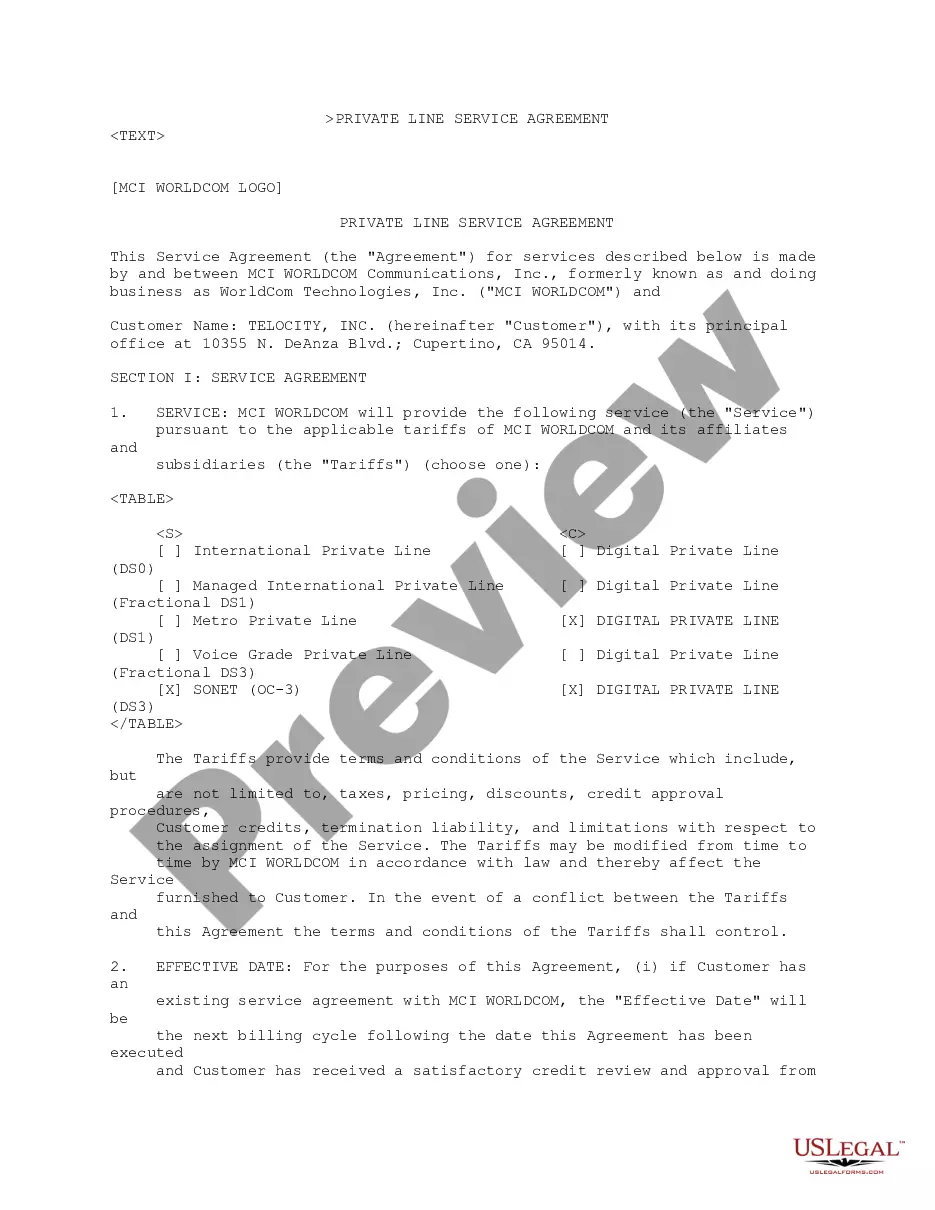
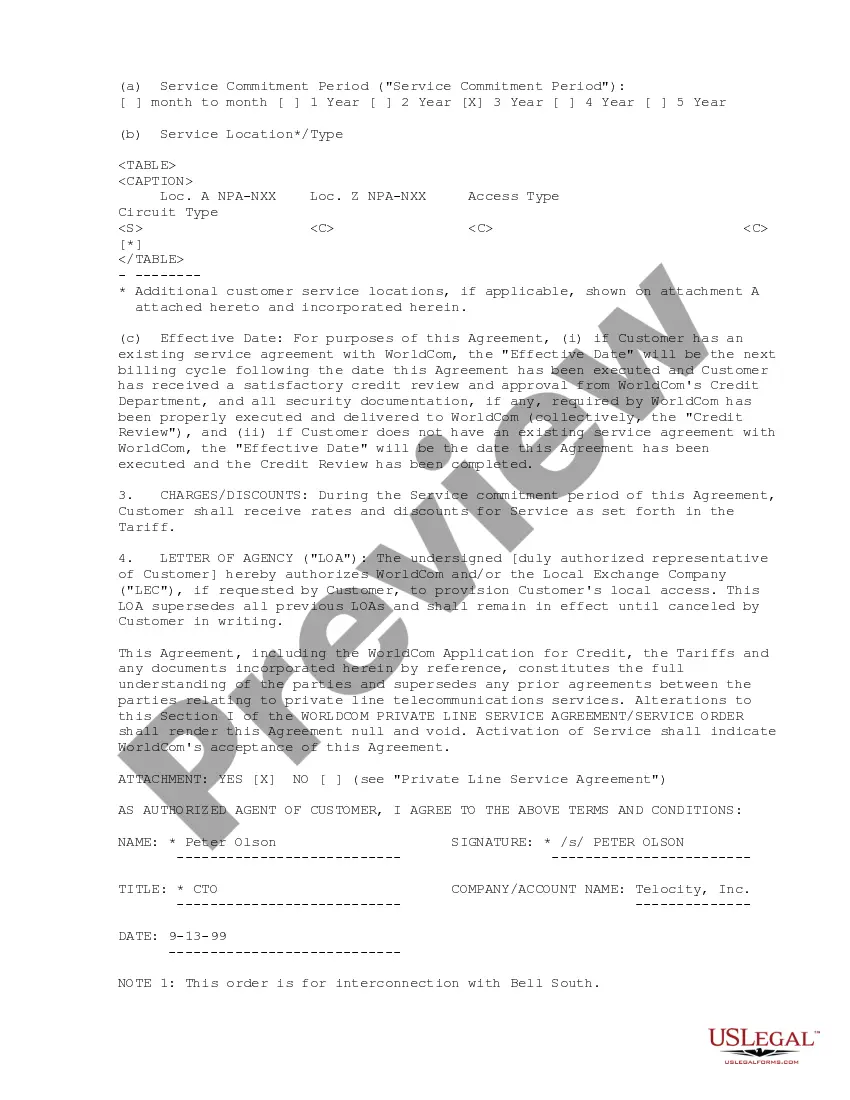
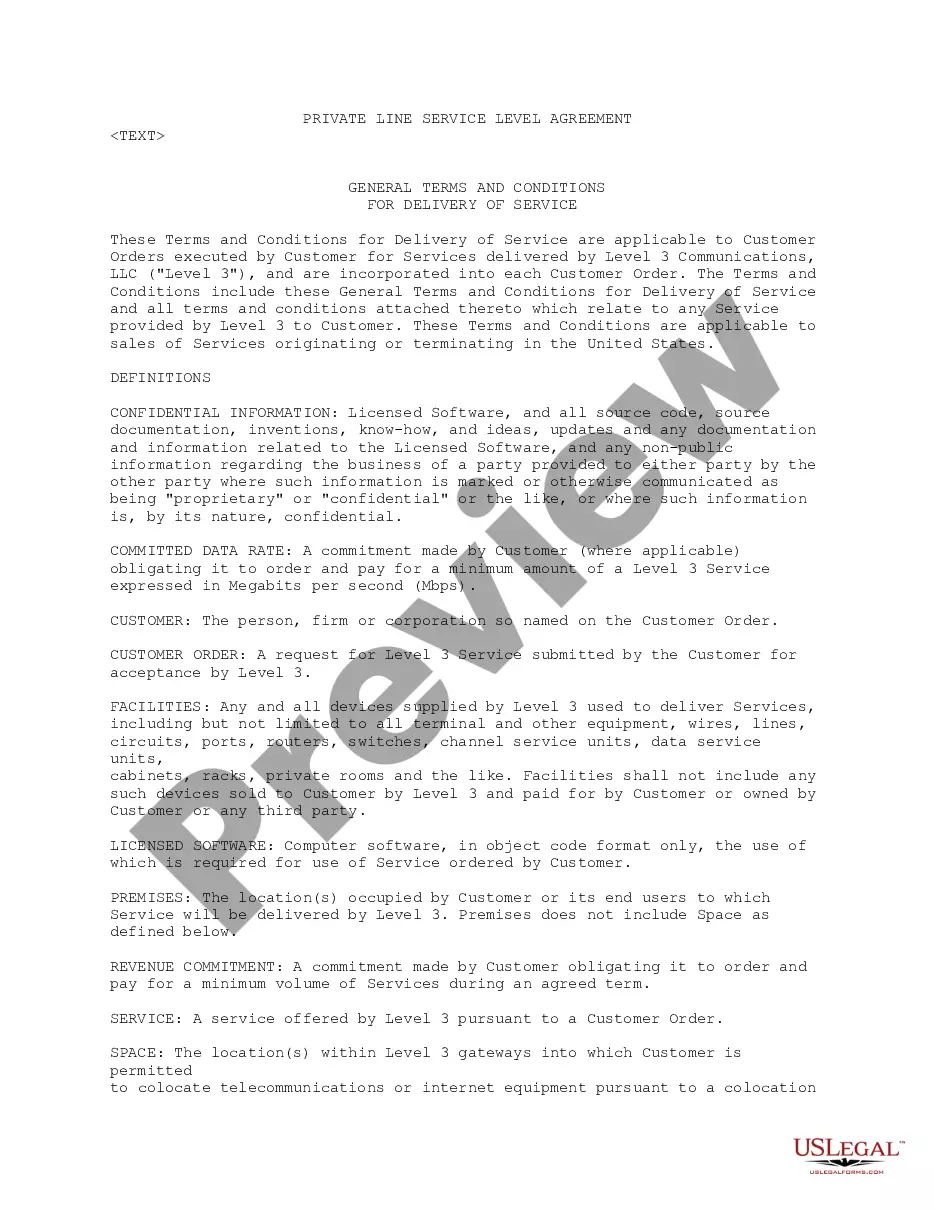
The Private Line Service Agreement is a legal document between MCI Worldcom Communications, Inc. and Telocity, Inc. that outlines the terms and conditions for private line telecommunications services. This agreement specifies the services offered, pricing structures, and the responsibilities of both parties, which distinguishes it from other telecommunications contracts that may not focus exclusively on private line services.
Key parts of this document
- Service Description: Details the types of private line services provided, such as Digital Private Line and SONET.
- Effective Date: Establishes when the agreement commences based on credit approval and existing agreements.
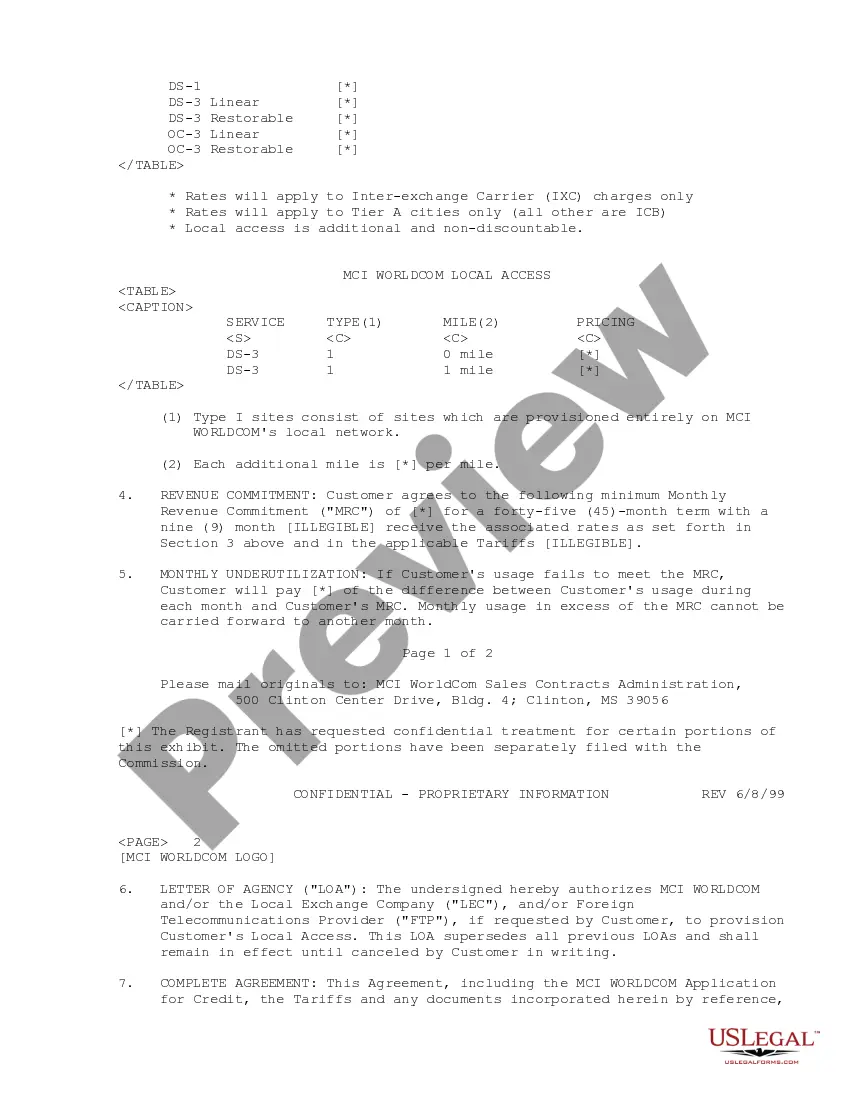
- Revenue Commitment: Specifies the minimum revenue commitment required from the customer for continued service.
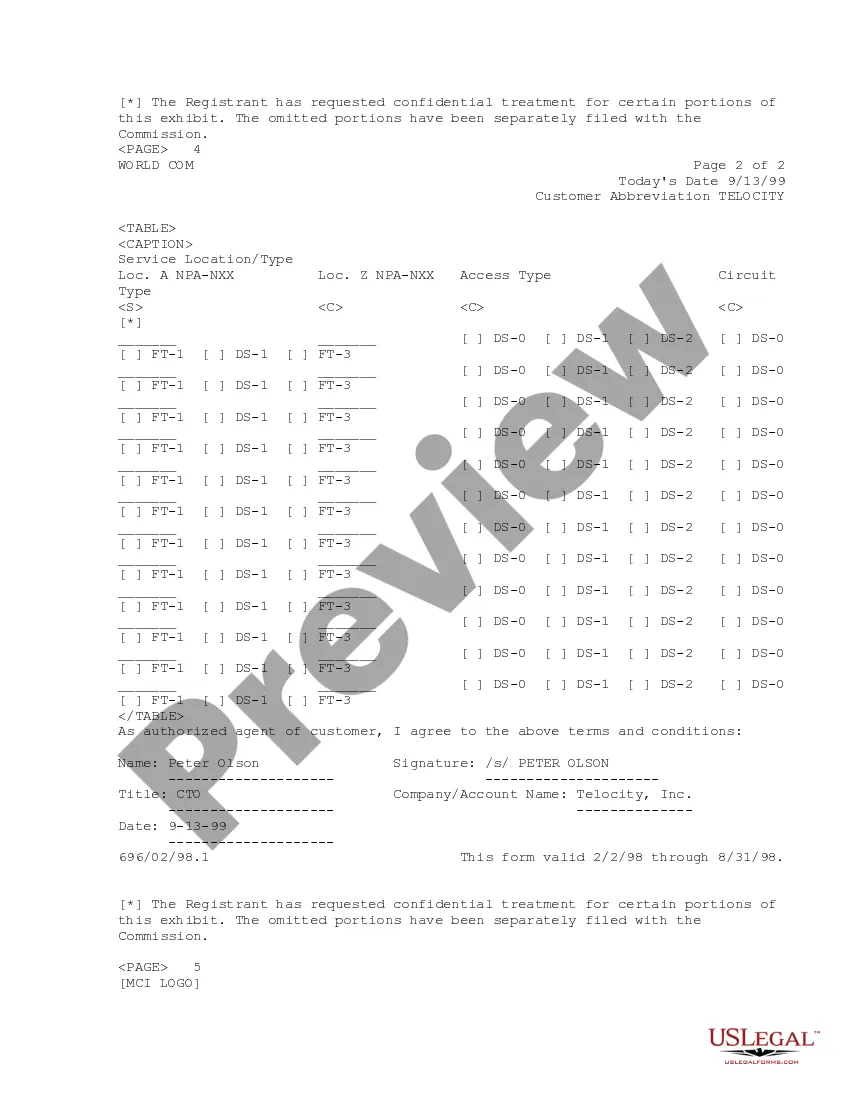
- Circuit and Connection Details: Outlines the circuits being utilized and their respective rates.
- Letter of Agency: Grants MCI Worldcom authority to manage local access provisioning.
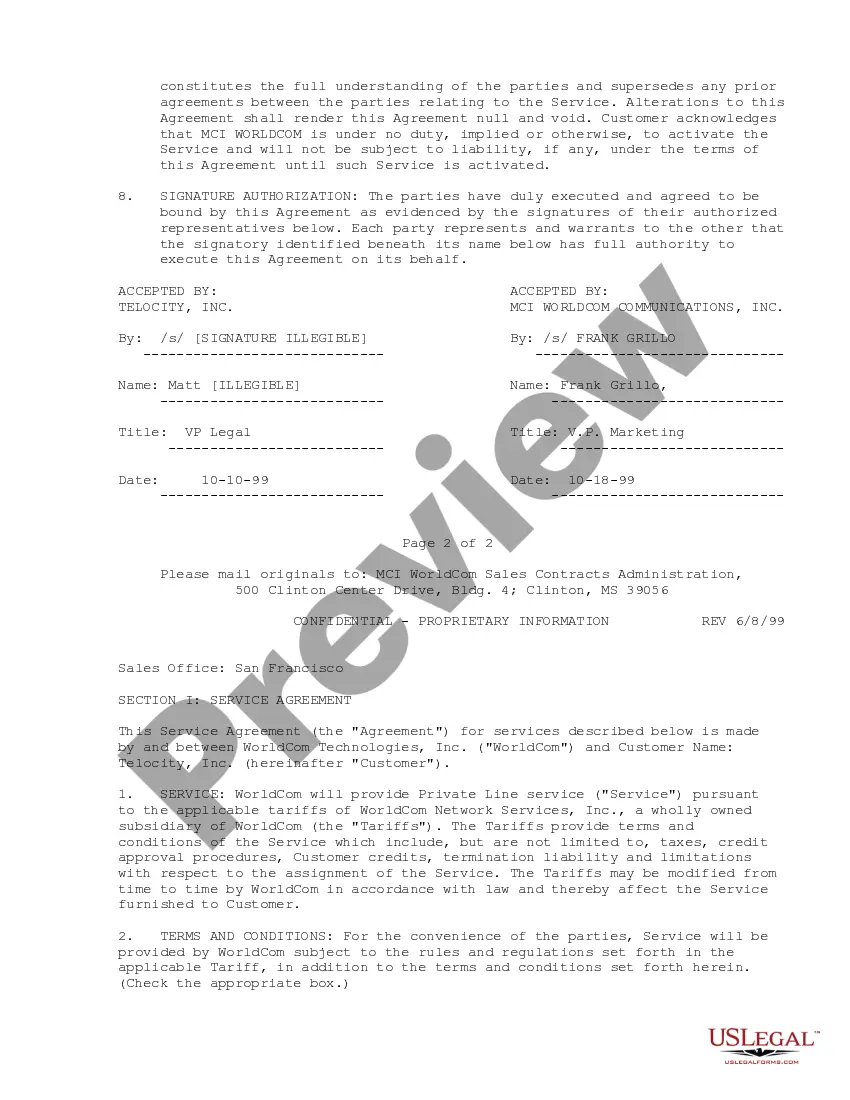
- Complete Agreement Clause: Confirms that this document represents the complete understanding between the parties.
When to use this document
This agreement is necessary when a business wants to establish a private line service with MCI Worldcom Communications, Inc. It is particularly relevant for companies that require dedicated telecommunications services for data transmission or voice communications, ensuring reliable connectivity for critical operations.
Who can use this document
- Businesses needing dedicated telecommunications services from MCI Worldcom.
- Telecommunication providers looking to set up private line agreements with MCI Worldcom.
- Customers who have undergone credit reviews and are ready to enter into service contracts for private lines.
How to prepare this document
- Identify the parties involved, namely MCI Worldcom Communications, Inc. and Telocity, Inc.
- Specify the type of service required by selecting the appropriate options from the service description section.
- Complete the effective date section based on existing service agreements and credit approval procedures.
- Fill in the revenue commitment to indicate the minimum monthly charges agreed upon.
- Obtain the necessary signatures from authorized representatives of both parties to finalize the agreement.
Notarization guidance
This form does not typically require notarization unless specified by local law. This means you can execute the agreement without needing a notarized signature, streamlining the process of establishing service contracts.
Get your form ready online
Our built-in tools help you complete, sign, share, and store your documents in one place.
Make edits, fill in missing information, and update formatting in US Legal Forms—just like you would in MS Word.
Download a copy, print it, send it by email, or mail it via USPS—whatever works best for your next step.
Sign and collect signatures with our SignNow integration. Send to multiple recipients, set reminders, and more. Go Premium to unlock E-Sign.
If this form requires notarization, complete it online through a secure video call—no need to meet a notary in person or wait for an appointment.
We protect your documents and personal data by following strict security and privacy standards.

Make edits, fill in missing information, and update formatting in US Legal Forms—just like you would in MS Word.

Download a copy, print it, send it by email, or mail it via USPS—whatever works best for your next step.

Sign and collect signatures with our SignNow integration. Send to multiple recipients, set reminders, and more. Go Premium to unlock E-Sign.

If this form requires notarization, complete it online through a secure video call—no need to meet a notary in person or wait for an appointment.

We protect your documents and personal data by following strict security and privacy standards.
Common mistakes to avoid
- Failing to check the appropriate service type before signing.
- Not maintaining a copy of the agreement for reference.
- Overlooking the letter of agency, which may be required for local access arrangements.
Why use this form online
- Easy access to the latest version of the Private Line Service Agreement.
- Convenience of filling out the form digitally and saving it securely.
- Enhanced reliability, ensuring all parties have the same document version.
Legal use & context:
- This agreement is enforceable under telecommunications regulations and serves as a documented commitment between the parties.
- Both parties must adhere to the terms outlined in the agreement as well as the applicable tariffs, which govern the service provided.
What to keep in mind
- The Private Line Service Agreement is crucial for formalizing telecommunications services between MCI Worldcom and Telocity.
- Complete all sections of the form carefully and ensure that signatures are obtained for legal validity.
- Understand the implications of the revenue commitments and any potential penalties for underutilization of services.
Looking for another form?
Form popularity
FAQ
DHCR may grant a rent increase based upon the actual, verified and reasonable cost of the improvement and installation. To be eligible for a rent increase, the MCI must be a new installation and not a repair to old equipment. Some procedures qualify as MCI's as well, such as pointing a building.
The average rent increase per year is, give or take, somewhere between 3% and 5%. For a monthly rent payment of $1,500, for example, we're talking between $45 and $75 more per month. Let's say your current rent is $1,500 a month.
The city defines an MCI as an improvement benefiting all the tenants in the building. MCIs also need to involve replacements rather than repairs. For example, a new boiler or a new roof qualifies as an MCI but not a repaired or rebuilt one.
I. General Overview. Major Capital Improvement Increases (MCI's) are a concept that parties can contract for if they are not subject to rent regulation.In regulated housing, a landlord may only obtain an MCI upon application to the New York State Division of Housing and Community Renewal (DHCR).
In most states, a landlord must give tenants notice at least 30 days before they'll enforce a rent increase. However, in other states like California, the notice can increase to 60 days' notice if the increase is more than 10% of the current rent rate.
Most likely, yes it is legal. Landlords can charge whatever rent the market allows. State laws dictate how much notice a landlord must give before raising the rent on a month-to-month agreement. If you are on a lease, good news, your landlord cannot raise the rent on you.