Terms of Class One Preferred Stock
About this form
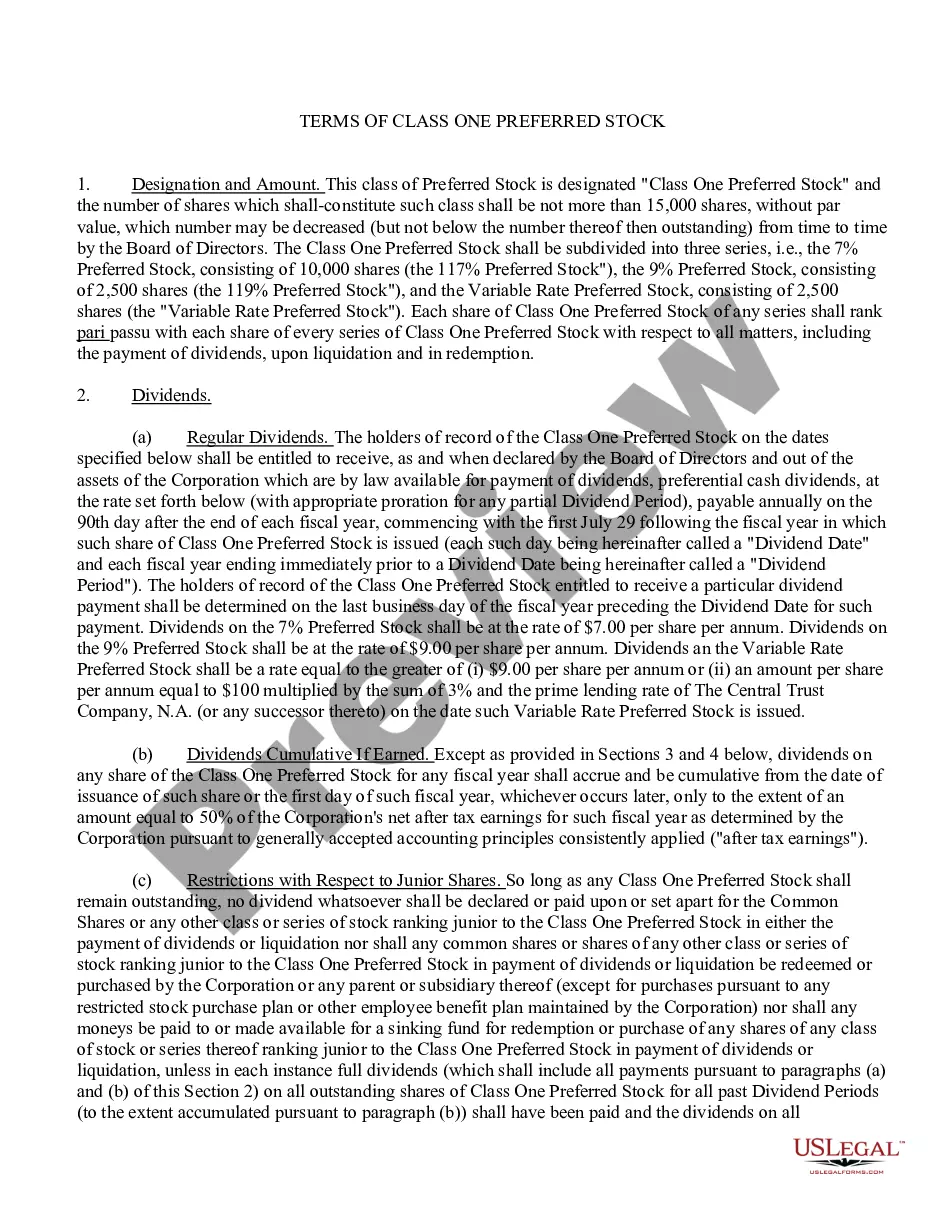
The Terms of Class One Preferred Stock form outlines the specific rights and obligations pertaining to a class of preferred stock in a corporation. This form serves as a detailed model for corporate matters, providing clear guidelines for equity holders regarding dividends, liquidation preferences, and potential redemption of shares. It is distinct from other stock forms, focusing specifically on the terms governing Class One Preferred Stock and its associated rights and features.
Key components of this form
- Designation and Amount: Specifies the number of shares and the different series of the Class One Preferred Stock.
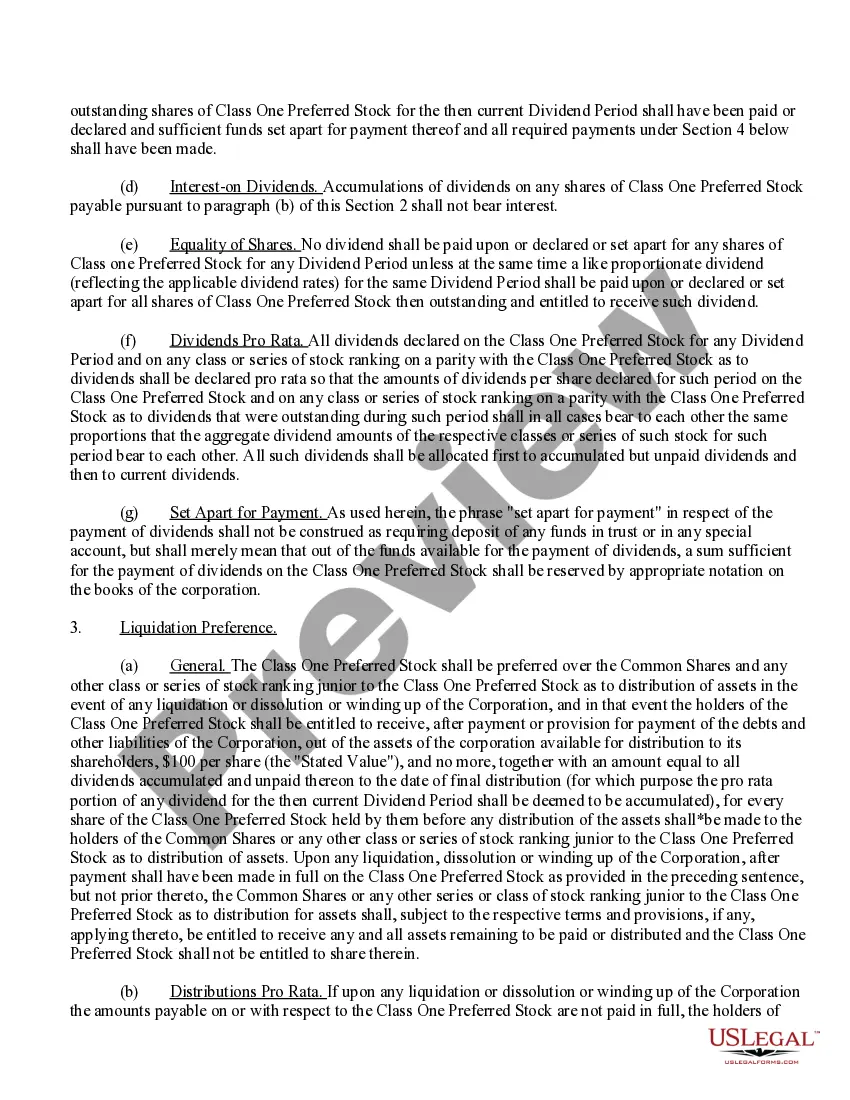
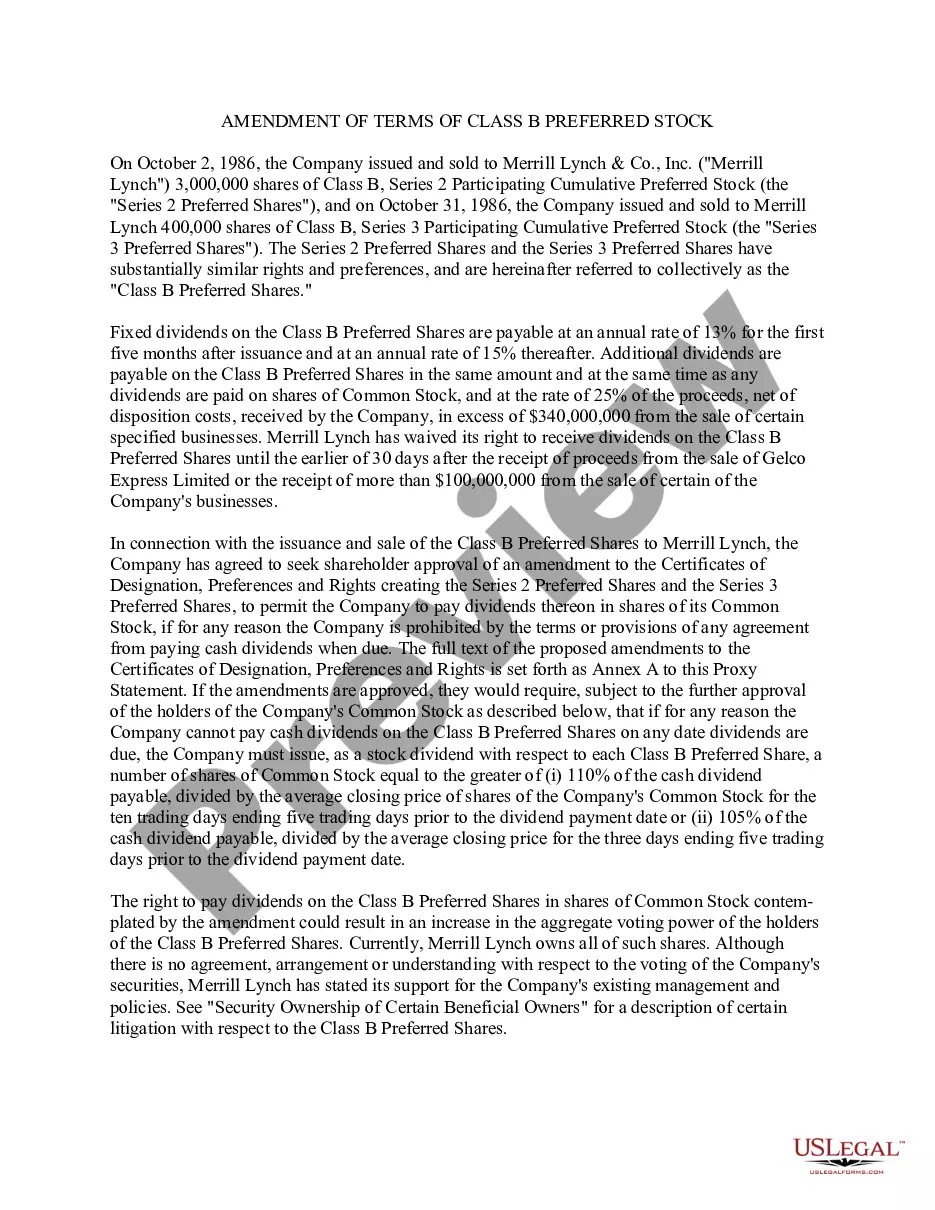
- Dividends: Outlines regular dividends, cumulative dividends, and restrictions regarding junior shares.
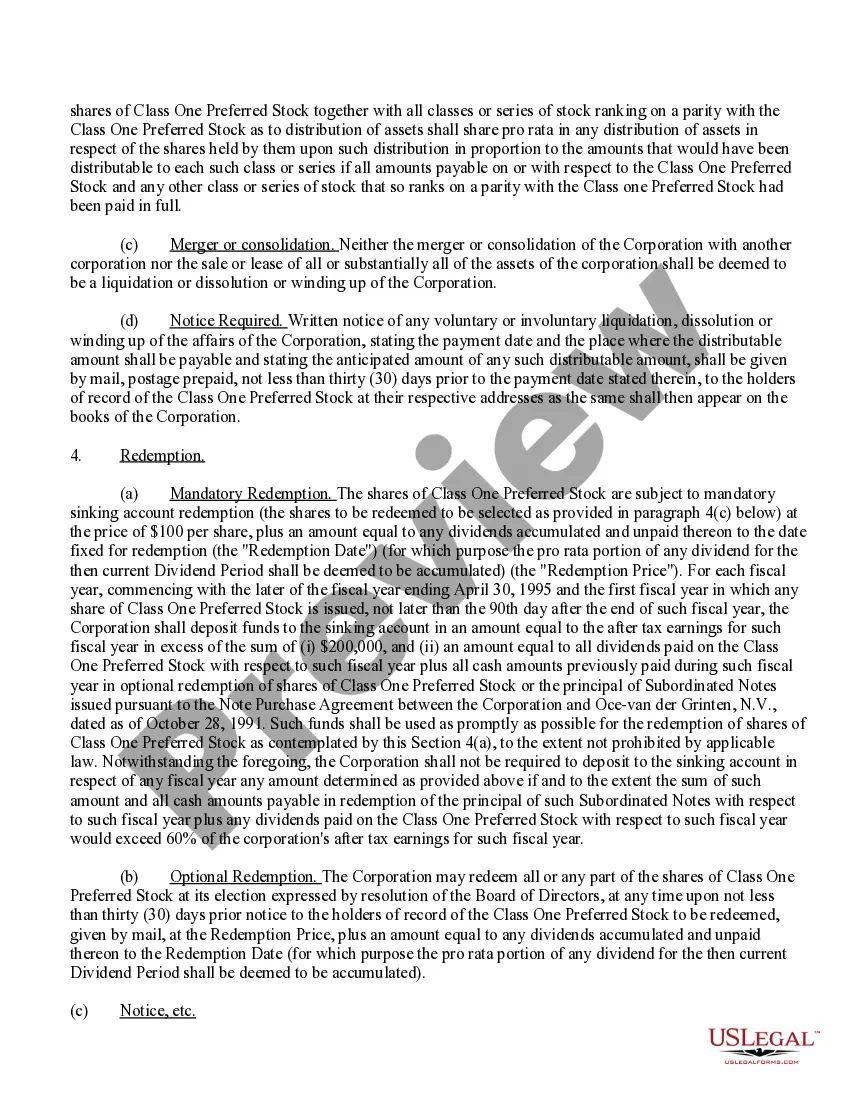
- Liquidation Preference: Describes the rights of holders upon liquidation of the corporation.
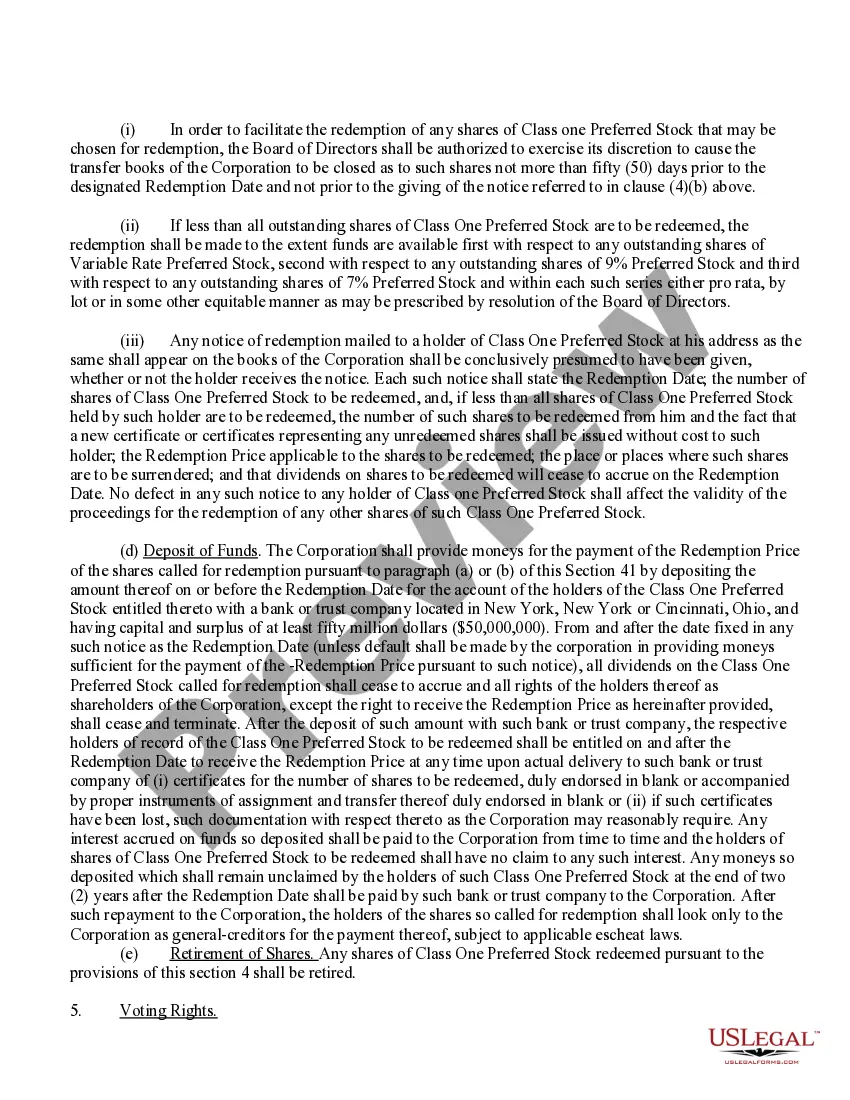
- Redemption: Details mandatory and optional redemption processes for shares.
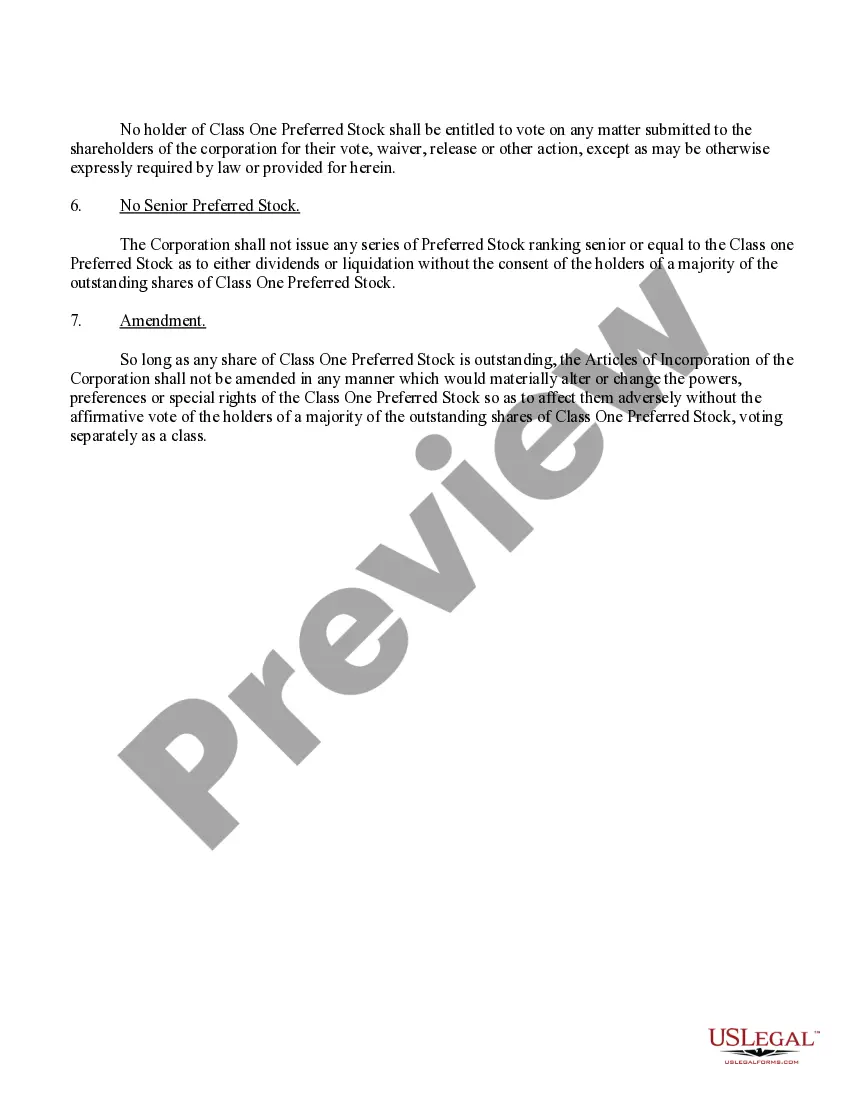
- Voting Rights: Clarifies the voting rights associated with the Class One Preferred Stock.
- Amendment: States the conditions under which amendments can be made to the Articles of Incorporation regarding the Class One Preferred Stock.

Common use cases
This form should be used when a corporation is issuing Class One Preferred Stock. It is essential in establishing the rights and obligations of both the corporation and its shareholders, particularly regarding dividend distributions, liquidation events, and share redemption. Corporations may use this form during the initial setup of preferred stock, when reflecting changes in stock structure, or in compliance with shareholder agreements.
Who this form is for
- Corporations planning to issue Class One Preferred Stock.
- Corporate lawyers handling equity transactions and shareholder agreements.
- Shareholders or potential investors wanting to understand their rights and obligations related to Class One Preferred Stock.
- Corporate executives involved in financial structuring and investments.
Steps to complete this form
- Identify the corporation's name and provide relevant company details.
- Specify the designation and number of Class One Preferred Stock shares to be issued.
- Detail the dividend rates, terms for payment, and any conditions regarding dividends.
- Outline the liquidation preferences and distribution rights of shareholders.
- Include terms for redemption of shares and any voting rights associated with the Class One Preferred Stock.
- Ensure all required signatures from authorized corporate officers are obtained.
Does this form need to be notarized?
Notarization is generally not required for this form. However, certain states or situations might demand it. You can complete notarization online through US Legal Forms, powered by Notarize, using a verified video call available anytime.
Get your form ready online
Our built-in tools help you complete, sign, share, and store your documents in one place.
Make edits, fill in missing information, and update formatting in US Legal Forms—just like you would in MS Word.
Download a copy, print it, send it by email, or mail it via USPS—whatever works best for your next step.
Sign and collect signatures with our SignNow integration. Send to multiple recipients, set reminders, and more. Go Premium to unlock E-Sign.
If this form requires notarization, complete it online through a secure video call—no need to meet a notary in person or wait for an appointment.
We protect your documents and personal data by following strict security and privacy standards.

Make edits, fill in missing information, and update formatting in US Legal Forms—just like you would in MS Word.

Download a copy, print it, send it by email, or mail it via USPS—whatever works best for your next step.

Sign and collect signatures with our SignNow integration. Send to multiple recipients, set reminders, and more. Go Premium to unlock E-Sign.

If this form requires notarization, complete it online through a secure video call—no need to meet a notary in person or wait for an appointment.

We protect your documents and personal data by following strict security and privacy standards.
Mistakes to watch out for
- Failing to specify the number of shares accurately can lead to disputes.
- Neglecting to outline the dividend payment schedule can result in confusion for shareholders.
- Not including a proper redemption clause may limit the corporation's flexibility in managing shareholder exits.
- Overlooking the voting rights provided for the preferred stock can lead to miscommunication among shareholders.
Why use this form online
- Convenience: Easily access and fill out the form from anywhere.
- Editability: Personalize the form to suit the specific needs of your corporation.
- Security: Use secure platforms that protect your sensitive information during completion.
- Time-saving: Instant downloads reduce delays associated with traditional paper forms.
Legal use & context
- This form is legally binding when completed and executed according to state laws governing stock issuance.
- It serves to protect the interests of preferred shareholders during corporate liquidations.
- Non-compliance with specified terms can result in legal disputes among shareholders.
Quick recap
- The Terms of Class One Preferred Stock is crucial for defining the rights of preferred shareholders.
- Ensure all specifications regarding dividends, redemption, and liquidations are clearly stated.
- Review and adapt the form according to local laws before use.
Looking for another form?


Form popularity
FAQ
Series A financing (also known as series A round or series A funding) is one of the stages in the capital-raising process by a startup.This means that a company secures the required capital from investors by selling the company's shares. However, in most cases, series A financing comes with anti-dilution provisions.
A-2 Common Stock means the Series A-2 common stock, par value $0.01 per share, of the Company and any securities issued in respect thereof, or in substitution therefor, in connection with any stock split, dividend or combination, or any reclassification, recapitalization, merger, consolidation, exchange or other
Key Takeaways. Class A shares refer to a classification of common stock that was traditionally accompanied by more voting rights than Class B shares. Traditional Class A shares are not sold to the public and also can't be traded by the holders of the shares.
There are two main types of stocks: common stock and preferred stock.
Class B shares are issued by corporations as a class of common stock with fewer voting rights and lower dividend priority than Class A shares.Class B shares may also refer to mutual fund shares that carry no sales load.
Growth stocks. These are the shares you buy for capital growth, rather than dividends. Dividend aka yield stocks. New issues. Defensive stocks. Strategy or Stock Picking?
There are two main types of stocks: common stock and preferred stock.
In America, Series A preferred stock is the first round of stock offered during the seed or early stage round by a portfolio company to the venture capital investor. Series A preferred stock is often convertible into common stock in certain cases such as an Initial public offering (IPO) or the sale of the company.