Amendment of terms of Class B preferred stock
What is this form?
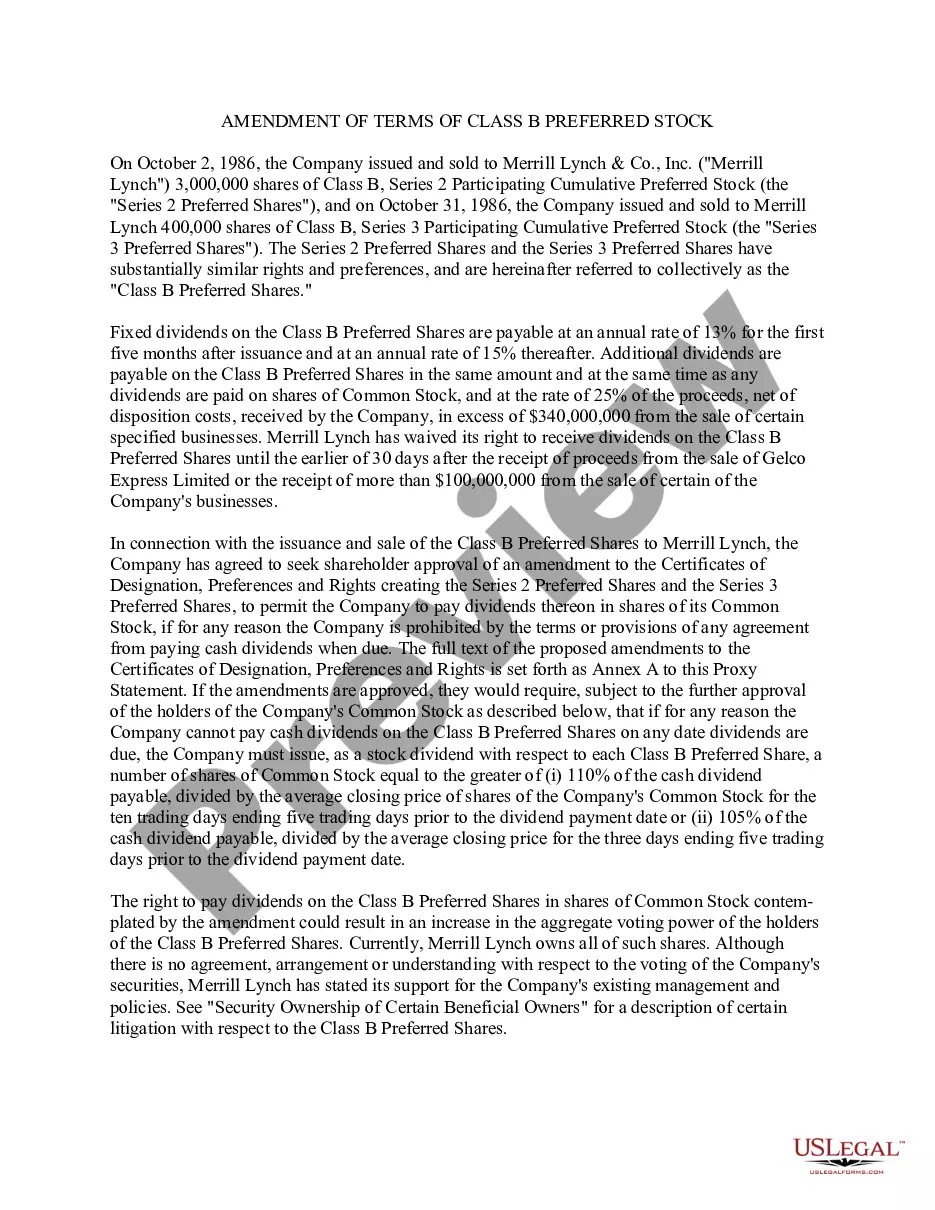
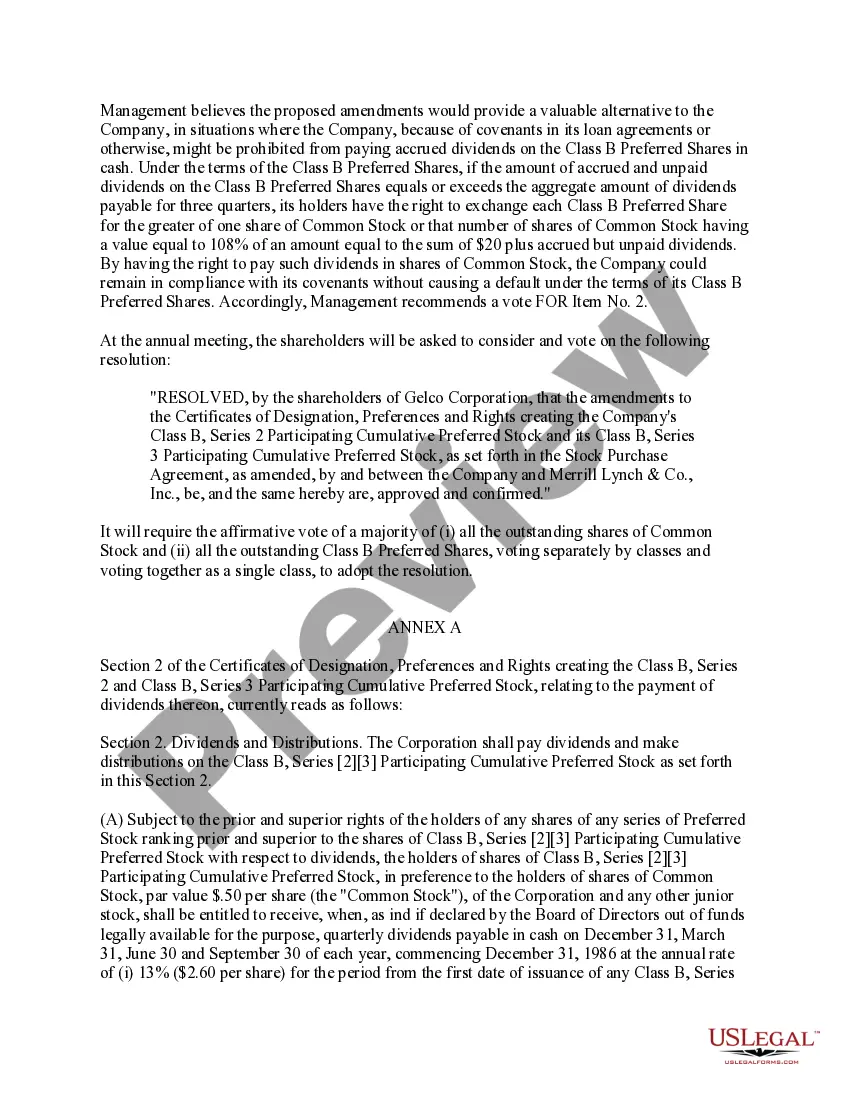
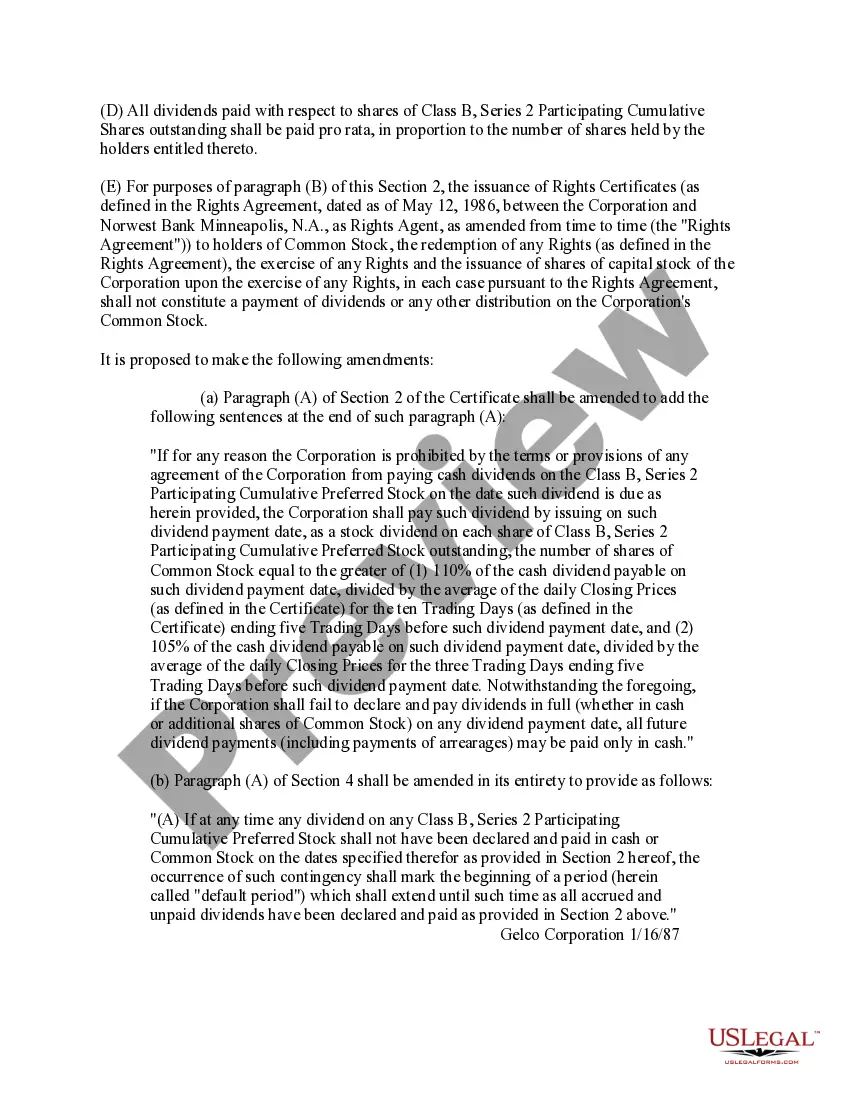
The Amendment of Terms of Class B Preferred Stock form is a legal document used by companies to modify specific terms relating to their Class B Preferred Shares. This amendment facilitates the payment of dividends, allowing shares to be paid in stock when cash payments are impeded. Unlike standard stock agreements, this form addresses complex dividend structures, shareholder rights, and compliance with corporate regulations. It is essential for maintaining the integrity and financial health of the corporation while addressing shareholder interests.
What’s included in this form
- Issuance details of Class B shares and their associated rights.
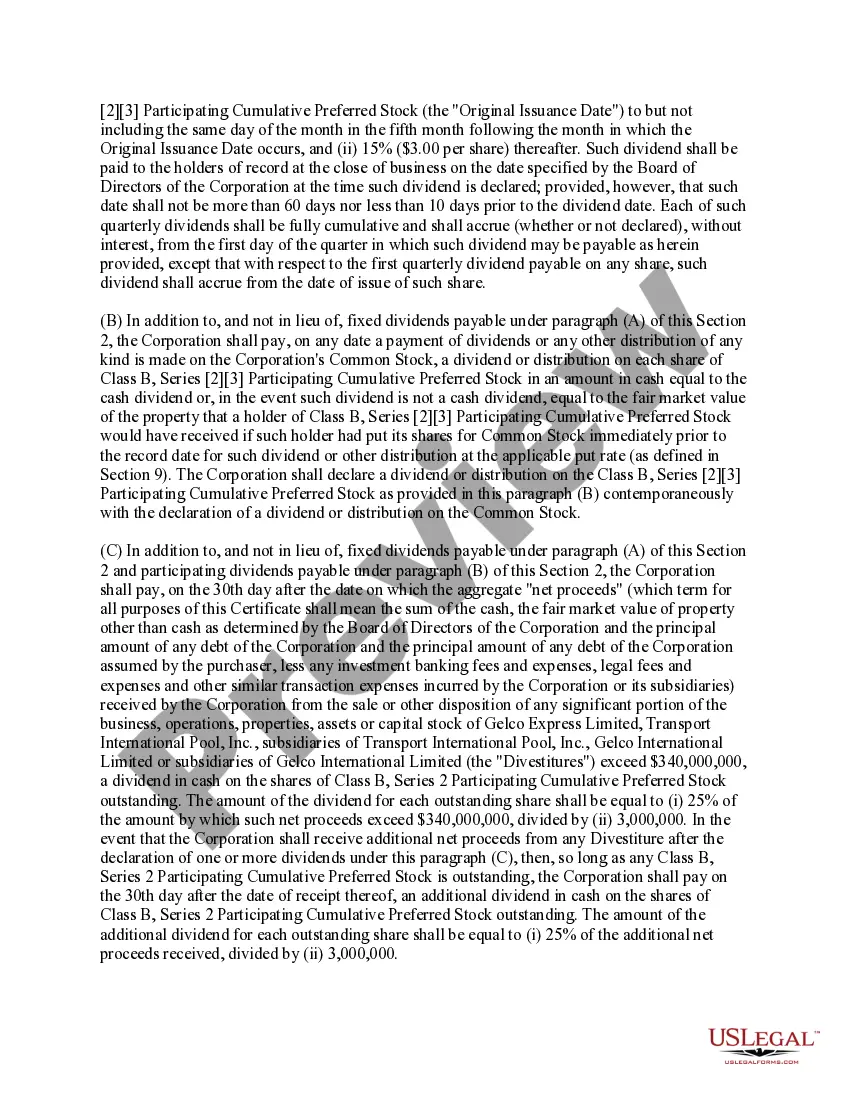
- Dividend payment structure and conditions for alternative payment methods.
- Amendments to the Certificates of Designation, Preferences and Rights.
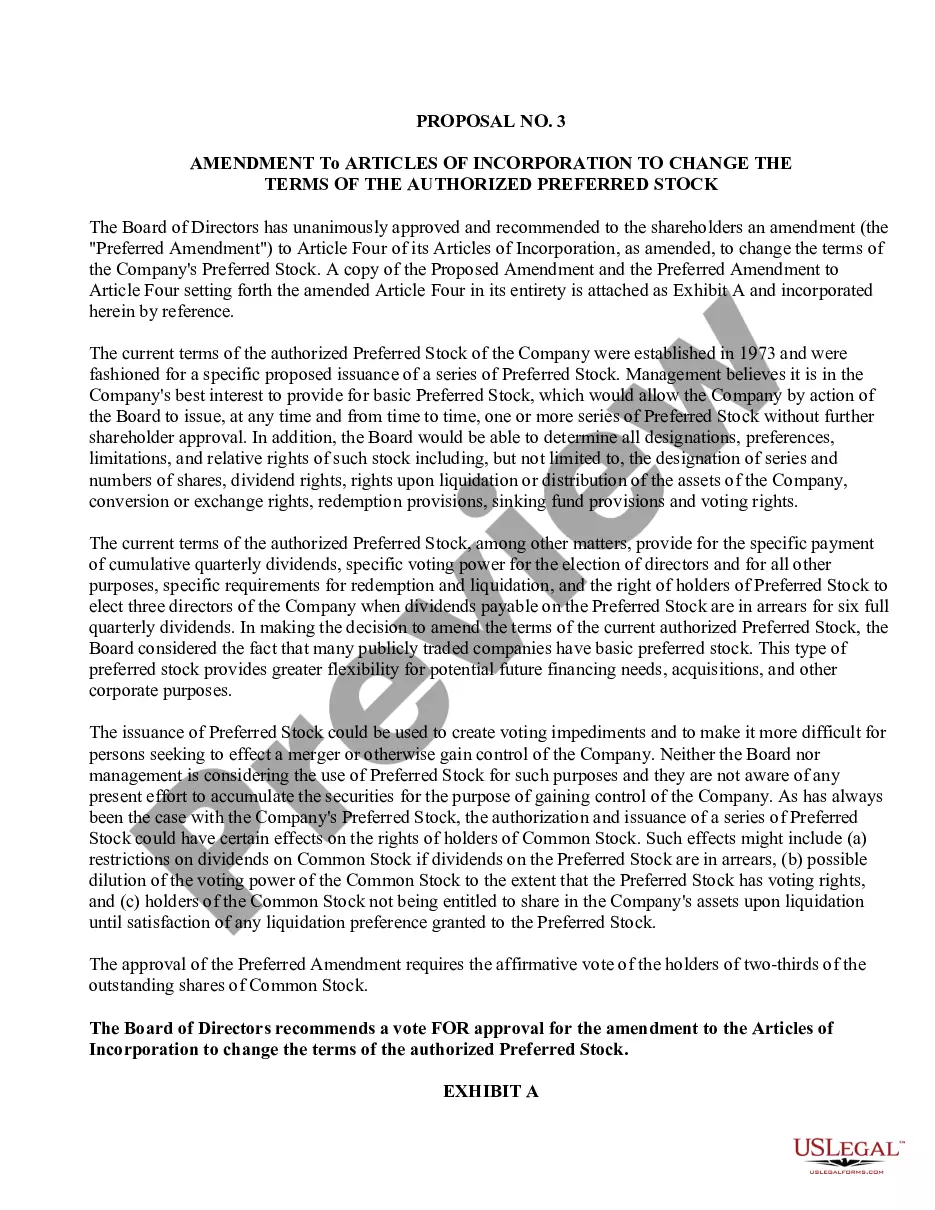
- Procedures for shareholder approval of the amendments.
- Specifications regarding the voting process for approving changes.


When this form is needed
This form is used when a corporation needs to amend the terms related to its Class B Preferred Stock, typically in situations where it is unable to pay cash dividends as required. Companies may need to use this amendment to maintain compliance with loan covenants or in cases where financial restructuring is necessary to protect the interests of shareholders.
Who needs this form
- Corporate boards looking to amend stock terms and dividend payments.
- Shareholders of Class B Preferred Stock requiring changes to dividend structures.
- Attorneys representing corporations or shareholders in corporate governance matters.
- Financial officers assessing compliance with corporate obligations and debt covenants.
Completing this form step by step
- Identify the corporation and specific Class B Preferred Shares involved.
- Provide details regarding the proposed amendments to dividend payment terms.
- Outline the conditions under which dividends will be paid in stock rather than cash.
- Draft the resolution for shareholder approval as specified in the form.
- Gather signatures from authorized corporate officers and obtain evidence of shareholder approval.
Does this form need to be notarized?
This form does not typically require notarization unless specified by local law. It is important to check with local regulations regarding the necessity of notarization when filing such corporate amendments.
Get your form ready online
Our built-in tools help you complete, sign, share, and store your documents in one place.
Make edits, fill in missing information, and update formatting in US Legal Forms—just like you would in MS Word.
Download a copy, print it, send it by email, or mail it via USPS—whatever works best for your next step.
Sign and collect signatures with our SignNow integration. Send to multiple recipients, set reminders, and more. Go Premium to unlock E-Sign.
If this form requires notarization, complete it online through a secure video call—no need to meet a notary in person or wait for an appointment.
We protect your documents and personal data by following strict security and privacy standards.

Make edits, fill in missing information, and update formatting in US Legal Forms—just like you would in MS Word.

Download a copy, print it, send it by email, or mail it via USPS—whatever works best for your next step.

Sign and collect signatures with our SignNow integration. Send to multiple recipients, set reminders, and more. Go Premium to unlock E-Sign.

If this form requires notarization, complete it online through a secure video call—no need to meet a notary in person or wait for an appointment.

We protect your documents and personal data by following strict security and privacy standards.
Avoid these common issues
- Failing to notice the voting requirements for shareholder approval.
- Overlooking the specific language needed in the amendment documentation.
- Not properly addressing the conditions under which dividends are paid in stock.
- Misunderstanding the rights of Class B Preferred Shareholders in the amendment process.
Why use this form online
- Quick access to a professionally drafted amendment template.
- Easy customization to fit the specific needs of your corporation.
- Reduced likelihood of errors through structured guidance.
- Efficiency in completing and filing necessary documents without legal delays.
Legal use & context
- This form provides a legal framework for modifying the terms of existing preferred stock agreements.
- It ensures compliance with corporate governance structures and state laws.
- Correctly completed amendments provide clear rights and obligations for shareholders, which enhances corporate transparency.
Summary of main points
- The Amendment of Terms of Class B Preferred Stock is vital for corporate governance.
- Precision in drafting amendments is crucial to avoid legal complications.
- Understanding the rights of preferred shareholders can influence corporate decision-making.
Looking for another form?



Form popularity
FAQ
Class A shares refer to a classification of common stock that was traditionally accompanied by more voting rights than Class B shares.Then, one Class A share might be accompanied by five voting rights, while one Class B share could have only one right to vote.
KEY TAKEAWAYS. Class A shares charge upfront fees and have lower expense ratios, so they are better for long-term investors. Class A shares also reduce upfront fees for larger investments, so they are a better choice for wealthy investors.
Growth stocks. These are the shares you buy for capital growth, rather than dividends. Dividend aka yield stocks. New issues. Defensive stocks. Strategy or Stock Picking?
Income Stocks. As its name suggests, this security generates a steady and stable income in the form of a dividend. Cyclical Stocks. Blue-Chip Stocks. Tech Stocks. Speculative Stocks. Defensive Stocks. Growth Stocks.
There are two main types of stocks: common stock and preferred stock.
A class of shares is a type of listed company stock that is differentiated by the level of voting rights shareholders receive. For example, a listed company might have two share classes, or classes of stock, designated as Class A and Class B.
Class A shares charge a front-end load.Compared to Class C shares, a smaller amount of money is invested in Class A shares, since a percentage of that investment is taken as commissions. Class B shares charge a back-end load. The initial investment buys the mutual fund shares without incurring a commission.
Class A shares refer to a classification of common stock that was traditionally accompanied by more voting rights than Class B shares.Then, one Class A share might be accompanied by five voting rights, while one Class B share could have only one right to vote.
Theoretically, a company can create any number of classes of shares of common stock.Class A shares may offer 10 voting rights per stock held, while class B shares offer only one. It depends on how the company decides to structure its stock.