Colorado Notice of Lien Claim - Individual
About this form
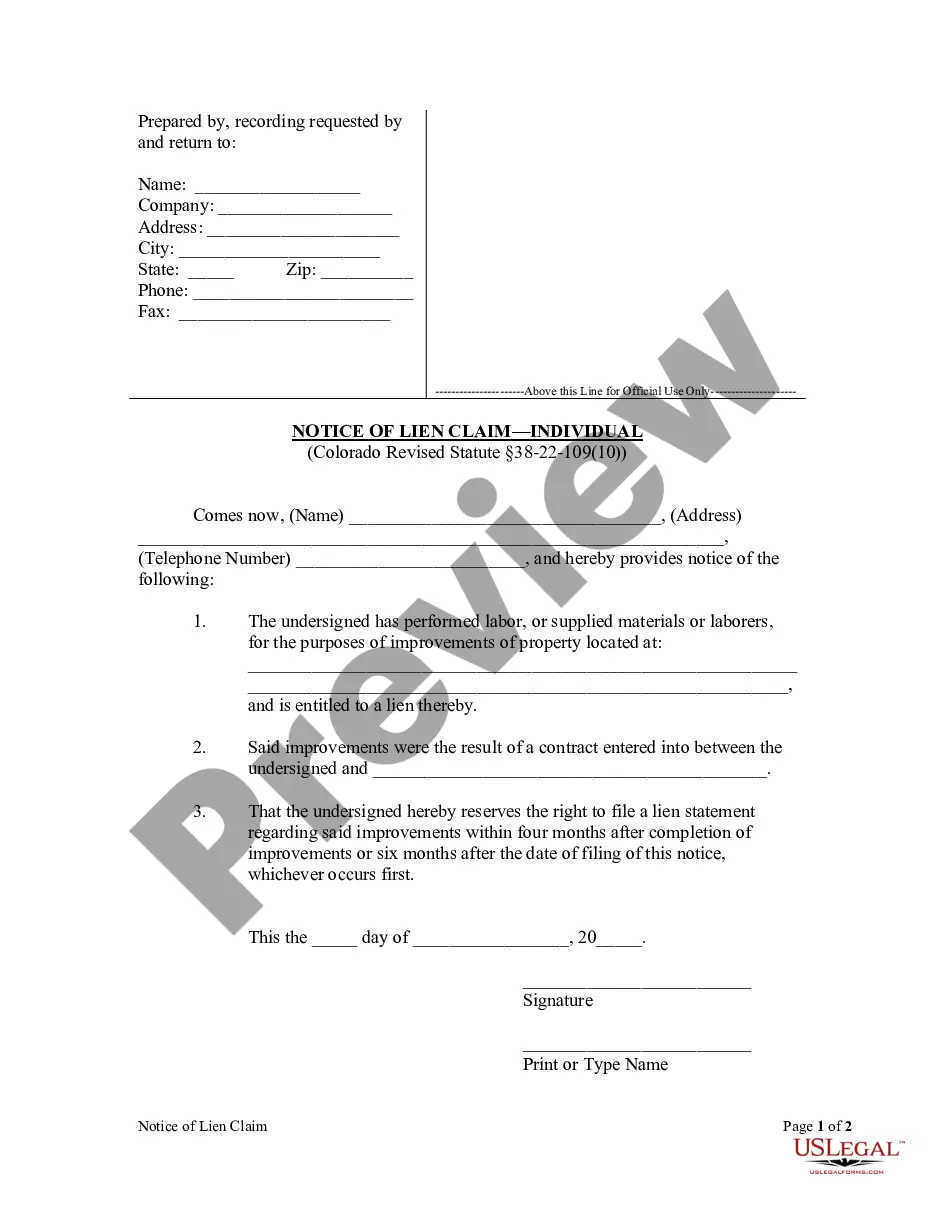
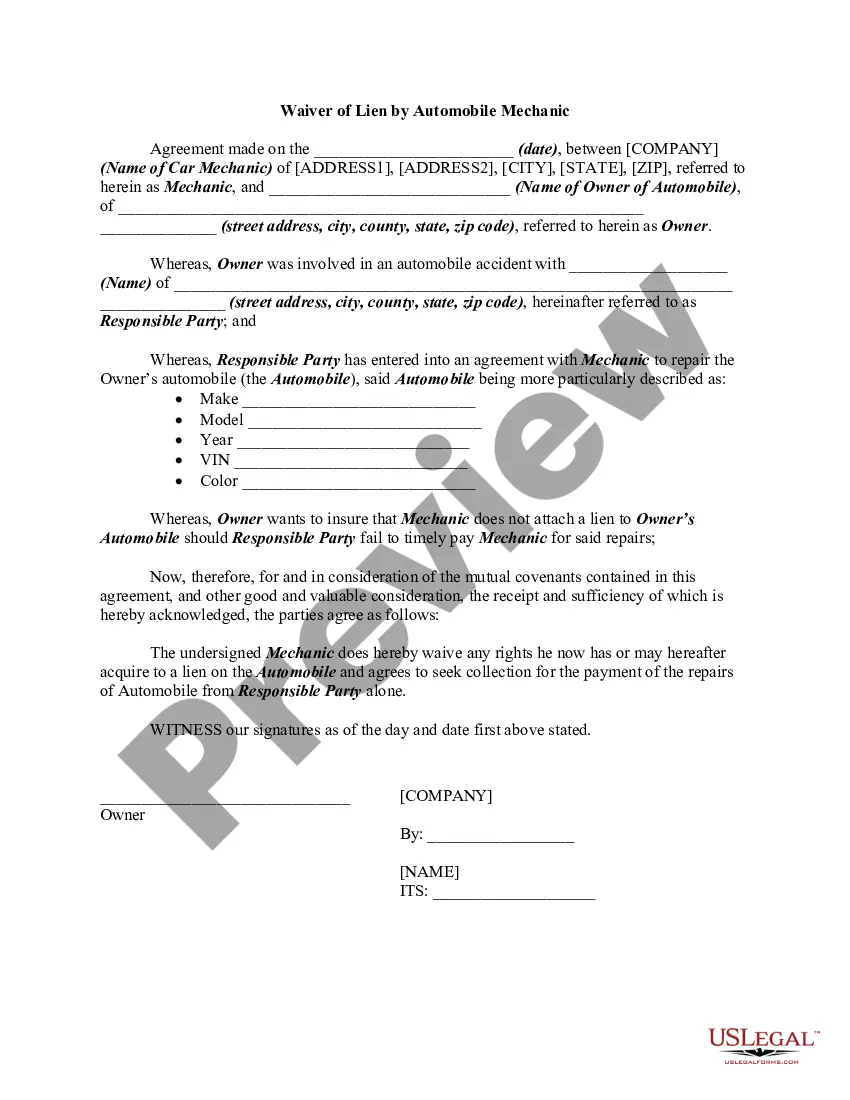
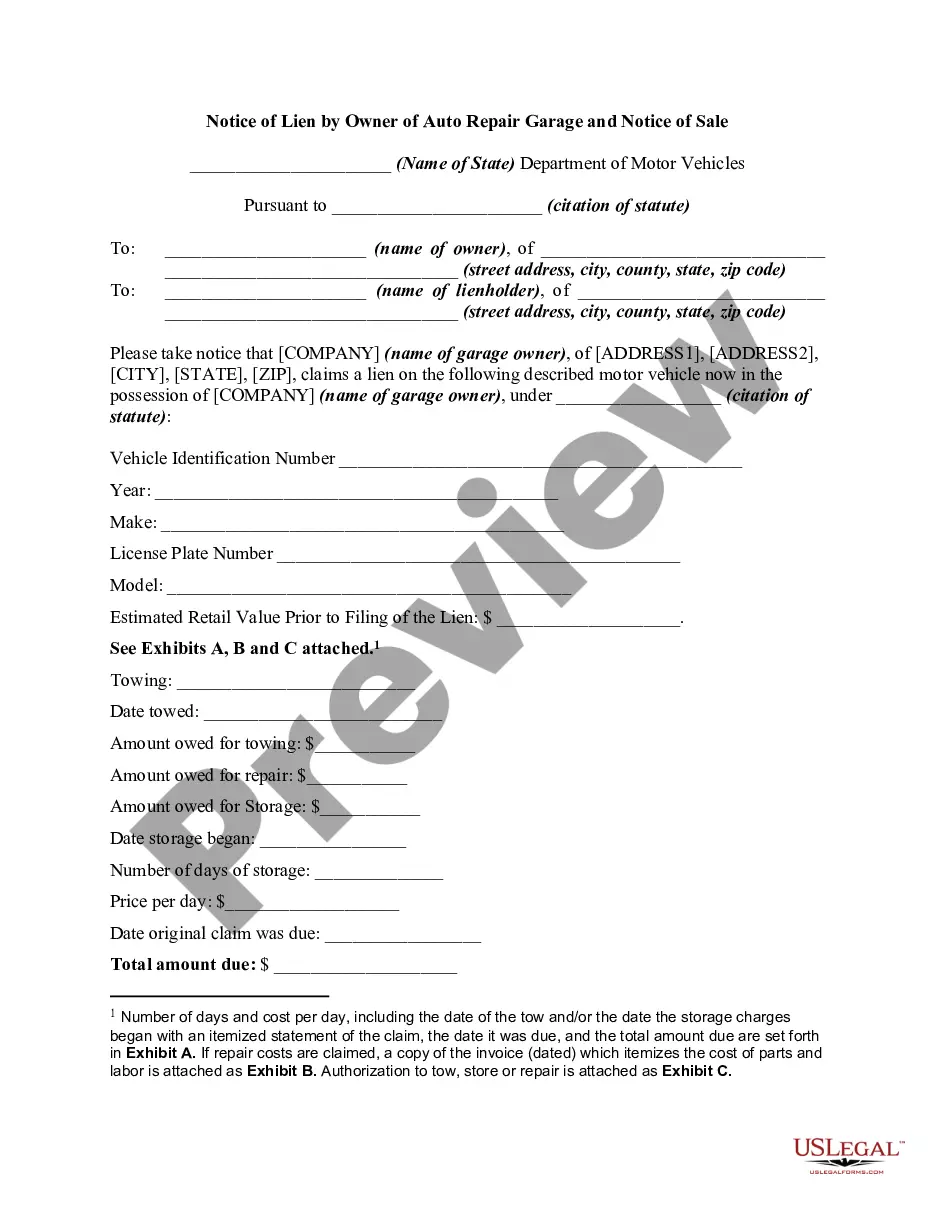
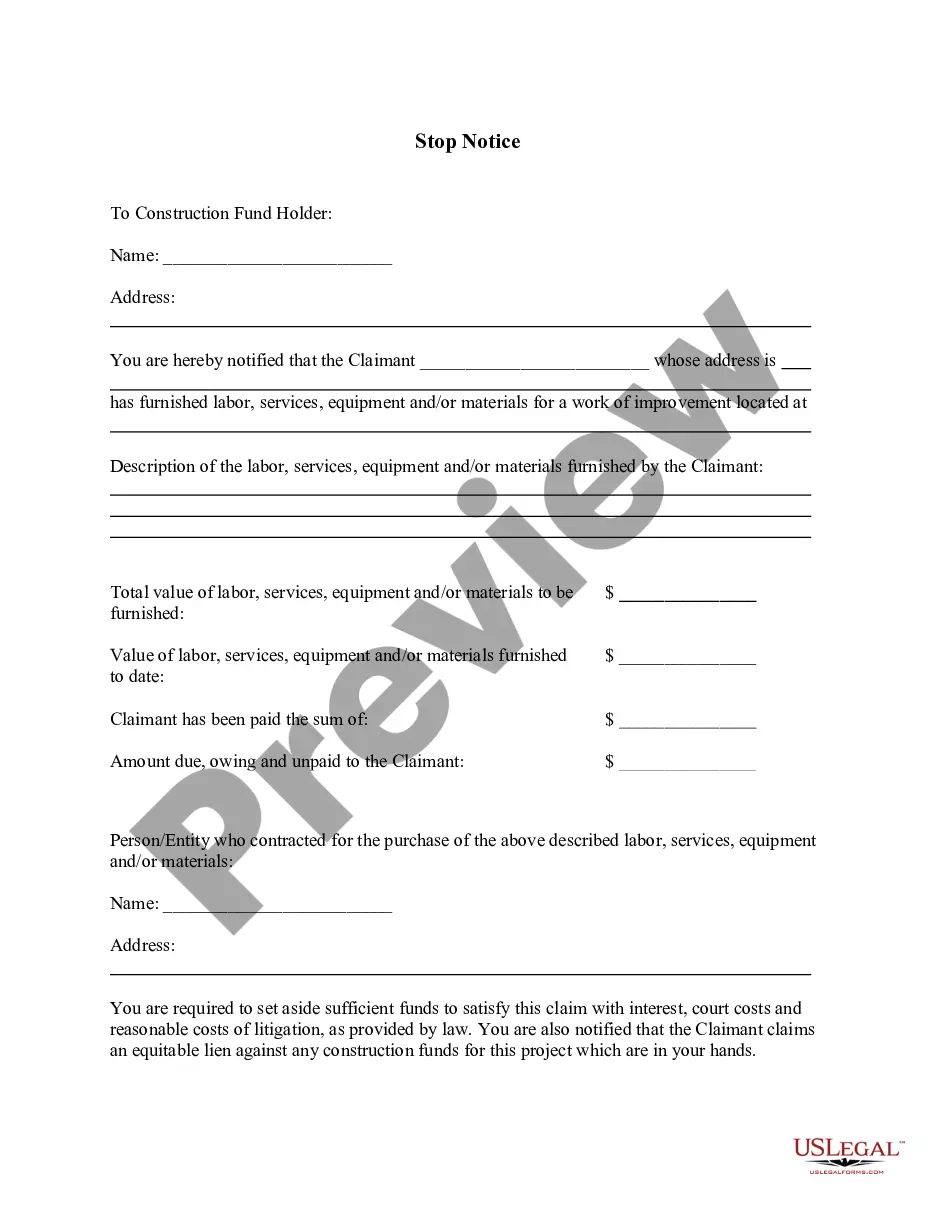
The Notice of Lien Claim - Individual is a legal document that allows an individual to formally notify others of a potential lien interest in a specified property in Colorado. This form serves to preserve the right to file a lien statement within designated time frames, differentiating it from general lien statements by providing a preliminary warning. It is critical for contractors, suppliers, or laborers who have contributed to property improvements to use this document to protect their financial interests.
Form components explained
- Name and contact information of the lien claimant.
- Description of the property where improvements were made.
- Details about the contract leading to the improvements.
- Statement of the right to file a lien within specific time frames.
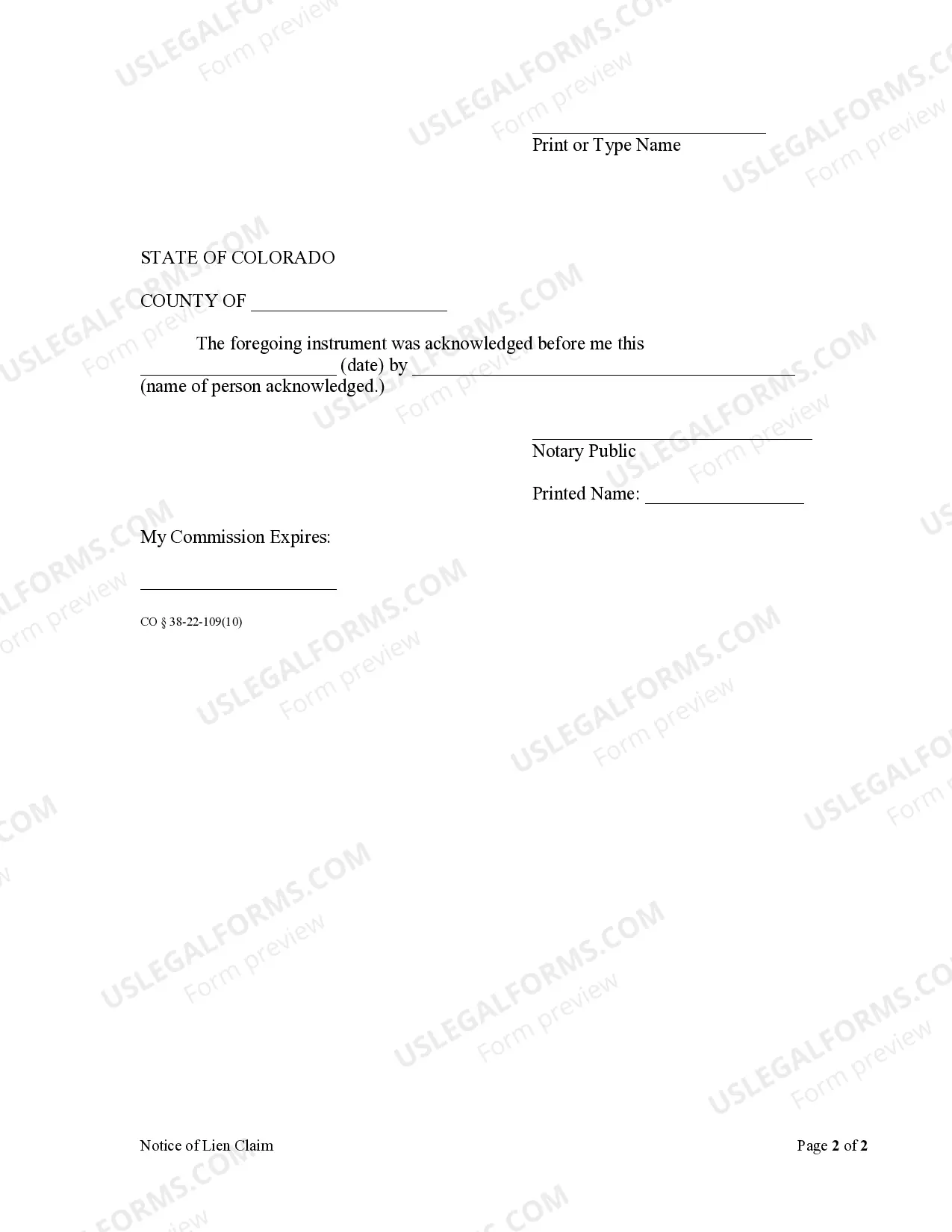
- Signature and notary acknowledgment section.
When this form is needed
This form should be used when an individual has performed labor or supplied materials for property improvements and wishes to assert their right to file a lien. It is essential to file this notice promptly to extend the lien filing period, particularly when the improvements have been completed or when there is a contractual dispute regarding payment.
Who can use this document
- Contractors who have provided labor or materials for a property improvement.
- Suppliers of construction materials or fixtures used in a property renovation.
- Laborers who performed work on a specific property that resulted in improvements.
How to complete this form
- Identify and fill in your name and contact information as the lien claimant.
- Specify the address of the property where the improvements were made.
- Detail the contract and provide the name of the individual or company involved.
- Indicate the date the notice is being completed.
- Sign the document and have it notarized for legal validity.
Notarization guidance
Yes, this form must be notarized to be legally valid. Notarization certifies the identity of the signer and ensures the document meets state execution requirements. US Legal Forms offers integrated online notarization services that are available 24/7 through a secure video call, simplifying the process.
Get your form ready online
Our built-in tools help you complete, sign, share, and store your documents in one place.
Make edits, fill in missing information, and update formatting in US Legal Forms—just like you would in MS Word.
Download a copy, print it, send it by email, or mail it via USPS—whatever works best for your next step.
Sign and collect signatures with our SignNow integration. Send to multiple recipients, set reminders, and more. Go Premium to unlock E-Sign.
If this form requires notarization, complete it online through a secure video call—no need to meet a notary in person or wait for an appointment.
We protect your documents and personal data by following strict security and privacy standards.

Make edits, fill in missing information, and update formatting in US Legal Forms—just like you would in MS Word.

Download a copy, print it, send it by email, or mail it via USPS—whatever works best for your next step.

Sign and collect signatures with our SignNow integration. Send to multiple recipients, set reminders, and more. Go Premium to unlock E-Sign.

If this form requires notarization, complete it online through a secure video call—no need to meet a notary in person or wait for an appointment.

We protect your documents and personal data by following strict security and privacy standards.
Common mistakes
- Failing to provide complete contact information for the lien claimant.
- Incorrectly listing the property address or description.
- Not adhering to the required timeframes for filing the notice.
- Neglecting to sign the document or obtain notarization.
Why use this form online
- Immediate access to a legally compliant template drafted by attorneys.
- Convenient downloading options for easy printing and filing.
- Editable fields that allow for customization to meet specific needs.
- Accessible guidance for completing the form correctly.
Legal use & context
- This form provides a legal mechanism for securing the right to file a lien, which can be essential for ensuring payment for services rendered.
- Failure to properly file the notice may result in loss of lien rights.
What to keep in mind
- The Notice of Lien Claim - Individual is crucial for individuals seeking to protect their lien rights in Colorado.
- Ensure complete and accurate details to avoid common mistakes during completion.
- Notarization is required for the validity of the form.
Looking for another form?


Form popularity
FAQ
You can obtain a lien release form through several sources, including your local county clerk's office, legal websites, or online legal form platforms. Websites like uslegalforms provide templates that ensure you fill out the form correctly. This form is vital for clearing up any claims associated with a Colorado Notice of Lien Claim - Individual, so make sure to get a reliable version.
To request a lien removal, you'll typically need to submit a formal request or application to the agency that recorded the lien. This request often requires documentation that supports your case for removal, such as proof of payment or fulfillment of the underlying obligation. Be sure to follow all local regulations to ensure your request for lien removal is successful, especially when dealing with a Colorado Notice of Lien Claim - Individual.
Creating a release of lien involves filling out a specific form that states the lien has been satisfied. You will need to include your information, the details of the lien, and signatures from all interested parties. After completing the form, you should file it with the appropriate agency to make your release official. If you need guidance, consider using uslegalforms as a resource for creating a release in connection with a Colorado Notice of Lien Claim - Individual.
To check for liens in Colorado, you can start by visiting the Colorado Secretary of State's website. They offer a searchable database where you can look for recorded liens against individuals or properties. Additionally, you can visit your local county clerk and recorder's office for more detailed information. This step is crucial if you're dealing with a Colorado Notice of Lien Claim - Individual.
To obtain a copy of a lien release from the IRS, you'll need to request it directly from the agency. You can do this by completing Form 4506 and submitting it to the IRS. Ensure that you provide all necessary details, including your name, Social Security number, and any applicable tax information. This process is essential for addressing any issues related to a Colorado Notice of Lien Claim - Individual.
In Colorado, you typically have six months to file a Colorado Notice of Lien Claim - Individual after the construction work has been completed or after the last materials were supplied. It is crucial to adhere to this timeframe to protect your rights as a claimant. If you fail to file within this period, you may lose your ability to enforce the lien. Therefore, it's advisable to act promptly and consult the uslegalforms platform for comprehensive guidance on filing a lien.
Yes, it is feasible to file a lien without a signed contract in certain situations. For example, if a contractor completes work and does not receive payment, they can file a Colorado Notice of Lien Claim - Individual based on reasonable efforts to communicate their claim. This allows them to secure their payment rights even without a formal agreement.
To file a formal notice or claim of lien, certain information must be included. Essential details encompass the property description, the amount owed, and the claimant's contact information. Filing a Colorado Notice of Lien Claim - Individual correctly ensures that the lien is enforceable and not easily challenged.
Yes, it is possible for someone to place a lien on your property without any formal contract. Liens can arise from various situations, including unpaid services or judgments against the property owner. Thus, a Colorado Notice of Lien Claim - Individual can be executed to establish a creditor's right even in the absence of written agreements.
Yes, a lien can be placed on a property even if there is no formal contract. For instance, some statutory liens arise from unpaid taxes or assessments related to the property. In Colorado, a Notice of Lien Claim - Individual can be filed under specific circumstances, allowing the lien holder to secure a claim against the property legally.