Proposed amendment to articles eliminating certain preemptive rights
About this form
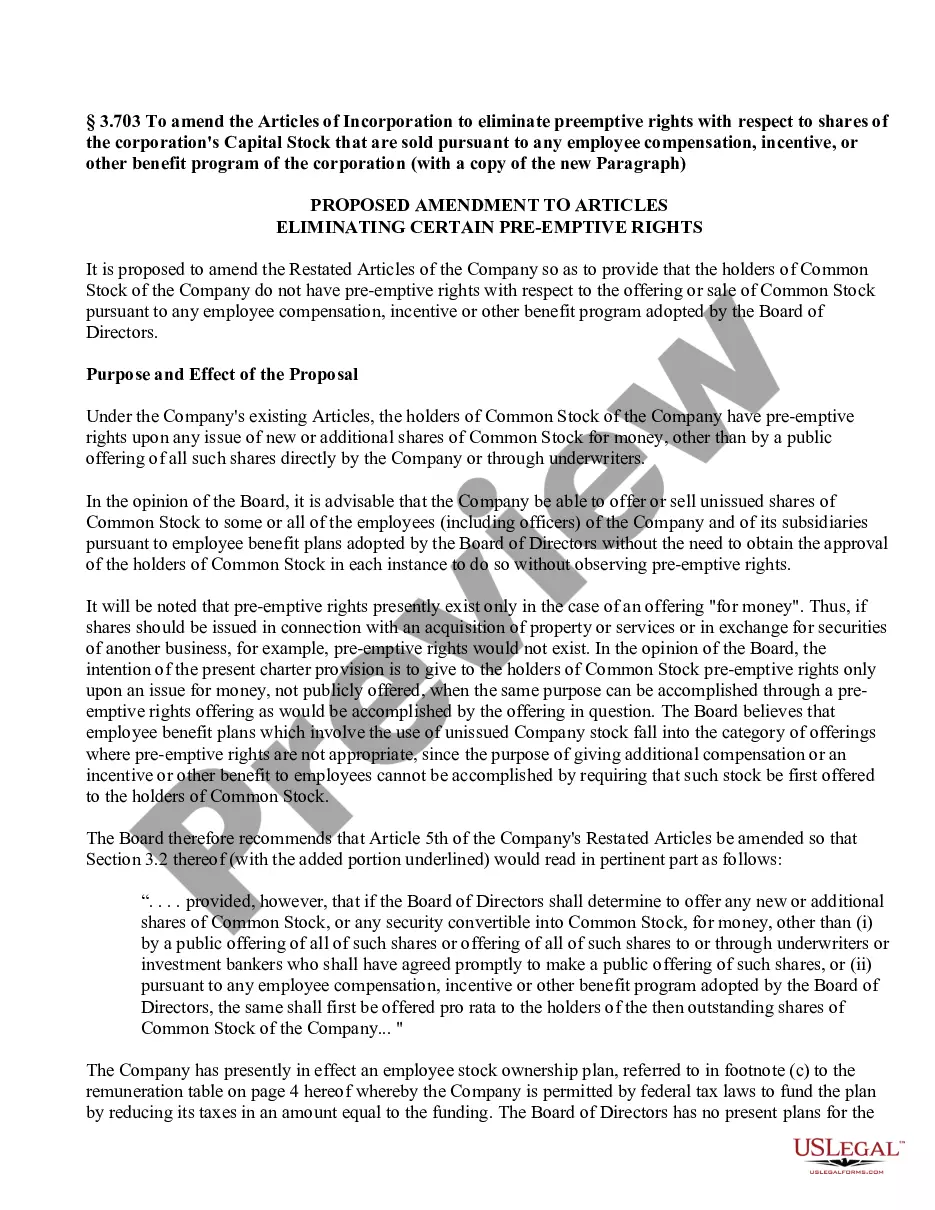
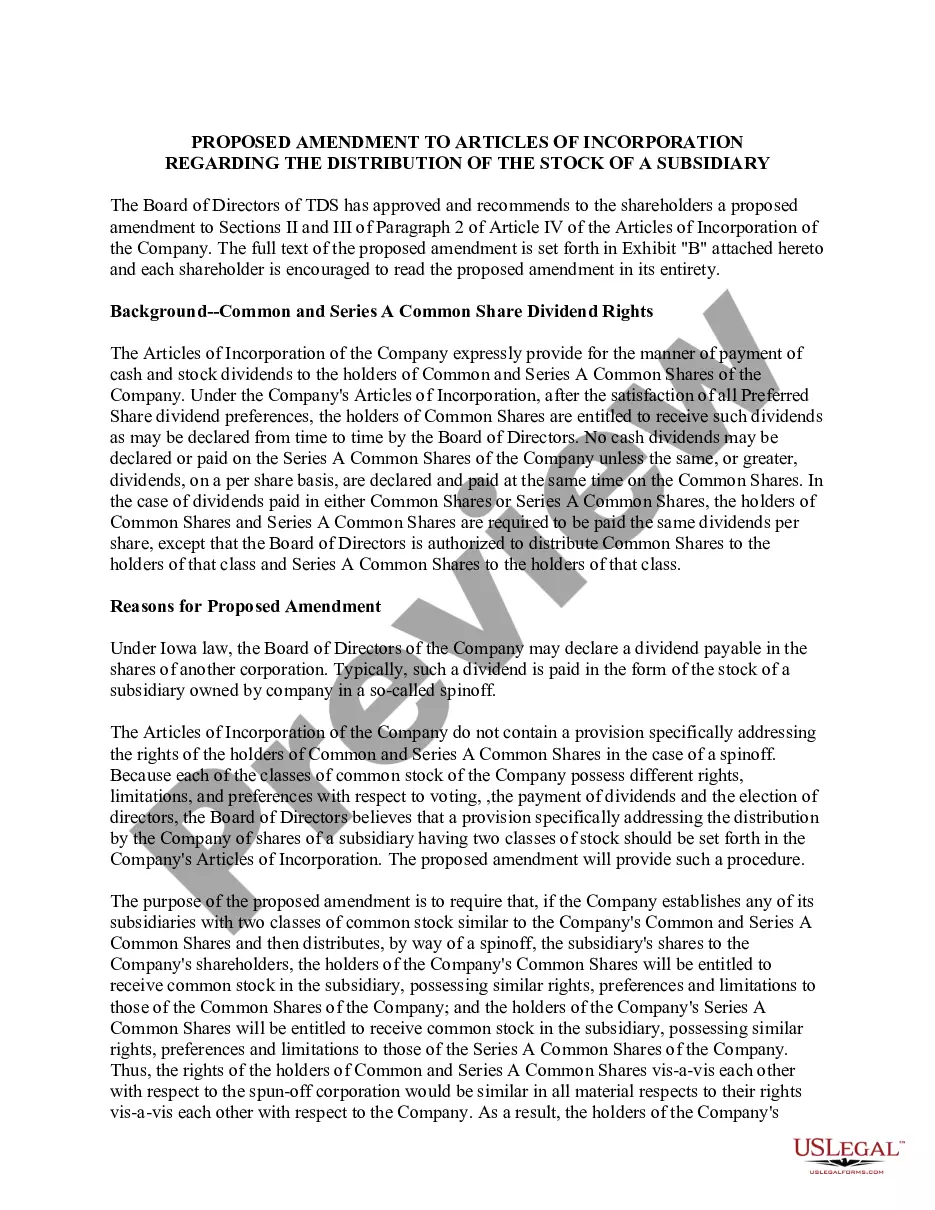
The Proposed Amendment to Articles Eliminating Certain Preemptive Rights is a corporate legal document designed to update the articles of incorporation of a company. This form allows corporations to eliminate the preemptive rights of common stockholders when issuing new shares as part of employee compensation or benefit programs. Unlike similar forms, this document specifically addresses the necessity to streamline internal corporate procedures without requiring shareholder approval for certain stock offerings.
Main sections of this form
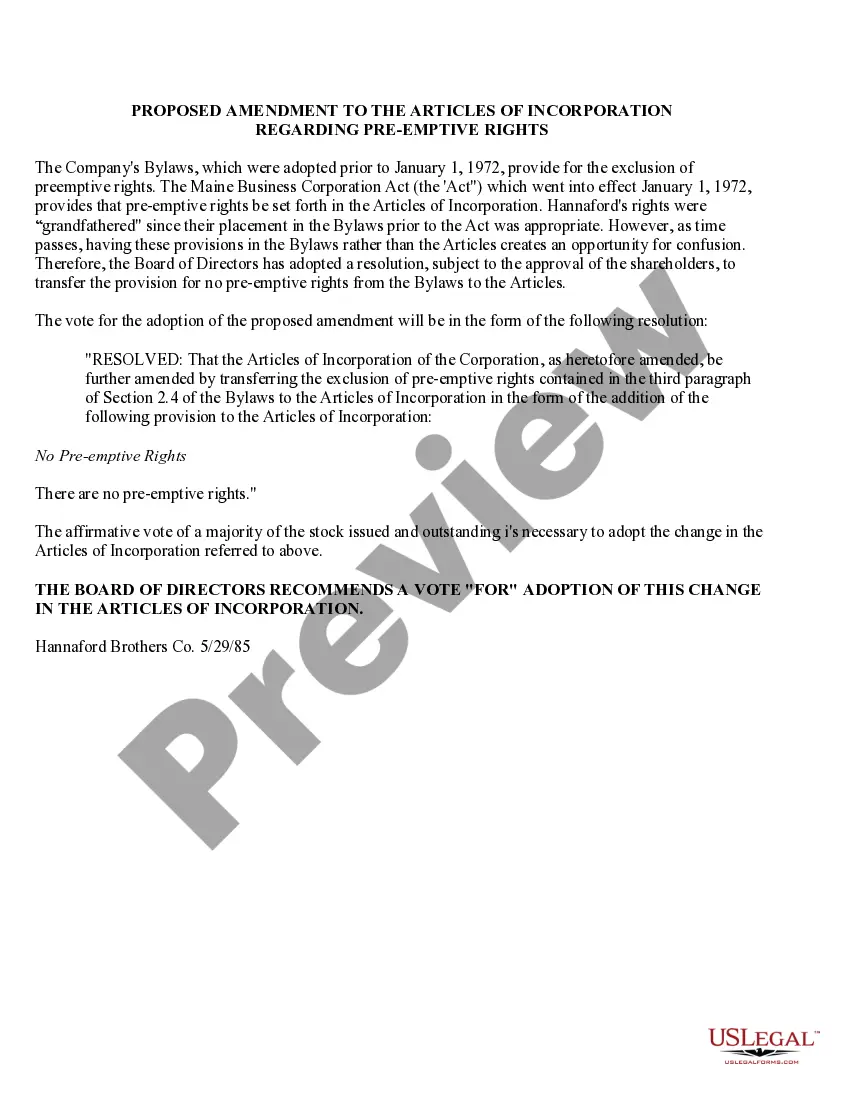
- Proposed amendment to eliminate preemptive rights for common stockholders
- Details on current preemptive rights in the company's existing articles
- Rationale provided by the Board of Directors for the amendment
- Specifications on employee compensation and incentive program offerings
- Voting requirements for shareholder approval of the amendment

When to use this document
This form should be used when a corporation wishes to amend its articles of incorporation to remove preemptive rights for existing shareholders. This is particularly relevant when the company intends to issue shares as part of employee benefit programs or compensation plans without obtaining prior approval from common stockholders each time. It is a practical solution for facilitating employee incentive programs and streamlining corporate processes.
Who needs this form
- Corporate boards of directors seeking to amend articles of incorporation
- Corporate legal teams or counsel involved in corporate governance
- Shareholders interested in understanding changes to their rights
- Companies planning to expand employee incentive programs through stock issuance
Steps to complete this form
- Review the current articles of incorporation to identify existing preemptive rights.
- Draft the proposed amendment language per the requirements of this form.
- Obtain approval from the corporate Board of Directors for the amendment proposal.
- Prepare a notice for shareholders detailing the proposed changes and voting instructions.
- Ensure that the proposed amendment receives the required two-thirds vote from common stockholders.
Does this document require notarization?
This form does not typically require notarization unless specified by local law. However, it is prudent to check your stateâs requirements to ensure compliance with particular regulations concerning corporate document amendments.
Get your form ready online
Our built-in tools help you complete, sign, share, and store your documents in one place.
Make edits, fill in missing information, and update formatting in US Legal Forms—just like you would in MS Word.
Download a copy, print it, send it by email, or mail it via USPS—whatever works best for your next step.
Sign and collect signatures with our SignNow integration. Send to multiple recipients, set reminders, and more. Go Premium to unlock E-Sign.
If this form requires notarization, complete it online through a secure video call—no need to meet a notary in person or wait for an appointment.
We protect your documents and personal data by following strict security and privacy standards.

Make edits, fill in missing information, and update formatting in US Legal Forms—just like you would in MS Word.

Download a copy, print it, send it by email, or mail it via USPS—whatever works best for your next step.

Sign and collect signatures with our SignNow integration. Send to multiple recipients, set reminders, and more. Go Premium to unlock E-Sign.

If this form requires notarization, complete it online through a secure video call—no need to meet a notary in person or wait for an appointment.

We protect your documents and personal data by following strict security and privacy standards.
Mistakes to watch out for
- Failing to obtain necessary board approval before proposing the amendment.
- Not clearly communicating the reasons for the amendment to stockholders.
- Overlooking the specific voting requirements mandated by state law.
- Using vague or unclear language in the amendment proposal.
Benefits of completing this form online
- Convenient access to legally drafted forms that are customizable to fit specific corporate needs.
- Easy download options in various formats for immediate use.
- Assured compliance with legal standards set forth by licensed attorneys.
Main things to remember
- The form facilitates amendments to eliminate preemptive rights for corporate stockholders.
- It is specifically tailored for use in employee compensation contexts.
- Understanding state-specific laws is crucial for compliance and effectiveness.
Looking for another form?






Form popularity
FAQ
The Bill of Rights is the first 10 Amendments to the Constitution.
The Ninth Amendment was part of the Bill of Rights that was added to the Constitution on December 15, 1791. It says that all the rights not listed in the Constitution belong to the people, not the government. In other words, the rights of the people are not limited to just the rights listed in the Constitution.
Amendment 1 - Religion and Expression2 Amendment 2 - Bearing Arms. Amendment 3 - Quartering Soldiers. Amendment 4 - Search and Seizure. Amendment 5 - Rights of Persons. Amendment 6 - Rights of Accused in Criminal Prosecutions. Amendment 7 - Civil Trials.
The Ninth Amendment tells us that the existence of a written constitution should not be treated as an excuse for ignoring nontextual rights, but it also tells us that the advocates of these rights cannot rest on ancient constitutional text to establish their existence.
Because the rights protected by the Ninth Amendment are not specified, they are referred to as unenumerated. The Supreme Court has found that unenumerated rights include such important rights as the right to travel, the right to vote, the right to keep personal matters private and to make important decisions about
The Ninth Amendment was part of the Bill of Rights that was added to the Constitution on December 15, 1791. It says that all the rights not listed in the Constitution belong to the people, not the government. In other words, the rights of the people are not limited to just the rights listed in the Constitution.
The transportation or importation into any state, territory, or possession of the United States for delivery or use therein of intoxicating liquors, in violation of the laws thereof, is hereby prohibited.
Freedom of speech. Freedom of the press. Freedom of religion. Freedom of assembly. Right to petition the government.
Ninth Amendment, amendment (1791) to the Constitution of the United States, part of the Bill of Rights, formally stating that the people retain rights absent specific enumeration.The enumeration in the Constitution, of certain rights, shall not be construed to deny or disparage others retained by the people.