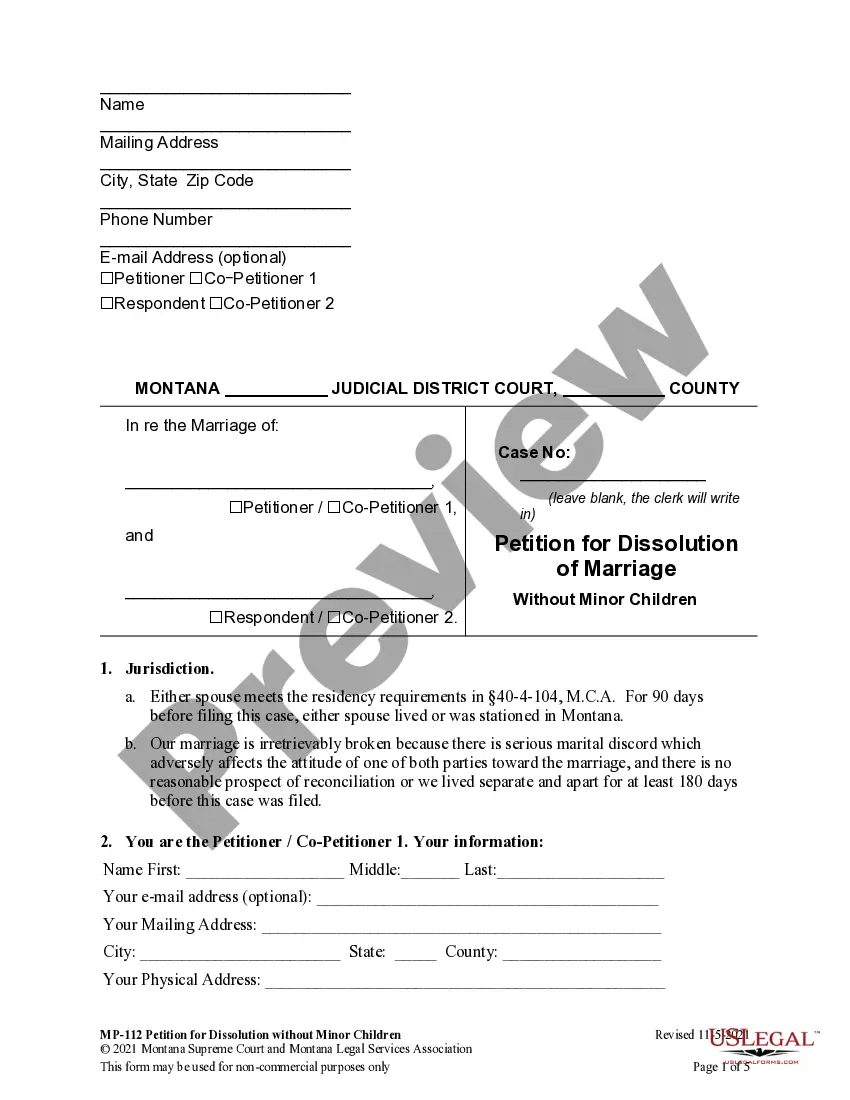
Phantom Stock Plan of Hercules, Inc.
Overview of this form
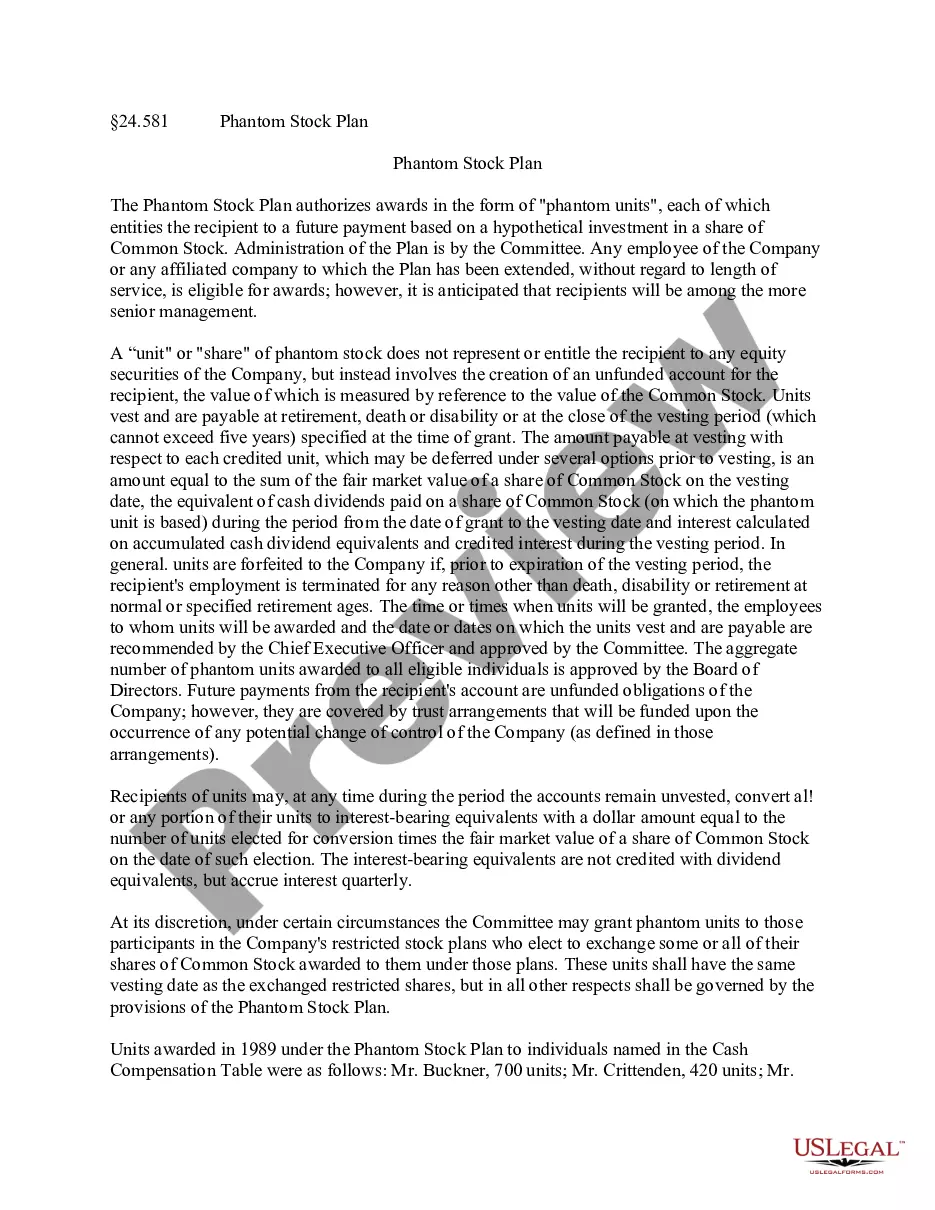
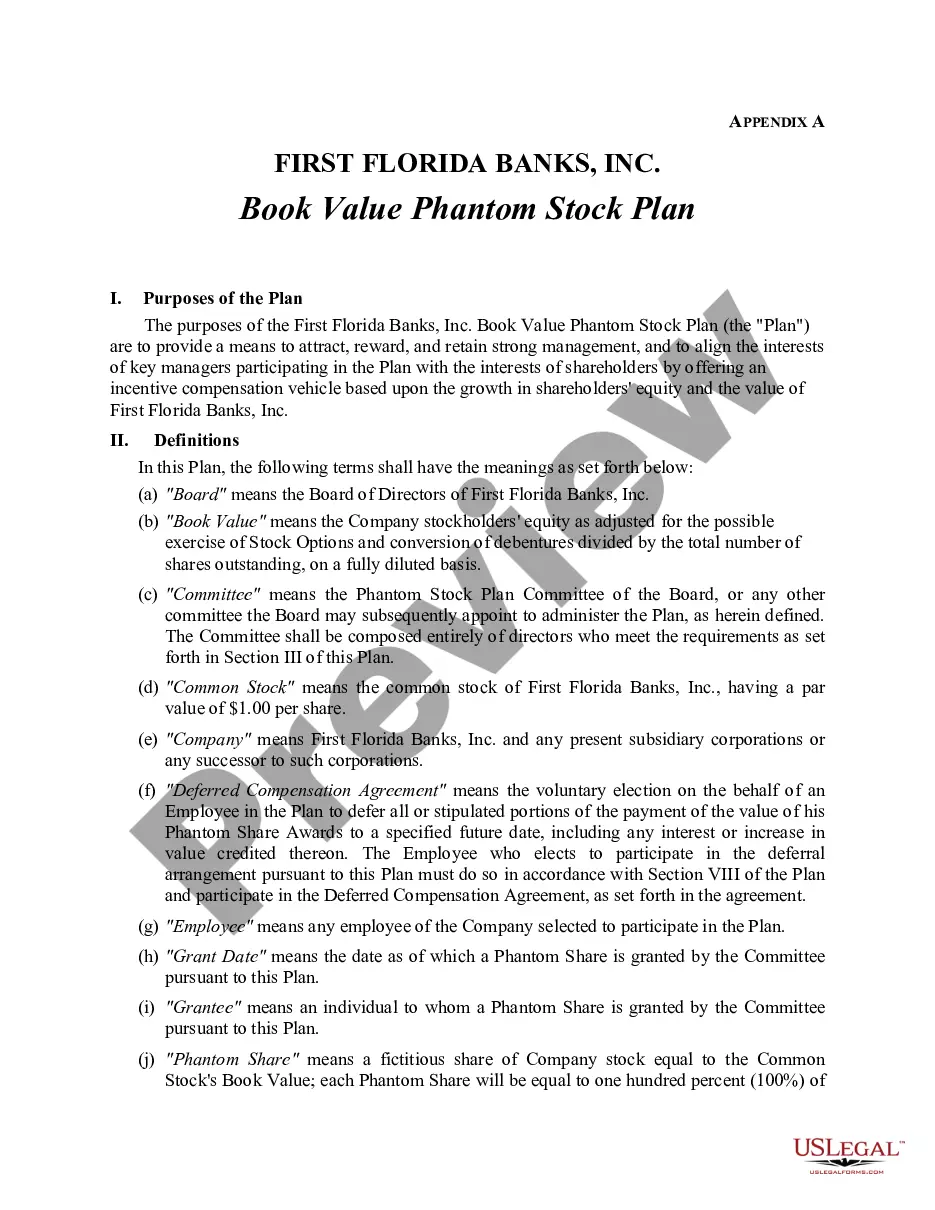
The Phantom Stock Plan of Hercules, Inc. is a corporate document designed to authorize phantom stock awards to employees, particularly in senior management roles. Unlike traditional stock options, phantom stock does not grant actual equity but entitles the holder to future payments based on the hypothetical investment in a share of Common Stock. This plan serves as an incentive for employees while allowing the company to manage its equity without diluting ownership.
Main sections of this form
- Definition of phantom units and their purpose
- Eligibility criteria for employees
- Vesting schedule and conditions for payment
- Options for converting phantom units to interest-bearing equivalents
- Protocol for committee approval of awards
- Provisions for forfeiture of units under certain conditions

Common use cases
This form should be used when a company wishes to implement a phantom stock plan to incentivize employees through a compensation structure that reflects the company's stock performance without giving up equity. It is particularly relevant during management restructuring or as part of broad employee retention strategies.
Who should use this form
- Companies seeking to offer compensation packages to attract and retain senior management.
- Human resources professionals responsible for managing employee benefits.
- Corporate executives involved in strategic compensation planning.
- Financial officers preparing company policies related to equity awards.
How to complete this form
- Identify the plan's purpose and objectives clearly.
- Determine the eligibility criteria and the specific employees who will receive phantom units.
- Establish the vesting schedule and specify conditions for unit payment.
- Include language regarding forfeiture conditions and committee approval processes.
- Consider incorporating options for conversions to interest-bearing equivalents if applicable.
Does this document require notarization?
Notarization is not commonly needed for this form. However, certain documents or local rules may make it necessary. Our notarization service, powered by Notarize, allows you to finalize it securely online anytime, day or night.
Get your form ready online
Our built-in tools help you complete, sign, share, and store your documents in one place.
Make edits, fill in missing information, and update formatting in US Legal Forms—just like you would in MS Word.
Download a copy, print it, send it by email, or mail it via USPS—whatever works best for your next step.
Sign and collect signatures with our SignNow integration. Send to multiple recipients, set reminders, and more. Go Premium to unlock E-Sign.
If this form requires notarization, complete it online through a secure video call—no need to meet a notary in person or wait for an appointment.
We protect your documents and personal data by following strict security and privacy standards.

Make edits, fill in missing information, and update formatting in US Legal Forms—just like you would in MS Word.

Download a copy, print it, send it by email, or mail it via USPS—whatever works best for your next step.

Sign and collect signatures with our SignNow integration. Send to multiple recipients, set reminders, and more. Go Premium to unlock E-Sign.

If this form requires notarization, complete it online through a secure video call—no need to meet a notary in person or wait for an appointment.

We protect your documents and personal data by following strict security and privacy standards.
Mistakes to watch out for
- Failing to clearly define vesting conditions, leading to confusion among employees.
- Omitting committee approval processes for award distributions.
- Neglecting to consult legal counsel, resulting in non-compliance with regulations.
- Not updating the plan as the company grows or changes in management occur.
Why complete this form online
- Convenience of accessing the form anytime for immediate use.
- Editability allows for customization to fit specific corporate goals.
- Reliability of templates drafted by licensed attorneys ensures legal compliance.
Legal use & context
- The Phantom Stock Plan serves to incentivize employees while maintaining company control.
- Payments are deferred, thus providing tax advantages until they are realized.
- The plan is governed by corporate law and must comply with securities regulations.
What to keep in mind
- The Phantom Stock Plan incentivizes employees without transferring equity.
- Eligibility is typically reserved for senior management, enhancing retention strategies.
- Vesting conditions are critical to the plan's effectiveness and must be clearly outlined.
Looking for another form?
Form popularity
FAQ
Phantom stock plans are considered liability awards for accounting purposes (assuming they will be settled in cash rather than stock). As such, the sponsoring company must recognize the plan expense ratably over the vesting period. Varying accrual schedules can be found in the market.
Understand what you are and aren't offering. Set a proper valuation. Create your shares. Decide how to award stock. Set a reward schedule.
Once these two answers are known, the phantom share price is calculated as the former (the value) divided by the latter (the number of shares). The value of the company can be established by a variety of means, including: Stock exchange (for public companies)
A. A phantom stock plan is a deferred compensation plan that provides the employee an award measured by the value of the employer's common stock. However, unlike actual stock, the award does not confer equity ownership in the company. In other words, there is no actual stock given to the employee.
For employees, there's no need to purchase phantom stock shares as regular stockholders must do on the open market. Instead, phantom shares are given to employees with no money changing hands. That's a big benefit to employees, who share in the stock's profits without having to pay for it.
A phantom stock plan is an employee benefit plan that gives selected employees (senior management) many of the benefits of stock ownership without actually giving them any company stock. This type of plan is sometimes referred to as shadow stock. Rather than getting physical stock, the employee receives mock stock.
A phantom stock plan is a deferred compensation plan that provides the employee an award measured by the value of the employer's common stock. However, unlike actual stock, the award does not confer equity ownership in the company. In other words, there is no actual stock given to the employee.