Approval of Key Employees' Restricted Stock Purchase Plan of The Pulitzer Publishing Co.
About this form
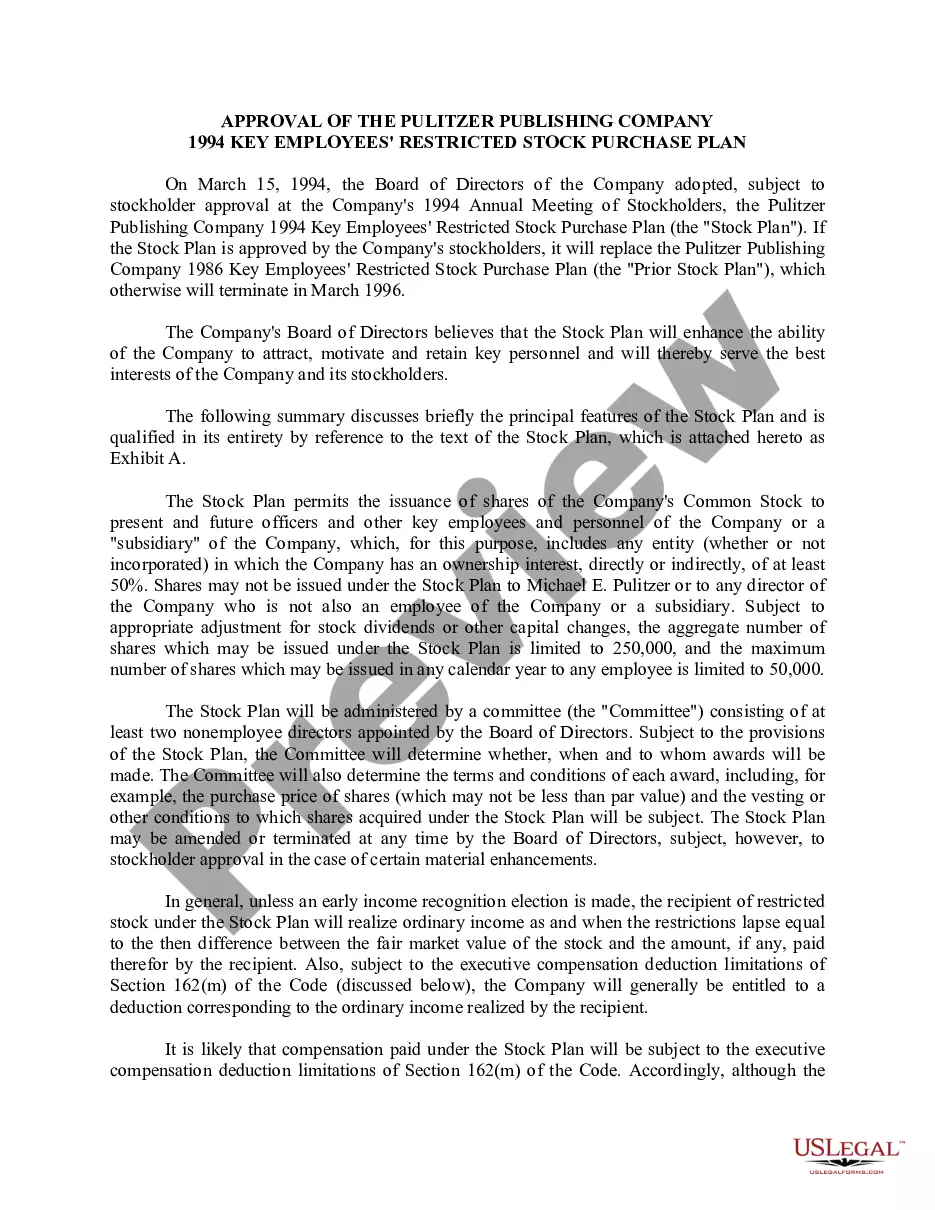
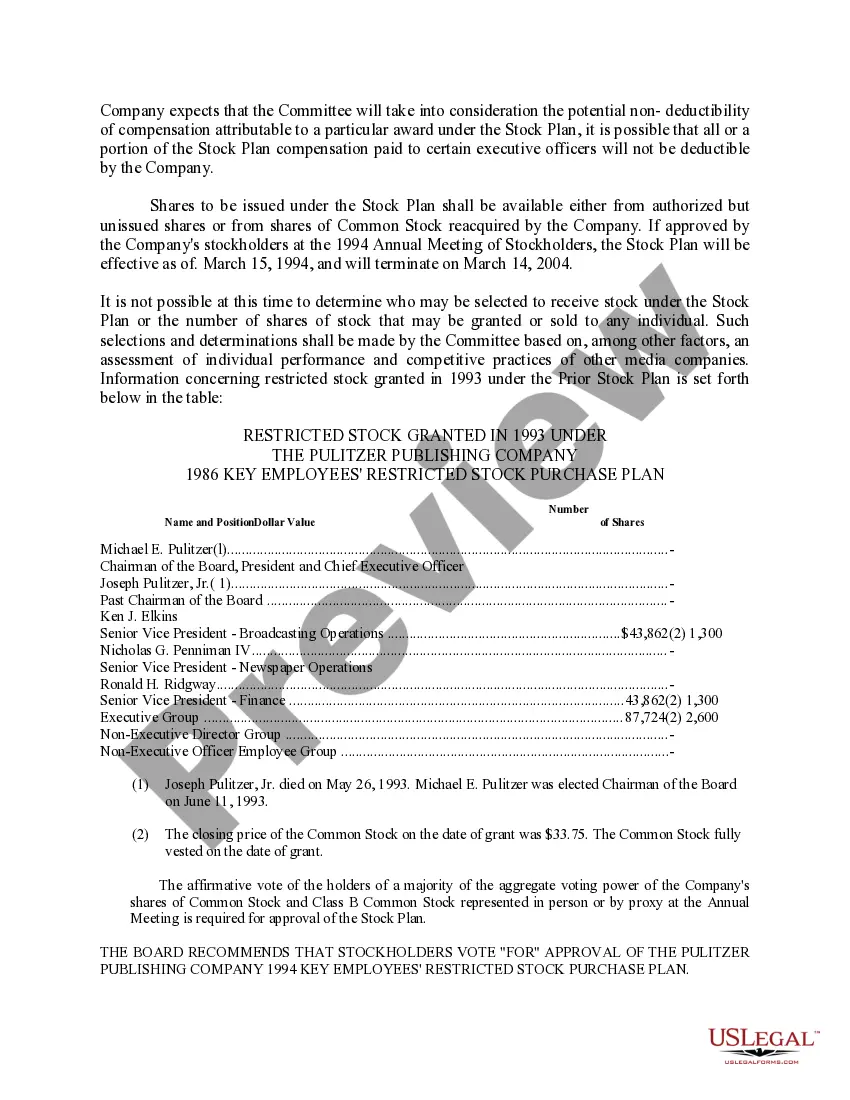
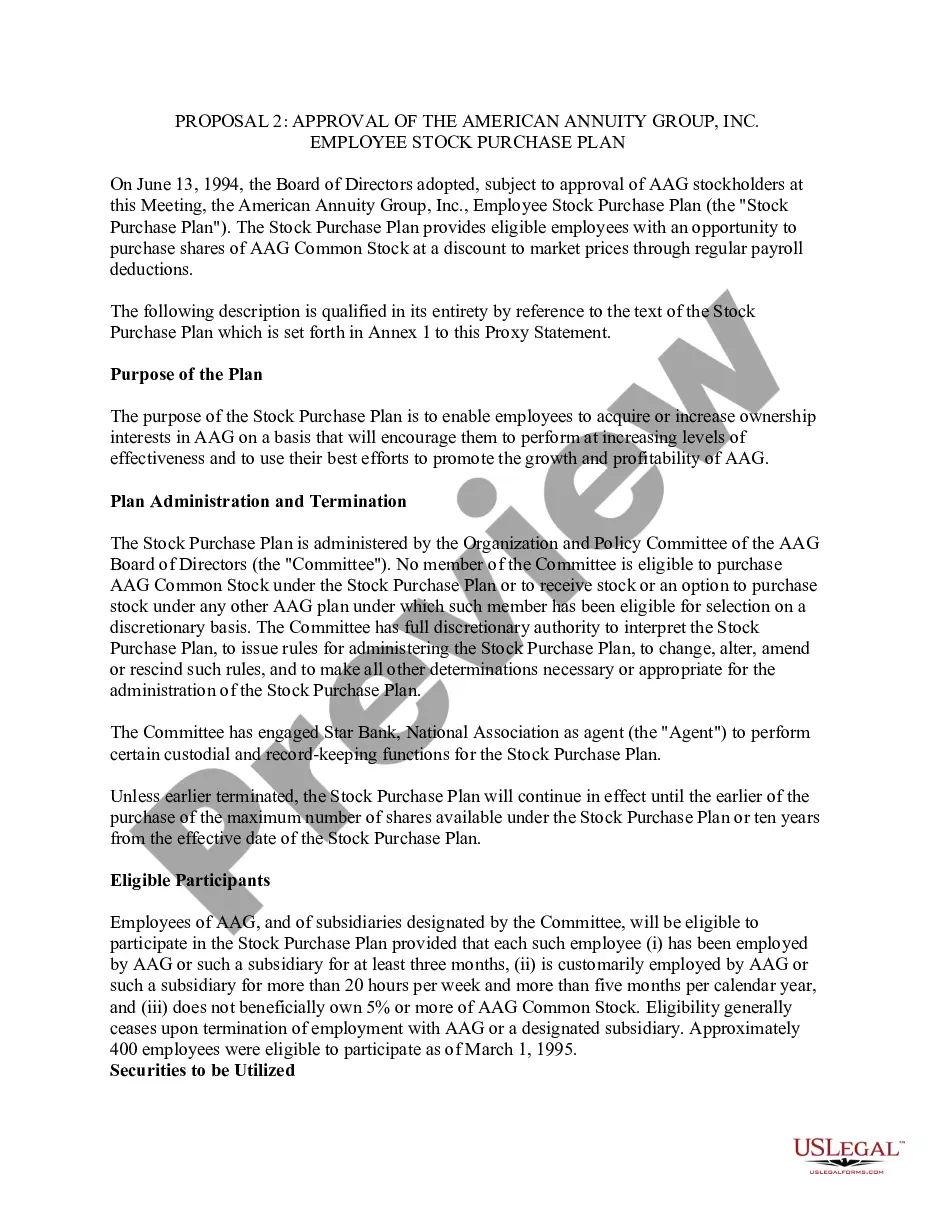
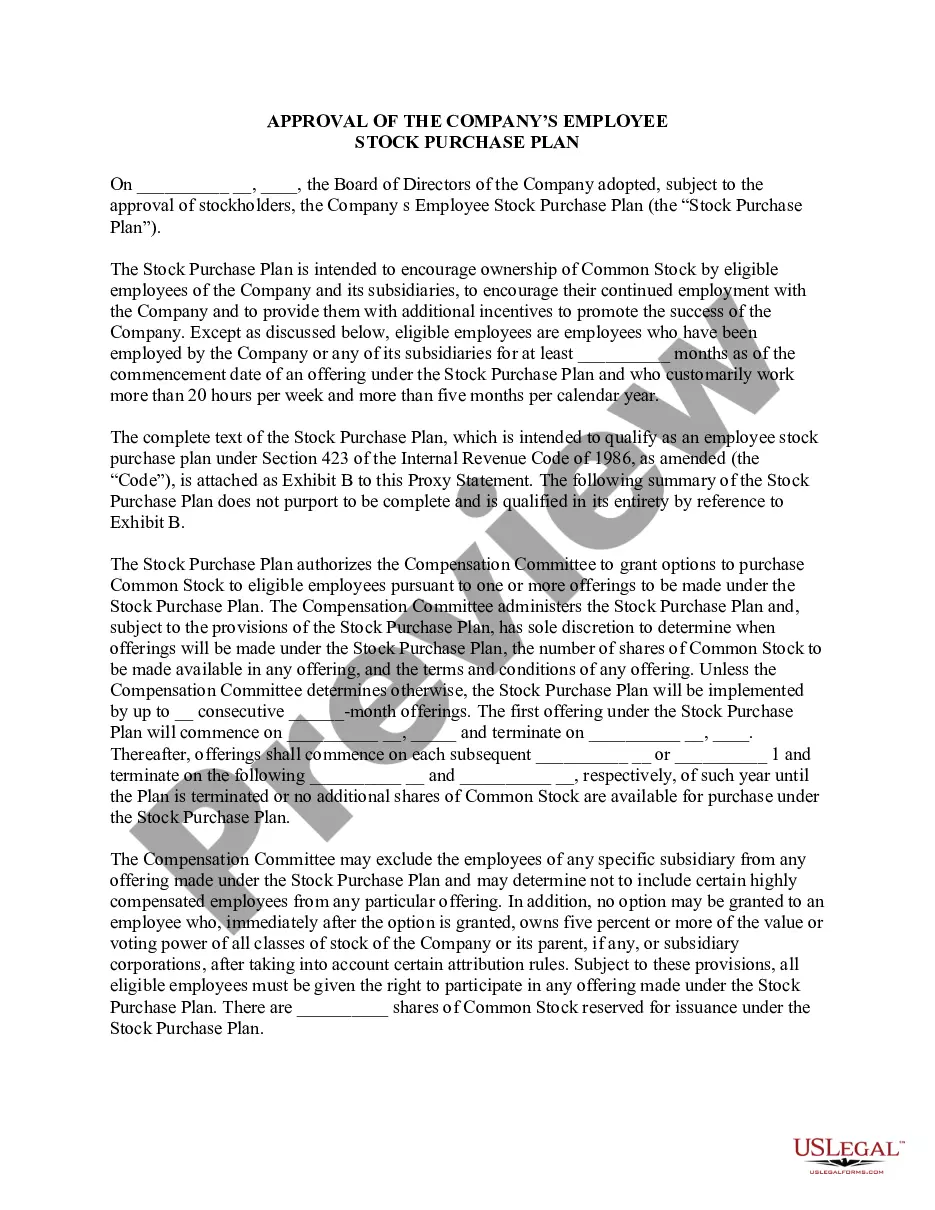
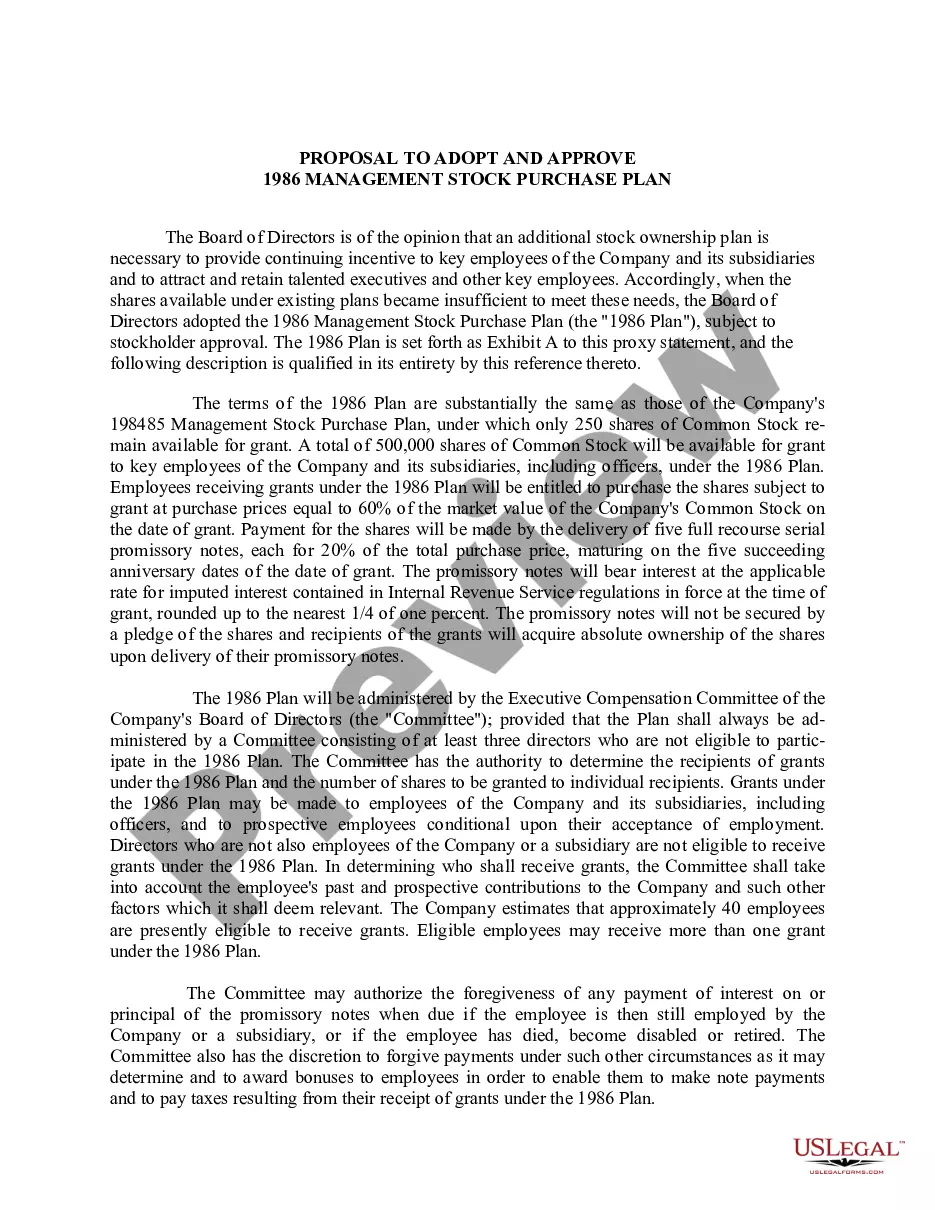
The Approval of Key Employees' Restricted Stock Purchase Plan of The Pulitzer Publishing Co. is a legal document that outlines a stock purchase plan meant for key employees within the organization. This plan allows the issuance of restricted stock to attract and retain talent, differentiating it from other stock plans by its specific criteria and limitations on share distribution. This form is essential for formalizing the approval process and ensuring compliance with corporate governance requirements.
Key components of this form
- Overview of the stock purchase plan, including its goal to attract key personnel.
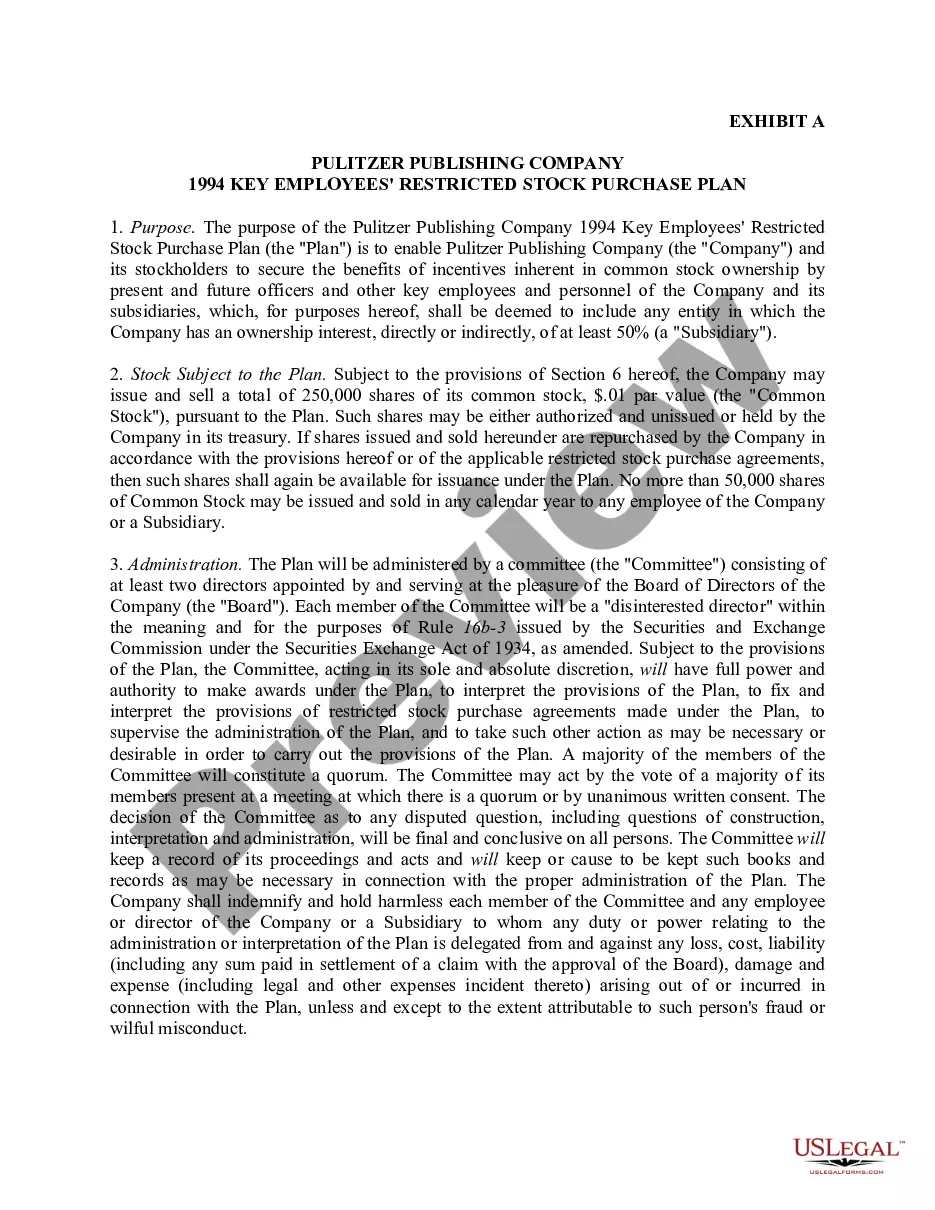
- Details on share issuance limits: up to 250,000 shares total and 50,000 shares per employee annually.
- Administration guidelines, including the role of a committee in determining awards and conditions.
- Tax implications for recipients and the company's ability to deduct compensation under IRS guidelines.
- Provision for amending or terminating the plan, subject to stockholder approval.
When to use this document
This form should be used when the Board of Directors of a corporation aims to establish or approve a restricted stock purchase plan for its key employees. It is particularly necessary when transitioning from an older plan, such as the 1986 Key Employees Restricted Stock Purchase Plan, to a new one. Utilize this form during the annual meeting of stockholders to secure the necessary approval for the plan's implementation.
Who needs this form
- Corporate Boards of Directors looking to adopt new compensation strategies for key employees.
- Legal representatives of companies needing to formalize stock purchase plans.
- Human resource professionals managing employee equity compensation programs.
- Shareholders who wish to vote on the adoption of a restricted stock plan.
How to prepare this document
- Identify and list the key employees eligible for stock awards under the plan.
- Specify the total number of shares authorized and the maximum number per employee.
- Determine the administration committee's structure and members from the Board of Directors.
- Include conditions related to stock purchase pricing and vesting requirements.
- Ensure provisions for potential modification or termination of the plan are outlined.
Notarization guidance
Notarization is generally not required for this form. However, certain states or situations might demand it. You can complete notarization online through US Legal Forms, powered by Notarize, using a verified video call available anytime.
Get your form ready online
Our built-in tools help you complete, sign, share, and store your documents in one place.
Make edits, fill in missing information, and update formatting in US Legal Forms—just like you would in MS Word.
Download a copy, print it, send it by email, or mail it via USPS—whatever works best for your next step.
Sign and collect signatures with our SignNow integration. Send to multiple recipients, set reminders, and more. Go Premium to unlock E-Sign.
If this form requires notarization, complete it online through a secure video call—no need to meet a notary in person or wait for an appointment.
We protect your documents and personal data by following strict security and privacy standards.

Make edits, fill in missing information, and update formatting in US Legal Forms—just like you would in MS Word.

Download a copy, print it, send it by email, or mail it via USPS—whatever works best for your next step.

Sign and collect signatures with our SignNow integration. Send to multiple recipients, set reminders, and more. Go Premium to unlock E-Sign.

If this form requires notarization, complete it online through a secure video call—no need to meet a notary in person or wait for an appointment.

We protect your documents and personal data by following strict security and privacy standards.
Typical mistakes to avoid
- Failing to obtain stockholder approval before implementing the plan.
- Not specifying clear criteria for employee eligibility and stock distribution.
- Overlooking tax implications for both the company and the employees involved.
- Neglecting to detail the administrative structure required to manage the plan.
Why use this form online
- Convenience of downloading and completing the form at your own pace.
- Editability allows users to customize details specific to their company's situation.
- Reliability of information drafted by licensed attorneys ensures proper legal formatting.
Legal use & context
- The plan is enforceable as long as it adheres to relevant corporate governance guidelines.
- Compliance with federal and state securities laws is necessary when issuing stock.
- Regular audits may be required to ensure ongoing compliance with tax codes and regulations.
Summary of main points
- The plan is specifically tailored for key employees to encourage retention and performance.
- Shareholder approval is critical for the launch of the stock purchase plan.
- Understanding tax implications is essential for both the company and employees.
- The form acts as a binding agreement once all conditions are met and approvals obtained.
Looking for another form?










Form popularity
FAQ
Stock options are when a company gives an employee the ability to purchase stock at a predetermined price at a given time.Conversely, RSUs are grants of stock that a company gives to an employee without any purchase. Employees get these either as shares or a cash equivalent.
RSUs give an employee interest in company stock but they have no tangible value until vesting is complete.Upon vesting, they are considered income, and a portion of the shares is withheld to pay income taxes. The employee receives the remaining shares and can sell them at their discretion.
IPO Lock-Up Period and Long Term Capital Gains In most scenarios when your RSUs vest you can sell them immediately and there is almost no tax impact.However, if the stock reverts to the original IPO/Vesting date price, don't hesitate to sell since there will be no additional tax benefit.
For RSUs, the profit/gain is the difference between the sale price and the vesting price. For ESOPs, the profit/gain is the difference between the sale price and the exercise price. For ESPPs, the profit/gain is the difference between the sale price and the market price, at the time of purchase.
A Restricted Stock Plan is a common way to share stock with employees in public companies.Customarily, restricted stock will carry a vesting schedule so that employees will forfeit some or all of the shares unless they remain with the company for a specified number of years (e.g. 3 or 4).
So that's the basic accounting for restricted stock under GAAP. The key takeaways are:The value recognized for each restricted share is the same as its current share price (for non-dividend paying stock). Restricted stock is recognized on the income statement over the service period.
If you measure 1 RSU against 1 stock option, RSUs are pretty much always going to win. Because an RSU is basically just a stock option with a $0 strike price, and a stock option is always going to have a strike price higher than $0.Companies know this and generally will offer you more options than they would RSUs.