Directors and Distributors Stock Option Plan
Overview of this form
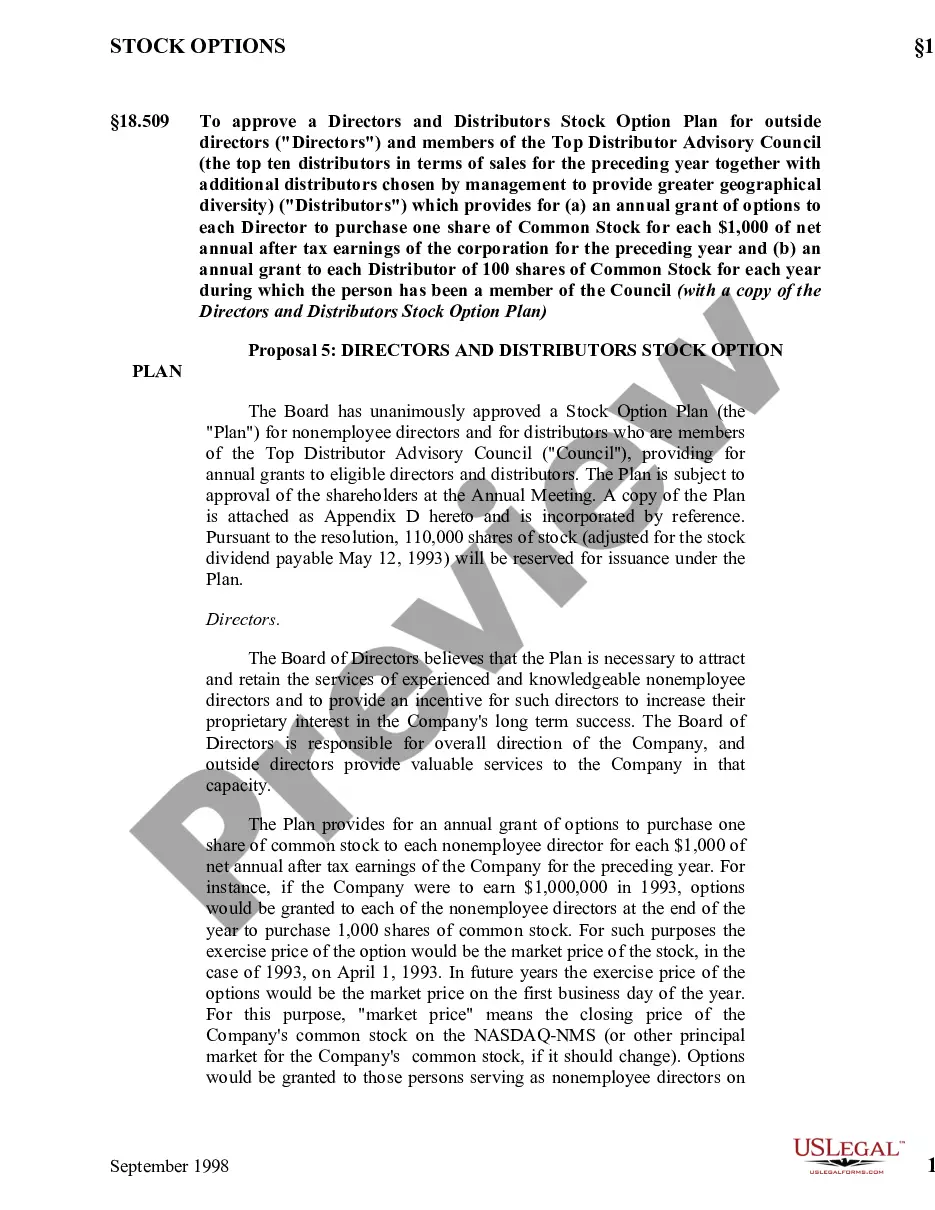
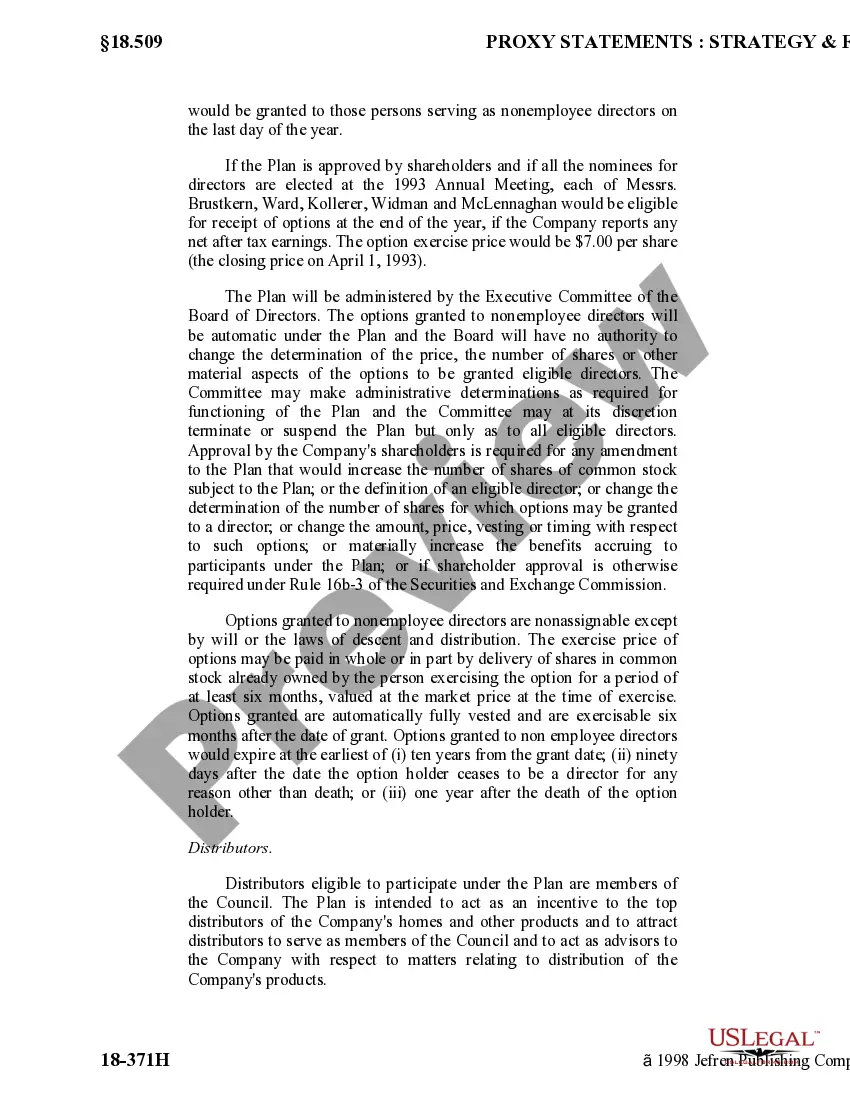
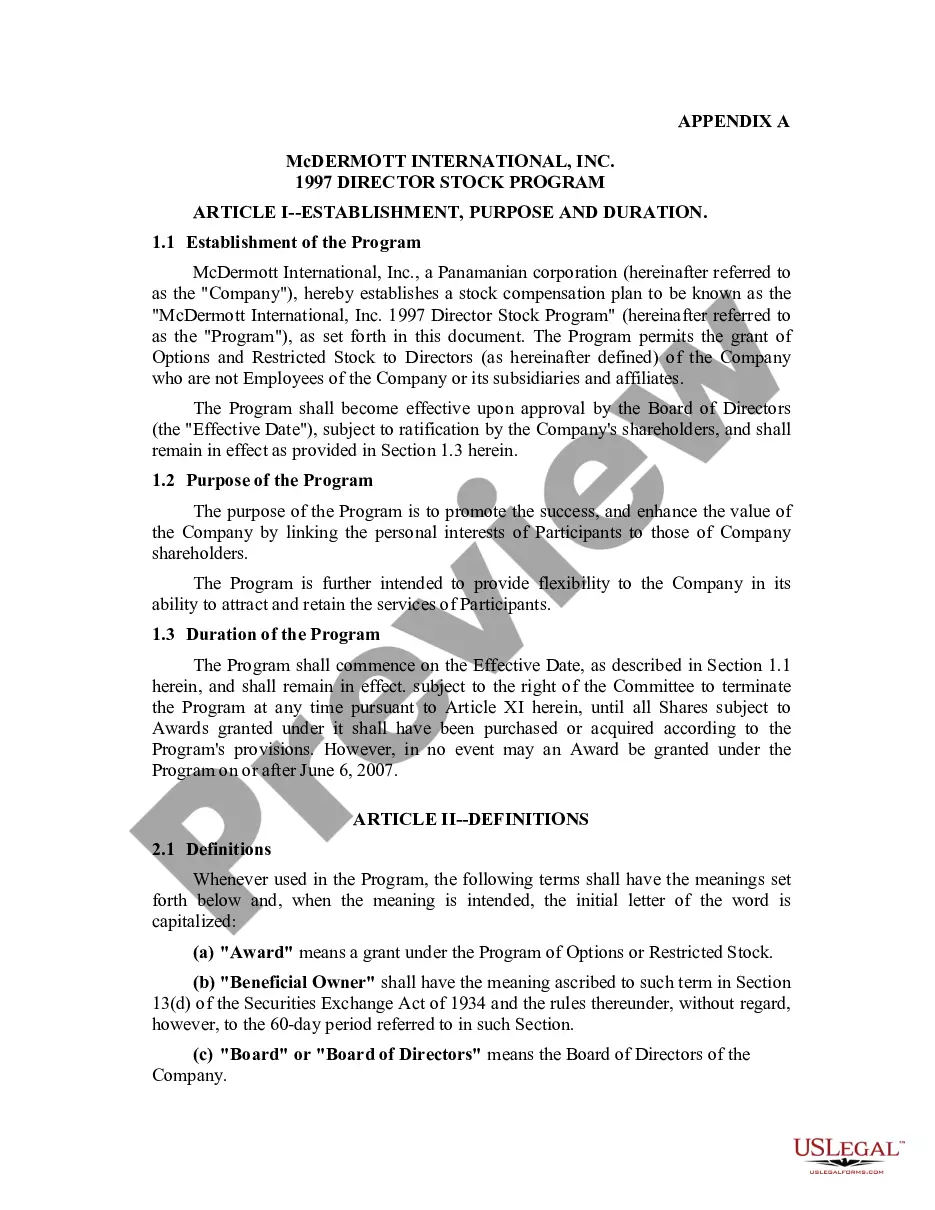
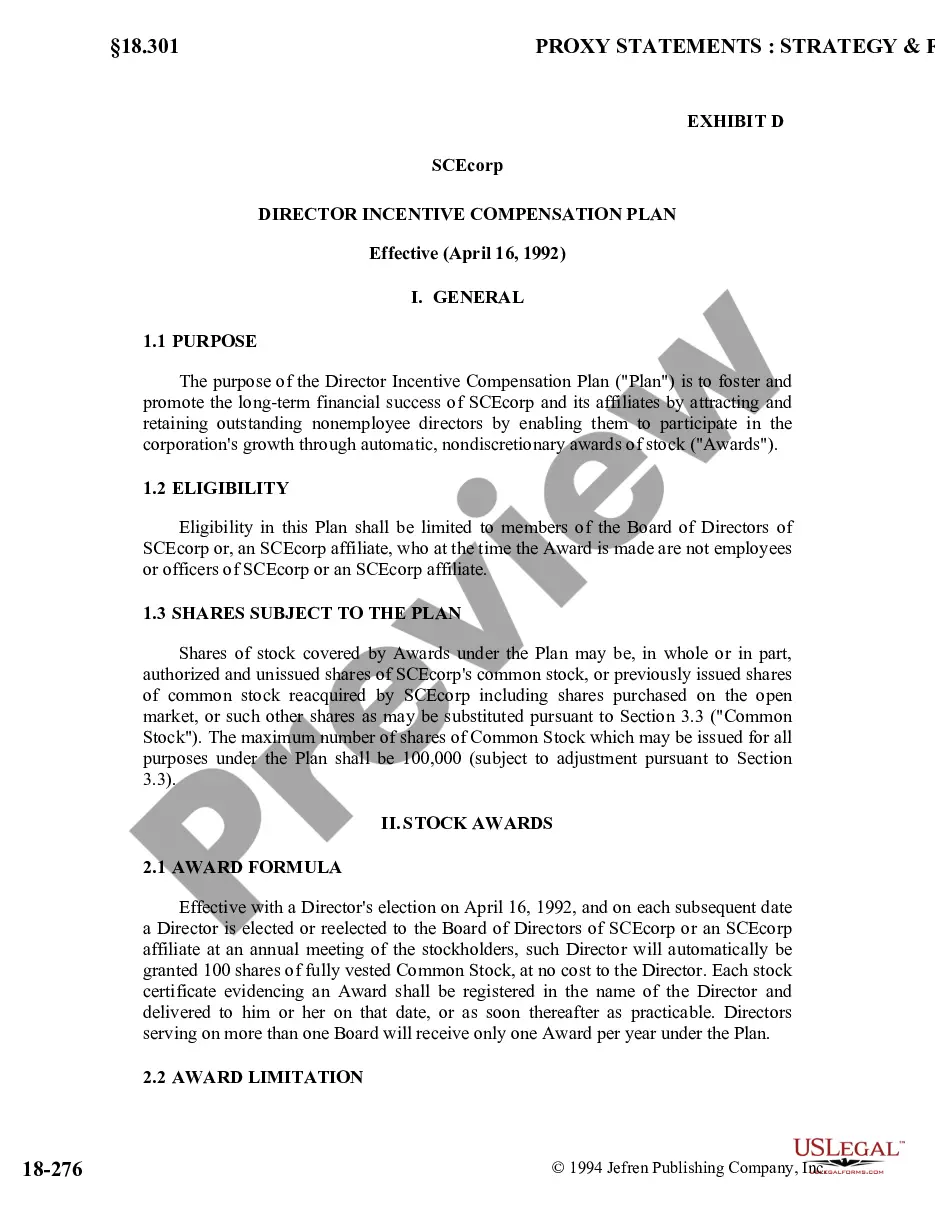
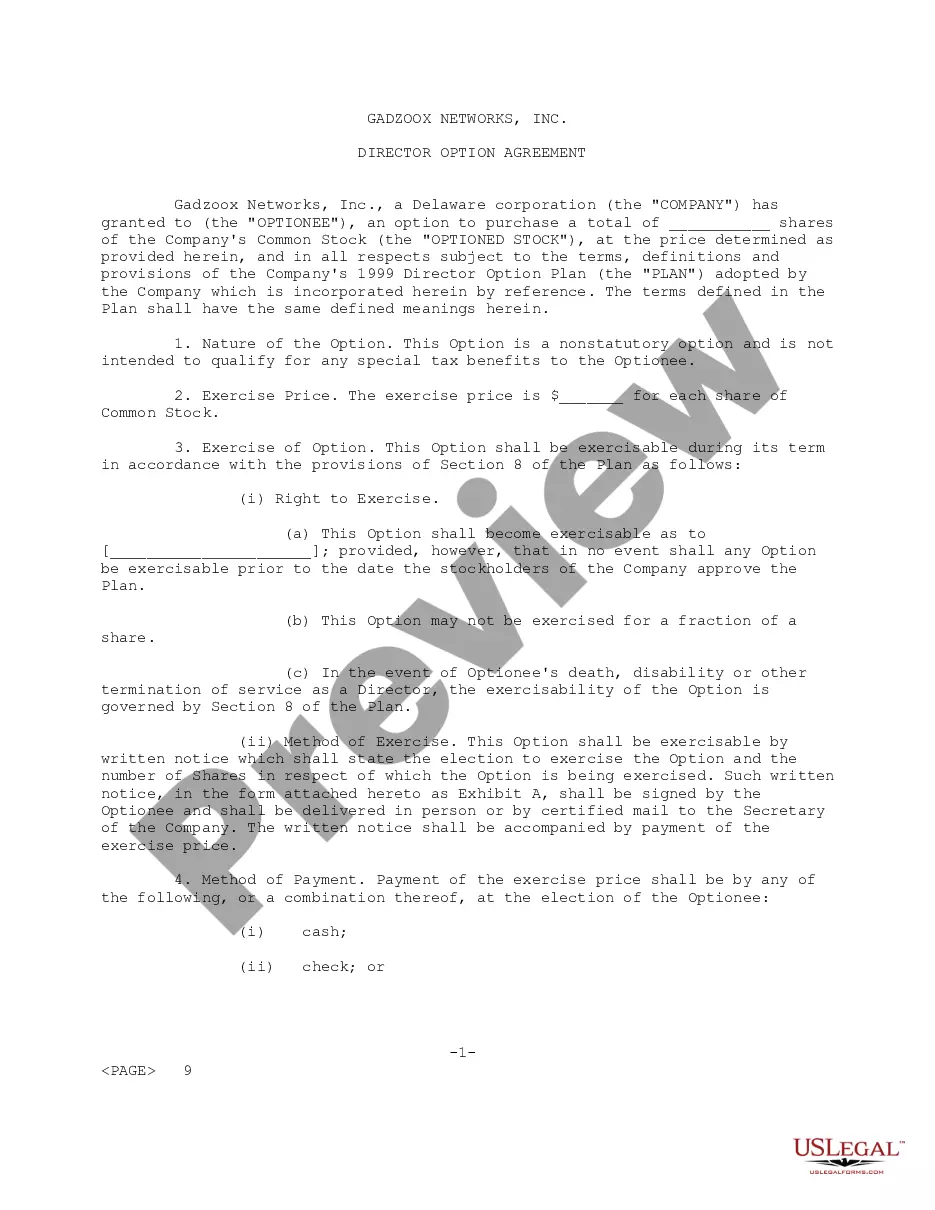
The Directors and Distributors Stock Option Plan is a legal document that outlines the framework for granting stock options to nonemployee directors and top distributors within a company. This plan serves as a means to attract and retain qualified individuals while incentivizing them to contribute to the company's long-term success. Unlike standard employment contracts, this form provides specific conditions under which stock options are granted, ensuring that eligible participants are rewarded according to the company's performance.
Key parts of this document
- Annual grants: Options granted annually based on the company's net annual after-tax earnings.
- Eligibility: Includes nonemployee directors and members of the Top Distributor Advisory Council.
- Option exercise price: Determined by the market price of the stock on specified dates.
- Expiration terms: Options expire after ten years or within specified timeframes in case of a director's departure.
- Automatic vesting: Options are automatically vested and exercisable after six months from the grant date.
- Administrative oversight: Managed by the Executive Committee of the Board of Directors.



When to use this form
This form is essential for companies that wish to implement a structured stock option plan to incentivize their nonemployee directors and top distributors. Use this form when establishing a new plan or when amending an existing one to include new eligibility criteria, adjust the number of shares authorized, or change the exercise price conditions.
Who should use this form
This form is appropriate for:
- Corporations seeking to create or amend a Stock Option Plan.
- Company boards interested in attracting and retaining skilled nonemployee directors.
- Distributors who are members of the Top Distributor Advisory Council looking to understand their eligibility for stock options.
Instructions for completing this form
- Identify the eligible participants, including nonemployee directors and council members.
- Define the number of shares available for the stock option plan.
- Specify the method for calculating the exercise price of the options granted.
- Detail the vesting conditions and timeline for the stock options.
- Obtain necessary approvals from company shareholders for implementation.
- Maintain accurate records of options granted and exercised for compliance purposes.
Does this document require notarization?
This form does not typically require notarization unless specified by local law. Ensure to verify any specific state requirements that may apply to your situation.
Get your form ready online
Our built-in tools help you complete, sign, share, and store your documents in one place.
Make edits, fill in missing information, and update formatting in US Legal Forms—just like you would in MS Word.
Download a copy, print it, send it by email, or mail it via USPS—whatever works best for your next step.
Sign and collect signatures with our SignNow integration. Send to multiple recipients, set reminders, and more. Go Premium to unlock E-Sign.
If this form requires notarization, complete it online through a secure video call—no need to meet a notary in person or wait for an appointment.
We protect your documents and personal data by following strict security and privacy standards.

Make edits, fill in missing information, and update formatting in US Legal Forms—just like you would in MS Word.

Download a copy, print it, send it by email, or mail it via USPS—whatever works best for your next step.

Sign and collect signatures with our SignNow integration. Send to multiple recipients, set reminders, and more. Go Premium to unlock E-Sign.

If this form requires notarization, complete it online through a secure video call—no need to meet a notary in person or wait for an appointment.

We protect your documents and personal data by following strict security and privacy standards.
Mistakes to watch out for
- Failing to clearly define eligibility criteria for stock options.
- Neglecting to specify the exercise price calculation method.
- Omitting shareholder approval prior to implementation.
- Not documenting the options granted accurately.
Why use this form online
- Convenient access for drafting and modifying stock option plans.
- Editability allows customization to fit specific corporate needs.
- Reliable templates drafted by licensed attorneys ensuring legal compliance.
Legal use & context
- The plan must comply with relevant securities laws and regulations.
- It should define all terms clearly to avoid ambiguity in enforcement.
- Companies should regularly review the plan in relation to corporate governance best practices.
Quick recap
- The Directors and Distributors Stock Option Plan provides a strategic way for companies to offer stock options to key individuals.
- Clear eligibility and documentation are vital for successful implementation.
- Regular oversight and review of the plan ensure compliance and effectiveness in achieving business goals.
Looking for another form?

Form popularity
FAQ
Develop your philosophy. Your stock option plan is an expression of your company philosophy. Paper it. Adopt your stock plan and option agreements and get board and stockholder approval. Make it official. Work with your lawyers to obtain all relevant state permits for your option plan.
What is a Stock Option? A stock option gives an investor the right, but not the obligation, to buy or sell a stock at an agreed upon price and date. There are two types of options: puts, which is a bet that a stock will fall, or calls, which is a bet that a stock will rise.
However, when you sell an optionor the stock you acquired by exercising the optionyou must report the profit or loss on Schedule D of your Form 1040. If you've held the stock or option for less than one year, your sale will result in a short-term gain or loss, which will either add to or reduce your ordinary income.
Stock Option Journal Entries Year 1 The stock option compensation is an expense of the business and is represented by the debit to the expense account in the income statement. The other side of the entry is to the additional paid in capital account (APIC) which is part of the total equity of the business.
Non-qualified stock options (NSOs) are granted to employees, advisors, and consultants; incentive stock options (ISOs) are for employees only. With NSOs, you pay ordinary income taxes when you exercise the options, and capital gains taxes when you sell the shares.
The stock option compensation is an expense of the business and is represented by the debit to the expense account in the income statement. The other side of the entry is to the additional paid in capital account (APIC) which is part of the total equity of the business.
Oftentimes, stock-based compensation is redeemable at the employee's or employer's option. Stock-based compensation that is redeemable at the employee's option is a considered an employer obligation, and thus a liability while awards that are redeemable at the employer's option are classified as equity.
In a private company setting, after the founders have been issued fully vested or restricted stock under their stock purchase agreements, the employees, consultants, advisors and directors who are subsequently hired commonly receive equity compensation through stock options.
Stock options may be considered a form of compensation which gives the employee the right to buy an amount of company stock at a set price during a certain time period. Under U.S. accounting methods, stock options are expensed according to the stock options' fair value.