Eligible Director Nonqualified Stock Option Agreement of Wyle Electronics
About this form
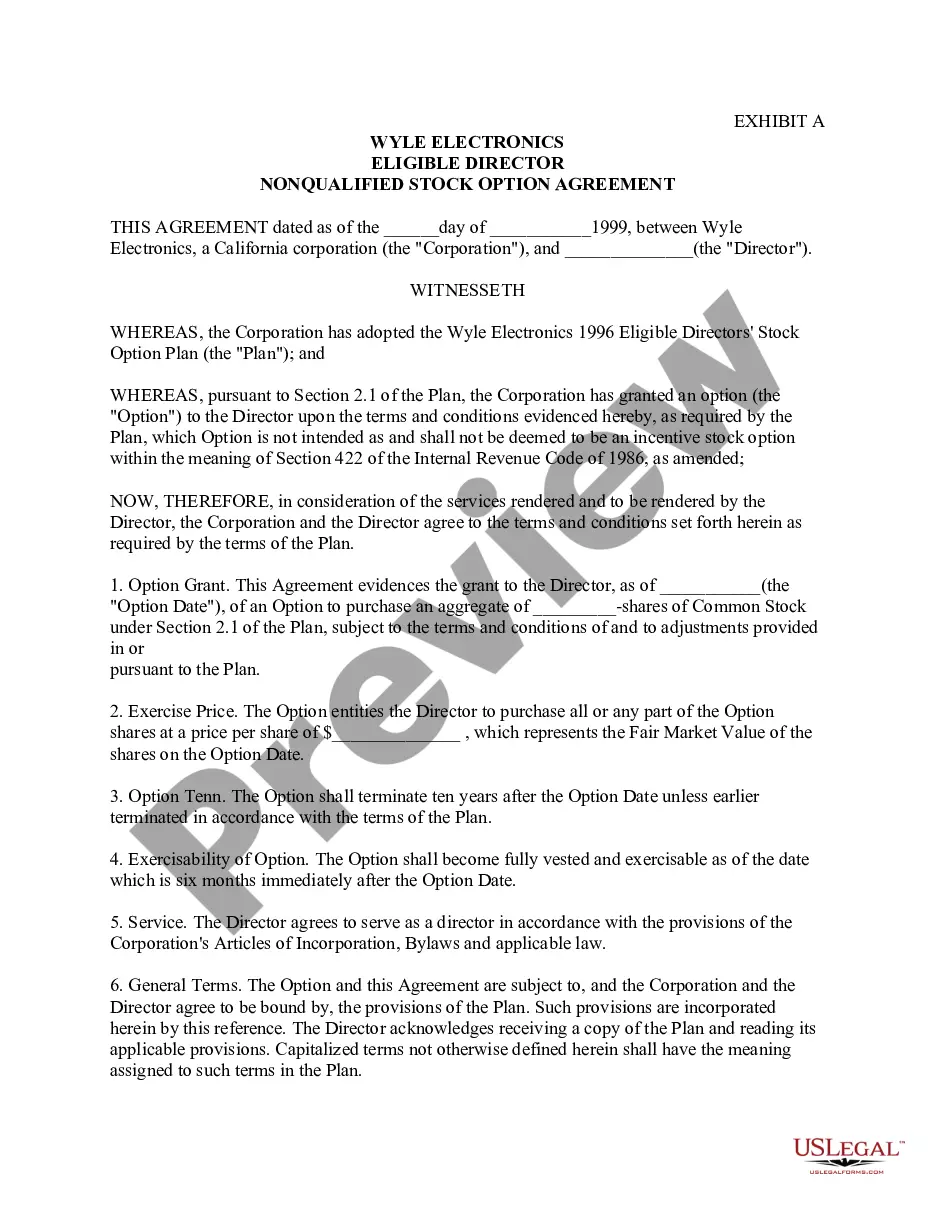
The Eligible Director Nonqualified Stock Option Agreement of Wyle Electronics is a legal document that outlines the terms under which a corporation grants stock options to its directors. Unlike incentive stock options, this agreement is nonqualified, meaning it does not offer the same tax advantages. This agreement is specifically designed for corporate governance and stock compensation, providing a clear framework for both the corporation and the director involved.
Key components of this form
- Option Grant: Specifies the number of shares granted to the director and the date of the option.
- Exercise Price: Indicates the price per share the director must pay to exercise the option, based on fair market value.
- Option Term: Details the ten-year duration of the option unless terminated earlier.
- Exercisability of Option: States that the option becomes fully vested and exercisable after six months from the option date.
- Conditional Grant: Clarifies that the agreement is subject to shareholder approval to be valid.



When to use this form
This form should be utilized when a corporation intends to grant stock options to its directors as part of their compensation package. It is particularly relevant during periods when the company is looking to incentivize its leadership, reward performance, or align directors' interests with shareholder value. Additionally, it can be used in connection with corporate plans that involve stock option grants.
Who can use this document
- Corporate entities planning to offer stock options to directors.
- Directors receiving stock options as part of their compensation.
- Legal professionals overseeing corporate governance and compliance matters.
- Shareholders interested in understanding the terms surrounding stock option grants.
How to complete this form
- Identify the parties: Enter the names of the corporation and the director.
- Specify the number of shares: Fill in the total shares granted under the option.
- Determine the exercise price: Set the fair market value price per share on the relevant date.
- Enter the option date: Provide the specific date the option is granted.
- Complete signatures: Both the corporation representative and director must sign and print their names.
Does this form need to be notarized?
Notarization is not commonly needed for this form. However, certain documents or local rules may make it necessary. Our notarization service, powered by Notarize, allows you to finalize it securely online anytime, day or night.
Get your form ready online
Our built-in tools help you complete, sign, share, and store your documents in one place.
Make edits, fill in missing information, and update formatting in US Legal Forms—just like you would in MS Word.
Download a copy, print it, send it by email, or mail it via USPS—whatever works best for your next step.
Sign and collect signatures with our SignNow integration. Send to multiple recipients, set reminders, and more. Go Premium to unlock E-Sign.
If this form requires notarization, complete it online through a secure video call—no need to meet a notary in person or wait for an appointment.
We protect your documents and personal data by following strict security and privacy standards.

Make edits, fill in missing information, and update formatting in US Legal Forms—just like you would in MS Word.

Download a copy, print it, send it by email, or mail it via USPS—whatever works best for your next step.

Sign and collect signatures with our SignNow integration. Send to multiple recipients, set reminders, and more. Go Premium to unlock E-Sign.

If this form requires notarization, complete it online through a secure video call—no need to meet a notary in person or wait for an appointment.

We protect your documents and personal data by following strict security and privacy standards.
Mistakes to watch out for
- Failing to specify the fair market value appropriately, leading to valuation disputes.
- Not obtaining necessary shareholder approval stipulated within the agreement.
- Neglecting to include all required signatures, which can render the agreement invalid.
- Overlooking state-specific regulations related to stock options.
Benefits of using this form online
- Convenience: Download and complete the form at your own pace without the need for immediate legal consultations.
- Editability: Customize the form easily to fit your specific corporate conditions.
- Reliability: Access a professionally drafted template, ensuring compliance with standard legal practices.
Looking for another form?


Form popularity
FAQ
A qualified stock option is a type of company share option granted exclusively to employees. It confers an income tax benefit when exercised. Qualified stock options are also referred to as "incentive stock options" or "incentive share options."
What Is a Non-Qualified Stock Option (NSO)? A non-qualified stock option (NSO) is a type of employee stock option wherein you pay ordinary income tax on the difference between the grant price and the price at which you exercise the option.
If the grant is an NSO, the employee pays federal income taxes on $0.90 of income per share at exercise, even though the employee has not sold any shares. If the grant is an ISO, there is no federal income tax due at exercise.
Employers must report the income from a 2020 exercise of Non-qualified Stock Options in Box 12 of the 2020 Form W-2 using the code V. The compensation element is already included in Boxes 1, 3 (if applicable) and 5, but is also reported separately in Box 12 to clearly indicate the amount of compensation arising from
Once you exercise your non-qualified stock option, the difference between the stock price and the strike price is taxed as ordinary income. This income is usually reported on your paystub. There are no tax consequences when you first receive your non-qualified stock option, only when you exercise your option.
Depending upon the tax treatment of stock options, they can be classified into qualified and non-qualified stock options. Qualified stock options are also called Incentive Stock Options (ISO). Nonqualified: Employees generally don't owe tax when these options are granted.
The first step in deciding when to exercise is to look at which NSOs are vested and eligible to exercise. Also, you should not exercise if the current stock price is lower than your option price, (under water).
Once you exercise your non-qualified stock option, the difference between the stock price and the strike price is taxed as ordinary income. This income is usually reported on your paystub.If you hold the shares for less than one year, any gain is taxed at your ordinary income tax rates, which are usually higher.
Incentive stock options, or ISOs, are options that are entitled to potentially favorable federal tax treatment. Stock options that are not ISOs are usually referred to as nonqualified stock options or NQOs.These do not qualify for special tax treatment.