Ratification of Sale of Stock
About this form
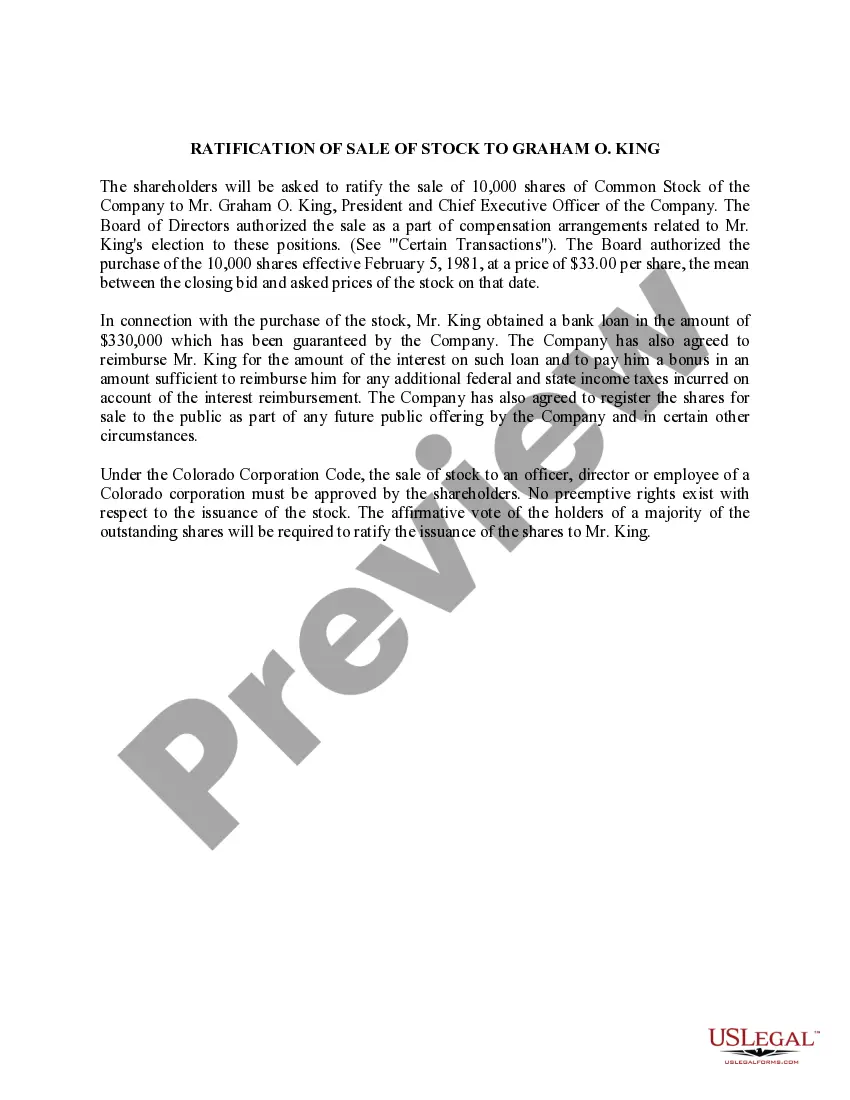
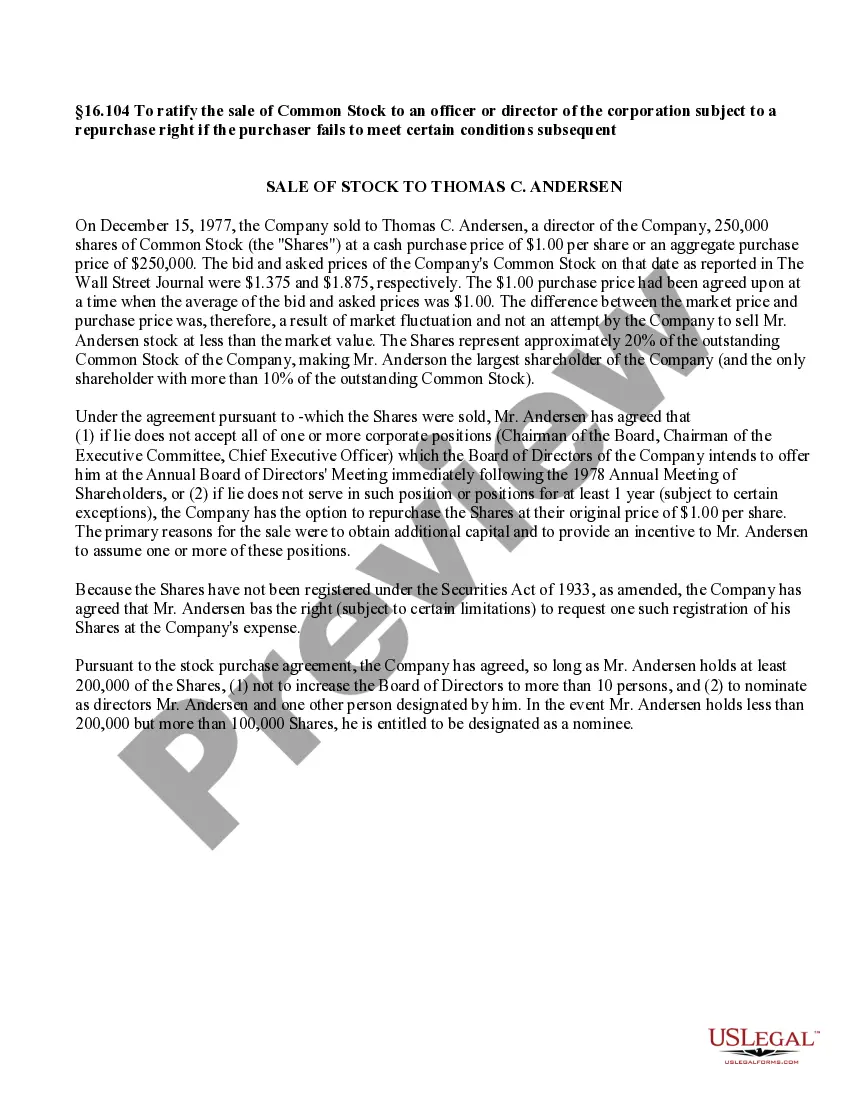
The Ratification of Sale of Stock is a legal document used to formally approve a stock sale that has already taken place without prior authorization. This form is particularly important for companies needing shareholder consent to validate stock transactions involving company officers or stakeholders. It provides a transparent way to document the sale and align it with corporate governance requirements.
Main sections of this form
- Details of the stock sale, including the number of shares and sale price.
- Identification of the buyer, often a company officer or director.
- Board of Directorsâ authorization of the sale.
- Shareholder voting requirements for ratification.
- Terms regarding any loans or reimbursements related to the stock acquisition.
When to use this document
This form is needed when a stock sale has occurred, typically for compensation or incentive purposes, and the company requires formal approval from its shareholders. It is particularly relevant for publicly held companies or corporations with a structured governance framework where such sales must be ratified to comply with the law.
Who should use this form
- Shareholders of a corporation who need to ratify a stock sale.
- Directors and officers involved in the transaction.
- Corporate secretaries or legal advisors managing corporate governance.
Steps to complete this form
- Identify the parties involved in the stock sale, including the seller and buyer.
- Specify the number of shares sold and the sale price per share.
- Outline the terms of the sale, including any loans or reimbursements associated with the transaction.
- Detail the approval process required, including any necessary shareholder votes.
- Ensure that signatures from the appropriate company representatives are obtained.
Does this document require notarization?
This form does not typically require notarization unless specified by local law. Always check with legal counsel to ensure compliance with any specific jurisdictional requirements.
Get your form ready online
Our built-in tools help you complete, sign, share, and store your documents in one place.
Make edits, fill in missing information, and update formatting in US Legal Forms—just like you would in MS Word.
Download a copy, print it, send it by email, or mail it via USPS—whatever works best for your next step.
Sign and collect signatures with our SignNow integration. Send to multiple recipients, set reminders, and more. Go Premium to unlock E-Sign.
If this form requires notarization, complete it online through a secure video call—no need to meet a notary in person or wait for an appointment.
We protect your documents and personal data by following strict security and privacy standards.

Make edits, fill in missing information, and update formatting in US Legal Forms—just like you would in MS Word.

Download a copy, print it, send it by email, or mail it via USPS—whatever works best for your next step.

Sign and collect signatures with our SignNow integration. Send to multiple recipients, set reminders, and more. Go Premium to unlock E-Sign.

If this form requires notarization, complete it online through a secure video call—no need to meet a notary in person or wait for an appointment.

We protect your documents and personal data by following strict security and privacy standards.
Mistakes to watch out for
- Failing to secure shareholder approval before the sale.
- Not detailing the terms of the stock sale adequately.
- Missing signatures from key parties.
- Overlooking specific state regulations regarding stock sales.
Benefits of using this form online
- Convenience of instant access and download from any location.
- Editability to tailor the form to specific transaction details.
- Reliability of forms drafted by licensed attorneys to ensure compliance.
Legal use & context
- The Ratification of Sale of Stock serves to validate unauthorized sales, ensuring legal accountability within corporate operations.
- It helps protect the interests of both the company and its shareholders by providing transparency in stock transactions.
- Understanding the implications of this form can prevent future legal disputes or claims from shareholders.
Summary of main points
- The Ratification of Sale of Stock is essential for validating stock sales made without prior approval.
- Shareholder consent is crucial for legal compliance and corporate governance.
- Properly completing this form can mitigate potential legal disputes between the company and its shareholders.
Looking for another form?

Form popularity
FAQ
Shareholder ratification is "any approval of challenged board ac- tion by a fully informed vote of shareholders, irrespective of. whether that shareholder vote is legally required for the transac- tion to attain legal existence."6 This Comment will focus on self-
: the act or process of ratifying something (such as a treaty or amendment) : formal confirmation or sanction Slavery officially ended in New Jersey in 1804, but in practice some people remained slaves until 1865, when the ratification of the 13th Amendment formally abolished slavery in the United States.
A ratified contract is a term used with real estate transactions. It refers to a contract in which the terms have been agreed upon by all parties but has not yet been fully executed, signed, and delivered. The typical steps in the contract process include the offer, acceptance, consideration, and ratification.
The term "ratification" is used with real estate contracts, but not generally used in business contracts. A "ratified" contract is one where the parties have agreed in writing to all of the offered terms, however it is not binding until it is delivered to the offeror.
To approve and give formal sanction to; confirm. The Senate ratified the treaty. When all the delegates sign a constitution, this is an example of a situation where they ratify the constitution.
A foreclosure sale that results in the property being sold to a third party can not be reversed in bankruptcy as a preference because the third party is almost never a pre-existing creditor of the homeowner. It is very common for the foreclosing lender to make a credit bid for some or all of the debt owed to it.
Foreclosure auctions are usually held at the courthouse in the county where the property is located. After a sale has taken place, it usually takes approximately 30-45 days for the sale to be ratified, however the ratification time can vary significantly from county to county.
(Md. Code Ann., Tax-Prop. § 14-833). These six months are called a "redemption period." (In Baltimore City, the redemption period is nine months from the date of sale for owner-occupied residential properties.
Notice of Intent to Foreclose (NOI) The NOI is a warning notice to the homeowner that a foreclosure action could be filed against them in court. The mortgage company must send the NOI by certified and first-class mail to the homeowner no less than 45 days before a foreclosure action is filed in court.