Form Letters - Notice of Default
What this document covers
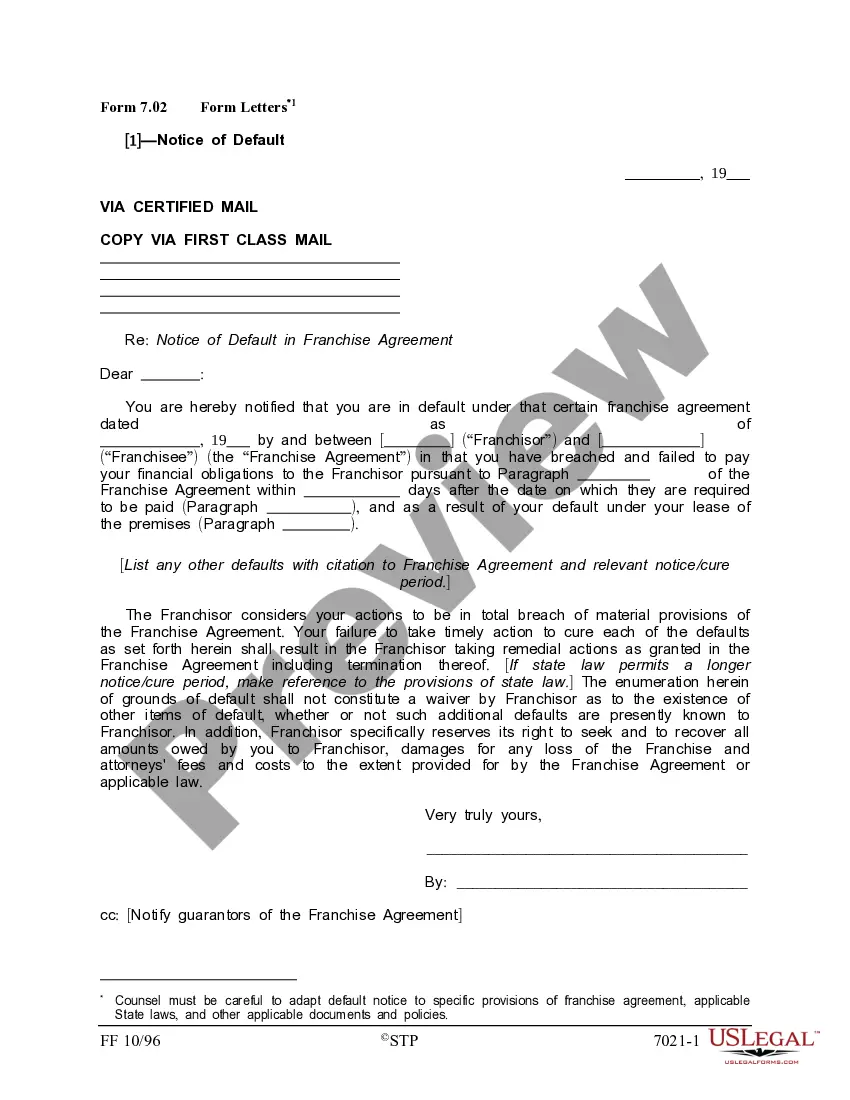
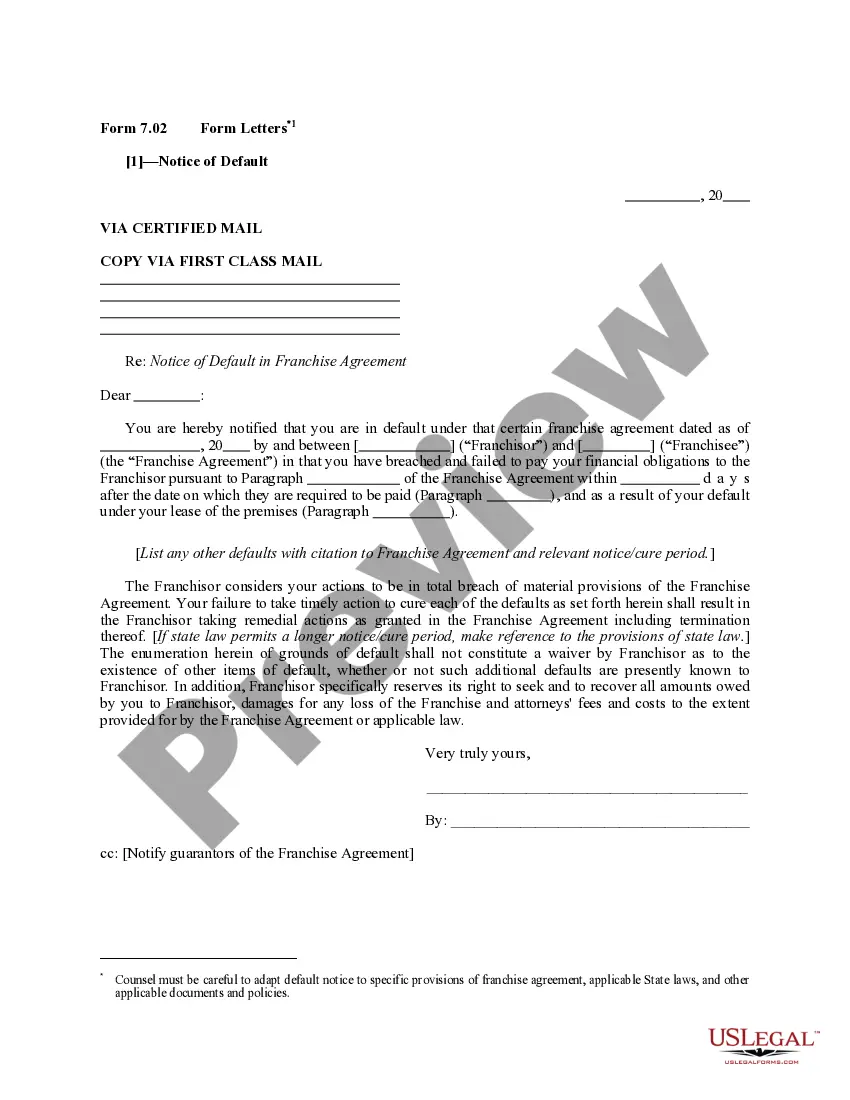
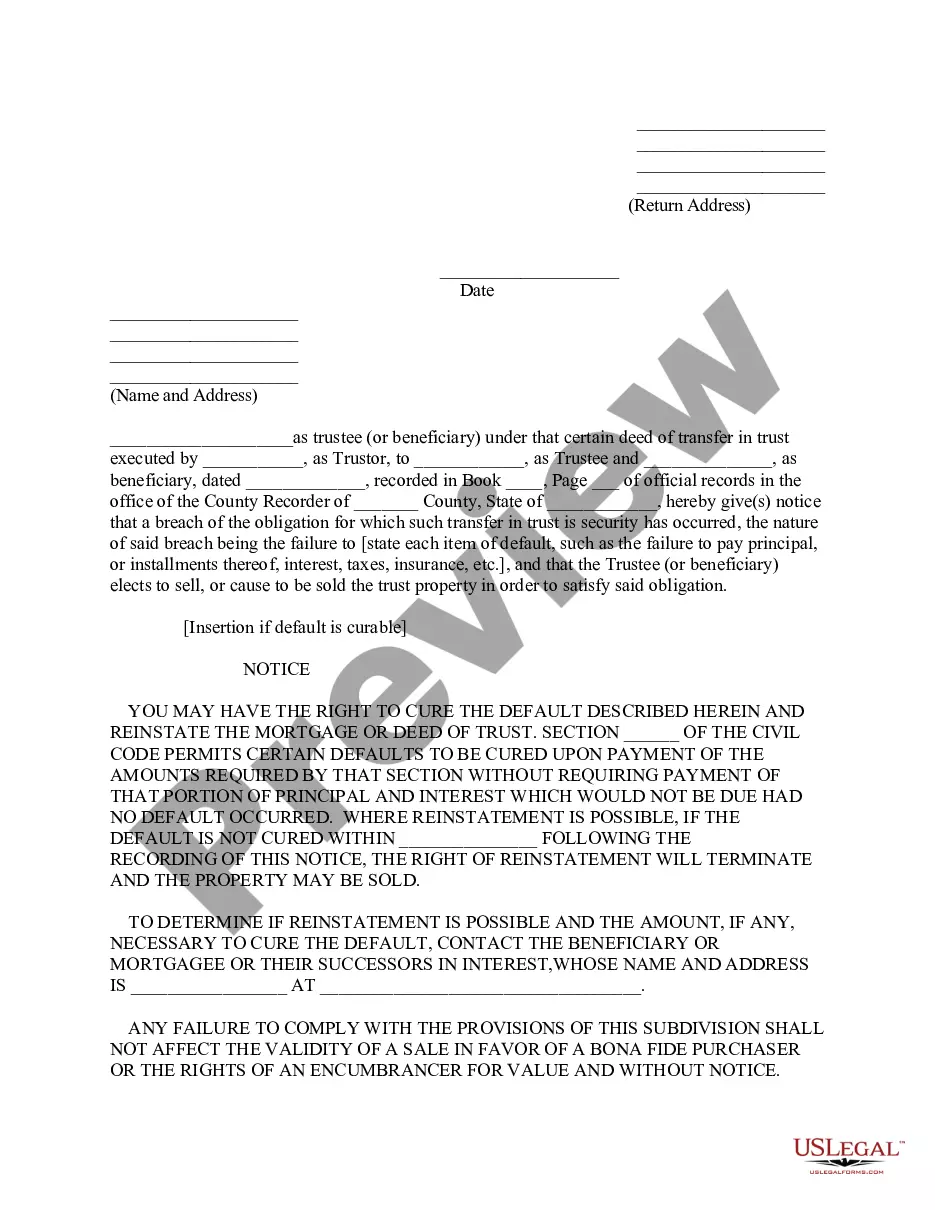
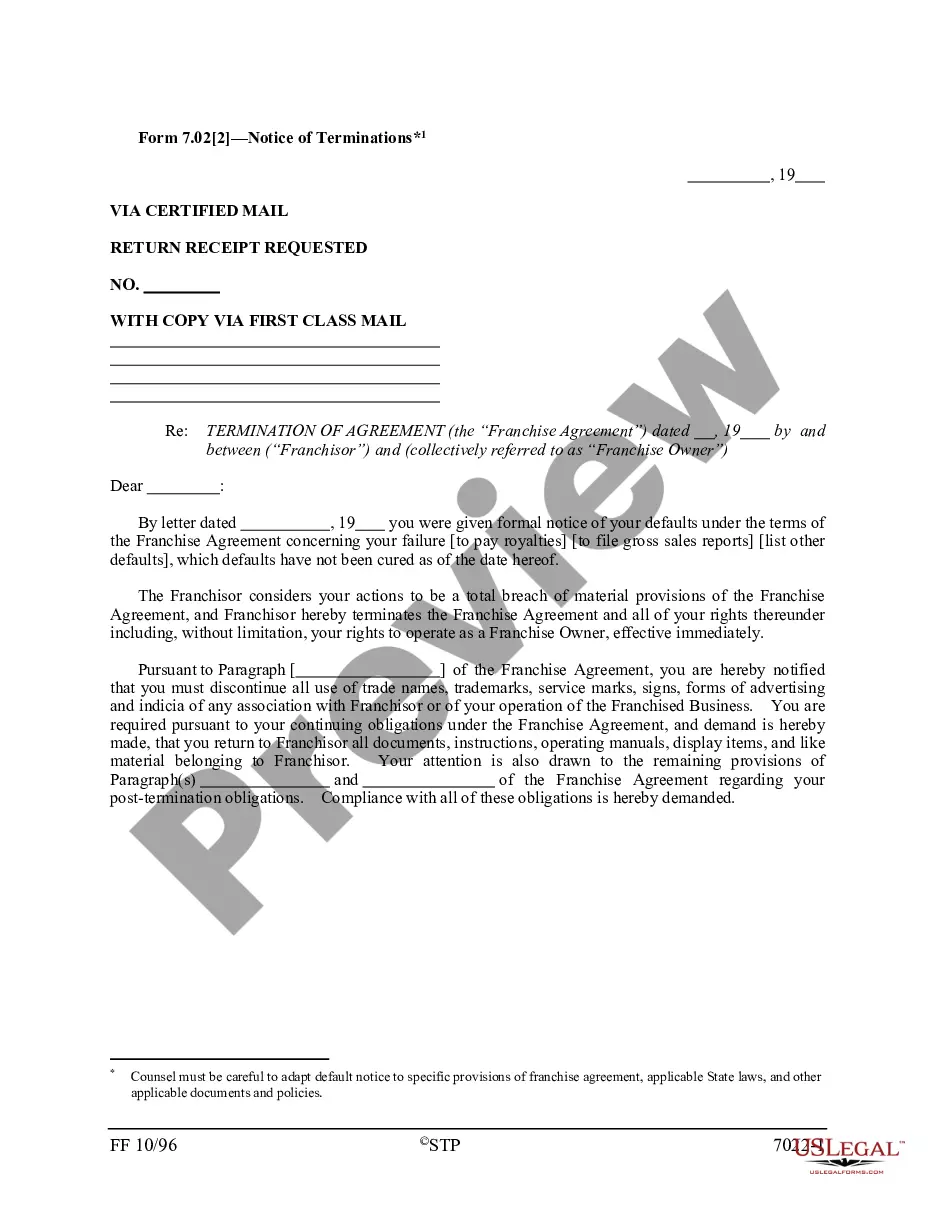
The Notice of Default is a formal letter used by a franchisor to inform a franchisee that they are in breach of their franchise agreement. This letter outlines specific defaults, primarily relating to financial obligations and contractual terms. Unlike other legal notices, the Notice of Default serves as a critical warning, indicating that failure to remedy the stated issues may lead to serious actions such as termination of the franchise agreement.
Main sections of this form
- Date and Address: The date of the letter and both the franchisor's and franchisee's addresses.
- Default Notification: A clear statement identifying the defaults under the franchise agreement.
- Details of Breaches: Specific paragraphs of the agreement that have been breached, including any relevant notice and cure periods.
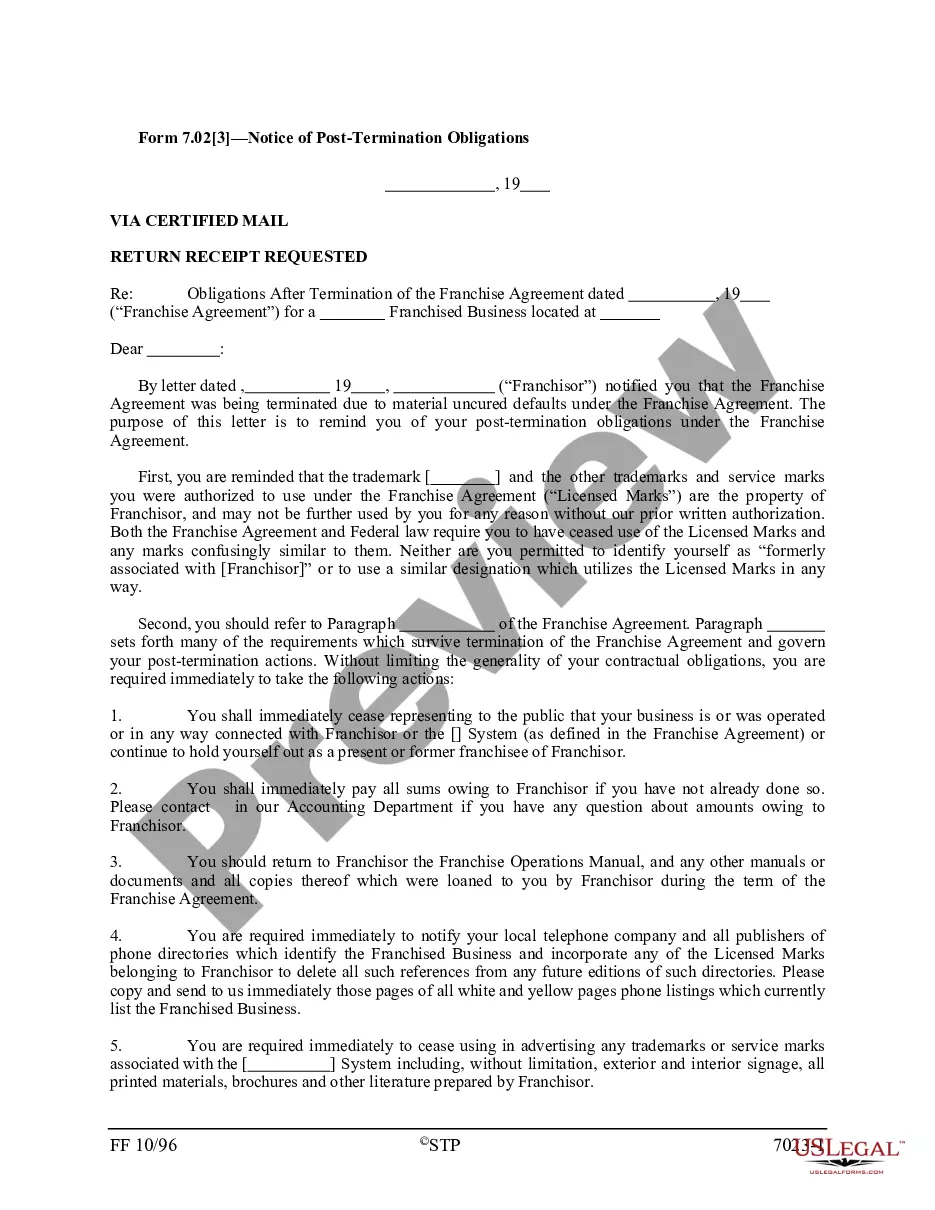
- Consequences of Inaction: A warning that failure to address these defaults may lead to termination of the agreement and other remedial actions.
- Legal Rights Reservation: A clause reserving the franchisor's rights to recover amounts owed and seek damages.
When this form is needed
This form should be used when a franchisor needs to formally notify a franchisee of defaults regarding their franchise agreement, particularly in situations where the franchisee has failed to meet financial obligations or has violated significant terms of the agreement. It is essential to send this notice as part of a legal requirement to provide the franchisee an opportunity to rectify the issues before further actions are taken.
Who needs this form
- Franchisors who need to address breaches in franchise agreements.
- Franchise legal counsel drafting default notices for franchisors.
- Franchisors needing to document communications relating to defaults and remedies.
How to complete this form
- Identify the parties involved, including the full names and addresses of both the franchisor and franchisee.
- Enter the date of the notice and the specific details of the franchise agreement.
- List the defaults by citing the specific sections of the franchise agreement that have been breached.
- Include a clear statement of any required actions the franchisee must take to cure the defaults.
- Sign the letter and include a copy for the franchisee's records, ensuring it is sent via certified mail.
Notarization guidance
This form usually doesn’t need to be notarized. However, local laws or specific transactions may require it. Our online notarization service, powered by Notarize, lets you complete it remotely through a secure video session, available 24/7.
Get your form ready online
Our built-in tools help you complete, sign, share, and store your documents in one place.
Make edits, fill in missing information, and update formatting in US Legal Forms—just like you would in MS Word.
Download a copy, print it, send it by email, or mail it via USPS—whatever works best for your next step.
Sign and collect signatures with our SignNow integration. Send to multiple recipients, set reminders, and more. Go Premium to unlock E-Sign.
If this form requires notarization, complete it online through a secure video call—no need to meet a notary in person or wait for an appointment.
We protect your documents and personal data by following strict security and privacy standards.

Make edits, fill in missing information, and update formatting in US Legal Forms—just like you would in MS Word.

Download a copy, print it, send it by email, or mail it via USPS—whatever works best for your next step.

Sign and collect signatures with our SignNow integration. Send to multiple recipients, set reminders, and more. Go Premium to unlock E-Sign.

If this form requires notarization, complete it online through a secure video call—no need to meet a notary in person or wait for an appointment.

We protect your documents and personal data by following strict security and privacy standards.
Avoid these common issues
- Failing to specify the exact defaults or referencing the wrong sections of the agreement.
- Not providing a clear notice/cure period, which can invalidate the notice.
- Omitting to send the letter through certified mail, impacting proof of delivery.
Advantages of online completion
- Easy access and immediate download for fast use when legal matters arise.
- Editability allows for customization to suit specific situations or agreements.
- Reliable templates ensure compliance with legal standards and requirements.
Looking for another form?


Form popularity
FAQ
A notice of default is the first step to a bank or mortgage lender's foreclosure process.If the mortgage is not paid up to date, the lender will seize the home. A notice of default is also known as a reinstatement period, notice of public auction, or notice of foreclosure.
This is a letter from your creditor warning that your account is about to default because you're behind with your payments. The default notice will give you at least two weeks to catch up with any missed payments. If you can do this your account will carry on as normal.
After the lender files the Notice of Default, you get 90 days to bring your past-due bill current. After the 90 days pass, the lender files a Notice of Sale with the clerk. The Notice of Sale displays the location, date and time of the sale. It lists the trustee's name and contact information.
Write to the agency making the claim. Present evidence of why the NOD was improperly issued or why you legitimately cannot make payments. Ask the agency in the letter if they will take a lower monthly payment, total settlement or a payment plan. Send a copy of your letter by certified mail.
Write to the agency making the claim. Present evidence of why the NOD was improperly issued or why you legitimately cannot make payments. Ask the agency in the letter if they will take a lower monthly payment, total settlement or a payment plan. Send a copy of your letter by certified mail.
What happens when you get a default notice? Your creditor will ask you to pay the full amount of the debt instead of paying the instalments you first agreed.Your creditor can also take further action after the account has defaulted, including: Passing the debt to a collection agency.
The term notice of default refers to a public notice filed with a court that states that the borrower of a mortgage is in default on a loan. The lender may file a notice of default when a mortgagor falls behind on their mortgage payments.
A default notice (sometimes referred to as a default letter or Notice of Default) is a formal letter sent to you by a creditor as a result of payments missed on a credit agreement between yourself and a credit provider.The notice will give you 14 days to pay any amount owed before issuing a default.
When it is very unlikely a default will be removed And although you may hate that default, it may actually be better for you than an Arrangement To Pay (AP) marker on your file! A defaulted record disappears after 6 years, an AP marker stays for 6 years after the debt is settled.