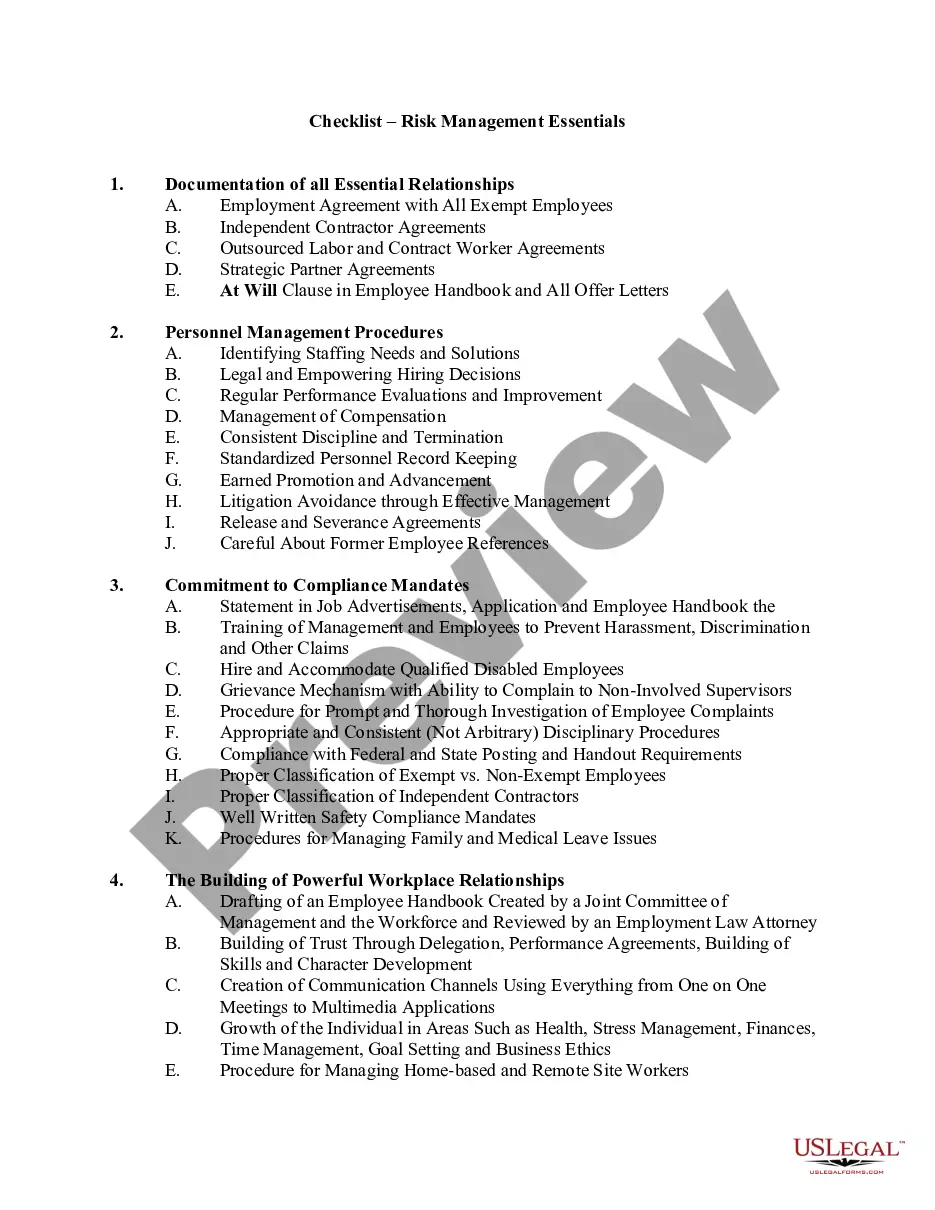
Checklist - Risk Management Essentials
Understanding this form
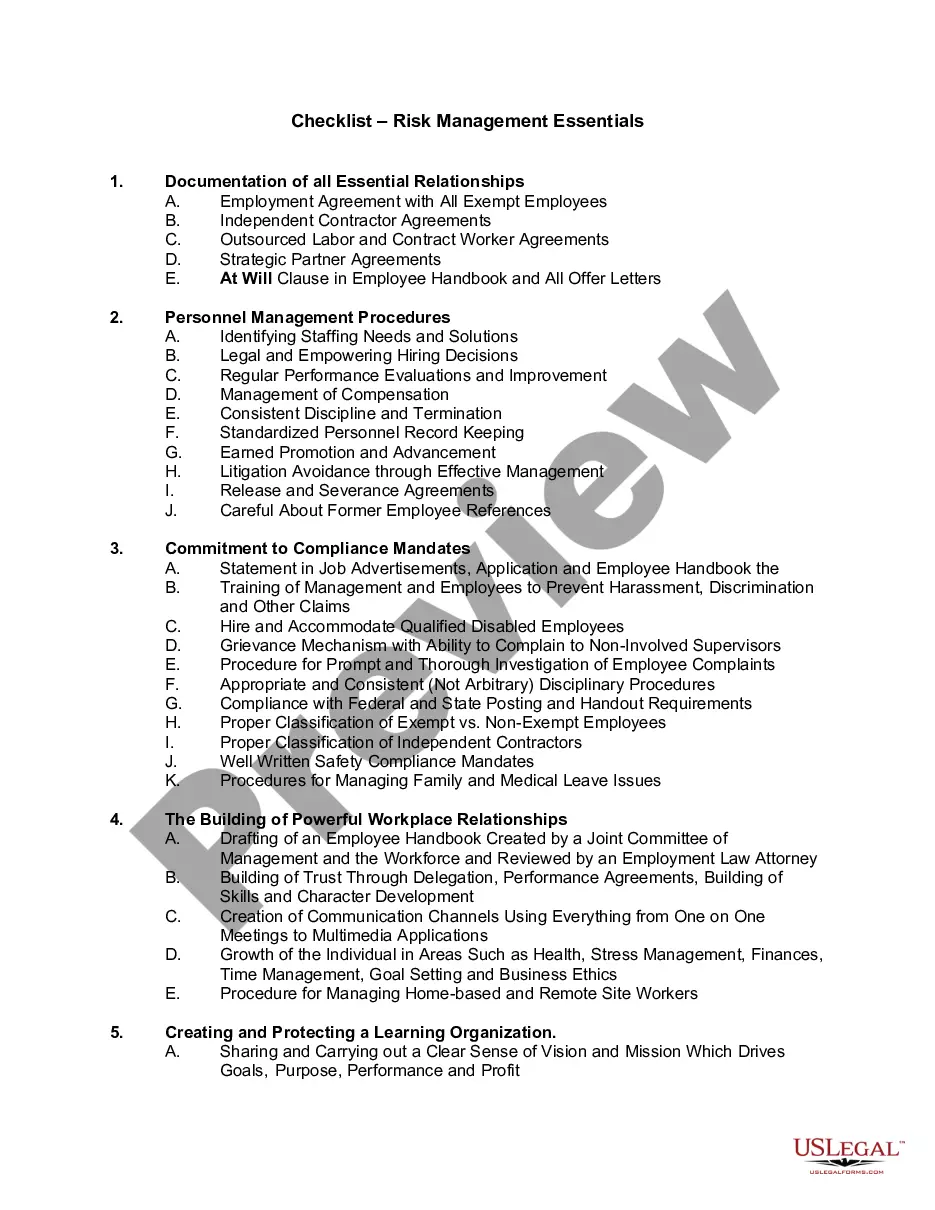
The Checklist - Risk Management Essentials is a strategic tool designed to help organizations and individuals identify and mitigate potential risks. This checklist assists in documenting essential relationships, managing personnel procedures, ensuring compliance with legal requirements, and establishing a culture of engagement and protection within the workplace. Unlike other forms that may focus solely on a single aspect of risk management, this comprehensive checklist covers various elements vital for effective risk management across different domains.
Key parts of this document
- Documentation of essential relationships with employees, contractors, and partners.
- Personnel management procedures including hiring, performance evaluations, and termination protocols.
- Compliance mandates ensuring adherence to legal regulations and workplace policies.
- Strategies for building strong workplace relationships and fostering communication.
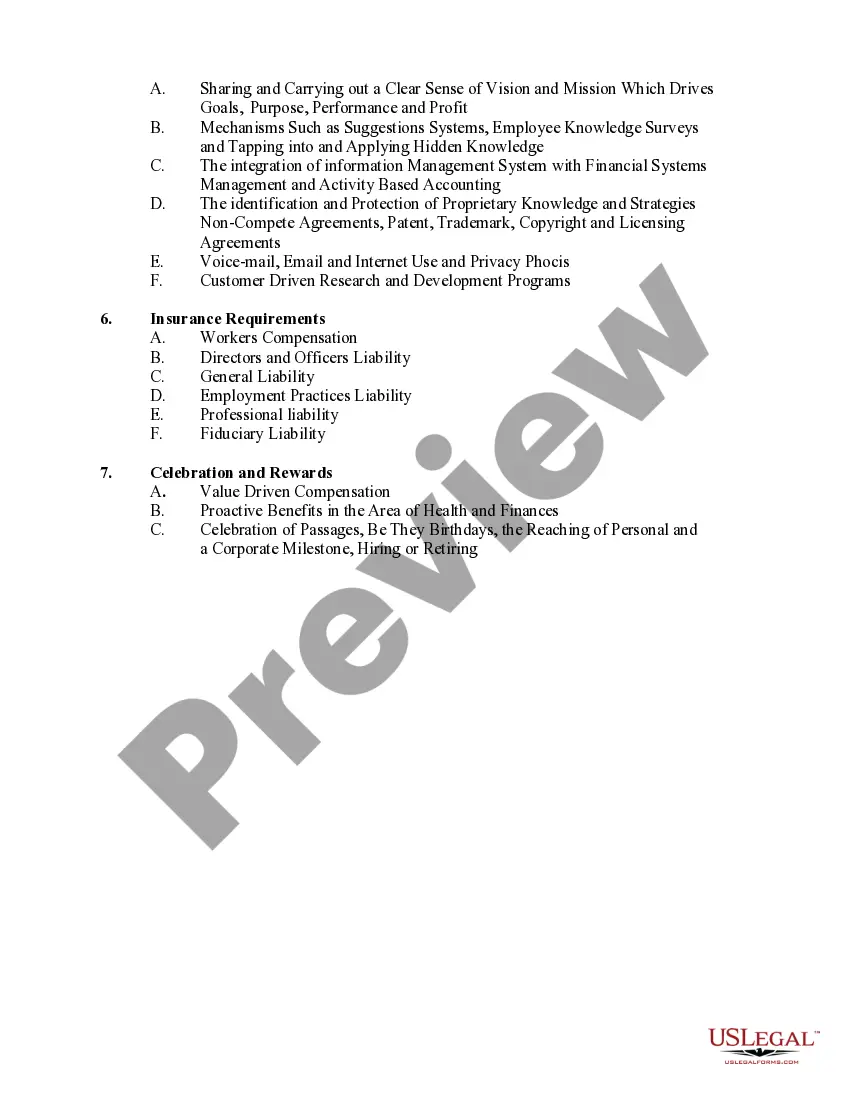
- Measures for creating and protecting a learning organization and proprietary knowledge.
- Insurance requirements including various liabilities like workers' compensation.
- Celebration and rewards strategies to enhance employee morale and recognition.
Situations where this form applies
This checklist is essential when establishing or reviewing an organization's risk management framework. It is particularly useful during the following scenarios: - When starting a new business or venture. - During employee onboarding and training sessions. - Prior to initiating partnership agreements or hiring staff. - As part of regular audits of existing procedures to ensure compliance and effectiveness. - In preparation for external audits or inspections related to workplace safety or employment practices.
Who should use this form
- Business owners looking to set up effective risk management strategies.
- Human resources professionals responsible for employee management and legal compliance.
- Managers involved in hiring, training, and employee relations.
- Compliance officers ensuring adherence to workplace regulations.
- Anyone involved in drafting contracts or agreements with staff or partners.
How to prepare this document
- Identify and document essential relationships, including employment and contractor agreements.
- Outline personnel management procedures, ensuring clarity in hiring, evaluations, and terminations.
- Establish compliance mandates and ensure proper training procedures are in place.
- Implement strategies for communication and relationship building within the workplace.
- Review and specify insurance requirements to cover various liabilities adequately.
Does this form need to be notarized?
This form does not typically require notarization to be legally valid. However, some jurisdictions or document types may still require it. US Legal Forms provides secure online notarization powered by Notarize, available 24/7 for added convenience.
Get your form ready online
Our built-in tools help you complete, sign, share, and store your documents in one place.
Make edits, fill in missing information, and update formatting in US Legal Forms—just like you would in MS Word.
Download a copy, print it, send it by email, or mail it via USPS—whatever works best for your next step.
Sign and collect signatures with our SignNow integration. Send to multiple recipients, set reminders, and more. Go Premium to unlock E-Sign.
If this form requires notarization, complete it online through a secure video call—no need to meet a notary in person or wait for an appointment.
We protect your documents and personal data by following strict security and privacy standards.

Make edits, fill in missing information, and update formatting in US Legal Forms—just like you would in MS Word.

Download a copy, print it, send it by email, or mail it via USPS—whatever works best for your next step.

Sign and collect signatures with our SignNow integration. Send to multiple recipients, set reminders, and more. Go Premium to unlock E-Sign.

If this form requires notarization, complete it online through a secure video call—no need to meet a notary in person or wait for an appointment.

We protect your documents and personal data by following strict security and privacy standards.
Common mistakes
- Failing to document all essential relationships accurately.
- Neglecting to update the checklist in response to legal changes.
- Overlooking important training procedures for compliance.
- Not involving relevant stakeholders in drafting and reviewing the checklist.
- Ignoring the ongoing monitoring and assessment of risk management procedures.
Benefits of using this form online
- Easy access to downloadable templates drafted by licensed attorneys.
- Editable format allows for customization to fit specific needs and legal requirements.
- Time-efficient, enabling quick completion and implementation of risk management strategies.
- Legal assurance that templates align with current laws and regulations.
- Convenient storage and retrieval of essential documents.
Looking for another form?


Form popularity
FAQ
Here are the basic steps you should take to create a risk register: Identify risks.Describe risks.Estimate the likelihood and impact of risks.Create a risk response plan.Prioritize risks.Assign risk owners.
There are five core steps within the risk identification and management process. These steps include risk identification, risk analysis, risk evaluation, risk treatment, and risk monitoring.
There are several ways to categorize an effective risk management process's constituent elements, but at the very least it should incorporate the following risk management components. Risk Identification.Risk Analysis.Response Planning.Risk Mitigation.Risk Monitoring.
Introduction; Implications of the 10Ps for business; 10Ps - Planning; Product; Process; Premises; Purchasing/Procurement; People; Procedures; Prevention and Protection; Policy; Performance; Interaction between all the elements; Conclusion.
With a checklist, you can be sure you have considered risk from every direction and have all the information to allow your company to ultimately develop a risk management plan. Compiling a risk assessment checklist is the first step to assessing risk.
What is it? Risk checklists are a historic list of risks identified or realized on past projects. Risk checklists are meant to be shared between Estimators and discipline groups on all projects.
A checklist is only a first step in carrying out a risk assessment. Further information may be needed to assess more complex risks and in some circumstances you may need an expert's help. For practical and analytical reasons, a checklist presents problems/hazards separately, but in workplaces they may be intertwined.
Ensure risks are identified early.Factor in organisational goals and objectives.Manage risk within context.Involve stakeholders.Ensure responsibilities and roles are clear.Create a cycle of risk review.Strive for continuous improvement.