FCRA Certification Letter to Consumer Reporting Agency
What this document covers
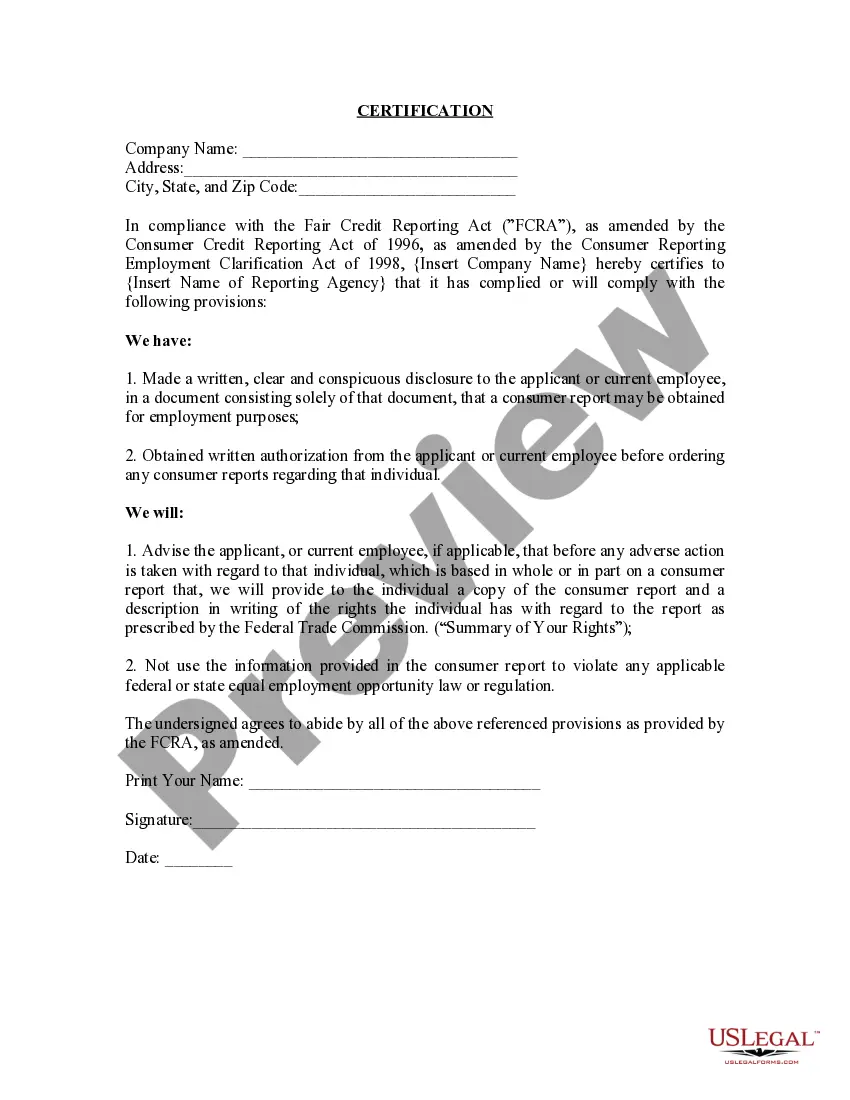
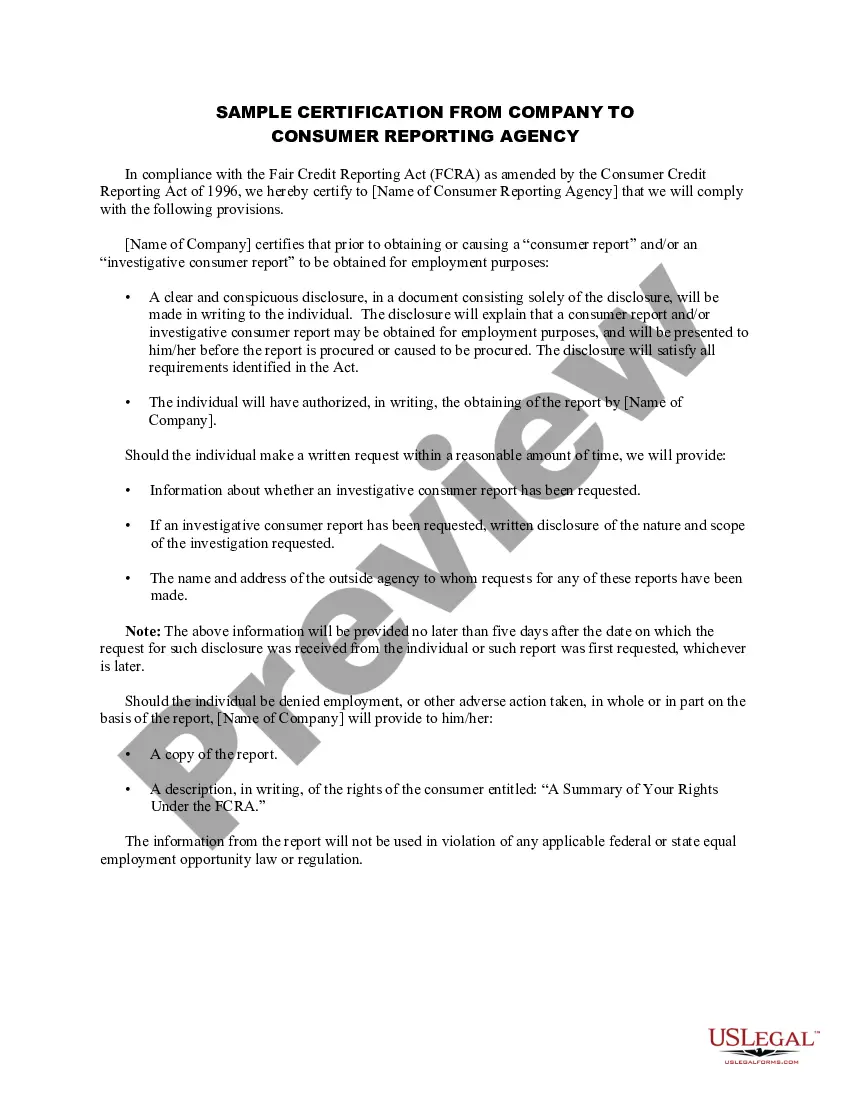
The FCRA Certification Letter to Consumer Reporting Agency is a formal declaration by a company confirming compliance with the Fair Credit Reporting Act (FCRA). This form serves to certify that the company has adhered to specific provisions when obtaining and using consumer reports, particularly for employment purposes. It is distinct from other legal documents as it focuses on the employer's responsibilities under federal law regarding employee rights related to credit information.
What’s included in this form
- Company name and address fields for identification.
- Certification statement confirming compliance with FCRA provisions.
- Disclosure requirements detailing obligations to inform the consumer about obtaining a report.
- Consent section for written authorization from the applicant or current employee.
- Information about rights related to the consumer report, including the right to receive a copy.
- Signature and date lines for the certifying individual.
When this form is needed
This form is needed when a company intends to obtain a consumer report for employment purposes, such as background checks or credit evaluations. It is used to ensure that the company is following legal requirements under the FCRA, thereby protecting the rights of the individuals whose reports are being obtained.
Who can use this document
- Employers seeking to conduct background checks on potential or current employees.
- Human resources professionals responsible for compliance with hiring practices.
- Legal departments ensuring adherence to federal laws governing consumer reporting.
- Companies involved in industries where background checks are a standard part of employment procedures.
How to prepare this document
- Enter the company name and address in the designated fields.
- Insert the name of the reporting agency in the certification statement.
- Review and confirm compliance with the FCRA provisions listed in the form.
- Sign and date the form to validate the certification.
- Provide a copy of this certification letter to the consumer as required.
Notarization guidance
This form does not typically require notarization unless specified by local law. It is essential to verify if specific state regulations necessitate notarization for legal validity.
Get your form ready online
Our built-in tools help you complete, sign, share, and store your documents in one place.
Make edits, fill in missing information, and update formatting in US Legal Forms—just like you would in MS Word.
Download a copy, print it, send it by email, or mail it via USPS—whatever works best for your next step.
Sign and collect signatures with our SignNow integration. Send to multiple recipients, set reminders, and more. Go Premium to unlock E-Sign.
If this form requires notarization, complete it online through a secure video call—no need to meet a notary in person or wait for an appointment.
We protect your documents and personal data by following strict security and privacy standards.

Make edits, fill in missing information, and update formatting in US Legal Forms—just like you would in MS Word.

Download a copy, print it, send it by email, or mail it via USPS—whatever works best for your next step.

Sign and collect signatures with our SignNow integration. Send to multiple recipients, set reminders, and more. Go Premium to unlock E-Sign.

If this form requires notarization, complete it online through a secure video call—no need to meet a notary in person or wait for an appointment.

We protect your documents and personal data by following strict security and privacy standards.
Common mistakes to avoid
- Failing to provide the required disclosure to the applicant or employee.
- Not obtaining written authorization before requesting consumer reports.
- Neglecting to inform the individual of their rights regarding the consumer report.
- Incorrectly filling out company information, which could lead to non-compliance.
- Omitting the date and signature, rendering the certification invalid.
Why complete this form online
- Convenient access to the form for immediate use.
- Editability allows customization based on specific company needs.
- Reliability of templates drafted by licensed attorneys, ensuring legal compliance.
- Quick download saves time compared to traditional methods of obtaining legal forms.
Legal use & context
- This certification letter is used as evidence of compliance with the FCRA.
- It supports transparency and protects employee rights prior to any employment-related decisions based on consumer reports.
- The letter can also serve as a critical document during audits or legal inquiries regarding employment practices.
Key takeaways
- This form certifies a companyâs compliance with FCRA regarding consumer reports for employment.
- It is crucial for employers to understand the legal implications of not using this form.
- Ensure accurate completion to avoid common pitfalls related to disclosure and authorization.
Looking for another form?



Form popularity
FAQ
(f) The term "consumer reporting agency" means any person which, for monetary fees, dues, or on a cooperative nonprofit basis, regularly engages in whole or in part in the practice of assembling or evaluating consumer credit information or other information on consumers for the purpose of furnishing consumer reports to
What is an adverse action letter? With respect to background checks, an adverse action letter is a written notice required by federal law, delivered in hard copy or electronic form, that informs a job candidate he or she will not be hired for a particular position because of the findings in a background check.
The Fair Credit Reporting Act (FCRA) is a federal law that helps to ensure the accuracy, fairness and privacy of the information in consumer credit bureau files. The law regulates the way credit reporting agencies can collect, access, use and share the data they collect in your consumer reports.
If the employer does not give you enough time to review the report and correct any errorsfor example, if the employer gives you the Pre-Adverse Action letter and then rejects your job application on the same dayyou may have a legal claim against the employer for violating your right to receive notice before the
The FCRA requires that employers take certain steps with respect to negative information obtained through a commercially produced background investigation.The letter will include a copy of the report and a summary of the candidate's rights under FCRA (2nd issuance if done at time of CBC consent).
Adverse action notices under the ECOA and Regulation B are designed to help consumers and businesses by providing transparency to the credit underwriting process and protecting against potential credit discrimination by requiring creditors to explain the reasons adverse action was taken.
Employment background checks also are known as consumer reports. They can include information from a variety of sources, including credit reports and criminal records.