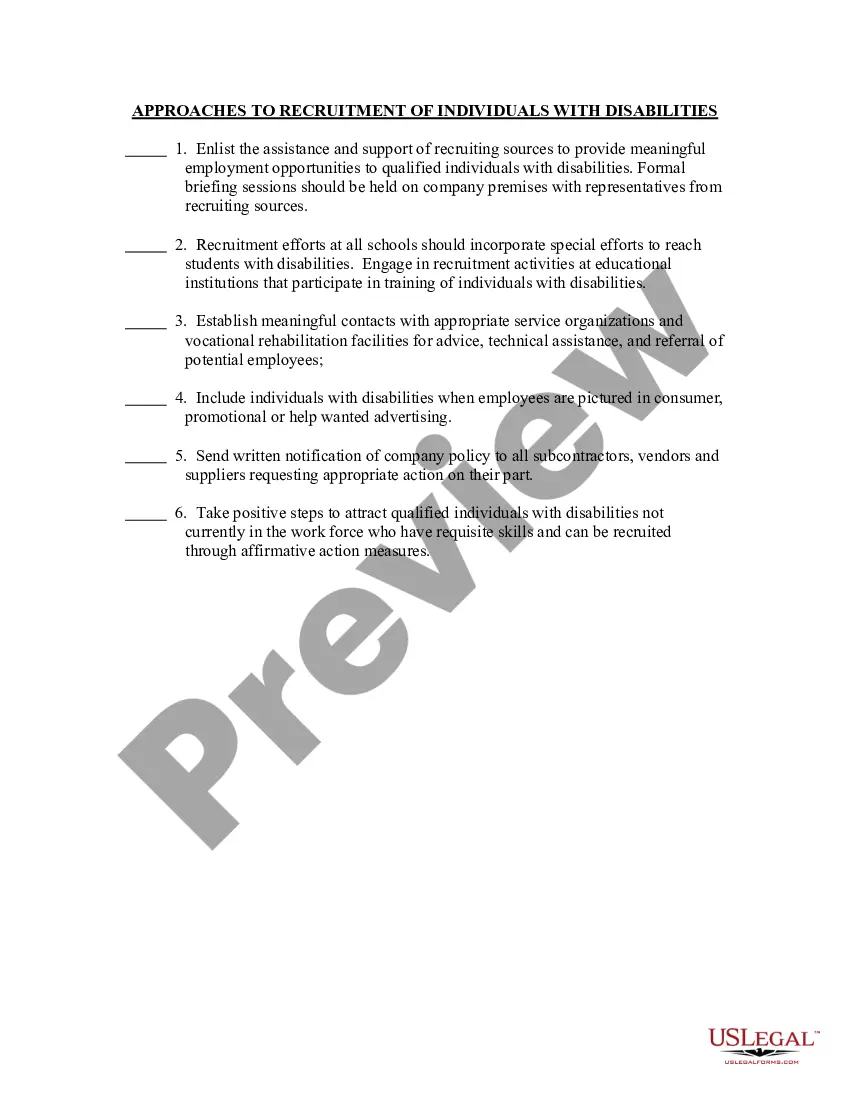
Approaches to Recruitment of Individuals with Disabilities
Overview of this form
The Approaches to Recruitment of Individuals with Disabilities form is designed to guide management in effectively recruiting individuals with disabilities. This form not only assists in creating a structured recruitment process but also emphasizes inclusivity in hiring, setting it apart from general recruitment forms.
What’s included in this form
- Introduction: Provides context and purpose for the recruitment strategy.
- Recruitment policies: Outlines specific policies aimed at attracting individuals with disabilities.
- Assessment criteria: Sets forth the criteria for evaluating candidates to ensure fairness.
- Implementation steps: Details actionable steps to implement the recruitment strategies.
- Feedback mechanism: Includes methods for gathering feedback from applicants and employees.
Common use cases
This form should be used by management and human resources when developing or revising recruitment strategies aimed at individuals with disabilities. It is particularly useful when an organization seeks to enhance diversity and inclusivity within its workforce.
Who should use this form
- Human resources professionals involved in recruitment.
- Management personnel aiming to improve diversity initiatives.
- Organizations committed to inclusive hiring practices.
How to prepare this document
- Identify key components of your recruitment strategy.
- Outline policies that support inclusion of individuals with disabilities.
- Establish assessment criteria that ensure fairness and equality.
- Document the implementation steps required for effective execution.
- Set up a feedback mechanism for continuous improvement.
Does this document require notarization?
In most cases, this form does not require notarization. However, some jurisdictions or signing circumstances might. US Legal Forms offers online notarization powered by Notarize, accessible 24/7 for a quick, remote process.
Get your form ready online
Our built-in tools help you complete, sign, share, and store your documents in one place.
Make edits, fill in missing information, and update formatting in US Legal Forms—just like you would in MS Word.
Download a copy, print it, send it by email, or mail it via USPS—whatever works best for your next step.
Sign and collect signatures with our SignNow integration. Send to multiple recipients, set reminders, and more. Go Premium to unlock E-Sign.
If this form requires notarization, complete it online through a secure video call—no need to meet a notary in person or wait for an appointment.
We protect your documents and personal data by following strict security and privacy standards.

Make edits, fill in missing information, and update formatting in US Legal Forms—just like you would in MS Word.

Download a copy, print it, send it by email, or mail it via USPS—whatever works best for your next step.

Sign and collect signatures with our SignNow integration. Send to multiple recipients, set reminders, and more. Go Premium to unlock E-Sign.

If this form requires notarization, complete it online through a secure video call—no need to meet a notary in person or wait for an appointment.

We protect your documents and personal data by following strict security and privacy standards.
Mistakes to watch out for
- Failing to align recruitment policies with legal requirements.
- Neglecting to involve individuals with disabilities in the feedback process.
- Using vague language in the assessment criteria.
Why complete this form online
- Convenient access and instant downloads.
- Edit and customize as needed to fit your organization's requirements.
- Reliable templates created by licensed attorneys, ensuring legal compliance.
Legal use & context
- Helps to ensure compliance with the Americans with Disabilities Act (ADA).
- Supports organizations in establishing fair hiring practices that promote diversity.
- Can be used as a part of broader diversity initiatives within companies.
Summary of main points
- The form aids in creating inclusive recruitment strategies for individuals with disabilities.
- Use it to stay compliant with legal obligations regarding non-discrimination in hiring.
- Effective recruitment of individuals with disabilities benefits both the organization and the community.
Looking for another form?







Form popularity
FAQ
Interview questions You can only ask questions about how an applicant's disability might relate to doing the job. You can ask how the workplace could be changed to help the applicant do the job. You can ask about how work hours or rosters could be changed to help the applicant be more productive.
Assisting a New Employee by Adjusting Their Computer. Accommodating a New Hire by Selecting the Right Furniture. Make the Work Area Inclusive for All Workers.
Emphasize the individual not the disability. Rather than using terms such as disabled person, handicapped people, a crippled person, use terms such as people/persons with disabilities, a person with a disability, or a person with a visual impairment.
Strategic recruiting is an approach to winning the best talent based on three components: employer branding, recruitment-directed marketing, and skilled selling. Combined, these components create effective responses to dynamic market conditions in support of an organization's strategic objectives.
Treat candidates like customers. Use social media. Implement an employee referral program. Create compelling job descriptions. Make use of sponsored jobs to stand out. Check resumes posted online. Consider past candidates. Claim your Company Page.
A recruitment strategy is a clear plan that explains what roles you'll recruit for, when, why and how. It should be tied to your overall company objectives. Your strategy must be possible to implement and easy to communicate. While you can tweak your tactics, the strategy must always be clear.
LinkedIn, Facebook and Twitter are increasingly being used to find candidates, and if used with care can be effective. Offer support for example, in filling in application forms, and making it easy to ask for reasonable adjustments throughout the recruitment process without fear of discrimination.
Develop a Clear Employer Brand. Create Job Posts That Reflect Your Company. Use Social Media. Invest in an Applicant Tracking System. Explore Niche Job Boards. Consider College Recruiting. Find Passive Candidates and Let Them Know You Want Them. Conduct Awesome Interviews.
Approach the person as you would anyone else; speak directly to the person, using clear, simple communication. Treat persons who are adults as adults. Do not patronize, condescend, or threaten when communicating with the person. Do not make decisions for the person or assume that you know the person's preferences.