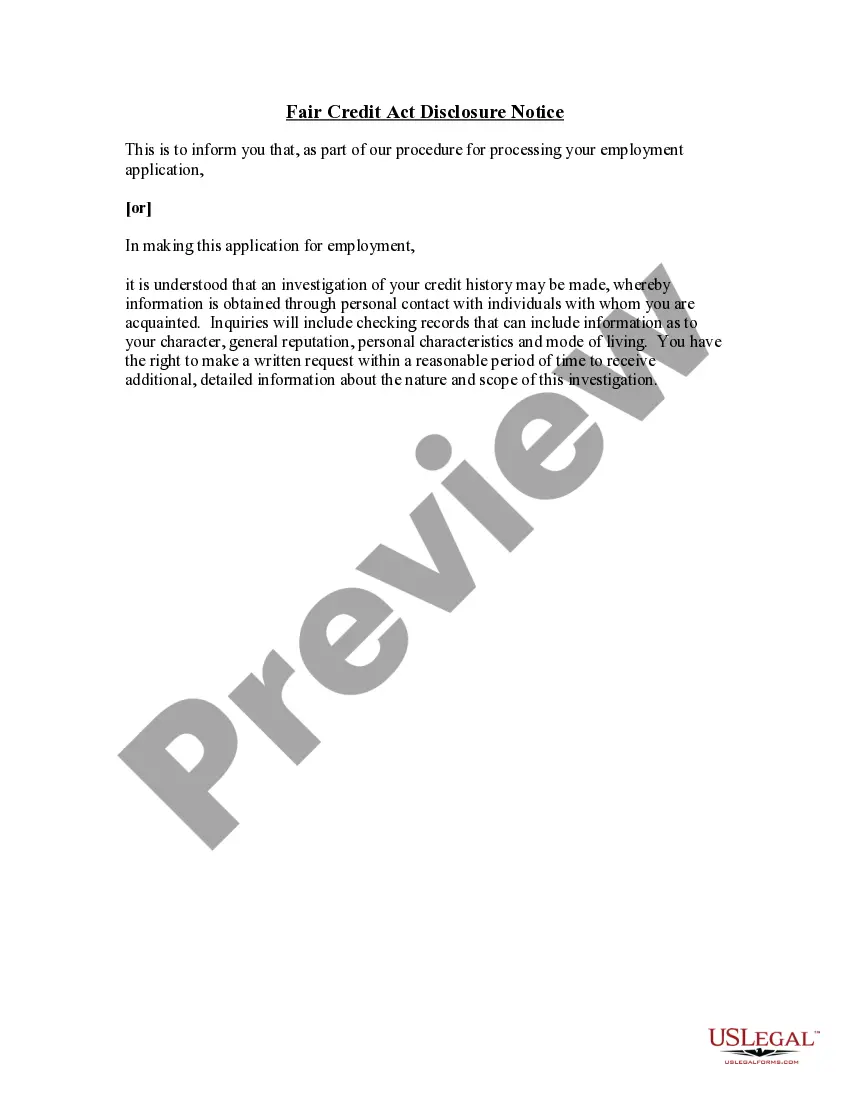
Fair Credit Act Disclosure Notice
Understanding this form
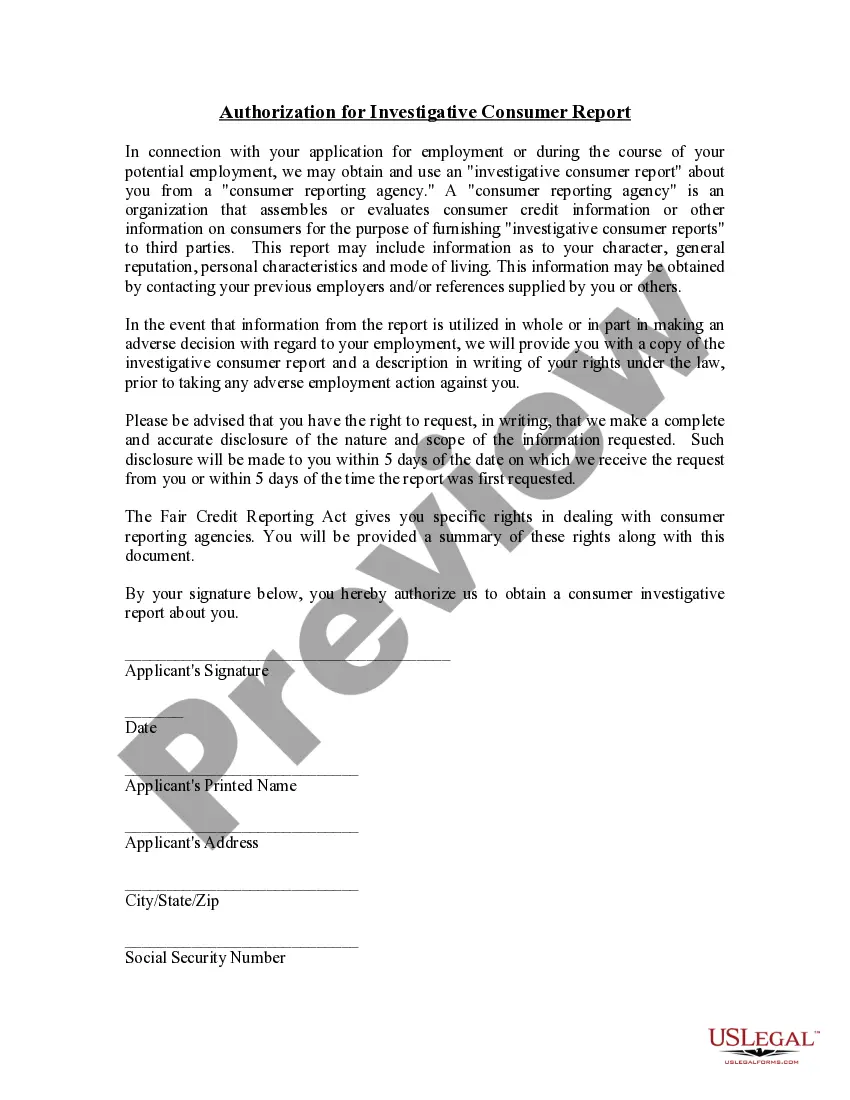
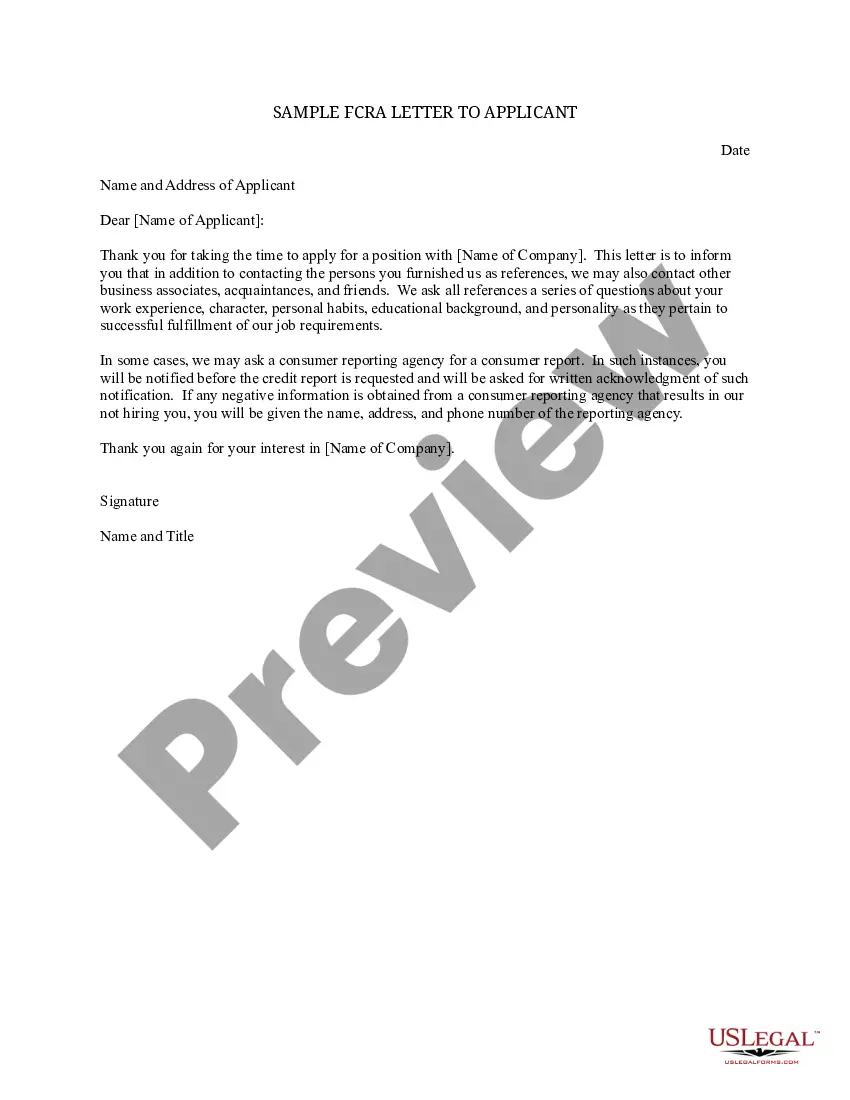
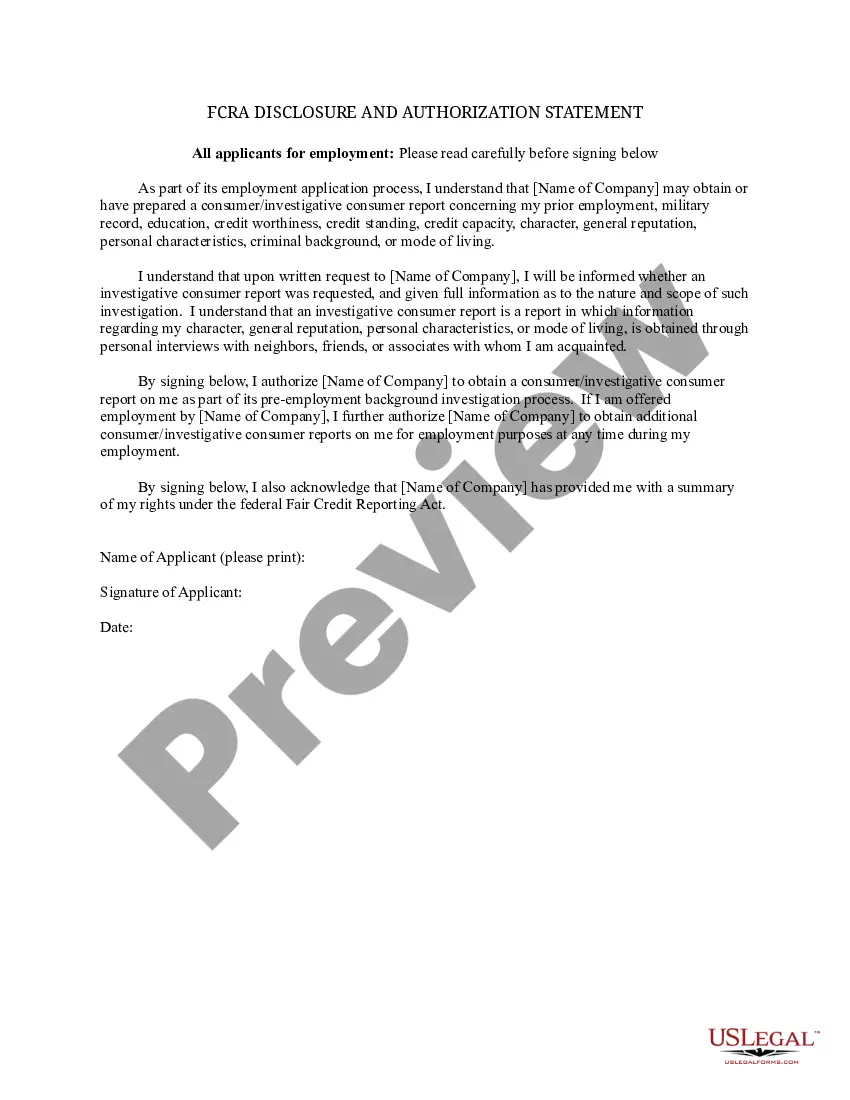
The Fair Credit Act Disclosure Notice is a legal document that informs potential employees that their credit history may be reviewed as part of the employment application process. Unlike other employment forms, this notice specifically addresses the investigation of an applicant's credit history and their rights regarding that inquiry. It serves to ensure transparency and gives applicants the opportunity to understand what information may be collected during the hiring process.
Key parts of this document
- Notification of possible credit history investigation.
- Explanation of how personal contacts may be used to gather information.
- Details on the types of information that may be collected, including character and reputation.
- Statement of the applicant's right to request additional information about the investigation.
When this form is needed
This form should be used by employers when they wish to inform potential employees that a credit history report may be obtained during the hiring process. It is especially important for positions that involve financial responsibilities, security, or trust. Using this notice helps ensure compliance with legal requirements and promotes transparency with applicants.
Who needs this form
- Employers who conduct credit checks as part of their hiring process.
- Human resources professionals seeking to inform applicants about credit evaluations.
- Companies requiring credit history assessments for specific job roles.
Completing this form step by step
- Identify the company and position for which the applicant is applying.
- Clearly state that a credit history investigation may be conducted.
- Include a summary of the types of information that will be gathered.
- Inform the applicant of their right to request detailed information about the investigation.
- Have the applicant sign and date the notice to acknowledge receipt.
Notarization guidance
This form does not typically require notarization to be legally valid. However, some jurisdictions or document types may still require it. US Legal Forms provides secure online notarization powered by Notarize, available 24/7 for added convenience.
Get your form ready online
Our built-in tools help you complete, sign, share, and store your documents in one place.
Make edits, fill in missing information, and update formatting in US Legal Forms—just like you would in MS Word.
Download a copy, print it, send it by email, or mail it via USPS—whatever works best for your next step.
Sign and collect signatures with our SignNow integration. Send to multiple recipients, set reminders, and more. Go Premium to unlock E-Sign.
If this form requires notarization, complete it online through a secure video call—no need to meet a notary in person or wait for an appointment.
We protect your documents and personal data by following strict security and privacy standards.

Make edits, fill in missing information, and update formatting in US Legal Forms—just like you would in MS Word.

Download a copy, print it, send it by email, or mail it via USPS—whatever works best for your next step.

Sign and collect signatures with our SignNow integration. Send to multiple recipients, set reminders, and more. Go Premium to unlock E-Sign.

If this form requires notarization, complete it online through a secure video call—no need to meet a notary in person or wait for an appointment.

We protect your documents and personal data by following strict security and privacy standards.
Common mistakes to avoid
- Failing to provide the notice prior to conducting a credit check.
- Not including all relevant details about the information to be collected.
- Neglecting to inform the applicant of their rights concerning the investigation.
Advantages of online completion
- Easy access to professionally drafted templates.
- Convenient download options that allow for quick editing.
- Reliable legal language that helps ensure compliance with regulations.
Legal use & context
- The Fair Credit Act Disclosure Notice ensures compliance with federal regulations.
- This notice protects the rights of job applicants and provides transparency in hiring practices.
Summary of main points
- The form is essential in the hiring process when credit checks are implemented.
- It informs applicants of their rights under the Fair Credit Reporting Act.
- Compliance with the form contributes to fair hiring practices.
Looking for another form?






Form popularity
FAQ
Criminal background checks will reveal felony and misdemeanor criminal convictions, any pending criminal cases, and any history of incarceration as an adult.Disclosure of convictions more than seven years old is forbidden in California, Kansas, Massachusetts, Maryland, Montana, New Hampshire, New York and Washington.
The federal Fair Credit Reporting Act (FCRA) promotes the accuracy, fairness, and privacy of information in the files of. consumer reporting agencies.
Under this new rule, lenders must provide consumers with a Risk-Based Pricing notice when a company grants credit on material terms that are materially less favorable than the most favorable terms available to a substantial proportion of the consumers. Lenders include banks, credit unions, mortgage lenders, auto
Common violations of the FCRA include: Creditors give reporting agencies inaccurate financial information about you. Reporting agencies mixing up one person's information with another's because of similar (or same) last name or social security number. Agencies fail to follow guidelines for handling disputes.
FCRA compliance is designed to protect consumers.The FCRA applies anytime an employer obtains a background check for employment purposes from a third party. These reports could include criminal history, employment and education verifications, motor vehicle reports, health care sanctions and professional licenses.
Access to Your Credit Report The act requires credit reporting agencies to provide you with any information in your credit file upon request once a year. You must have proper identification. You have a right to a free copy of your credit report within 15 days of your request.
A statement of action taken by the creditor. Either a statement of the specific reasons for the action taken or a disclosure of the applicant's right to a statement of specific reasons and the name, address, and telephone number of the person or office from which this information can be obtained.
A creditor must disclose a consumer's credit score and information relating to a credit score on a risk-based pricing notice when the score of the consumer to whom the creditor extends credit or whose extension of credit is under review is used in setting the material terms of credit.
The statement that a dispute meets the requirements of the FCRA means both that the consumer filed a formal dispute, and that the CRA has issued a formal Notice of Results of Reinvestigation finding the asserted inaccuracy has been verified as accurate.