Client Bill of Rights
What this document covers
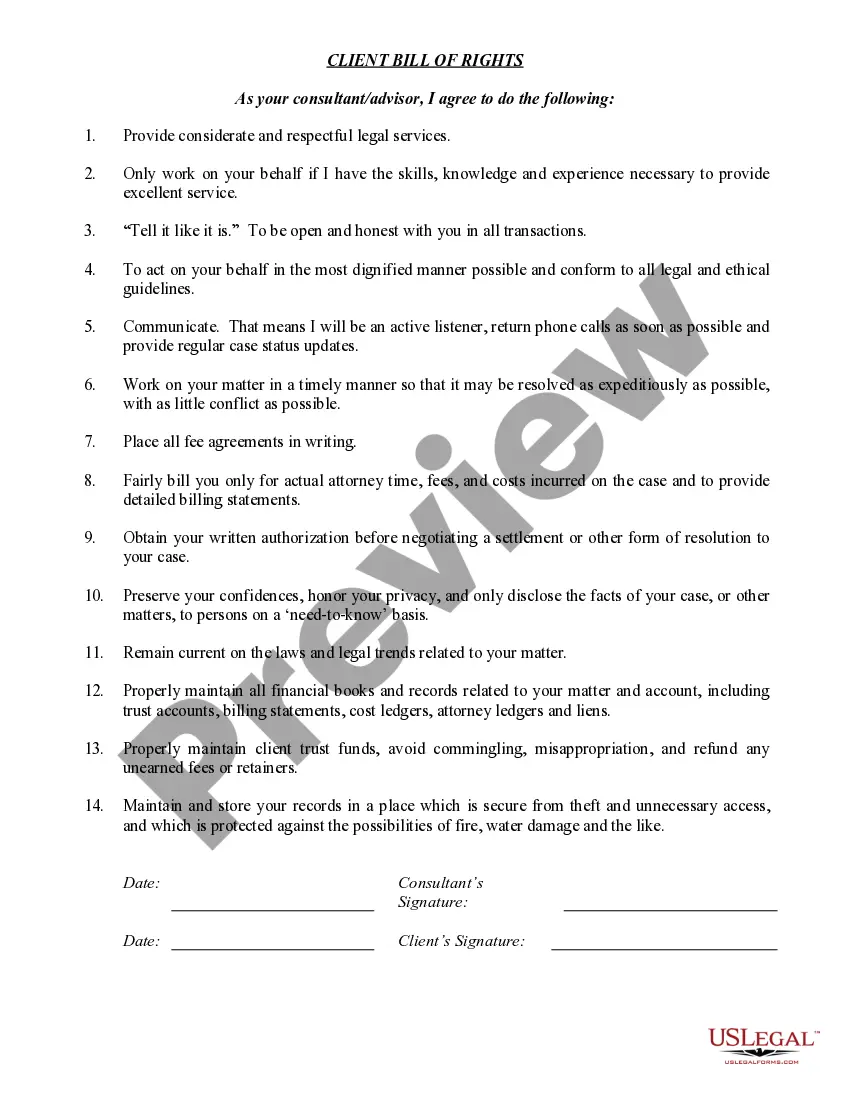
The Client Bill of Rights is a legal document used by attorneys to outline the rights of clients within the attorney-client relationship. This form helps to ensure transparency by clearly articulating the responsibilities of both parties, distinguishing it from other legal agreements that may focus solely on contractual obligations. It supports clients in understanding their rights, which is crucial for fostering trust and effective communication.
Form components explained
- Statement of agreement between the attorney and the client.
- Detailed enumeration of client rights, ensuring they are informed and protected.
- Obligations of the attorney to uphold the rights and provide necessary information.
- Confidentiality clauses that explain the importance of privacy in legal matters.
- Mechanisms for dispute resolution if client rights are infringed upon.

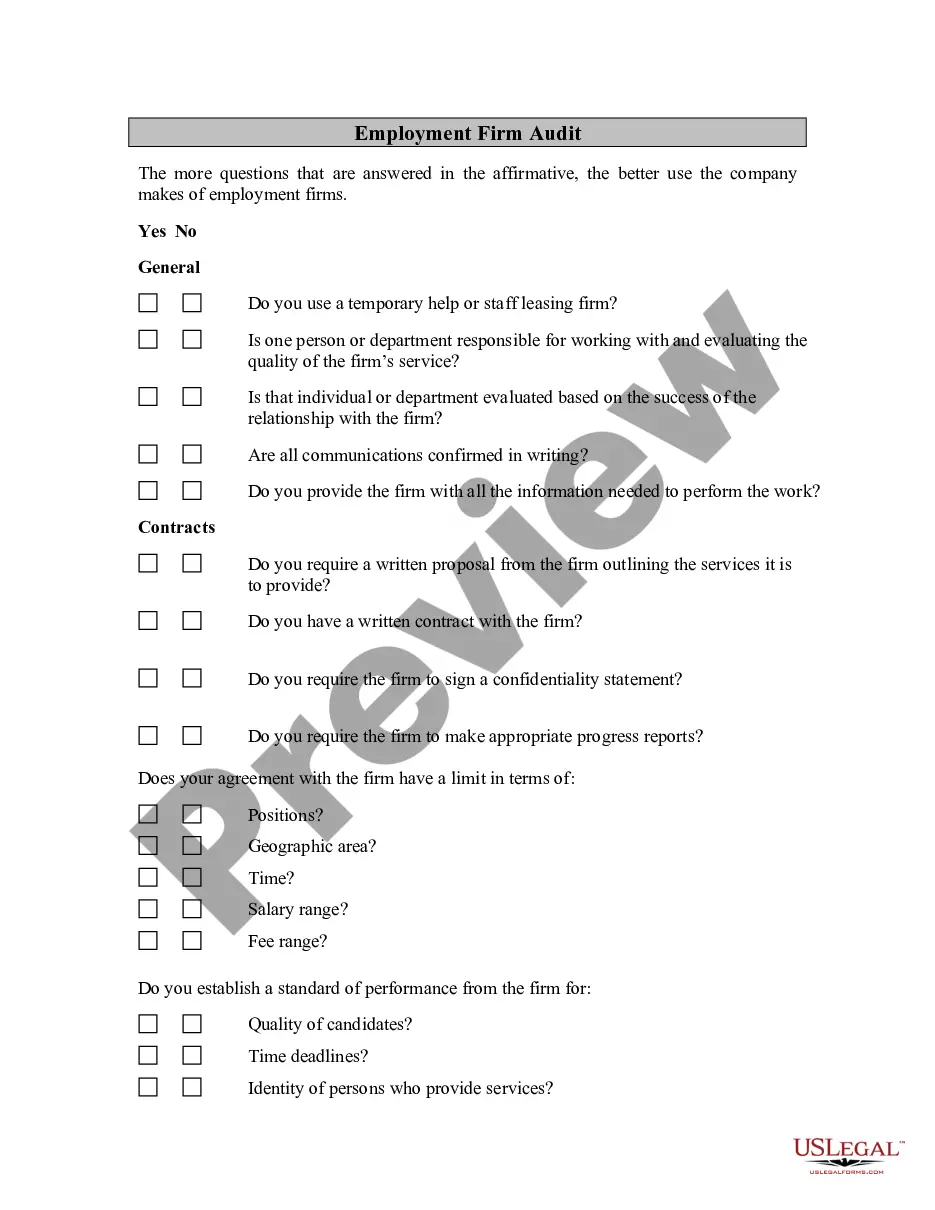

Common use cases
This form is essential when an attorney begins representing a new client. It should be provided at the initial meeting to foster understanding and trust. Additionally, lawyers may use it in situations where clients are unsure of their rights or when transparency in the attorney-client relationship is vital, such as in complex legal cases.
Who this form is for
- Attorneys who wish to inform clients about their rights.
- Clients entering a legal agreement seeking clarity on their entitlements.
- Law firms aiming to establish clear communication protocols with clients.
Instructions for completing this form
- Identify the parties involved, including the attorney and client names.
- Read through the rights outlined and ensure understanding.
- Fill in any necessary personal information specific to the client.
- Review the obligations of the attorney included in the document.
- Sign and date the form to confirm agreement and understanding.
Does this document require notarization?
This form usually doesn’t need to be notarized. However, local laws or specific transactions may require it. Our online notarization service, powered by Notarize, lets you complete it remotely through a secure video session, available 24/7.
Get your form ready online
Our built-in tools help you complete, sign, share, and store your documents in one place.
Make edits, fill in missing information, and update formatting in US Legal Forms—just like you would in MS Word.
Download a copy, print it, send it by email, or mail it via USPS—whatever works best for your next step.
Sign and collect signatures with our SignNow integration. Send to multiple recipients, set reminders, and more. Go Premium to unlock E-Sign.
If this form requires notarization, complete it online through a secure video call—no need to meet a notary in person or wait for an appointment.
We protect your documents and personal data by following strict security and privacy standards.

Make edits, fill in missing information, and update formatting in US Legal Forms—just like you would in MS Word.

Download a copy, print it, send it by email, or mail it via USPS—whatever works best for your next step.

Sign and collect signatures with our SignNow integration. Send to multiple recipients, set reminders, and more. Go Premium to unlock E-Sign.

If this form requires notarization, complete it online through a secure video call—no need to meet a notary in person or wait for an appointment.

We protect your documents and personal data by following strict security and privacy standards.
Avoid these common issues
- Failing to provide the form to the client at the outset.
- Not customizing the form to reflect specific attorney-client relationships.
- Overlooking the explanation of rights, leading to client misunderstandings.
Why complete this form online
- Convenience of immediate access and download.
- Editability to tailor the form to specific cases.
- Reliability with templates vetted by licensed attorneys.
Looking for another form?


Form popularity
FAQ
The amendments, known as the Bill of Rights, were designed to protect the basic rights of U.S. citizens, guaranteeing the freedom of speech, press, assembly, and exercise of religion; the right to fair legal procedure and to bear arms; and that powers not delegated to the federal government were reserved for the states
Amendment 1. - Freedom of Religion, Speech, and the Press. Amendment 2. - The Right to Bear Arms. Amendment 3. - The Housing of Soldiers. Amendment 4. - Protection from Unreasonable Searches and Seizures. Amendment 5. Amendment 6. Amendment 7. Amendment 8.
The 10 amendments that are now known as the Bill of Rights were ratified on December 15, 1791, and thus became part of the Constitution.
Article I The Legislative Branch. The principal mission of the legislative body is to make laws. Article II The Executive Branch. Article III The Judicial Branch. Article IV The States. Article V Amendment. Article VI Debts, Supremacy, Oaths. Article VII Ratification.
Amendment 1 - Religion and Expression2 Amendment 2 - Bearing Arms. Amendment 3 - Quartering Soldiers. Amendment 4 - Search and Seizure. Amendment 5 - Rights of Persons. Amendment 6 - Rights of Accused in Criminal Prosecutions. Amendment 7 - Civil Trials.
Amendment one. Freedom of speech, religion, press and assemly. amendment two. Right to bear arms. amendment three. Quatering Troops. amendment four. Searches and Seizures. amendment five. Rights of the accused person. amendment six. Right to speedy, fair trial. amendment seven. amendment eight.
The Bill of Rights derives from the Magna Carta (1215), the English Bill of Rights (1689), the colonial struggle against king and Parliament, and a gradually broadening concept of equality among the American people. Virginia's 1776 Declaration of Rights, drafted chiefly by George Mason, was a notable forerunner.
The Bill of Rights is the first 10 Amendments to the Constitution. It spells out Americans' rights in relation to their government.It sets rules for due process of law and reserves all powers not delegated to the Federal Government to the people or the States.
A bill of rights, sometimes called a declaration of rights or a charter of rights, is a list of the most important rights to the citizens of a country. The purpose is to protect those rights against infringement from public officials and private citizens.