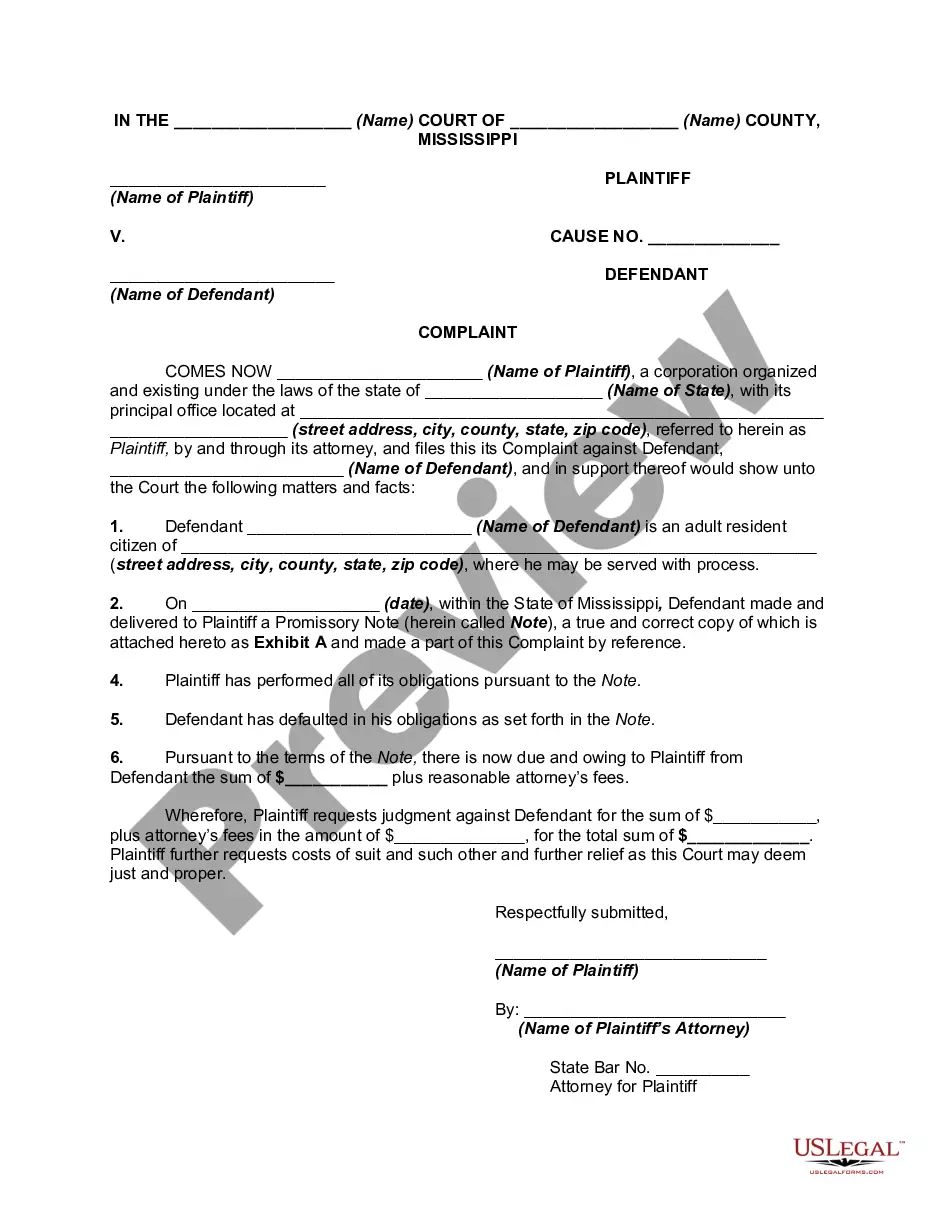
Louisiana Forfeiture Agreement
Overview of this form
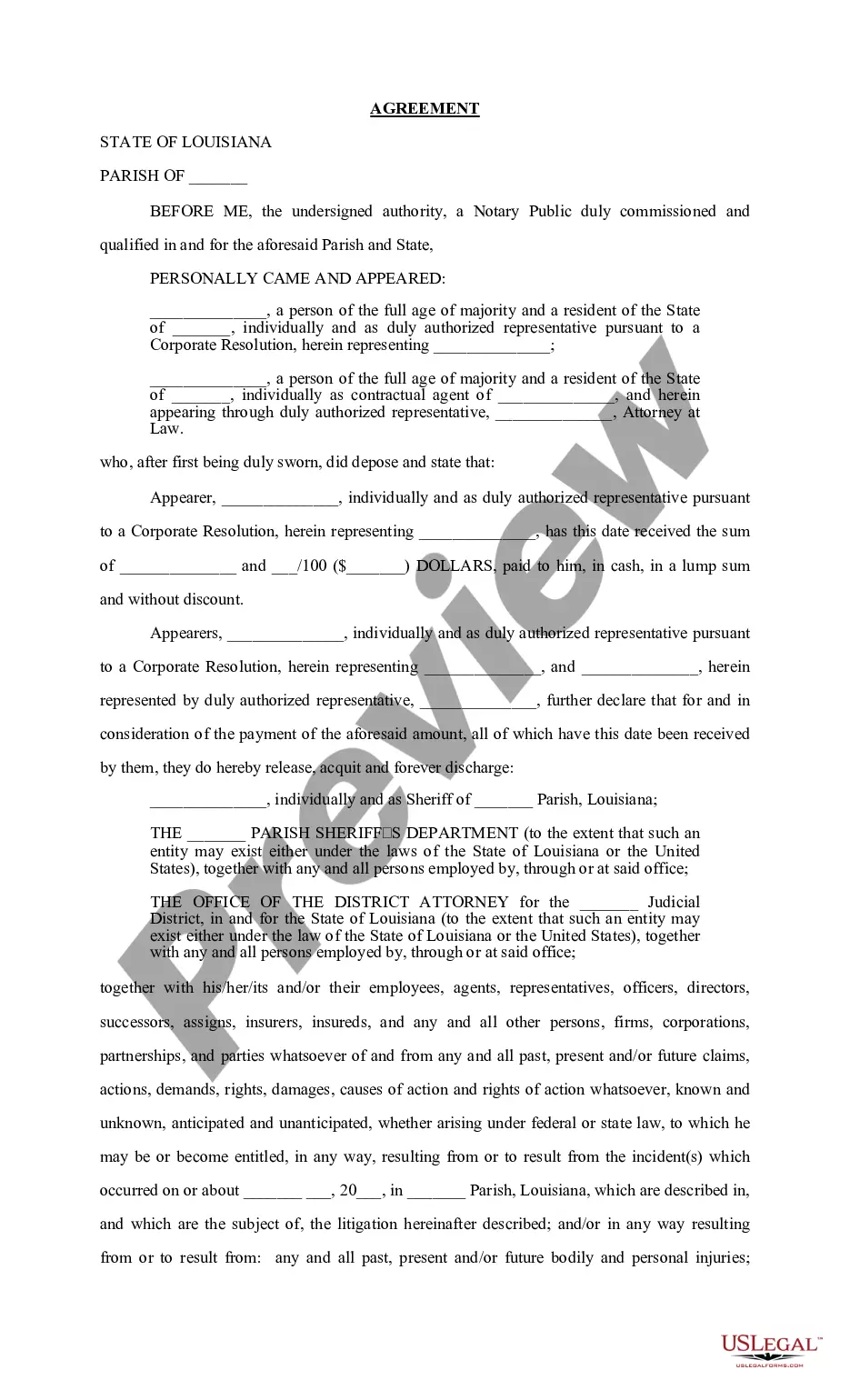
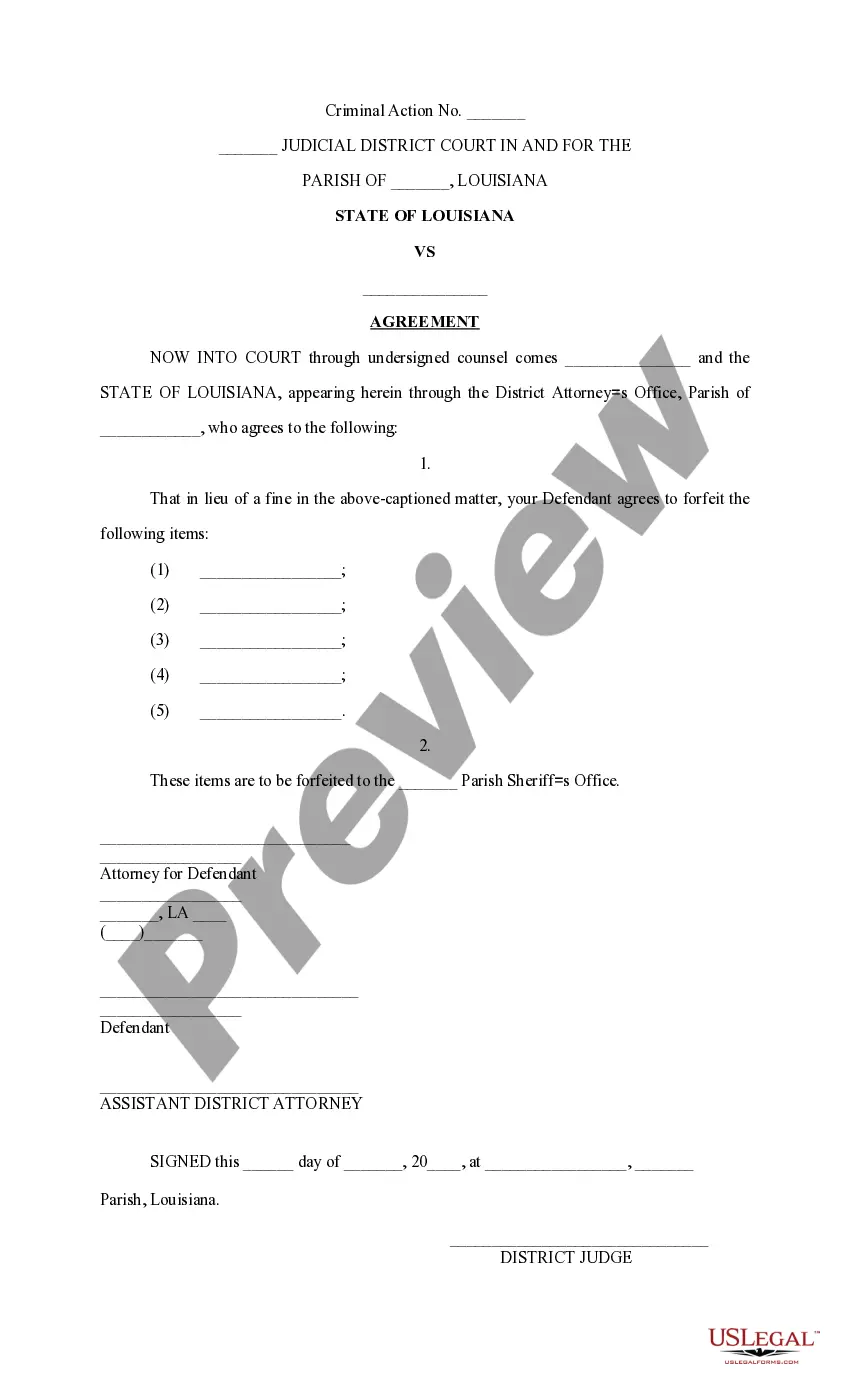
The Forfeiture Agreement is a legal document designed to settle disputes by releasing a party from future claims in exchange for a cash payment. This agreement primarily involves the corporation waiving any future legal actions against designated officials or departments related to a specific incident. Unlike other agreements, it includes terms that prevent further litigation over the same matter once the payment is made.
Form components explained
- Identification of parties involved, including representatives and entities.
- Details of the cash payment to be received by the representative.
- The release clause discharging the sheriff and other officials from future claims.
- Acknowledgment of the claims being settled and dismissed with prejudice.
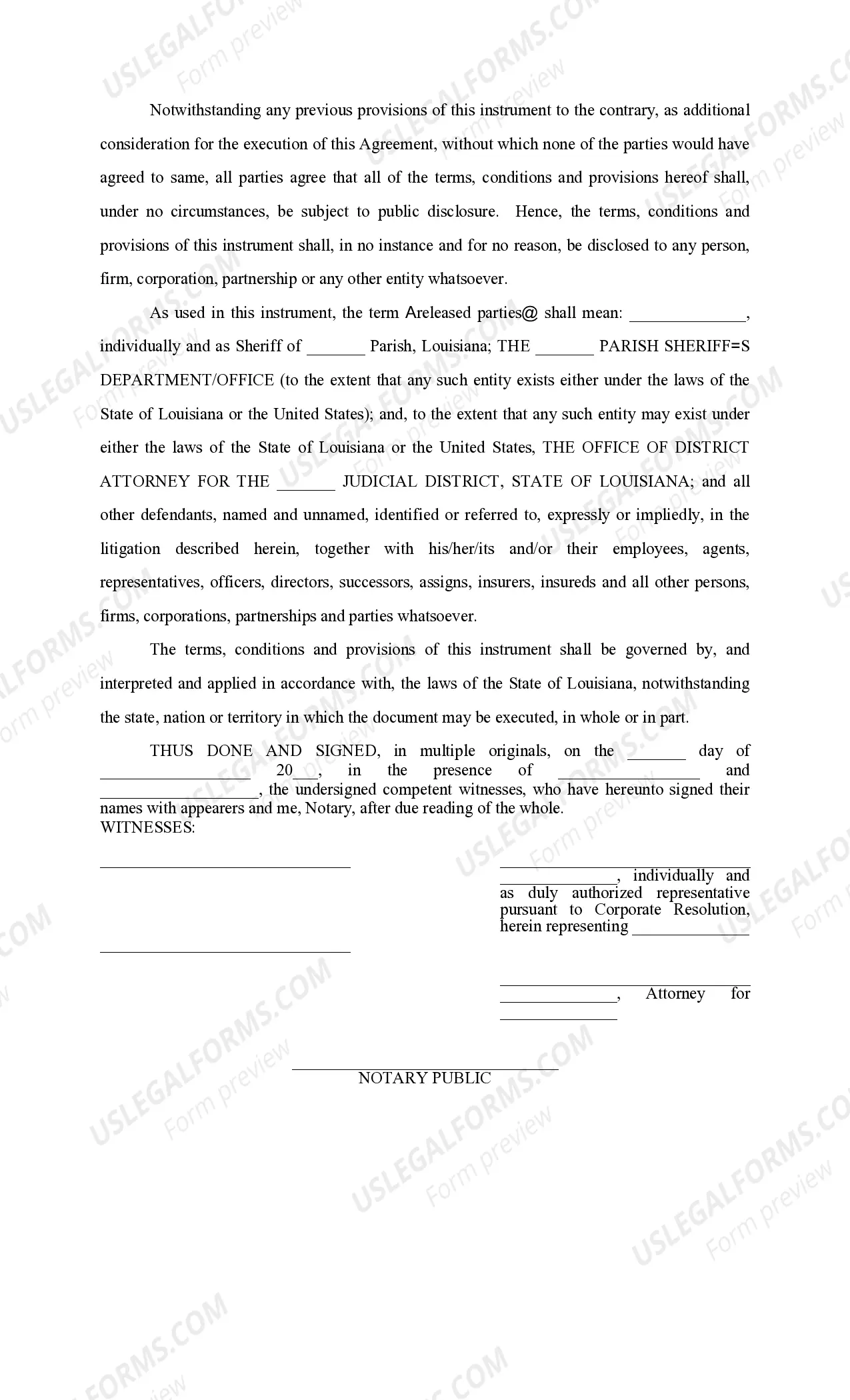
- Indemnification provisions protecting released parties against further claims.
- Confidentiality clause regarding the terms of the agreement.


When to use this document
This form is typically used when a corporation wishes to settle a claim against officials or departments (such as a sheriff's office) without admitting any liability. It is beneficial in cases where a dispute has arisen from an incident but where both parties are inclined to avoid the costs and complexities of litigation. The Forfeiture Agreement formalizes this settlement, allowing both sides to move forward with certainty.
Who needs this form
- Corporations involved in legal disputes with law enforcement or district attorneys.
- Individuals serving as authorized representatives for the corporation.
- Legal professionals assisting clients in settlement negotiations.
- Any party seeking to avoid future litigation related to a specific incident.
How to complete this form
- Identify the parties involved in the agreement, including the corporation and its representatives.
- Specify the cash payment amount being made as part of the agreement.
- Describe the incident that prompted the need for this agreement, including relevant dates and locations.
- Fill out the release clause, ensuring it covers all future claims related to the incident.
- Have all parties sign the agreement in the presence of a notary public to validate the document.
- Store completed copies of the agreement securely for future reference.
Does this form need to be notarized?
Yes, this form must be notarized to be legally valid. Notarization helps ensure the authenticity of the signatures and the integrity of the agreement. US Legal Forms offers integrated online notarization services, allowing you to complete this process securely via video call at any time.
Get your form ready online
Our built-in tools help you complete, sign, share, and store your documents in one place.
Make edits, fill in missing information, and update formatting in US Legal Forms—just like you would in MS Word.
Download a copy, print it, send it by email, or mail it via USPS—whatever works best for your next step.
Sign and collect signatures with our SignNow integration. Send to multiple recipients, set reminders, and more. Go Premium to unlock E-Sign.
If this form requires notarization, complete it online through a secure video call—no need to meet a notary in person or wait for an appointment.
We protect your documents and personal data by following strict security and privacy standards.

Make edits, fill in missing information, and update formatting in US Legal Forms—just like you would in MS Word.

Download a copy, print it, send it by email, or mail it via USPS—whatever works best for your next step.

Sign and collect signatures with our SignNow integration. Send to multiple recipients, set reminders, and more. Go Premium to unlock E-Sign.

If this form requires notarization, complete it online through a secure video call—no need to meet a notary in person or wait for an appointment.

We protect your documents and personal data by following strict security and privacy standards.
Common mistakes
- Failing to include all relevant parties in the agreement.
- Not specifying the exact amount of the cash payment.
- Leaving out the detailed description of the incident in question.
- Omitting to sign the agreement in front of a notary public.
- Misunderstanding the scope of the release clause, which may expose parties to future liability.
Why use this form online
- Convenience of downloading and completing the form at your own pace.
- Editability allows you to tailor the form to your specific needs.
- Access to templates that are drafted and reviewed by licensed attorneys for reliability.
- Cost-effectiveness compared to hiring legal counsel for routine agreements.
- Reduction of paperwork as the agreement can often be stored digitally.
Looking for another form?


Form popularity
FAQ
Forfeiture, under the terms of a contract, refers to the requirement by the defaulting party to give up ownership of an asset, or cash flows from an asset, as compensation for the resulting losses to the other party.The process of forfeiture often involves proceedings in a court of law.
Forfeiture refers to a loss of any property, money, or assets without consideration or compensation in return. A forfeiture generally occurs due to default in complying with repayment obligations under a contract. It can also be used as a penalty for an illegal way of conducting business.
United States. There are two types of forfeiture (confiscation) cases, criminal and civil.
Forfeiture, under an agreement, highlights a mandate by a defaulting party to relinquish an asset or monetary sum as compensation if that party breaches the contract.Example: In a contractual relationship, a party may have to relinquish a specified property if that party fails to fulfill an obligation.
Seizure is the act of taking property.Forfeiture occurs when your rights to the seized property are permanently lost through a court order or judgment. Forfeiture occurs after seizure, and seizure does not always end in forfeiture. In our example, the seizure takes place when Officer Potts takes the money from Steve.
The involuntary relinquishment of money or property without compensation as a consequence of a breach or nonperformance of some legal obligation or the commission of a crime. The loss of a corporate charter or franchise as a result of illegality, malfeasance, or Nonfeasance.
Your Claim Opposing Forfeiture (MC-200) must be filed in the county where the property was seized. If you have received a notice, you can find the address of the court on that notice. Within 30 days after filing your claim, you must serve a copy on the District Attorney.
Letter of forfeiture means a notice in varied forms, sent to a bail bond agency/branch office, advising the agency/branch office that a defendant who has secured a bail bond with that agency has failed to appear on a given date in a given court in accordance with RCW 10.19. 090.
The name of the notice that is given to property owners to appear in court to say why the property shouldn't be forfeited.