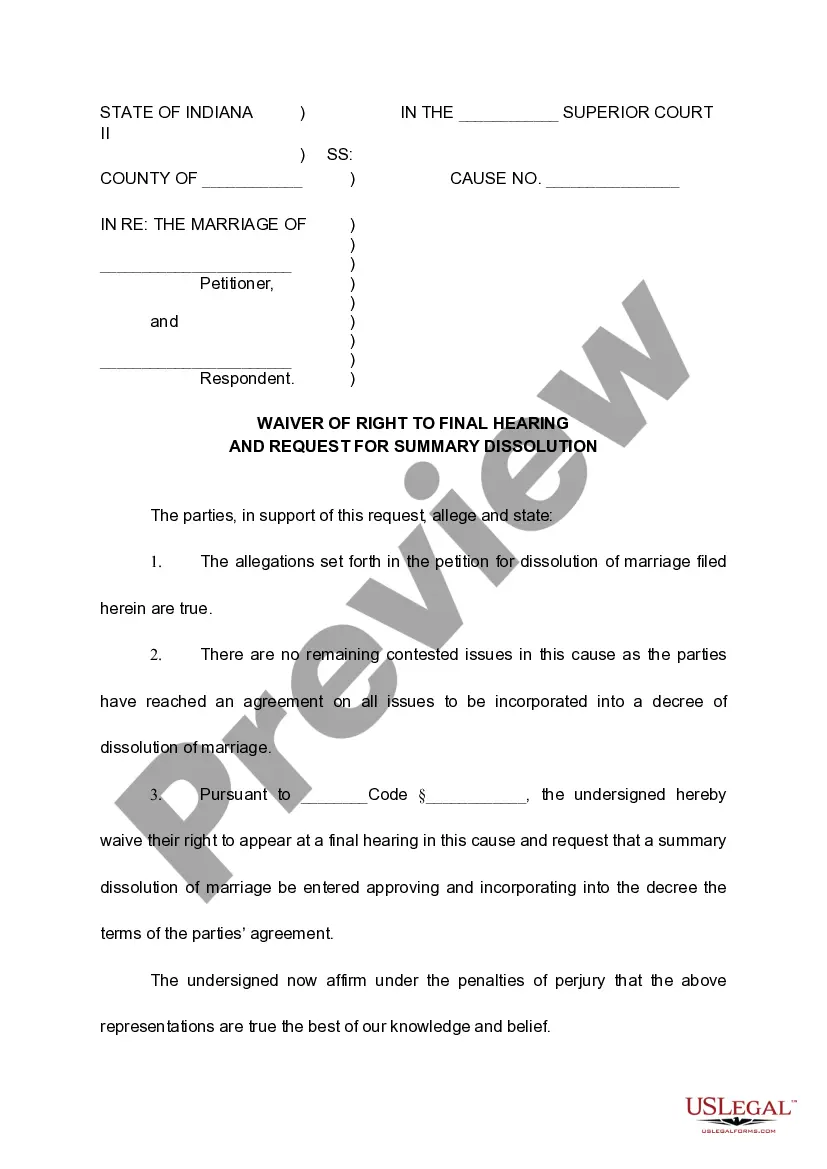
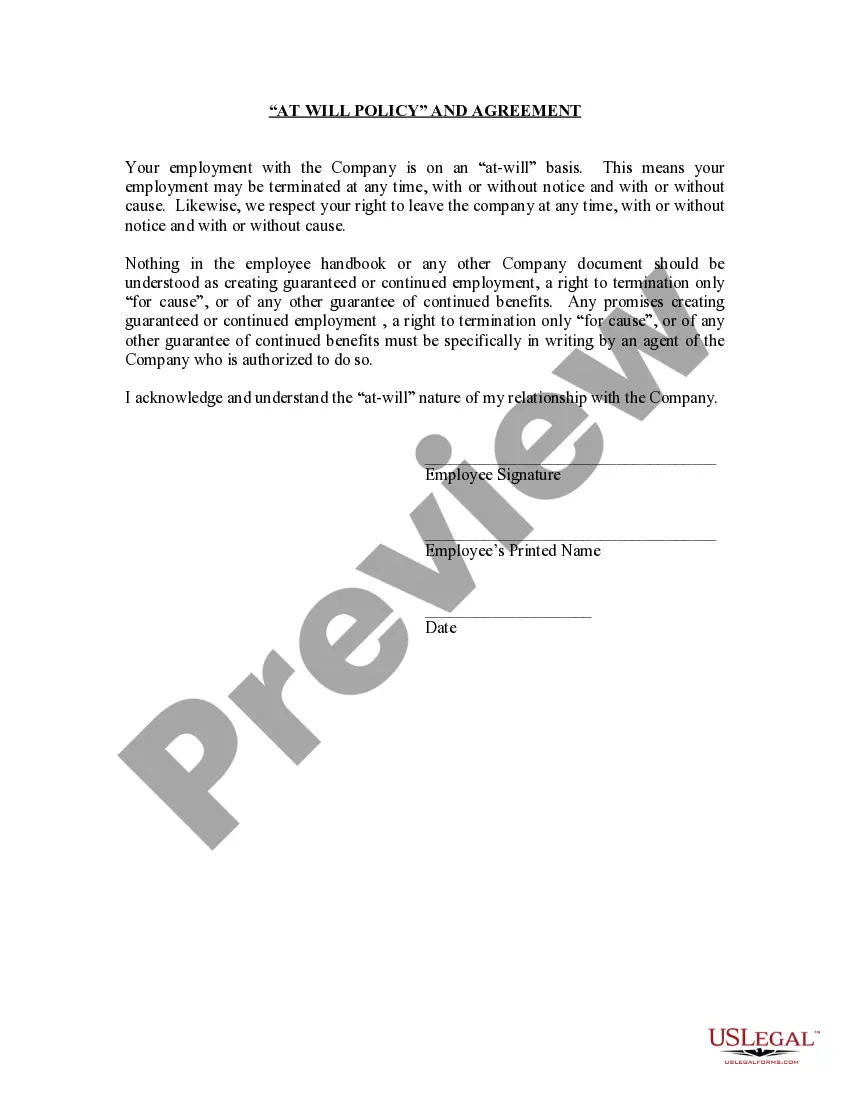
At Will Policy and Agreement
About this form
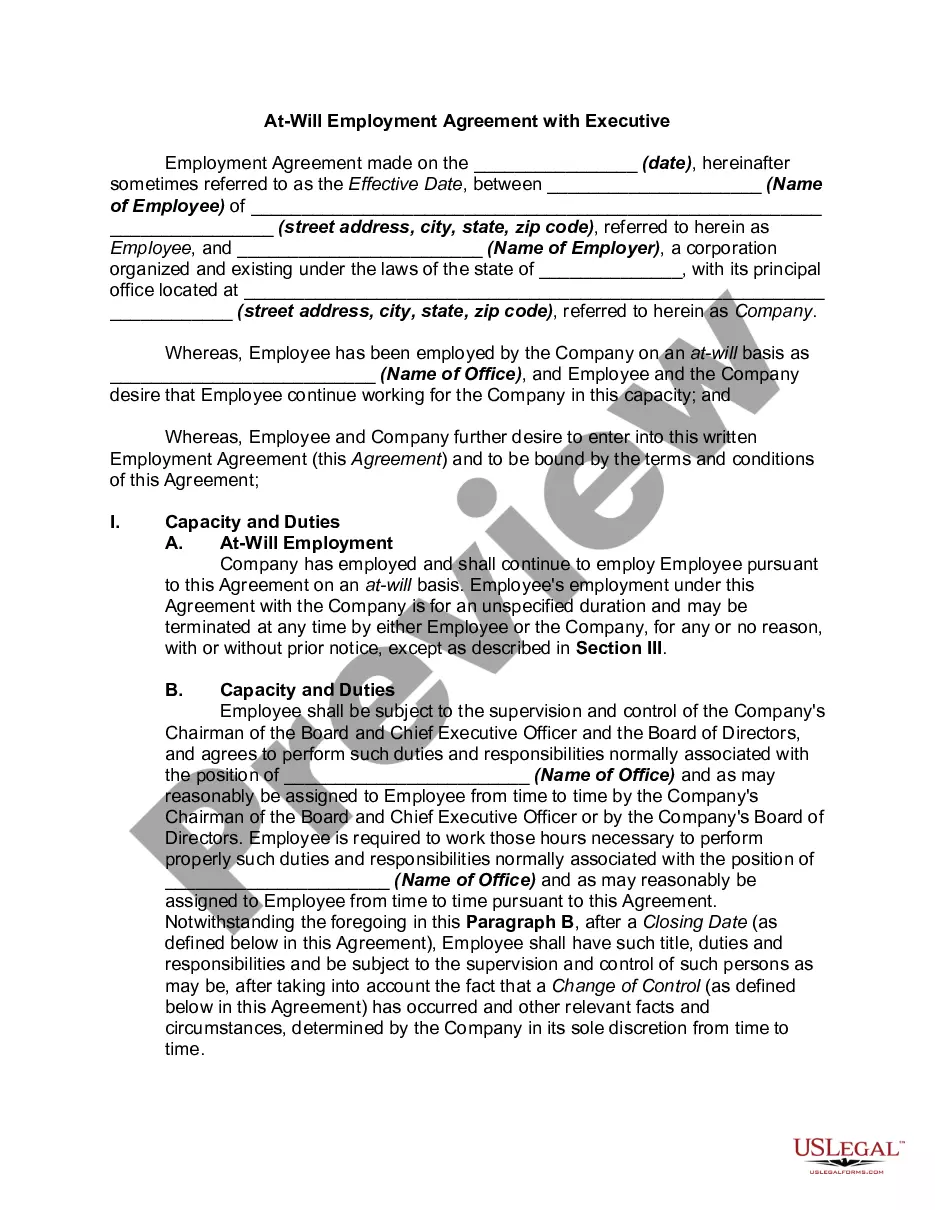
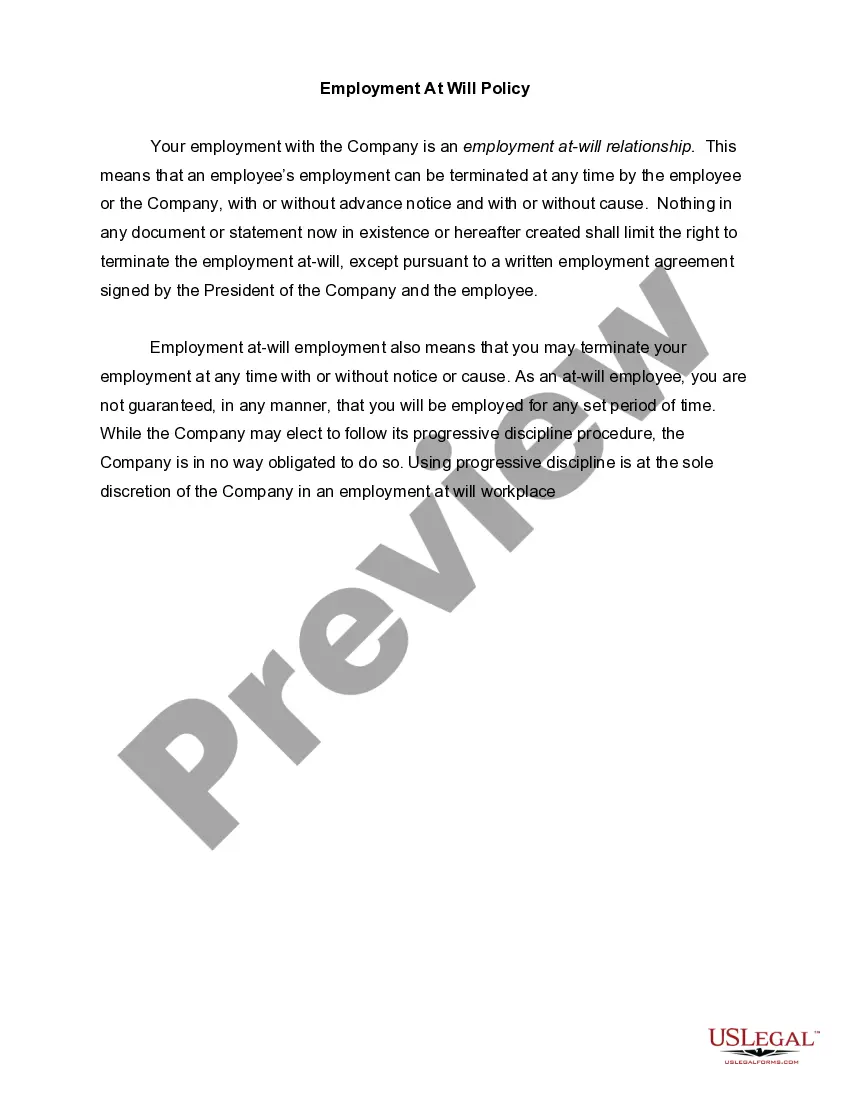
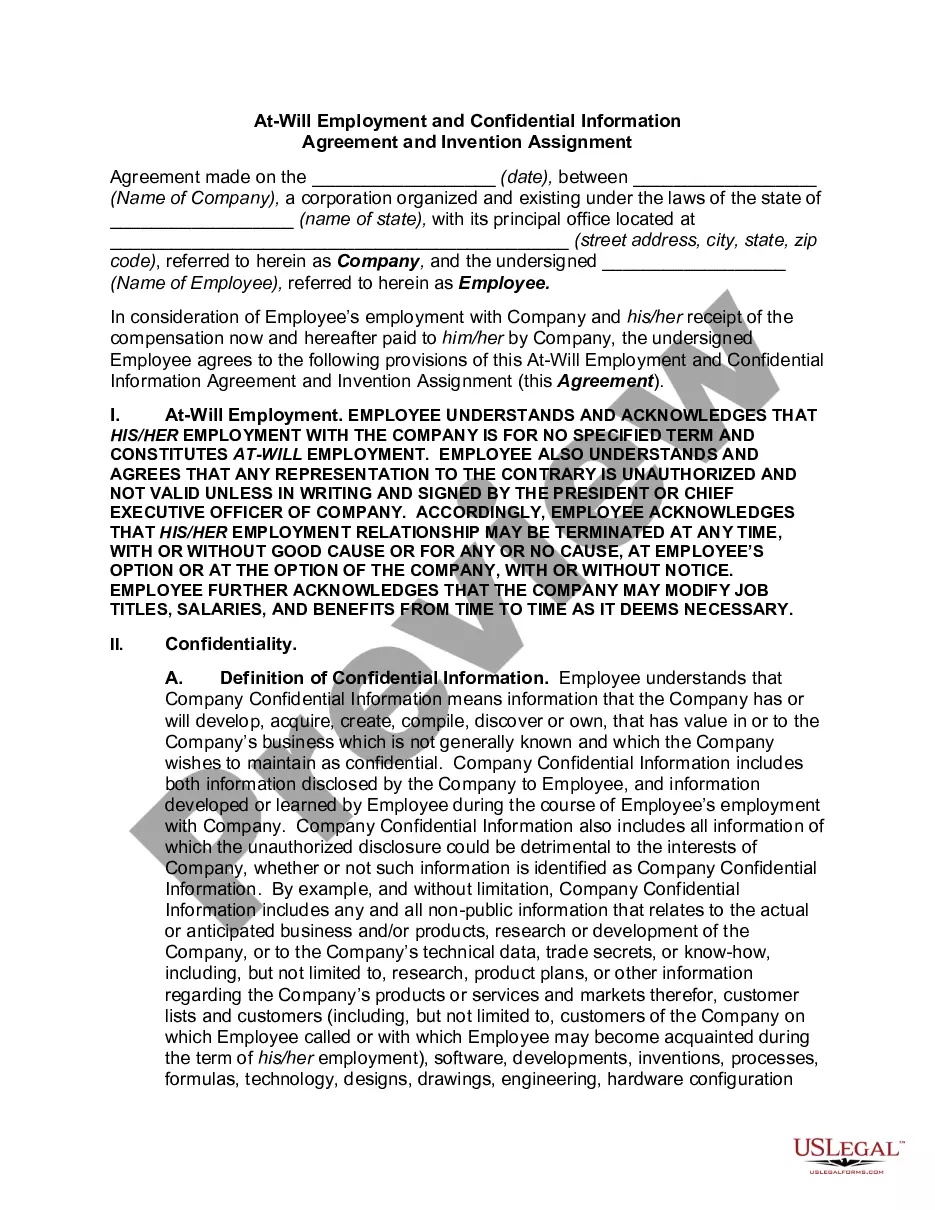
The At Will Policy and Agreement is a critical document that outlines the nature of the employment relationship between an employee and their employer. This form states that employment is "at will," meaning either party can terminate the relationship at any time, without cause or notice. This form differs from other employment agreements that may provide more job security or specify conditions under which termination can occur.
Key components of this form
- Statement of at-will employment status.
- Clarification of termination rights for both the employer and employee.
- Declaration that no guarantees of continued employment are made.
- Requirement for written agreements for any exceptions to at-will employment.
- Employee acknowledgment of understanding the at-will nature of their employment.
Common use cases
This form should be used when an employer wants to clearly communicate to employees that their employment can be terminated at any time, for any reason. It is particularly useful during onboarding processes or when updating company policies to ensure employees understand their rights and responsibilities regarding their employment status.
Who this form is for
- Employers seeking to establish an at-will employment relationship with their employees.
- Human resources professionals looking to update employment policies.
- Employees who want to understand the implications of at-will employment.
How to complete this form
- Review the document to understand the at-will employment policy thoroughly.
- Have the employee read and acknowledge their understanding of the terms.
- Require the employee to sign and date the form in the designated areas.
- Keep a copy of the signed agreement in the employee's file for future reference.
Does this form need to be notarized?
Notarization is generally not required for this form. However, certain states or situations might demand it. You can complete notarization online through US Legal Forms, powered by Notarize, using a verified video call available anytime.
Get your form ready online
Our built-in tools help you complete, sign, share, and store your documents in one place.
Make edits, fill in missing information, and update formatting in US Legal Forms—just like you would in MS Word.
Download a copy, print it, send it by email, or mail it via USPS—whatever works best for your next step.
Sign and collect signatures with our SignNow integration. Send to multiple recipients, set reminders, and more. Go Premium to unlock E-Sign.
If this form requires notarization, complete it online through a secure video call—no need to meet a notary in person or wait for an appointment.
We protect your documents and personal data by following strict security and privacy standards.

Make edits, fill in missing information, and update formatting in US Legal Forms—just like you would in MS Word.

Download a copy, print it, send it by email, or mail it via USPS—whatever works best for your next step.

Sign and collect signatures with our SignNow integration. Send to multiple recipients, set reminders, and more. Go Premium to unlock E-Sign.

If this form requires notarization, complete it online through a secure video call—no need to meet a notary in person or wait for an appointment.

We protect your documents and personal data by following strict security and privacy standards.
Common mistakes to avoid
- Failing to clearly explain the meaning of "at will" to employees.
- Not obtaining the employee's signature, which could invalidate the acknowledgment.
- Assuming verbal explanations are sufficient without providing a written document.
Benefits of completing this form online
- Immediate access to a professionally drafted agreement.
- Ability to edit the document to fit specific company policies.
- Time-saving convenience, allowing for quick distribution to new employees.
Looking for another form?
Form popularity
FAQ
Contract employment is the opposite of at-will employment. Contracts outline the terms of employment, including the employee's duties, work hours, length of employment, salary and benefits.
Additionally, as an at-will employee, without any contractual obligation to continue work, you may quit your job for any reason at any time. You cannot be forced to work for an employer and you don't have to give your employer a reason for quitting.
Theoretically, you don't have to sign an at-will agreementbut most courts have held that your employer can fire (or refuse to hire) you for failing to do so. And, even if you don't sign the agreement, the default rule is that employees work at will.
In California, employment is considered at-will, meaning the employer or employee can end the employment relationship at any time, with or without notice, and for no reason or any reason, so long as the employer's reason is not unlawful.
California is an at-will employment state. At-will employment means that an employer can fire an employee for any reason or at any time. They do not need to have a reason or justification for terminating an at-will employee.
In U.S. labor law, at-will employment is an employer's ability to dismiss an employee for any reason (that is, without having to establish "just cause" for termination), and without warning, as long as the reason is not illegal (e.g. firing because of the employee's race, religion or sexuality).
The three major common law exceptions are public policy, implied contract, and implied covenant of good faith. The at-will presumption is strong, however, and it can be difficult for an employee to prove that his circumstances fall within one of the exceptions.
Under the public-policy exception to employment at will, an employee is wrongfully discharged when the termination is against an explicit, well-established public policy of the State.The public-policy exception is the most widely accepted ex- ception, recognized in 43 of the 50 States.
Yes, it is possible for an employer to wrongfully terminate an at-will employee. While employers in the state can use almost any reason to terminate an employee, California has created a list of reasons that are off-limits for employers, even with the state's at-will employment laws.