Jury Instruction - Entrapment
Overview of this form
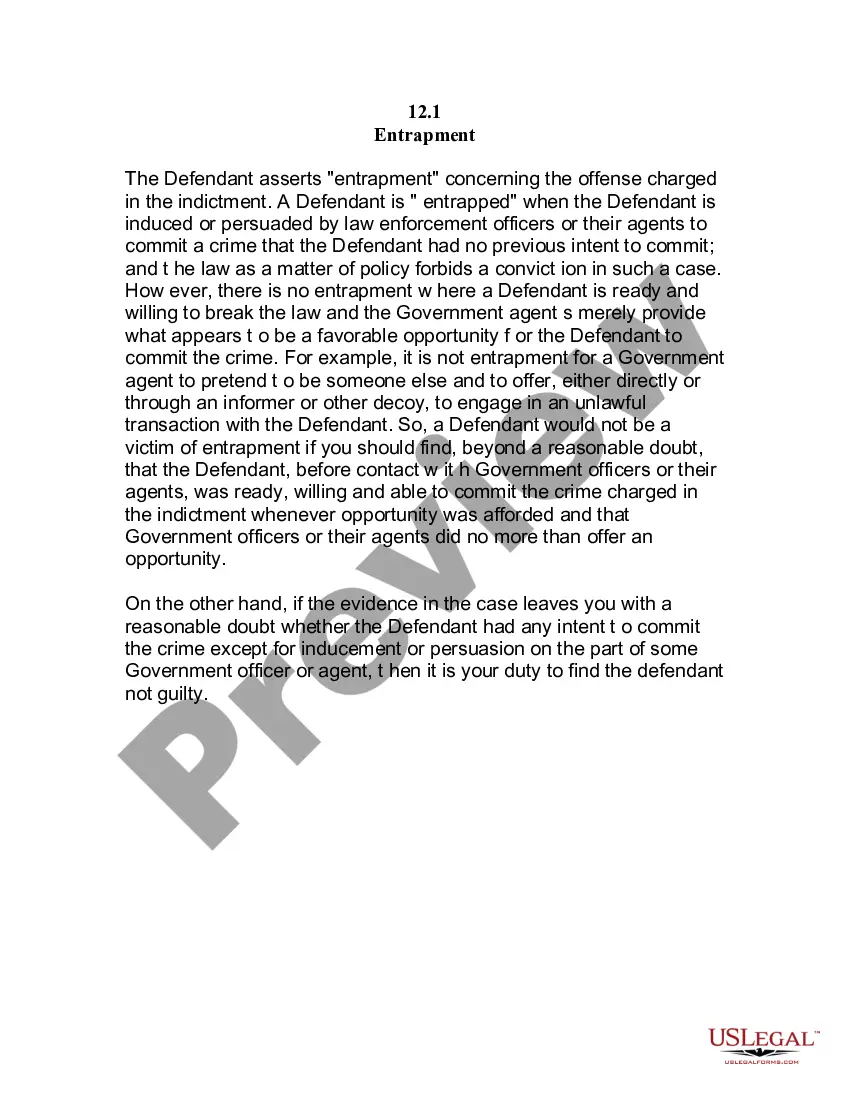
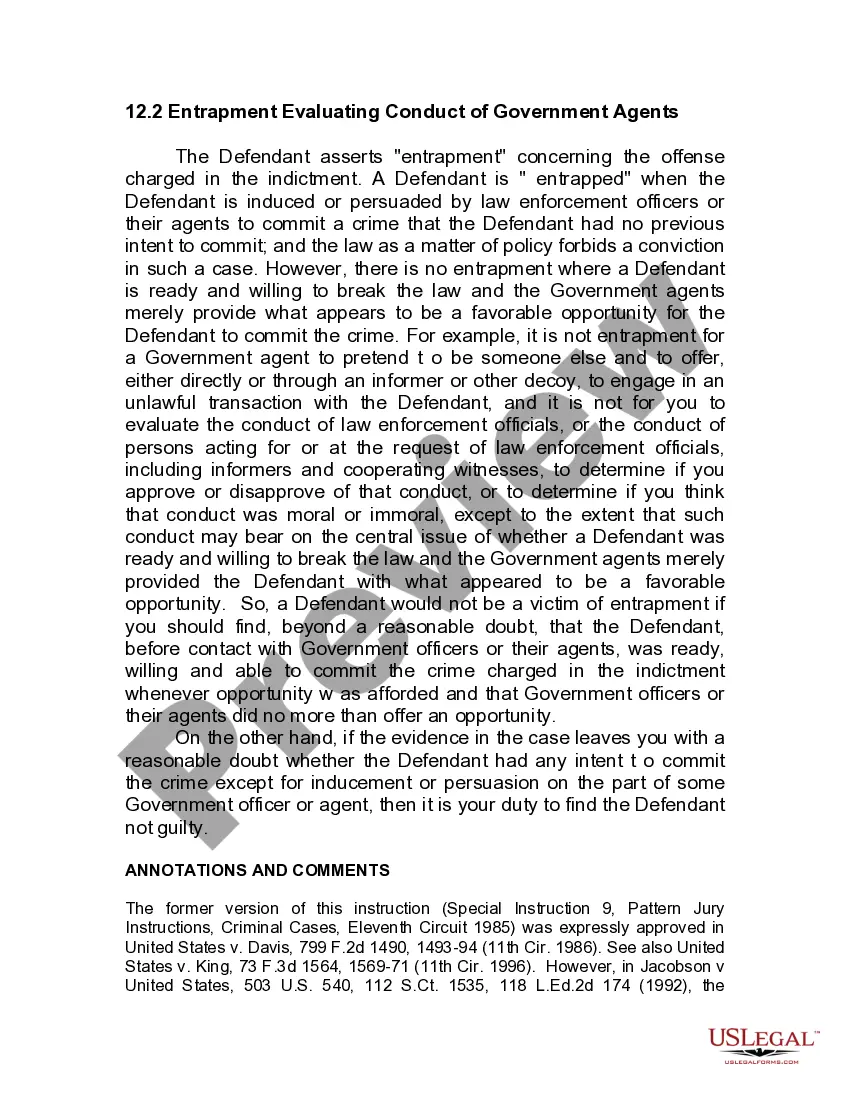
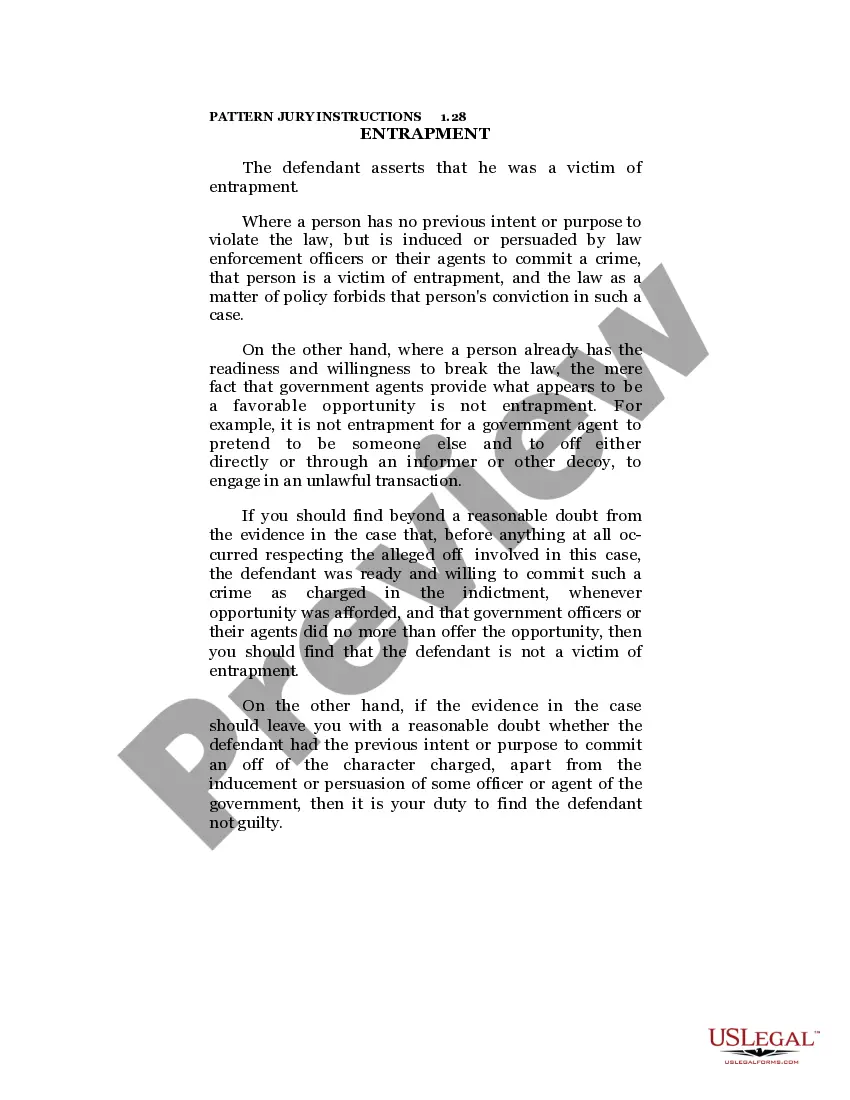
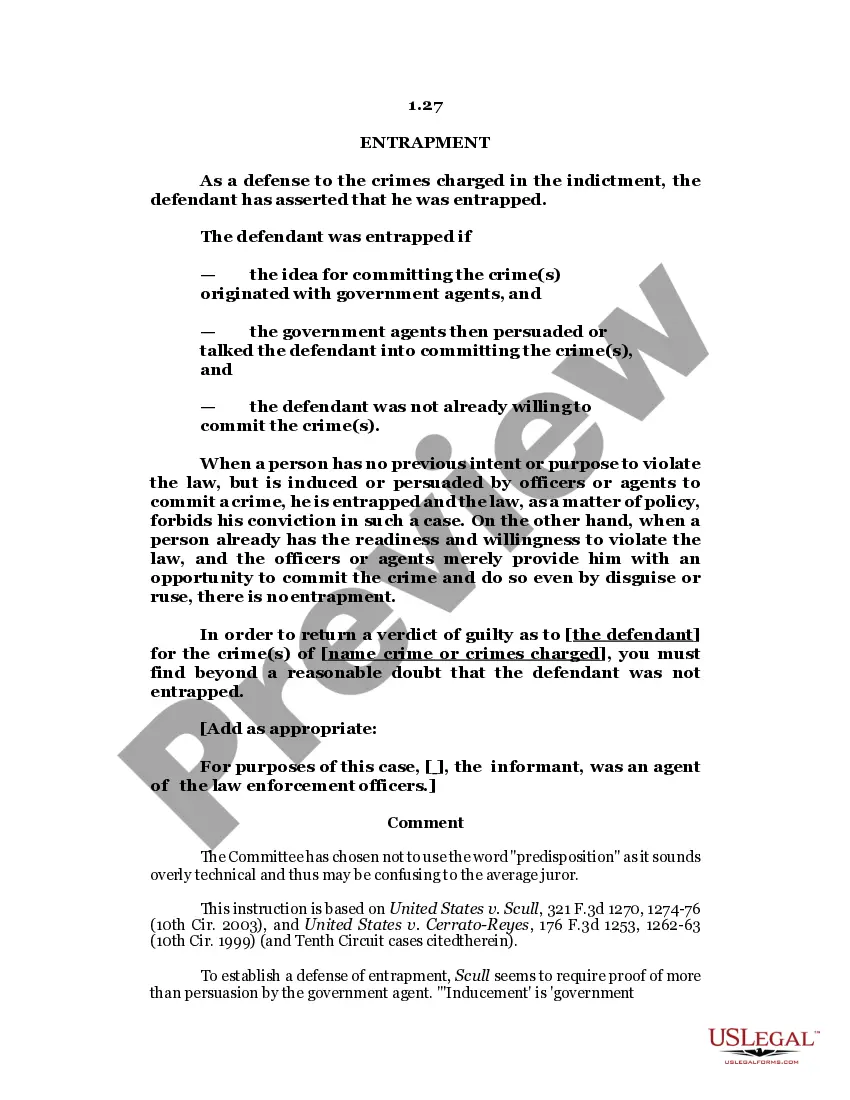
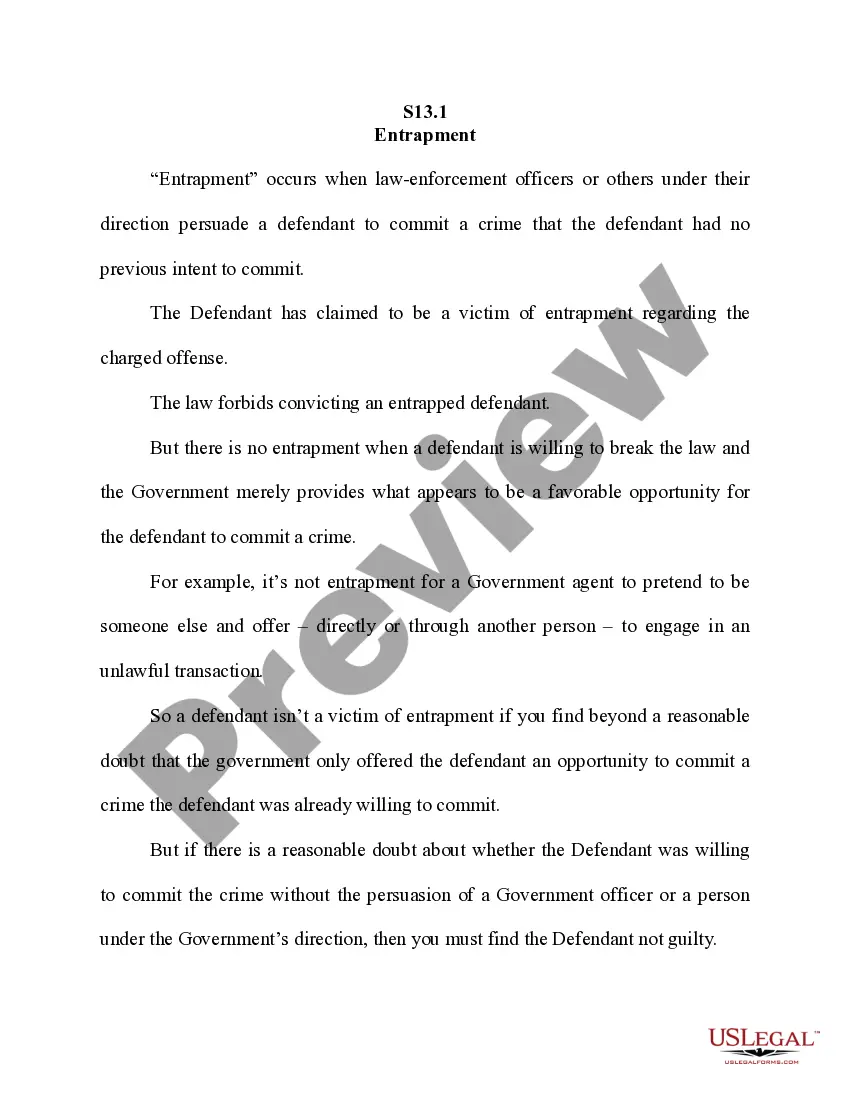
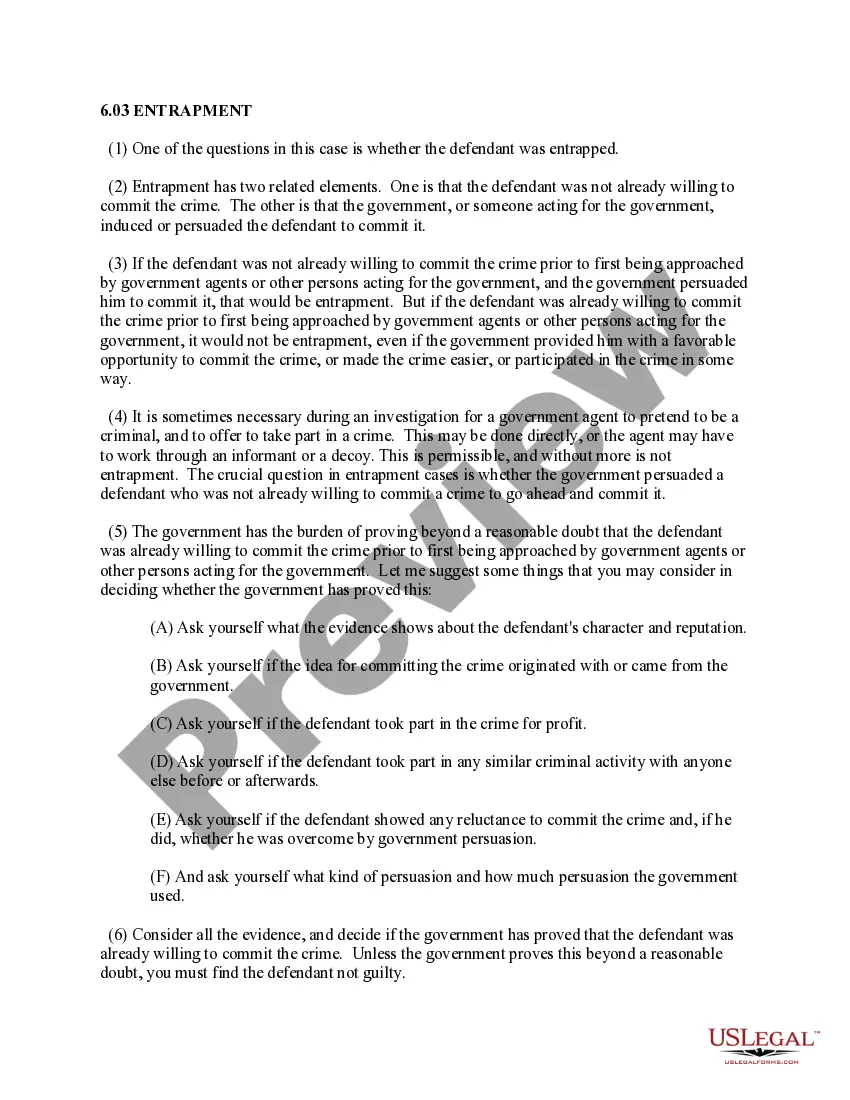
The Jury Instruction - Entrapment form provides standard legal guidelines to be used by jurors in cases where a defendant claims they were entrapped by law enforcement. This form outlines the concept of entrapment, distinguishing it from lawful police conduct aimed at apprehending individuals willing to commit crimes.
Main sections of this form
- Description of what constitutes entrapment.
- Clarification on the difference between entrapment and lawful opportunities presented by law enforcement.
- Guidelines for jurors regarding their duty to find a defendant not guilty if there is reasonable doubt about the defendant's predisposition to commit the crime.

When this form is needed
This form is applicable in criminal cases where the defendant asserts an entrapment defense. It is essential when claims arise that law enforcement induced the defendant to commit a crime they otherwise would not have committed.
Who needs this form
- Legal professionals involved in criminal defense cases.
- Judges presiding over trials where the entrapment defense is asserted.
- Jury members tasked with determining the outcome of cases involving an entrapment claim.
Steps to complete this form
- Identify the key parties involved in the case and their respective roles.
- Review the instructions thoroughly, ensuring understanding of the definition of entrapment.
- Modify the sample instructions to reflect the specific facts of the case.
- Present the completed instructions to the court for approval prior to use in jury deliberations.
Is notarization required?
Notarization is not commonly needed for this form. However, certain documents or local rules may make it necessary. Our notarization service, powered by Notarize, allows you to finalize it securely online anytime, day or night.
Get your form ready online
Our built-in tools help you complete, sign, share, and store your documents in one place.
Make edits, fill in missing information, and update formatting in US Legal Forms—just like you would in MS Word.
Download a copy, print it, send it by email, or mail it via USPS—whatever works best for your next step.
Sign and collect signatures with our SignNow integration. Send to multiple recipients, set reminders, and more. Go Premium to unlock E-Sign.
If this form requires notarization, complete it online through a secure video call—no need to meet a notary in person or wait for an appointment.
We protect your documents and personal data by following strict security and privacy standards.

Make edits, fill in missing information, and update formatting in US Legal Forms—just like you would in MS Word.

Download a copy, print it, send it by email, or mail it via USPS—whatever works best for your next step.

Sign and collect signatures with our SignNow integration. Send to multiple recipients, set reminders, and more. Go Premium to unlock E-Sign.

If this form requires notarization, complete it online through a secure video call—no need to meet a notary in person or wait for an appointment.

We protect your documents and personal data by following strict security and privacy standards.
Mistakes to watch out for
- Failing to adapt the jury instructions to the specific case facts.
- Misunderstanding the definition of entrapment and its distinction from lawful police conduct.
- Overlooking the importance of jurors' reasonable doubt regarding the defendant's intent.
Why use this form online
- Immediate access to professionally drafted legal instructions.
- Convenience of downloading and editing instructions as needed.
- Ensures that the instructions comply with current legal standards.
Legal use & context
- The entrapment defense is recognized in many jurisdictions but may vary based on local laws.
- Accurate jury instructions are crucial for ensuring fair trials and just outcomes.
- Instruction advice must align with recent legal precedents to enhance clarity and enforceability.
Looking for another form?


Form popularity
FAQ
Entrapment may result from the use of threats, intimidation, extended fraud, or any other means where the defendant was essentially forced to commit a crime. For example, law enforcement officers could set up a sting operation for a suspected criminal to commit a burglary.
The objective entrapment defense focuses on law enforcement behavior, and provides a defense if the tactics law enforcement uses would convince a reasonable, law-abiding person to commit the crime. Under the objective entrapment defense, the defendant's criminal record is irrelevant and inadmissible.
An entrapment defense arises when government agents resort to repugnant behavior such as the use of threats, harassment, fraud, or even flattery to induce defendants to commit crimes. Case Example 1. Mary-Anne Berry is charged with selling illegal drugs to an undercover police officer.
A jury instruction is given by the judge to the jury to explain what is happening in the court, to explain the points of law relevant to the case, to explain certain aspects of the evidence presented and to assist the jurors in understanding their duties in reaching a verdict.
A valid entrapment defense has two related elements: (1) government inducement of the crime, and (2) the defendant's lack of predisposition to engage in the criminal conduct.
Under California law, entrapment refers to a situation where a normally law abiding person is induced to commit a crime that he/she otherwise would not have committed. Entrapment only applies to overbearing official conduct, seen in the form of pressure, harassment, fraud, flattery, or threats.
Entrapment is an affirmative defense, which means the defendant has the burden of proving that entrapment occurred. The defendant must prove that: law enforcement agents approached the defendant and/or introduced the idea of committing a crime. the defendant was not ready and willing to commit the crime, and.
A curative instruction is given to a jury by the judge in a case to negate the prejudicial effect of an erroneous instruction or tainted evidence.
Entrapment is a defense to criminal charges, and it's based on interaction between police officers and the defendant prior to (or during) the alleged crime. A typical entrapment scenario arises when law enforcement officers use coercion and other overbearing tactics to induce someone to commit a crime.