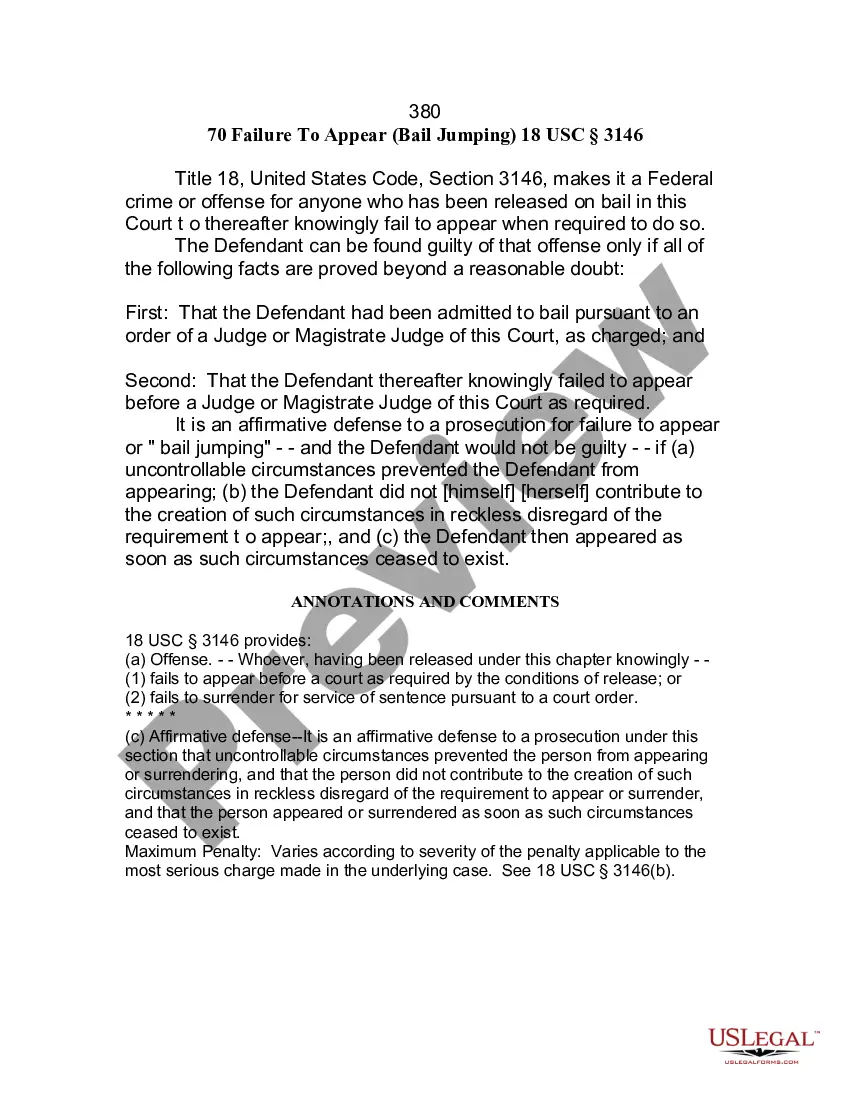
Jury Instruction - Failure To Appear - Bail Jumping
Understanding this form
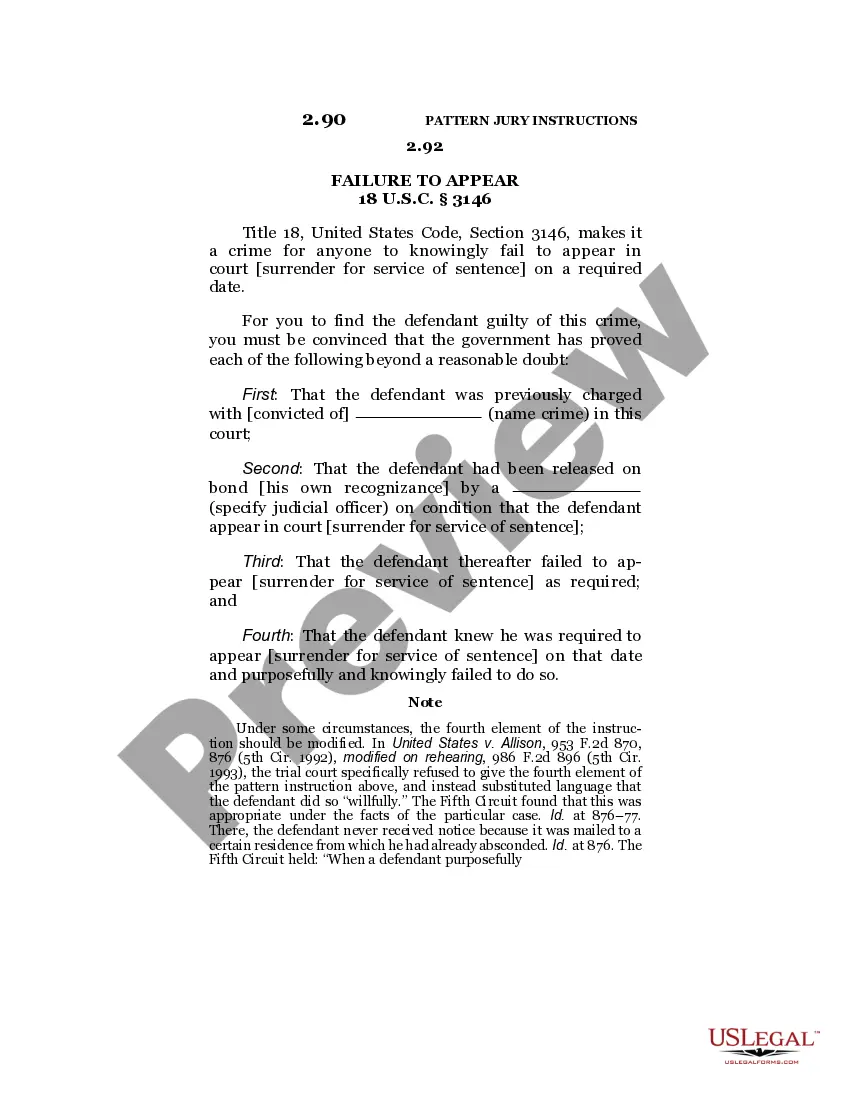
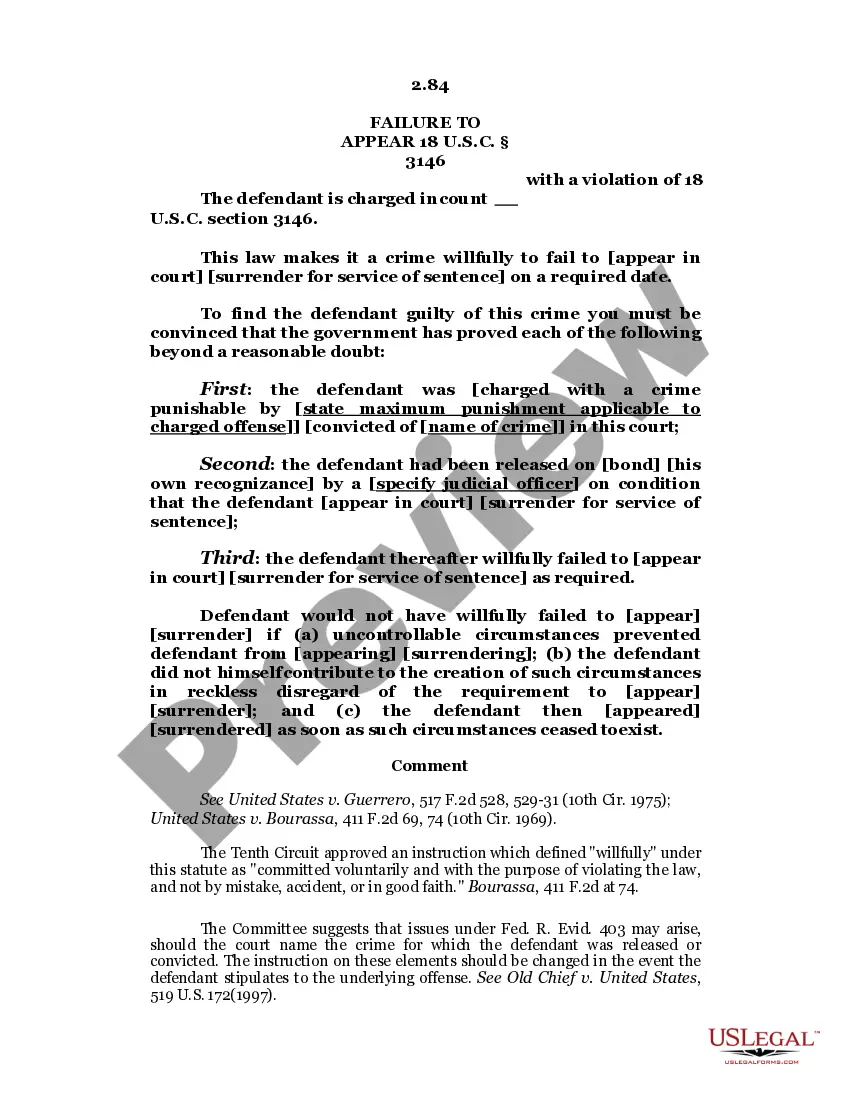
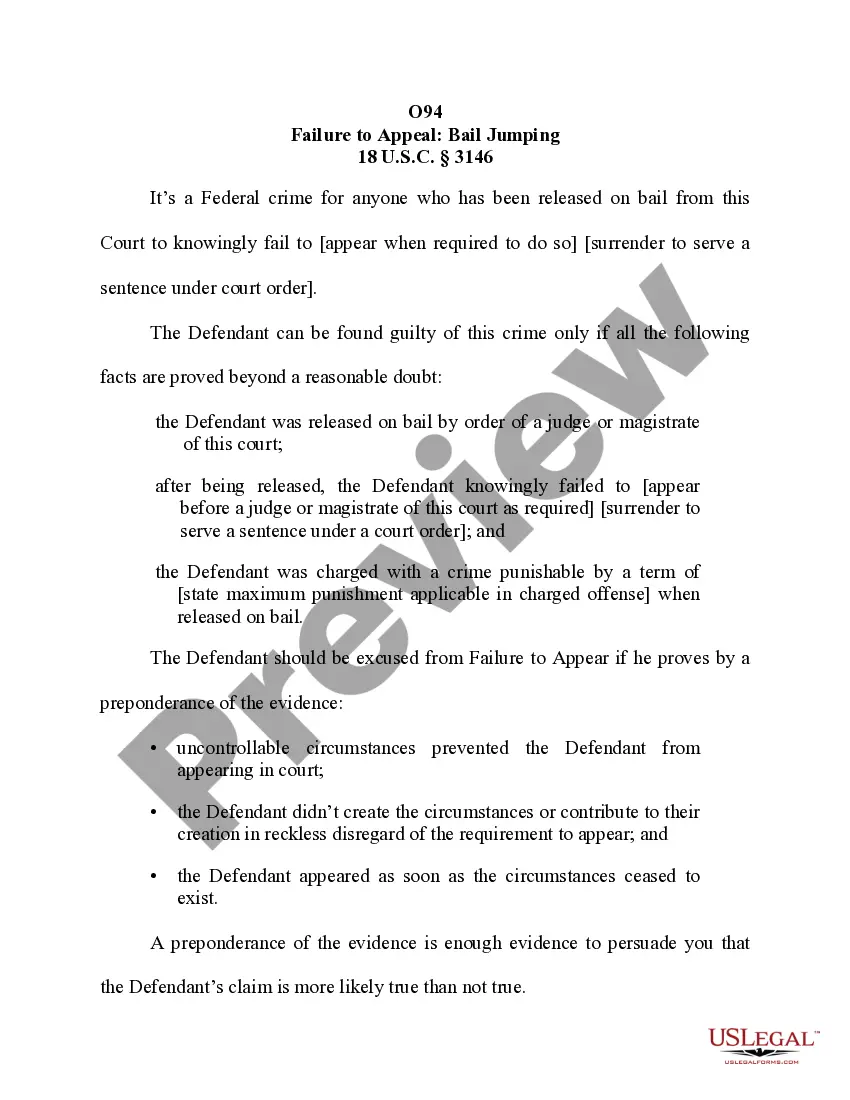
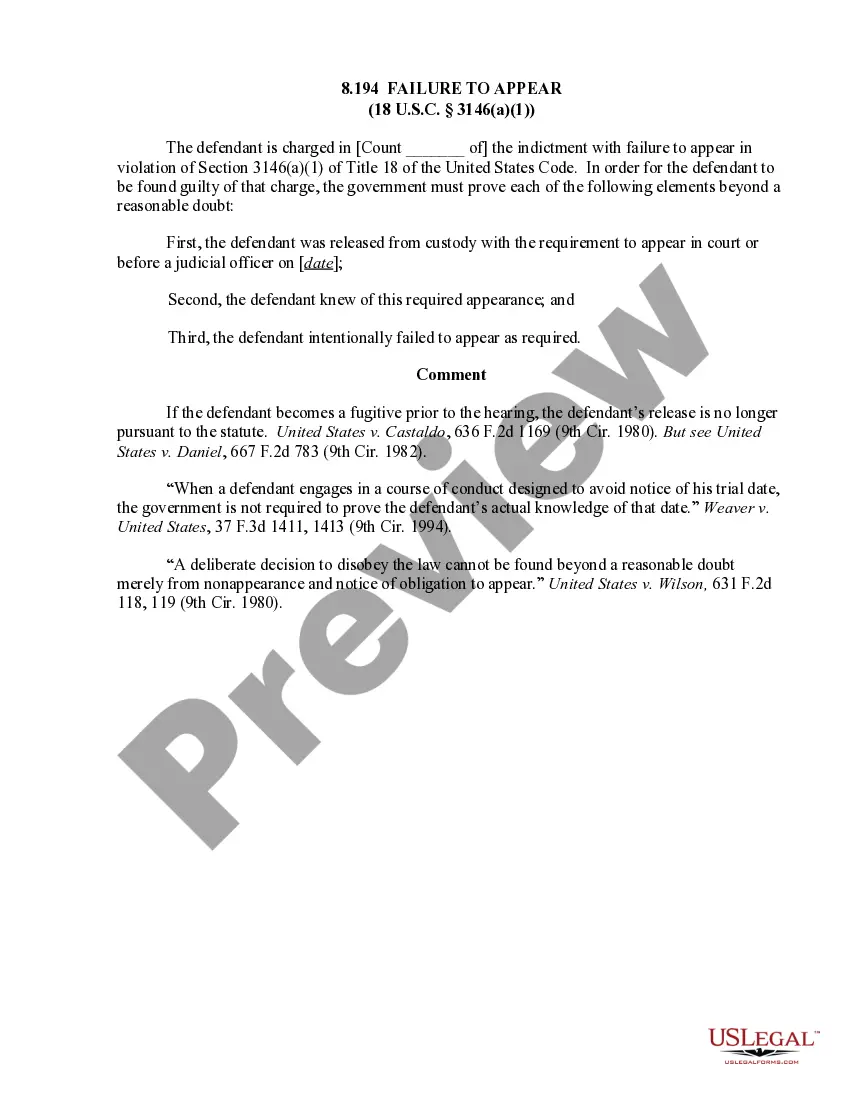
The Jury Instruction for Failure to Appear - Bail Jumping provides guidelines for jurors in cases where a defendant is accused of failing to appear in court after being released on bail. This form outlines the legal definitions and considerations relevant to such cases, ensuring that jurors understand the requirements for proving guilt. It differs from other jury instruction forms by specifically addressing bail jumping under federal law, helping jurors make informed decisions based on the evidence presented in court.
Key components of this form
- Definition of the offense: Describes the legal meaning of failure to appear and bail jumping.
- Burden of proof: Outlines the necessity for the prosecution to prove all elements of the offense beyond a reasonable doubt.
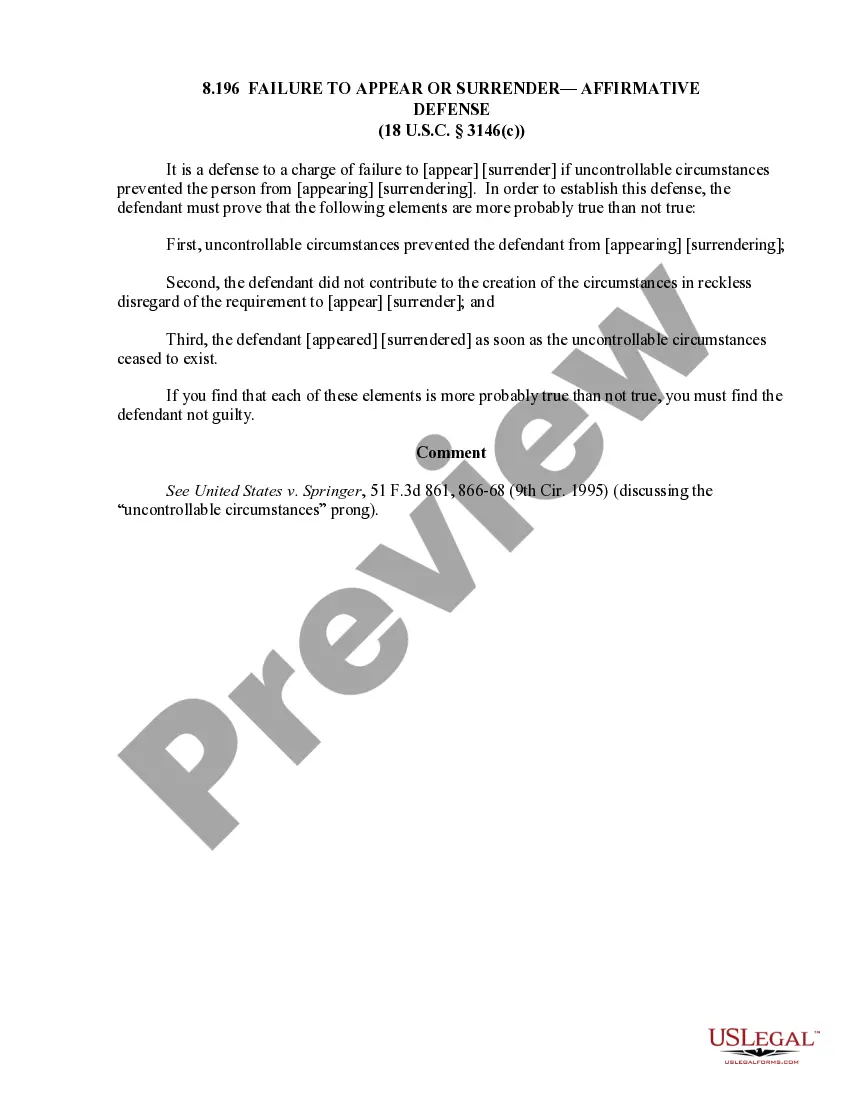
- Defendant's rights: States that the defendant has affirmative defenses available in certain circumstances.
- Affirmative defenses: Details conditions under which a defendant may not be guilty due to uncontrollable circumstances.
- Penalty information: Provides context on the potential penalties for bail jumping offenses.
When to use this document
This form is used in federal court proceedings where a defendant is charged with bail jumping after failing to appear for a scheduled court date. It is applicable when jurors need clear instructions on the legal parameters surrounding failure to appear cases, ensuring they are well-informed before deliberating a verdict.
Who can use this document
- Judges who need to provide clear jury instructions in bail jumping cases.
- Legal practitioners preparing cases involving failures to appear.
- Jurors who require guidance on legal definitions and standards of proof for specific cases.
Steps to complete this form
- Review the legal definitions and standards outlined in the form.
- Ensure all pertinent evidence is presented during the trial.
- Provide jurors with a copy of the instructions for clarity during deliberation.
- Specify the circumstances under which the court deems a defendantâs failure to appear unreasonable.
- Document any affirmative defenses the defendant may raise in response to the charges.
Notarization guidance
This form does not typically require notarization to be legally valid. However, some jurisdictions or document types may still require it. US Legal Forms provides secure online notarization powered by Notarize, available 24/7 for added convenience.
Get your form ready online
Our built-in tools help you complete, sign, share, and store your documents in one place.
Make edits, fill in missing information, and update formatting in US Legal Forms—just like you would in MS Word.
Download a copy, print it, send it by email, or mail it via USPS—whatever works best for your next step.
Sign and collect signatures with our SignNow integration. Send to multiple recipients, set reminders, and more. Go Premium to unlock E-Sign.
If this form requires notarization, complete it online through a secure video call—no need to meet a notary in person or wait for an appointment.
We protect your documents and personal data by following strict security and privacy standards.

Make edits, fill in missing information, and update formatting in US Legal Forms—just like you would in MS Word.

Download a copy, print it, send it by email, or mail it via USPS—whatever works best for your next step.

Sign and collect signatures with our SignNow integration. Send to multiple recipients, set reminders, and more. Go Premium to unlock E-Sign.

If this form requires notarization, complete it online through a secure video call—no need to meet a notary in person or wait for an appointment.

We protect your documents and personal data by following strict security and privacy standards.
Avoid these common issues
- Failing to include all elements of the offense: It's crucial to outline every requirement for proving bail jumping.
- Neglecting to clarify affirmative defenses: Ensure that jurors are informed about what constitutes uncontrollable circumstances.
- Using ambiguous language: Clarity is key in legal instruction to prevent misunderstandings among jurors.
Why complete this form online
- Convenience: Download the form anytime, ensuring easy access during legal proceedings.
- Editability: Modify the form to fit specific case needs while maintaining legal integrity.
- Reliability: Forms are prepared by licensed attorneys, ensuring they meet legal standards.
Legal use & context
- This form serves as a guide for presenting jury instructions in federal court regarding bail jumping.
- It highlights the legal obligations of defendants who have been released on bail.
- The instructions assist juries in correctly applying the law to the facts of the case.
What to keep in mind
- This form serves as a guide for jurors in bail jumping cases.
- Understanding the burden of proof is essential for jurors to reach a fair verdict.
- Defendants have affirmative defenses that must be considered in court.
Looking for another form?
Form popularity
FAQ
You may believe that failing to appear in court after you have been released on bail simply means that you will forfeit bond. As a result, a defendant who fails to appear in court will continue to face their original charge, may forfeit bond, and may face a separate bail jumping charge.
"Jumping bail" describes a situation where a person posts bail, is released on bail, and then subsequently fails to appear in court for the purpose of avoiding prosecution or sentencing. Jumping bail, or skipping bail, may result in the person's bail bond being forfeited and a warrant issued for their arrest.
"Jumping bail" describes a situation where a person posts bail, is released on bail, and then subsequently fails to appear in court for the purpose of avoiding prosecution or sentencing. Jumping bail, or skipping bail, may result in the person's bail bond being forfeited and a warrant issued for their arrest.
You pay the bondsman up to 10% of the bail amount so that if a defendant has bail set at $50,000, you can buy or secure a bond for $5000. After paying the bond amount, the bondsman will deliver it to the court to secure the defendant's release. The premium paid to the bondsman is non-refundable.
Skipping Bail is Illegal Make no mistake. Skipping bail is illegal. A defendant who fails to appear in court is considered a fugitive and will likely face additional charges. If you have misdemeanor charges, you could get a felony charge for the bail skip added to your charges.
A conviction for Bail Jumping and Failure to Appear is punished as a Class A Misdemeanor,2 with a maximum possible fine under Texas state law of up to $4,000 and jail time of up to one year, unless it falls into one of the two categories described in the next two paragraphs.
As long as you attend all of your court appearances, your cash bail amount will be returned.If you fail to appear at any court appearance, you may forfeit that cash bail (California Penal Code Section 1305) and will not be able to get the cash back.
You can't get jail time for not paying the bail bond...they would have to sue you to get the money. You may just want to be honest with them about your financial situation and see if they will work out a payment plan.
In the event of a skipped court appearance, the bail bond is said to be in default. Now you are at risk of losing all the money you put up to get your friend or family member out of jail. You are also at risk of losing the collateral you used to secure the bond, which could be your house, car or other possessions.