Jury Instruction - Obstruction Of Correspondence - Taking Of Mail
What this document covers
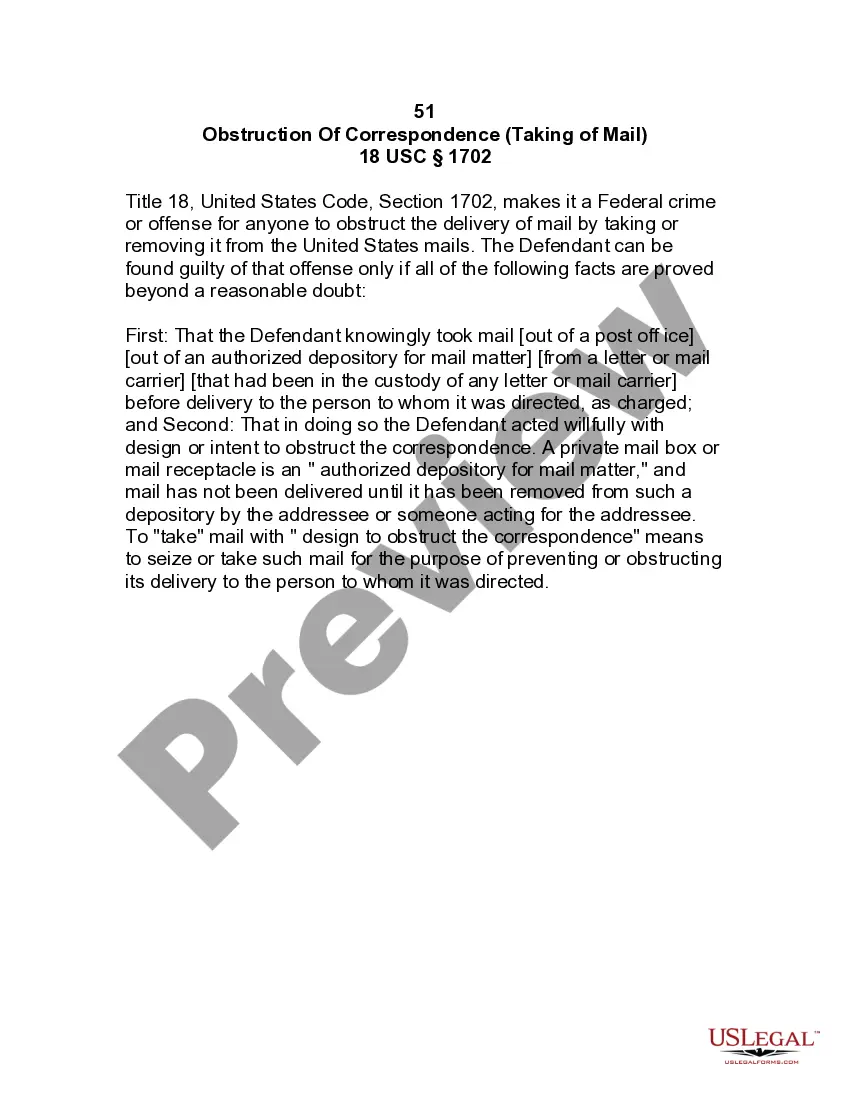
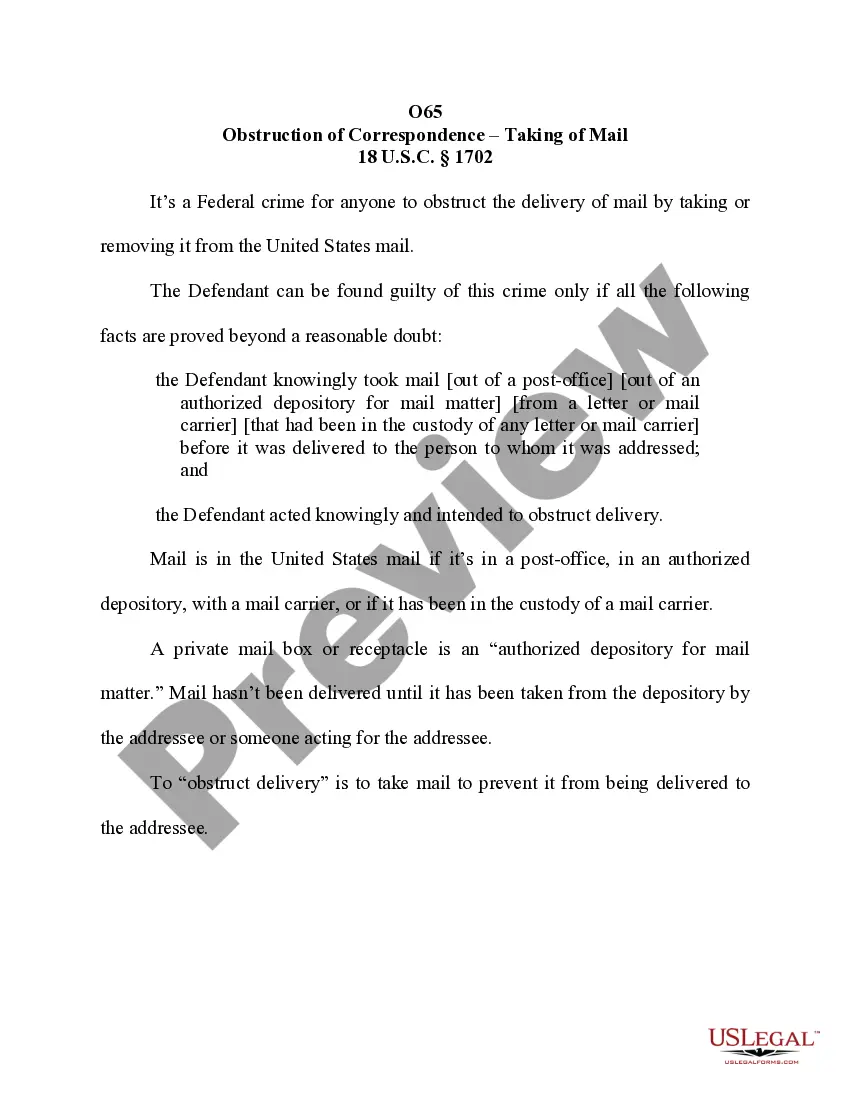
The Jury Instruction for Obstruction of Correspondence (Taking of Mail) is a legal document that provides guidance to juries in federal court cases involving violations of Title 18, United States Code, Section 1702. This form details the essential elements necessary to establish a conviction for obstructing mail delivery, distinguishing it from other jury instructions on related offenses.
Key parts of this document
- Definition of obstruction: Explains what constitutes obstruction of mail delivery under federal law.
- Elements of the offense: Outlines the specific facts that must be proven beyond a reasonable doubt.
- Willful intent: Details the need for the defendant to act willfully with the purpose of obstructing correspondence.
- Authorized depositories: Clarifies what qualifies as an authorized depository for mail matter.
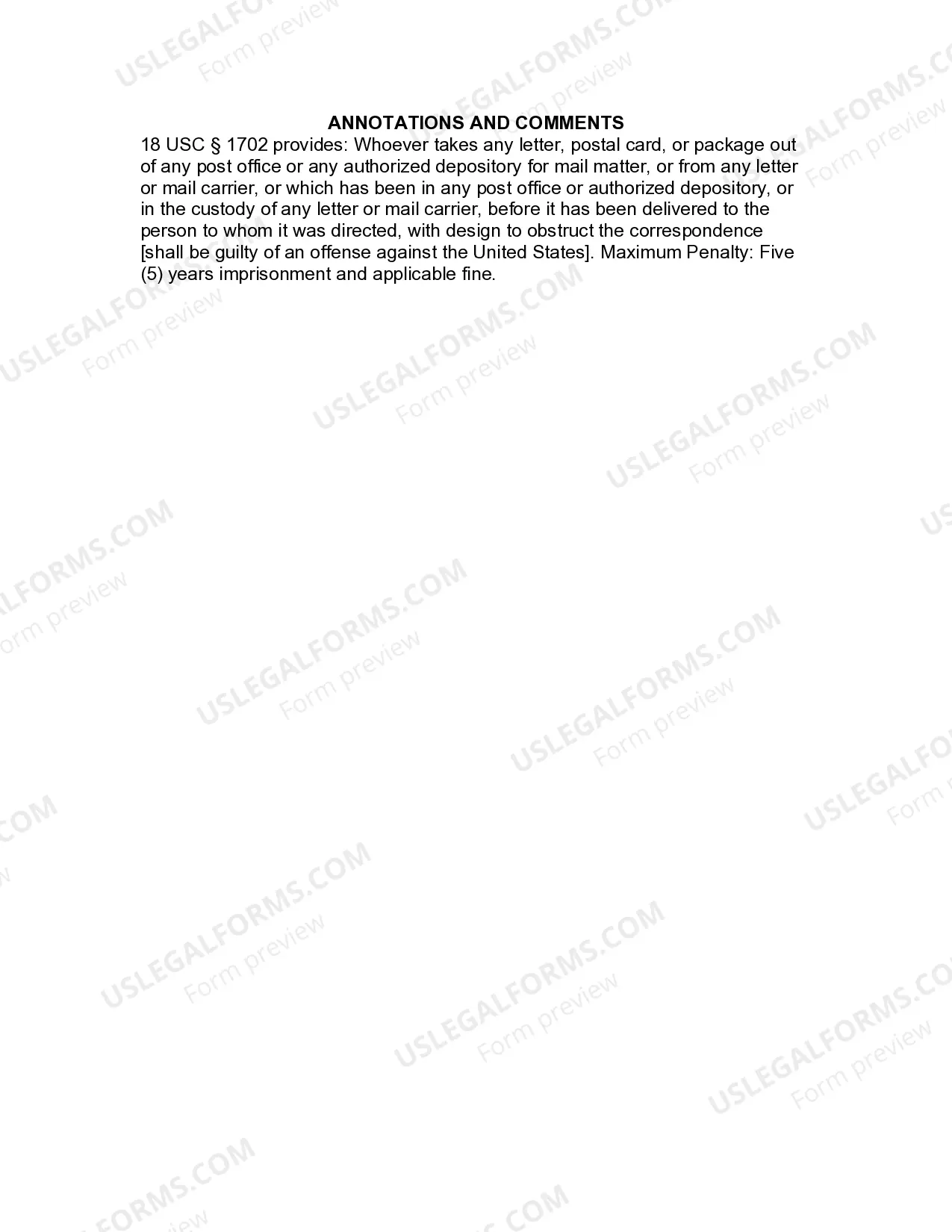
- Criminal penalties: Lists the maximum penalties, including imprisonment and fines for violations.
Common use cases
This form is used during federal trials when a jury is tasked with evaluating cases related to the obstruction of mail. It serves to clarify the legal standards jurors must apply in determining whether someone has unlawfully taken mail with the intent to obstruct its delivery.
Who should use this form
- Judges presiding over federal cases involving mail obstruction.
- Attorneys representing defendants or plaintiffs in such cases.
- Jury members who require clear instructions regarding the law on mail obstruction.
How to prepare this document
- Review the elements of the offense to understand what needs to be proven.
- Ensure jurors are provided with the definition of willful intent regarding obstructing mail.
- Introduce the concept of authorized depositories to the jury as they deliberate.
- Discuss the significance of proving the defendant's intent to obstruct correspondence.
- Clarify the potential penalties if the jury finds the defendant guilty.
Is notarization required?
This form usually doesn’t need to be notarized. However, local laws or specific transactions may require it. Our online notarization service, powered by Notarize, lets you complete it remotely through a secure video session, available 24/7.
Get your form ready online
Our built-in tools help you complete, sign, share, and store your documents in one place.
Make edits, fill in missing information, and update formatting in US Legal Forms—just like you would in MS Word.
Download a copy, print it, send it by email, or mail it via USPS—whatever works best for your next step.
Sign and collect signatures with our SignNow integration. Send to multiple recipients, set reminders, and more. Go Premium to unlock E-Sign.
If this form requires notarization, complete it online through a secure video call—no need to meet a notary in person or wait for an appointment.
We protect your documents and personal data by following strict security and privacy standards.

Make edits, fill in missing information, and update formatting in US Legal Forms—just like you would in MS Word.

Download a copy, print it, send it by email, or mail it via USPS—whatever works best for your next step.

Sign and collect signatures with our SignNow integration. Send to multiple recipients, set reminders, and more. Go Premium to unlock E-Sign.

If this form requires notarization, complete it online through a secure video call—no need to meet a notary in person or wait for an appointment.

We protect your documents and personal data by following strict security and privacy standards.
Common mistakes
- Failing to adequately explain the difference between lawful mail handling and obstruction.
- Not clearly outlining the requirements for proving willful intent.
- Overlooking the importance of an authorized depository in the definition of the offense.
Benefits of using this form online
- Immediate access to correctly drafted jury instructions tailored for federal cases.
- Easily customizable to fit specific trial circumstances.
- Utilization of templates created by licensed attorneys, ensuring legal reliability.
Main things to remember
- The form provides critical guidance for juries in federal cases involving mail obstruction.
- Understanding the legal definitions and requirements is essential for accurate verdicts.
- This jury instruction emphasizes the importance of intent and authorized handling of mail.
Looking for another form?








Form popularity
FAQ
Whoever, without authority, opens, or destroys any mail or package of newspapers not directed to him, shall be fined under this title or imprisoned not more than one year, or both. (June 25, 1948, ch. 645, 62 Stat.
The exact definition will vary by jurisdiction, but "tampering" generally includes opening, destroying, damaging, or interfering with mail intended for another person.Taking mail from someone else's mailbox is a crime. Destroying, damaging, or interfering with the mail are also often considered mail tampering.
18, U.S.C., 1702, makes it a Federal crime or offense for anyone to obstruct the delivery of mail by taking or removing it from the United States mails.
Jury lists are compiled from voter registrations and driver license or ID renewals. From those lists, summonses are mailed. A panel of jurors is then assigned to a courtroom.
These are civil or criminal jury instructions approved by a state court, bench committee, or bar association. They are commonly used by courts in the relevant jurisdiction, as they ease the process of drafting fair jury instructions and theoretically do not have errors.
Jury Instructions. instructions that are given by the trial judge that specifically state what the defendant can be found guilty of and what the prosecution or plaintiff has to prove in order for a guilty verdict.
They will review the evidence and arguments made by both sides, and frame the legal principles on which the jury has to make its decision. These remarks from the judge are known as jury directions. Jury directions have become more and more frequent as the criminal process has developed over the generations.