Jury Instruction - 3.3.2 Section 1, Per Se Violation Tying Agreement - Defense Of Justification
Understanding this form
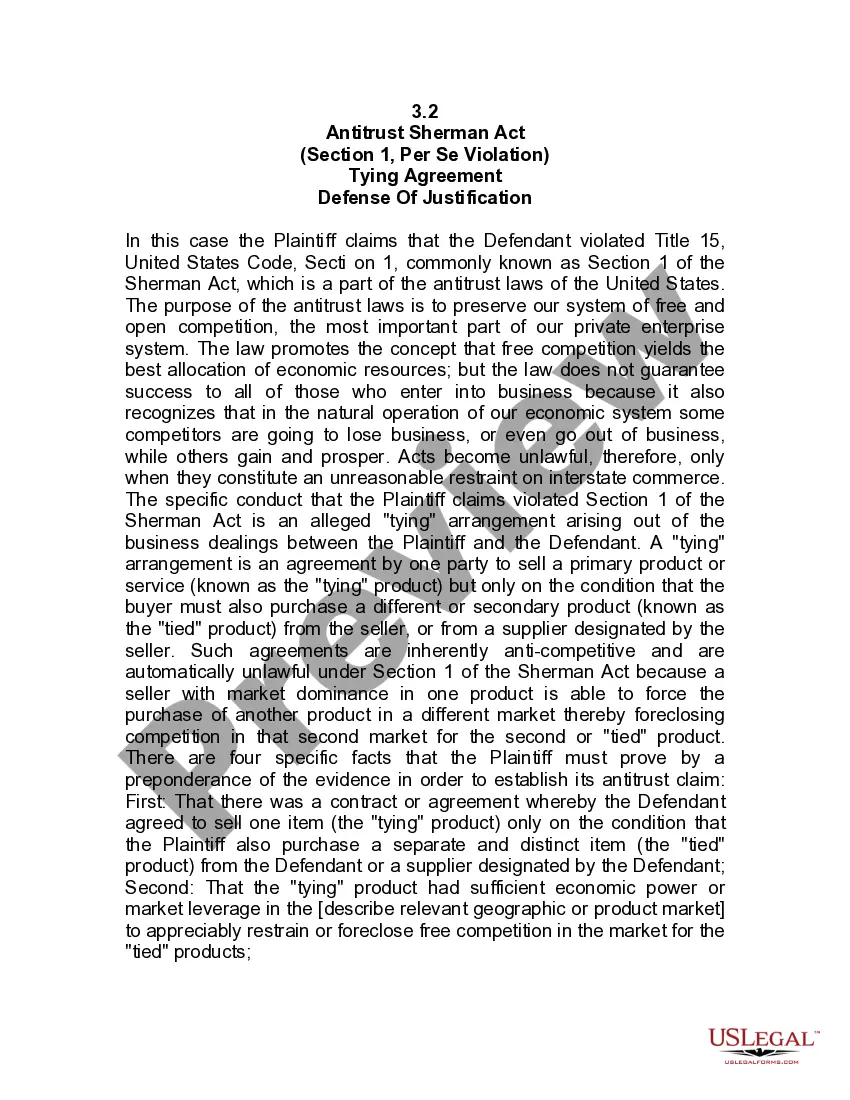
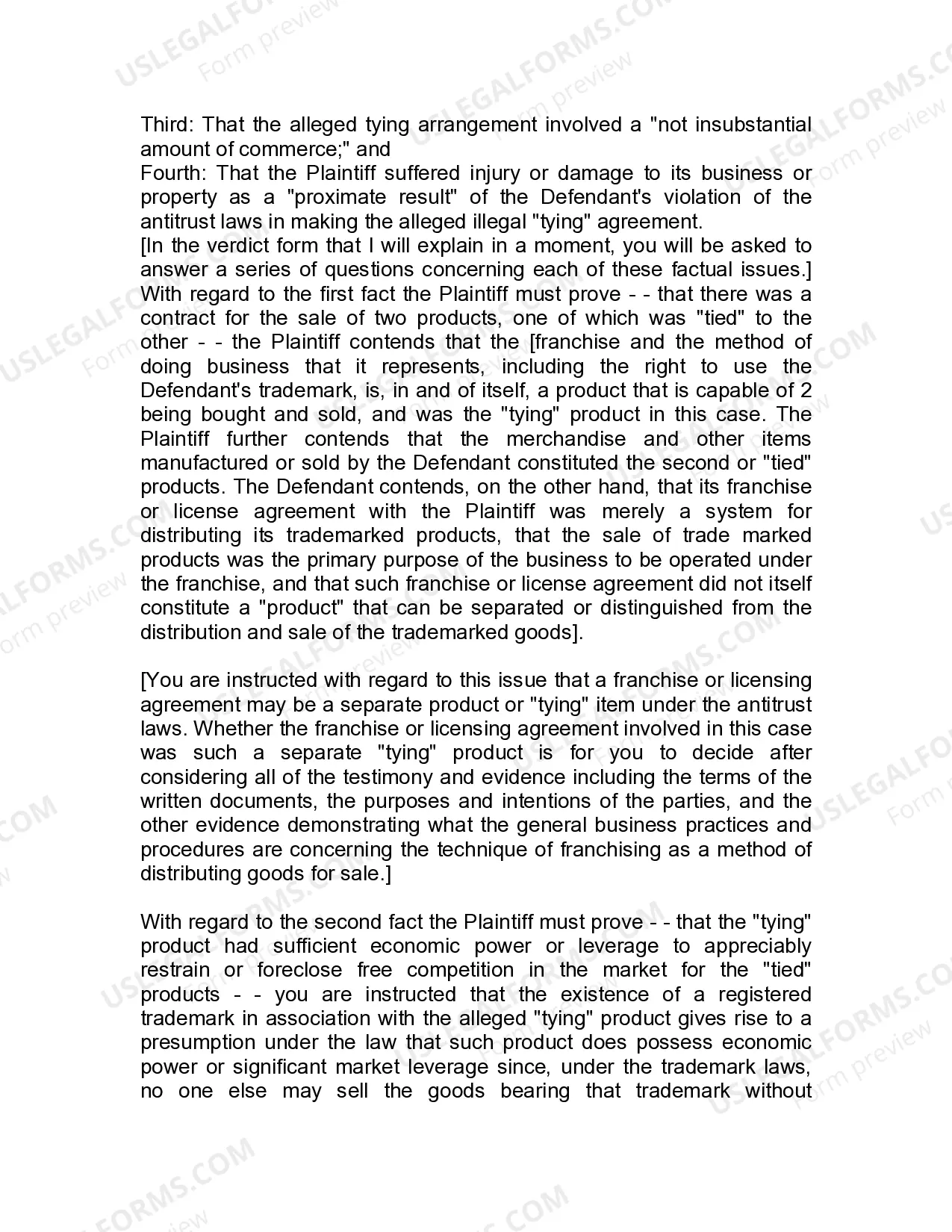
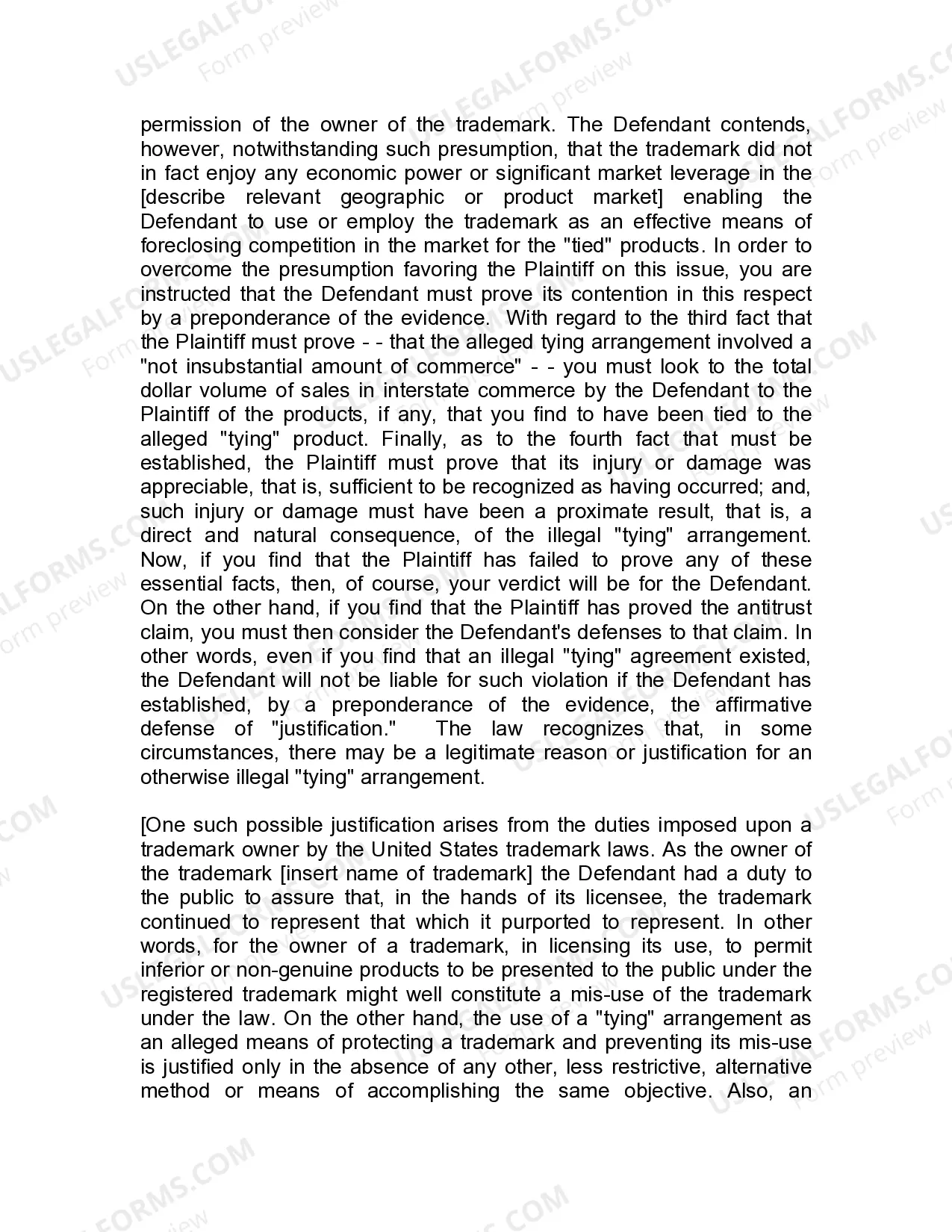
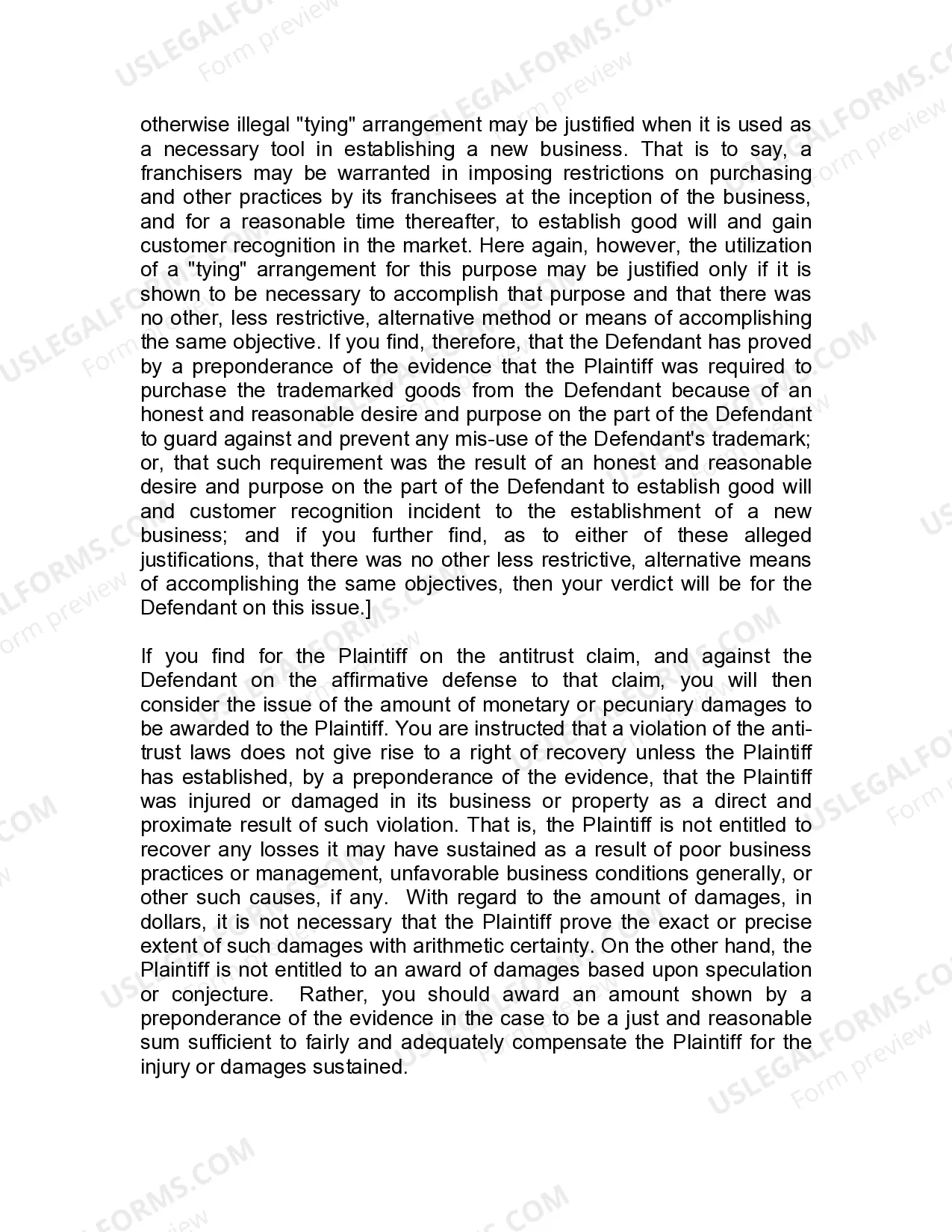
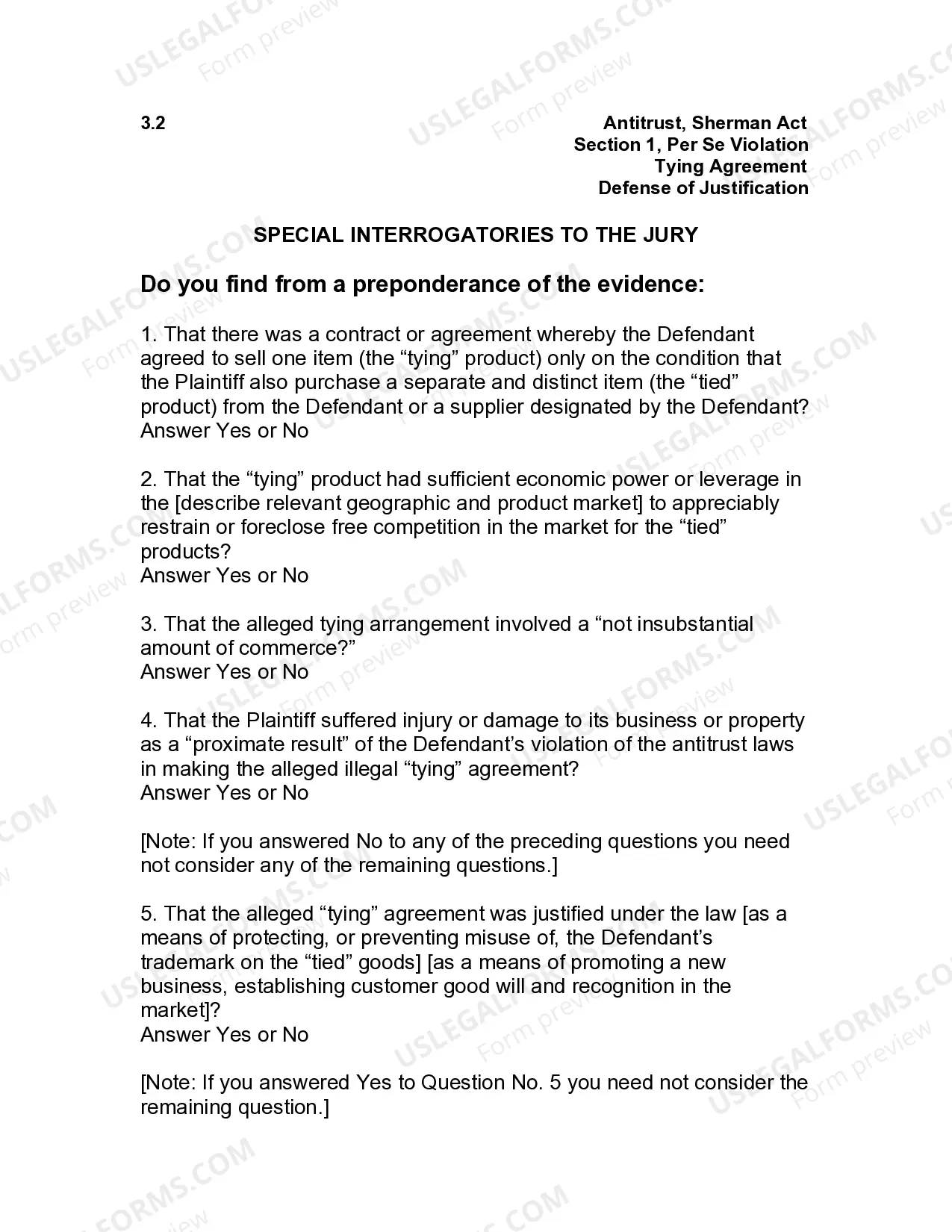
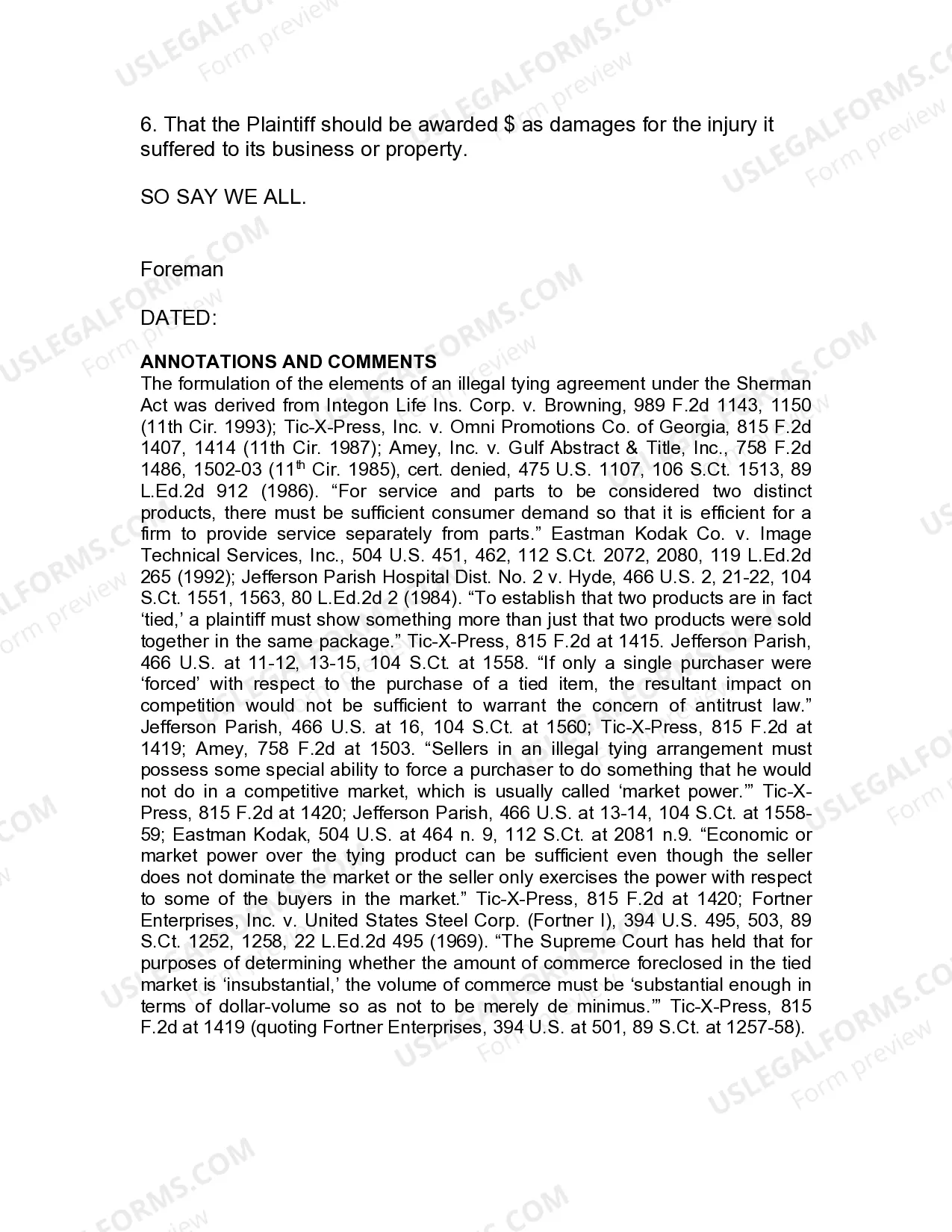
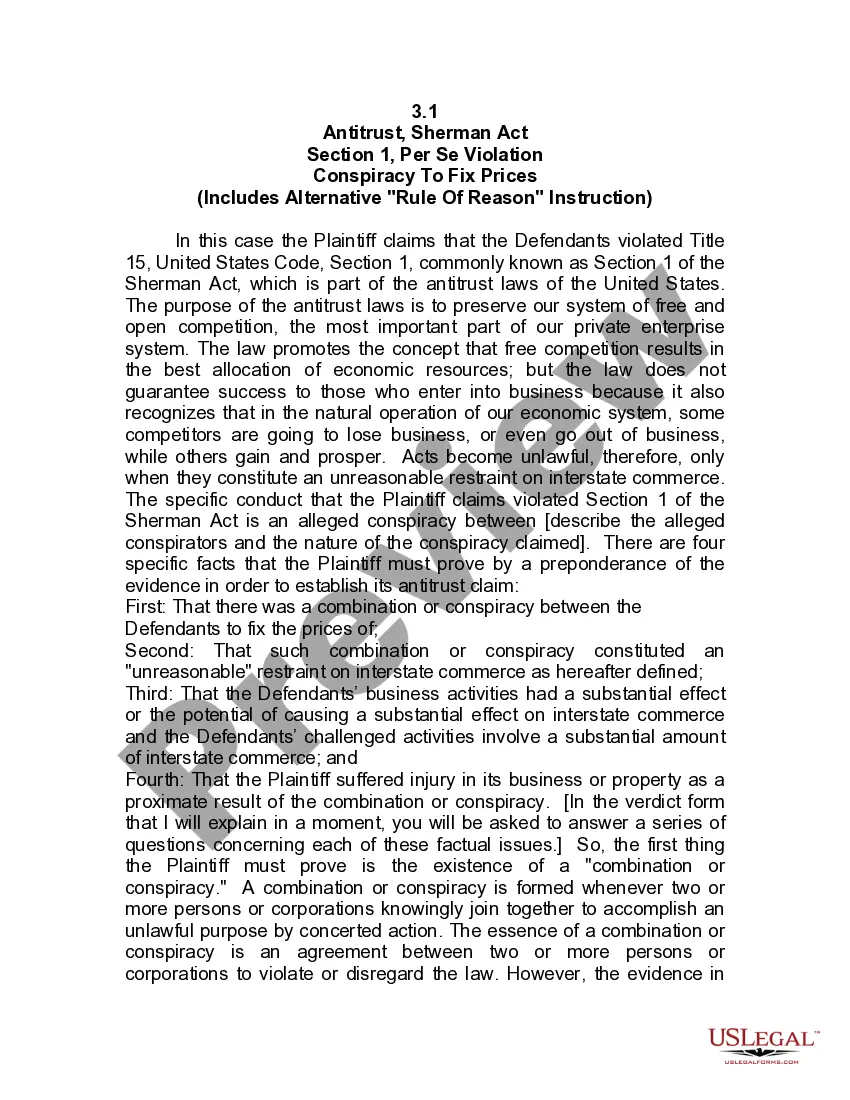
The Jury Instruction - 3.3.2 Section 1, Per Se Violation Tying Agreement - Defense of Justification provides sample jury instructions for courts dealing with antitrust cases, specifically those involving tying agreements under Section 1 of the Sherman Act. This form guides juries in determining whether a defendant engaged in an illegal tying arrangement and outlines the necessary conditions the plaintiff must prove to establish their antitrust claim.
Key parts of this document
- Definitions of key legal concepts, including "tying product" and "tied product".
- Elements that the Plaintiff must prove, which include the existence of a contract, economic power, amount of commerce involved, and resultant damages.
- Consideration of defenses, including justification based on trademark protection or new business establishment.
- Special interrogatories that guide jurors in their decision-making process.
When to use this form
This form is utilized during jury trials concerning claims of illegal tying arrangements in violation of antitrust laws. It is particularly relevant when a plaintiff alleges that a defendant has conditioned the sale of one product on the purchase of another, leading to an unreasonable restraint on commerce. This form helps clarify the legal standards and criteria that must be met for such claims.
Intended users of this form
- Judges presiding over jury trials involving antitrust cases.
- Legal practitioners representing either plaintiffs or defendants in antitrust violations.
- Juries tasked with determining the outcome of antitrust litigation related to tying agreements.
Completing this form step by step
- Review the relevant facts of the case to ensure accurate presentation of the Plaintiff's claims.
- Determine the agreement details between the Plaintiff and Defendant to establish the existence of a tying arrangement.
- Assess the market power of the tying product as it relates to the tied product.
- Evaluate the commerce involved and any damages sustained by the Plaintiff due to the alleged antitrust violation.
- Prepare the jury instructions based on the outlined components, ensuring all elements for the claim are covered.
Notarization guidance
Notarization is generally not required for this form. However, certain states or situations might demand it. You can complete notarization online through US Legal Forms, powered by Notarize, using a verified video call available anytime.
Get your form ready online
Our built-in tools help you complete, sign, share, and store your documents in one place.
Make edits, fill in missing information, and update formatting in US Legal Forms—just like you would in MS Word.
Download a copy, print it, send it by email, or mail it via USPS—whatever works best for your next step.
Sign and collect signatures with our SignNow integration. Send to multiple recipients, set reminders, and more. Go Premium to unlock E-Sign.
If this form requires notarization, complete it online through a secure video call—no need to meet a notary in person or wait for an appointment.
We protect your documents and personal data by following strict security and privacy standards.

Make edits, fill in missing information, and update formatting in US Legal Forms—just like you would in MS Word.

Download a copy, print it, send it by email, or mail it via USPS—whatever works best for your next step.

Sign and collect signatures with our SignNow integration. Send to multiple recipients, set reminders, and more. Go Premium to unlock E-Sign.

If this form requires notarization, complete it online through a secure video call—no need to meet a notary in person or wait for an appointment.

We protect your documents and personal data by following strict security and privacy standards.
Typical mistakes to avoid
- Failing to establish a clear connection between the tying product and the tied product.
- Neglecting to provide sufficient evidence for the economic power of the tying product.
- Omitting vital facts necessary to support the Plaintiff's claims, leading to insufficient jury instruction.
Legal use & context
- This form serves as a reliable guide for juries in antitrust cases, ensuring that jury instructions are aligned with current legal standards.
- Understanding the legal framework surrounding Section 1 of the Sherman Act is crucial for enforcing fair competition regulations.
- Misapplication of this form can lead to biased jury decisions, undermining the legal process in antitrust litigation.
Looking for another form?

Form popularity
FAQ
The Sherman Act outlawed contracts and conspiracies restraining trade and/or monopolizing industries. For example, the Sherman Act says that competing individuals or businesses can't fix prices, divide markets, or attempt to rig bids. The Sherman Act laid out specific penalties and fines for violating the terms.
Antitrust law is the law of competition. Why then is it called antitrust? The answer is that these laws were originally established to check the abuses threatened or imposed by the immense trusts that emerged in the late 19th Century.
Antitrust laws protect competition. Free and open competition benefits consumers by ensuring lower prices and new and better products. In a freely competitive market, each competing business generally will try to attract consumers by cutting its prices and increasing the quality of its products or services.
The Sherman Act; the Clayton Act; and. the Federal Trade Commission Act (FTCA).
The main statutes are the Sherman Act of 1890, the Clayton Act of 1914 and the Federal Trade Commission Act of 1914.
ANTITRUST LAWS The most common antitrust violations fall into two categories: (i) Agreements to restrain competition, and (ii) efforts to acquire a monopoly. In the case of a merger, a combination that would likely substantially reduce competition in a market would also violate antitrust laws.
ANTITRUST LAWS The most common antitrust violations fall into two categories: (i) Agreements to restrain competition, and (ii) efforts to acquire a monopoly. In the case of a merger, a combination that would likely substantially reduce competition in a market would also violate antitrust laws.
An example of behavior that antitrust laws prohibit is lowering the price in a certain geographic area in order to push out the competition.Another example of an antitrust violation is collusion. For example, three companies manufacture and sell widgets. They charge $1.00, $1.05, and $1.10 for their widgets.