Jury Instruction - 10.10.1 Reasonable Compensation To Stockholder - Employee
Overview of this form
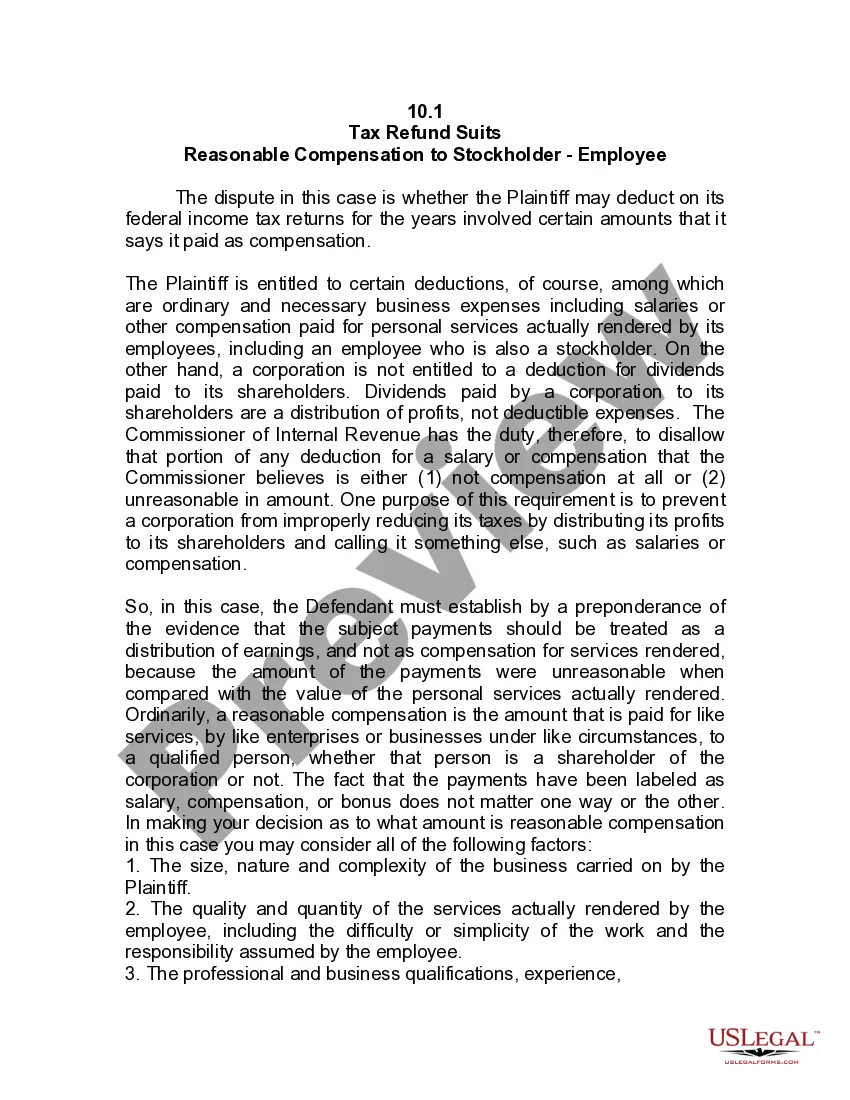
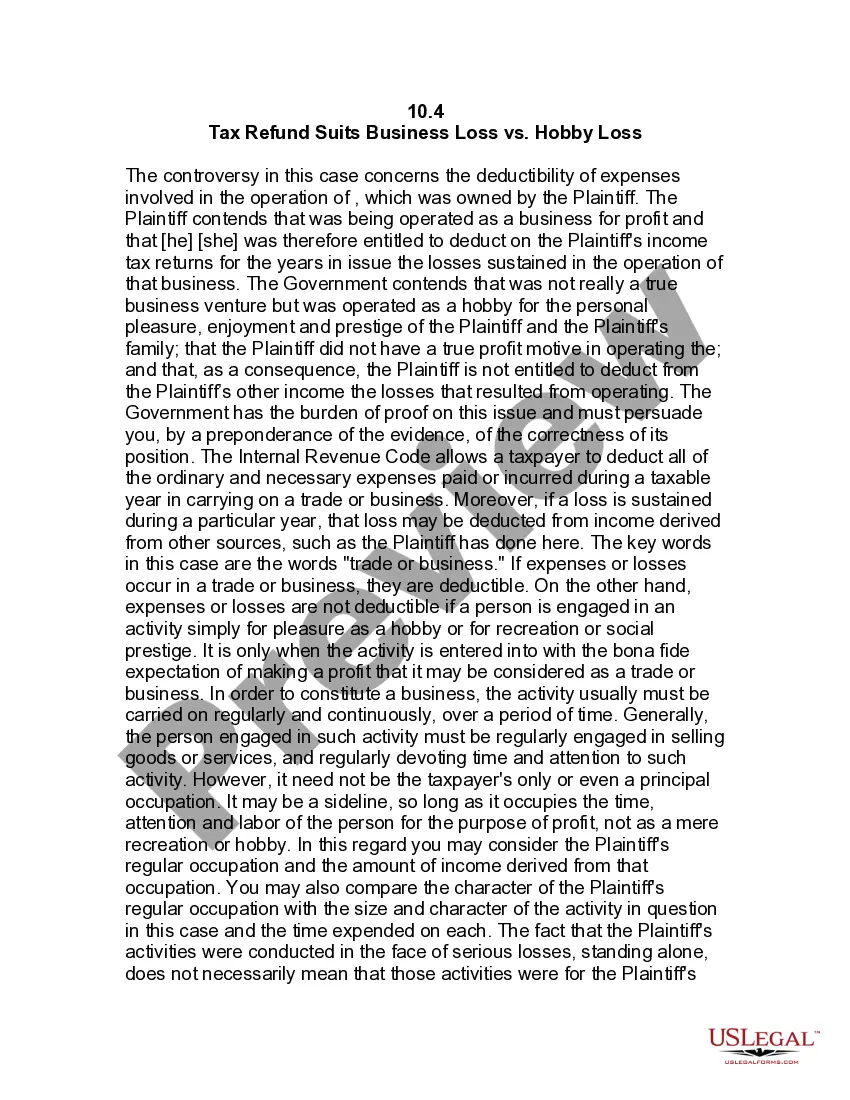
The Jury Instruction - 10.10.1 Reasonable Compensation To Stockholder - Employee is a legal template designed to assist in tax refund suits concerning the deductibility of payments made to employees who are also shareholders. This form provides model jury instructions used throughout the United States, outlining what constitutes reasonable compensation versus profit distribution. It serves to guide jurors in evaluating whether a corporation's compensation claims are justifiable under the law.
What’s included in this form
- Explanation of tax deduction eligibility for employee compensation
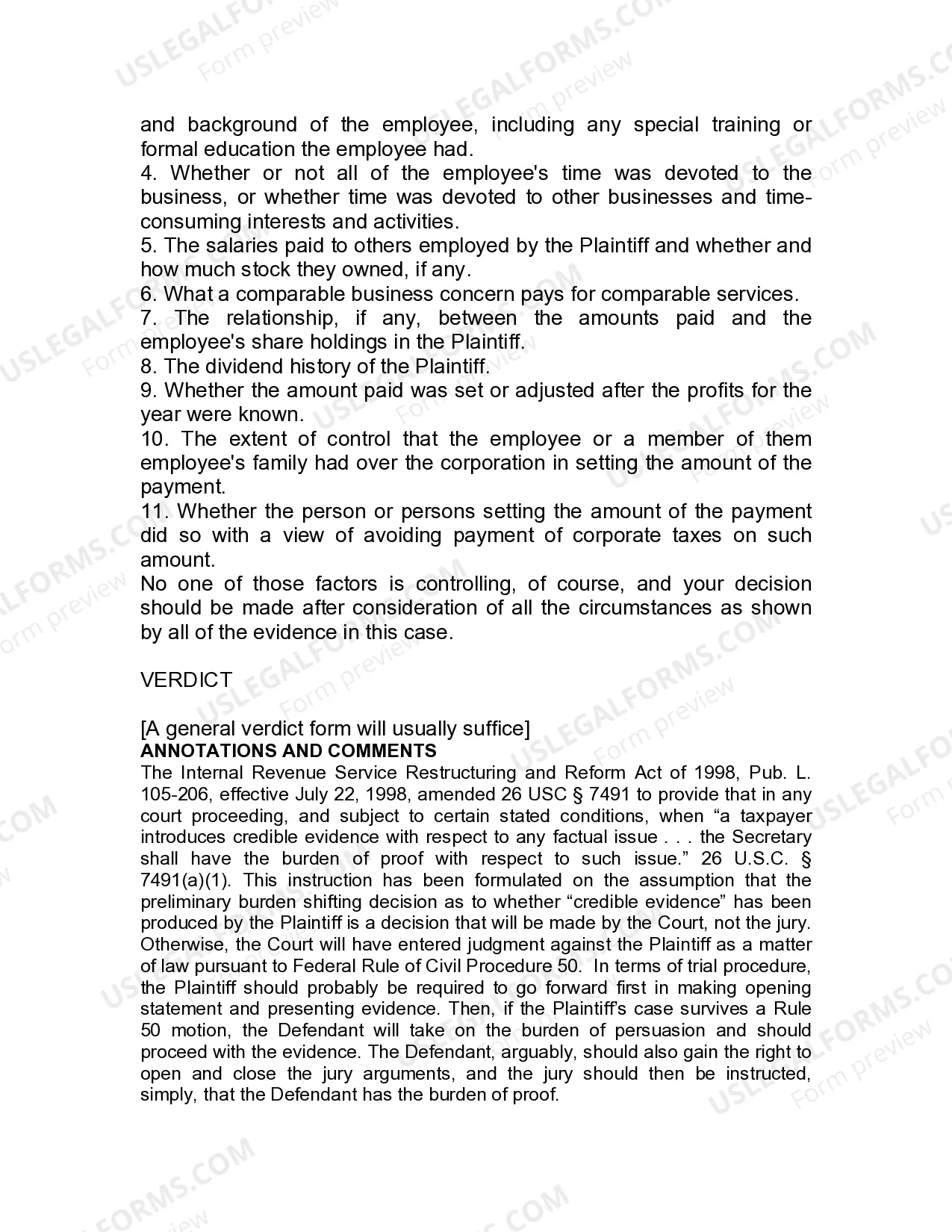
- Criteria for determining reasonable compensation
- Instructions for jurors on assessing evidence and determining verdicts
- Factors influencing compensation judgments, such as business size and employee qualifications
- Clarification on the distinction between salary and dividends


Common use cases
This form is applicable in cases where a corporation seeks to deduct compensation paid to an employee who is also a shareholder on their federal income tax returns. Use this form when disputing whether these payments should be classified as reasonable compensation or as profit distributions that do not qualify for tax deductions. It is particularly relevant in legal disputes involving tax refund claims
Intended users of this form
This form is intended for:
- Corporations pursuing tax refund claims regarding employee compensation
- Legal professionals representing clients in tax-related lawsuits
- Shareholders who are involved in disputes over compensation classifications
- Accountants needing a framework for tax deduction support
Instructions for completing this form
- Identify the parties involved in the case
- Review the compensation payments made to the employee-shareholder
- Evaluate the factors influencing reasonable compensation as outlined in the instructions
- Prepare the evidence to support claims regarding the nature of the payments
- Complete the jury instructions as guided by the form for presentation during trial
Notarization guidance
This form does not typically require notarization unless specified by local law. However, it is advisable to check local regulations or consult with an attorney regarding specific requirements that may apply in your jurisdiction.
Get your form ready online
Our built-in tools help you complete, sign, share, and store your documents in one place.
Make edits, fill in missing information, and update formatting in US Legal Forms—just like you would in MS Word.
Download a copy, print it, send it by email, or mail it via USPS—whatever works best for your next step.
Sign and collect signatures with our SignNow integration. Send to multiple recipients, set reminders, and more. Go Premium to unlock E-Sign.
If this form requires notarization, complete it online through a secure video call—no need to meet a notary in person or wait for an appointment.
We protect your documents and personal data by following strict security and privacy standards.

Make edits, fill in missing information, and update formatting in US Legal Forms—just like you would in MS Word.

Download a copy, print it, send it by email, or mail it via USPS—whatever works best for your next step.

Sign and collect signatures with our SignNow integration. Send to multiple recipients, set reminders, and more. Go Premium to unlock E-Sign.

If this form requires notarization, complete it online through a secure video call—no need to meet a notary in person or wait for an appointment.

We protect your documents and personal data by following strict security and privacy standards.
Mistakes to watch out for
- Failing to differentiate between salaries and profit distributions
- Neglecting to gather supporting evidence related to compensation
- Using compensation figures without considering local market standards
- Overlooking the importance of the employee's qualifications and contributions
Advantages of online completion
- Convenience of downloading and filling out the form at your own pace
- Editability allows for customized language and details as needed
- Access to legally vetted documents ensures compliance with current laws
- Secured and organized storage of forms for easy reference during legal matters
Legal use & context
- Establishes legal guidelines for jury consideration in tax deduction cases.
- Helps prevent improper tax deductions and maintain fair tax practices.
- Informs both plaintiffs and defendants of evidentiary expectations related to compensation claims.
Quick recap
- The form provides essential jury instructions related to tax and compensation disputes.
- Understanding the distinction between reasonable compensation and dividends is crucial.
- This form helps guide the jurorsâ assessments based on various factors influencing compensation.
- Accessible across multiple states, it serves as a reliable reference for legal professionals.
Looking for another form?

Form popularity
FAQ
You pay tax on either all your profit, or half (50%) your profit, depending on how long you held the shares. Less than 12 months and you pay tax on the entire profit. More than 12 months and you pay tax on 50% of the profit only.
You can minimize or avoid capital gains taxes by investing for the long term, using tax-advantaged retirement plans, and offsetting capital gains with capital losses.
Invest for the long term. Take advantage of tax-deferred retirement plans. Use capital losses to offset gains. Watch your holding periods. Pick your cost basis.
Taking sales proceeds and buying new stock typically doesn't save you from taxes.With some investments, you can reinvest proceeds to avoid capital gains, but for stock owned in regular taxable accounts, no such provision applies, and you'll pay capital gains taxes according to how long you held your investment.
If you're holding shares of stock in a regular brokerage account, you may need to pay capital gains taxes when you sell the shares for a profit.Short-term capital gains tax is a tax on profits from the sale of an asset held for a year or less. Short-term capital gains tax rates are the same as your usual tax bracket.
If you sold stocks at a profit, you will owe taxes on gains from your stocks.And if you earned dividends or interest, you will have to report those on your tax return as well. However, if you bought securities but did not actually sell anything in 2020, you will not have to pay any "stock taxes."
If the IRS discovers that mistakes or omissions on your tax return resulted in underpayment, you will be subject to the late payment penalty of 0.5 percent of the overdue amount for every month the payment is late. In addition, the IRS charges interest on overdue taxes that is compounded daily.
Generally, any profit you make on the sale of a stock is taxable at either 0%, 15% or 20% if you held the shares for more than a year or at your ordinary tax rate if you held the shares for less than a year. Also, any dividends you receive from a stock are usually taxable.