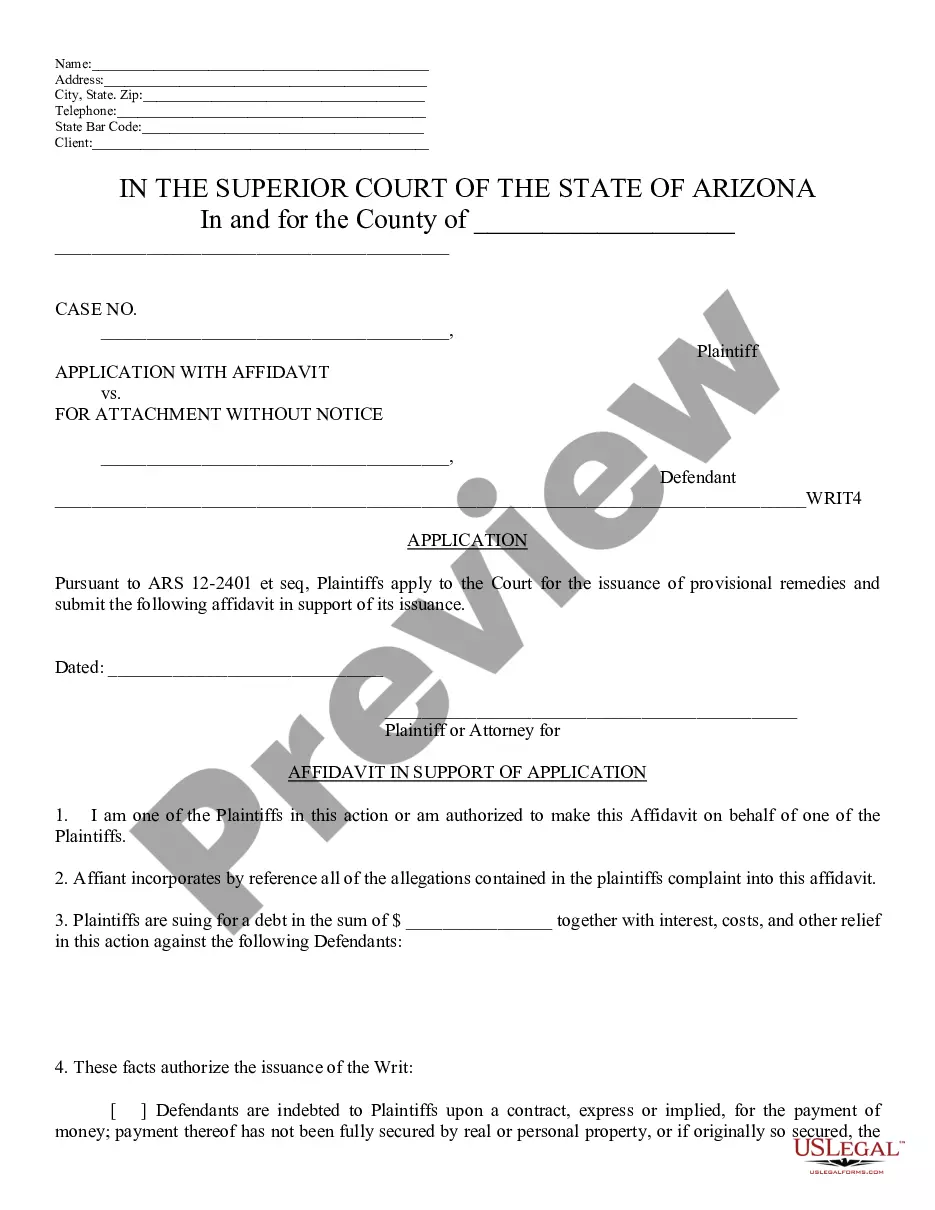
Mississippi Complaint for Alienation of Affections
What is this form?
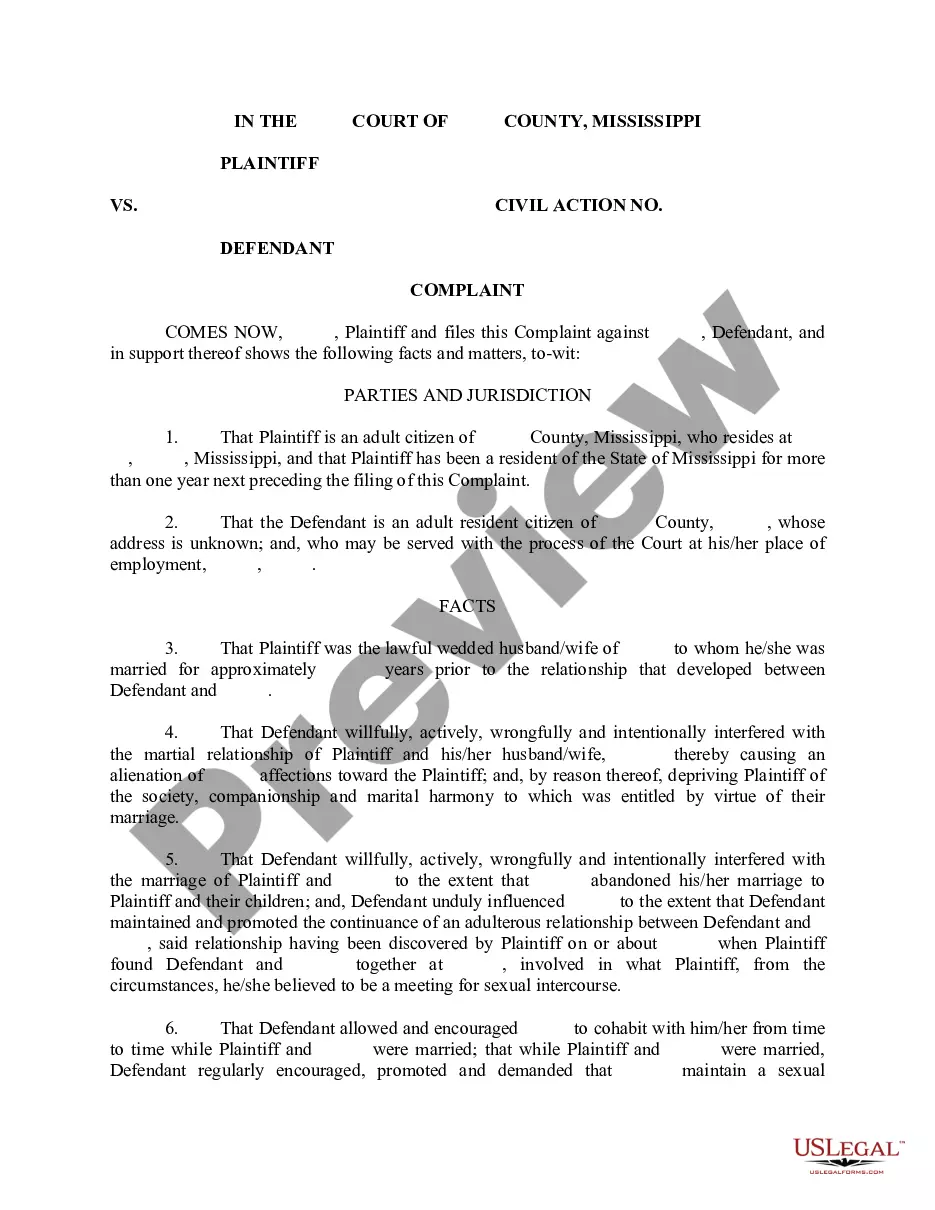
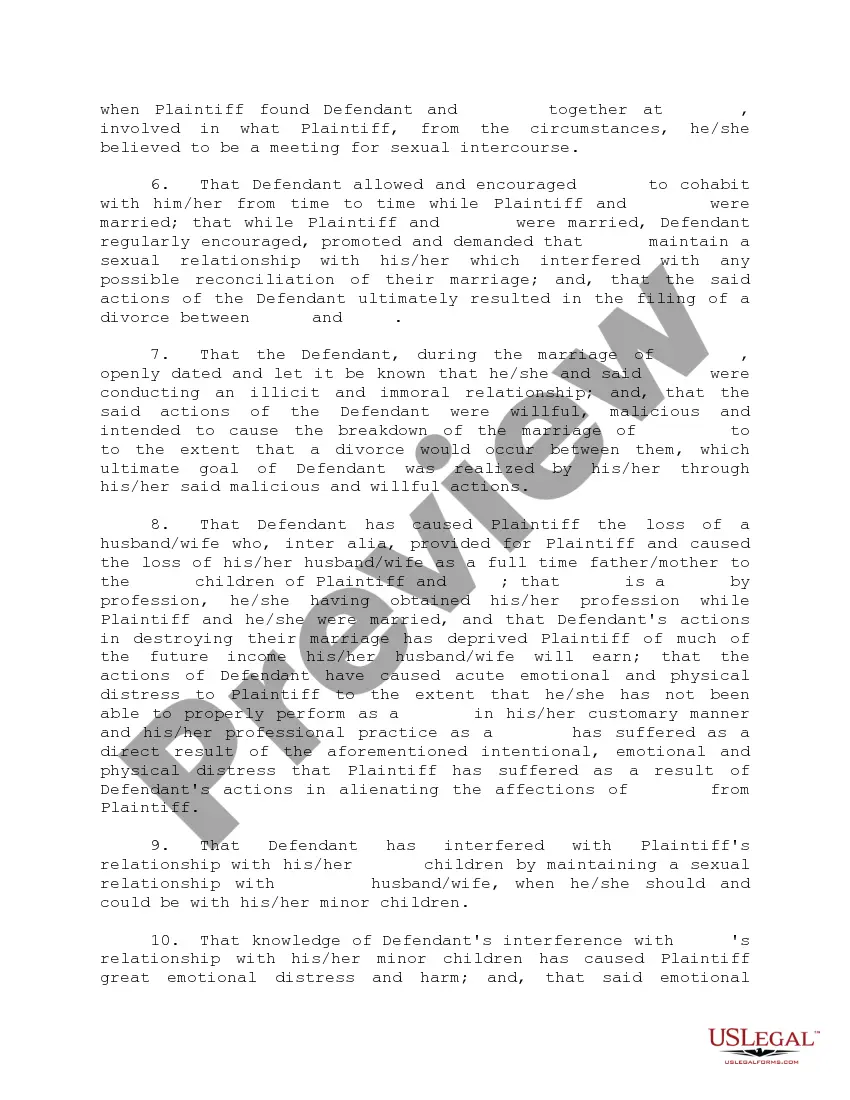
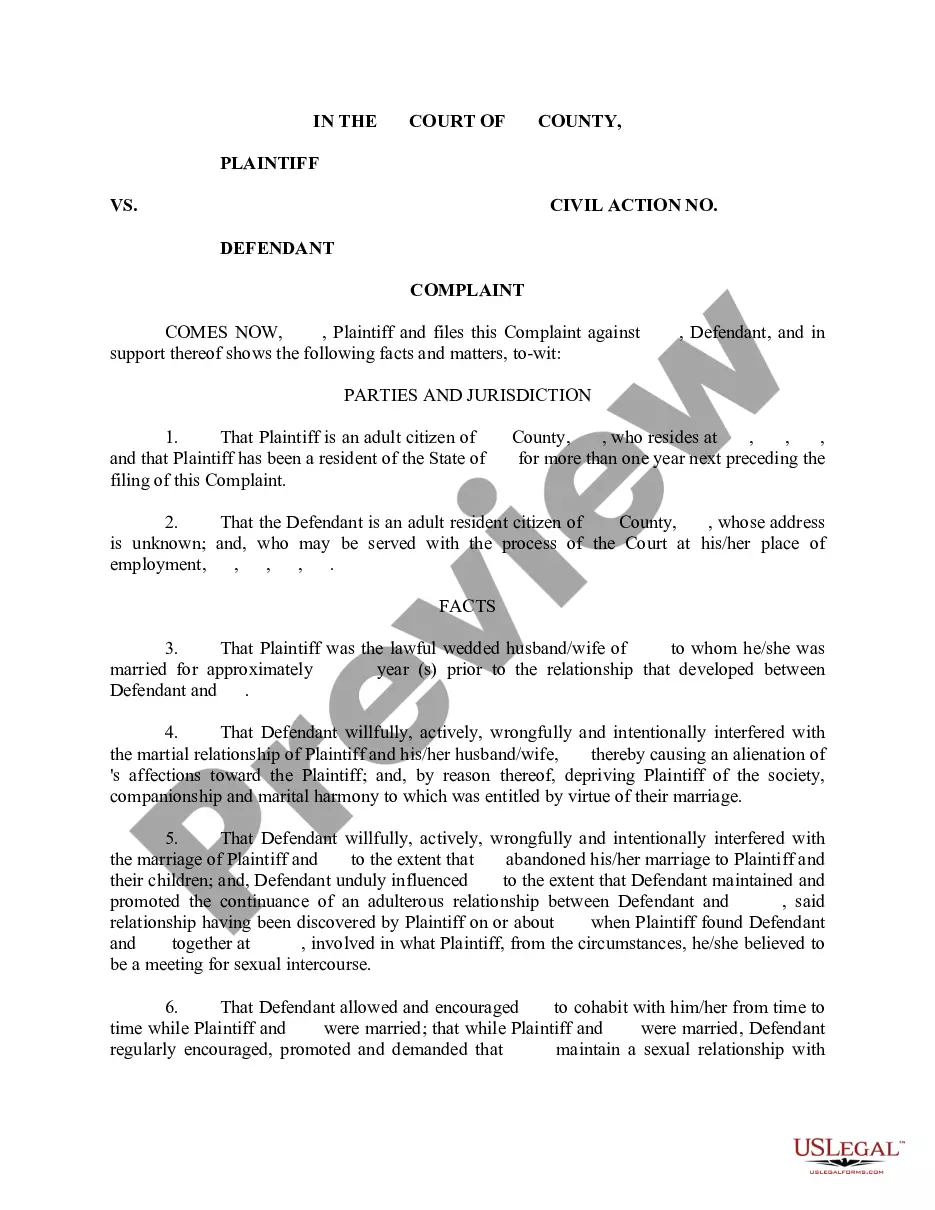
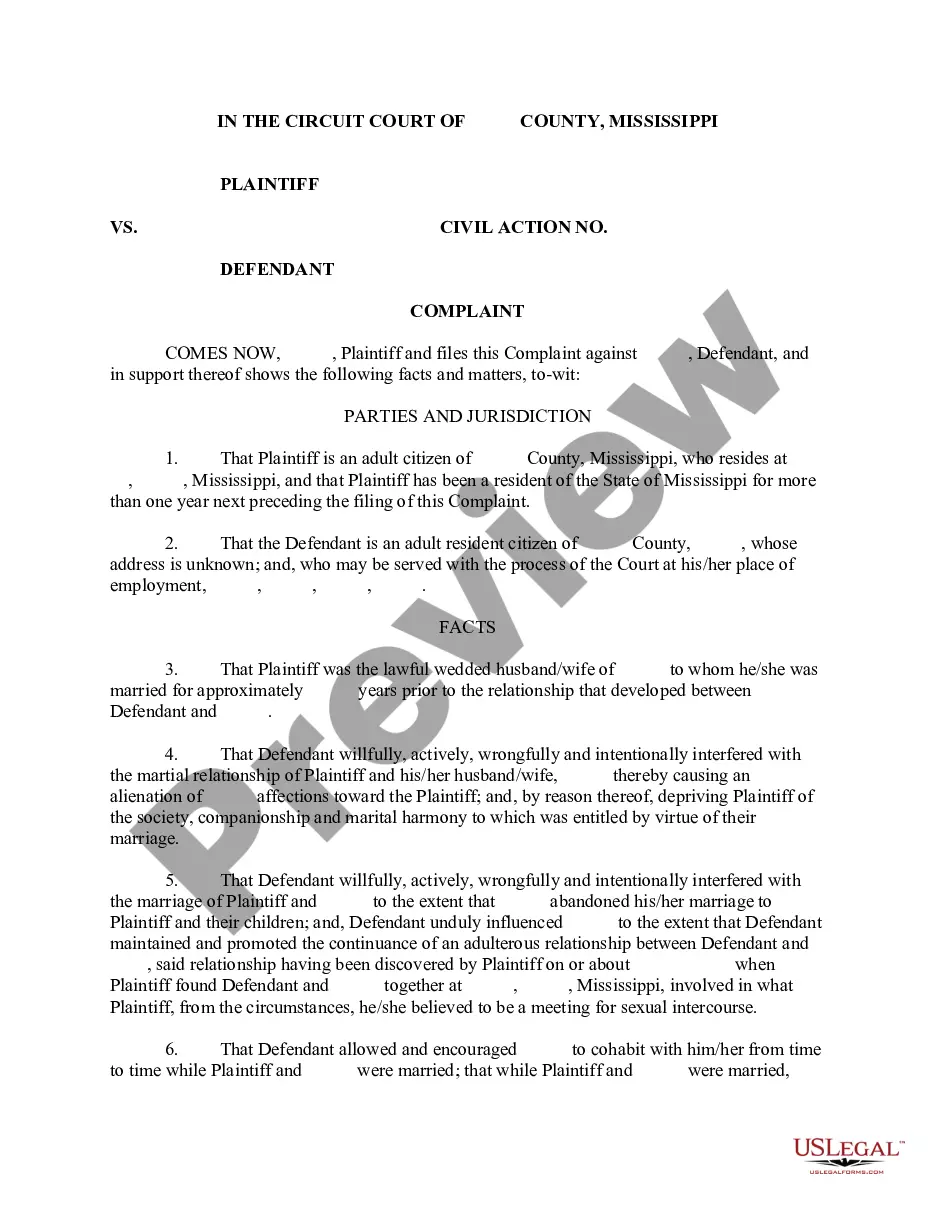
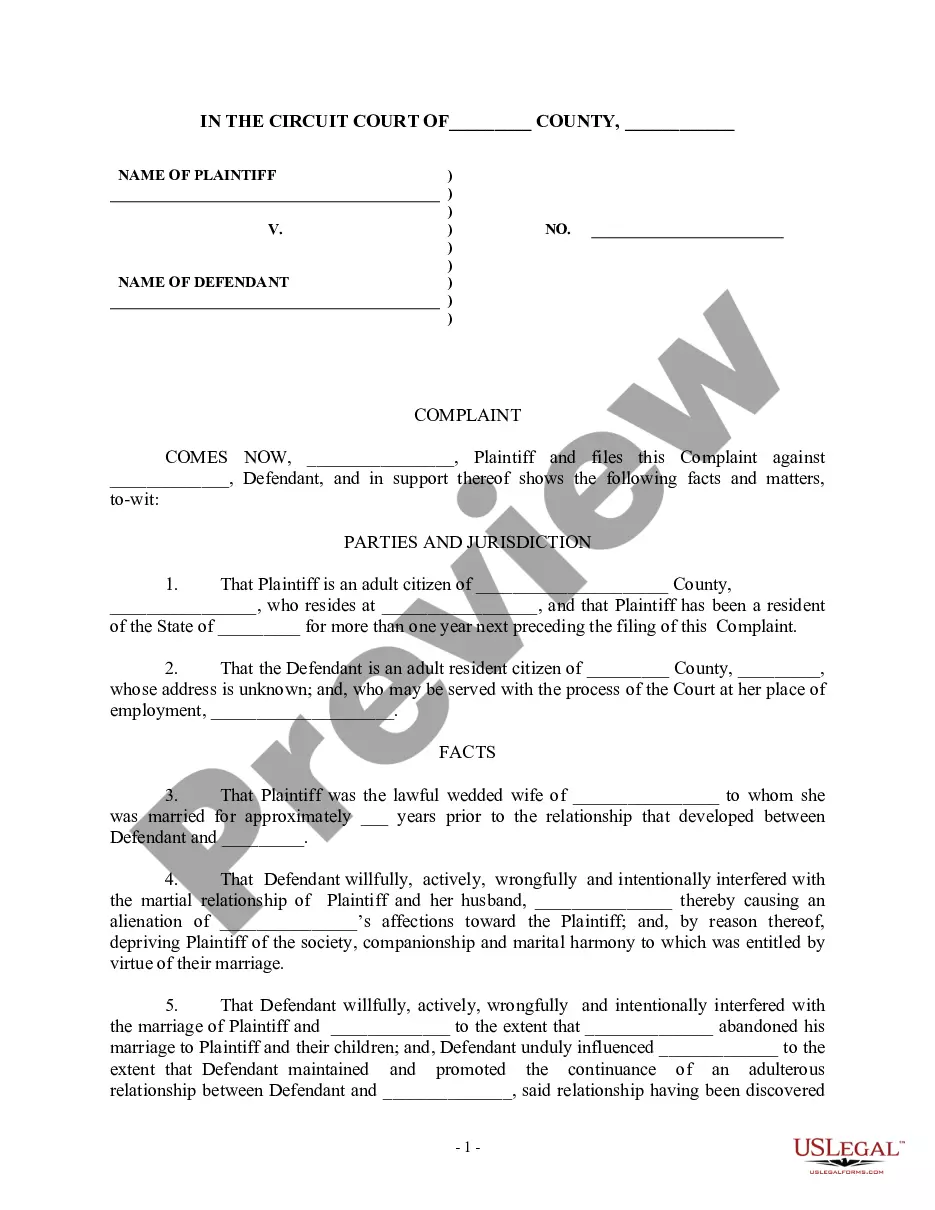
The Complaint for Alienation of Affections is a legal document that initiates a court action against a third party who has allegedly interfered with a marital relationship. This form serves to outline the claims and allegations made by the complaining party, specifically focusing on the emotional distress and damages caused by the defendant's actions. Unlike other legal complaints, this form addresses the interference in a marriage, which can include emotional support and affection disrupted by another individualâs actions.
Key parts of this document
- Introduction: Identifies the parties involved in the complaint.
- Basis of the complaint: Lists specific allegations against the defendant.
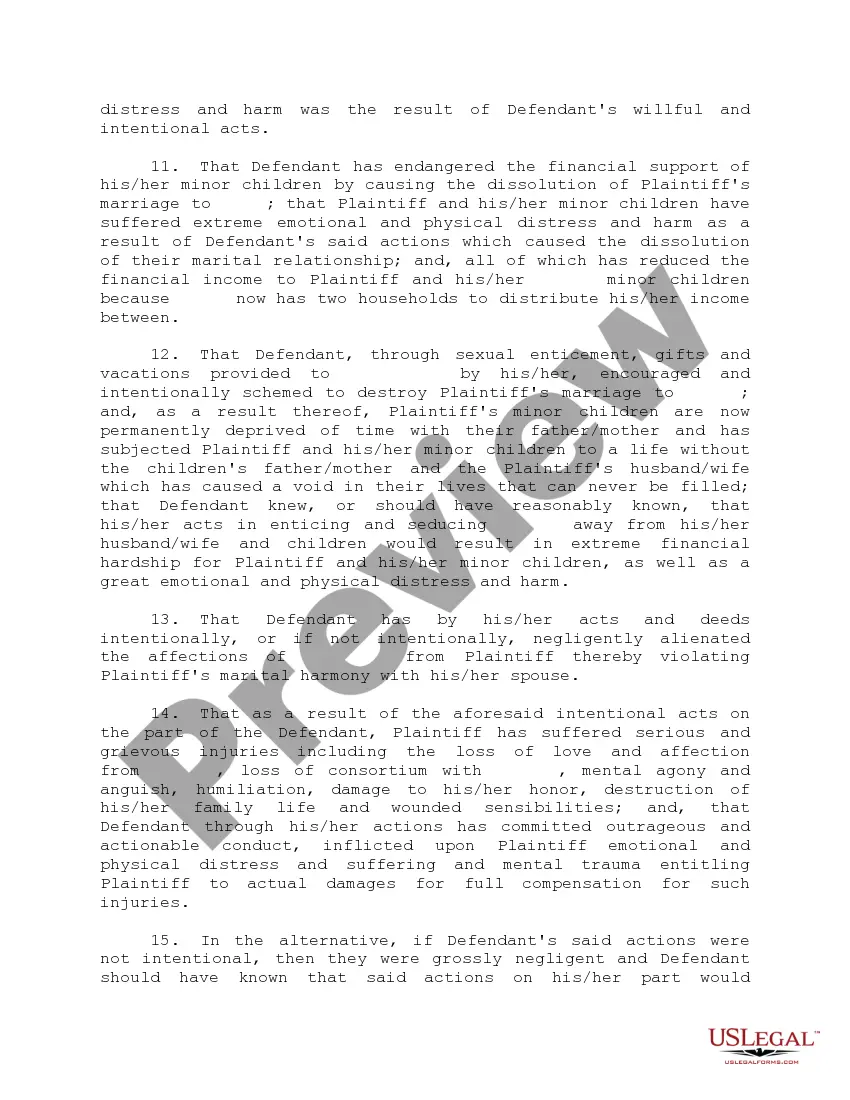
- Details of damages: Describes the emotional and financial harm suffered by the plaintiff.
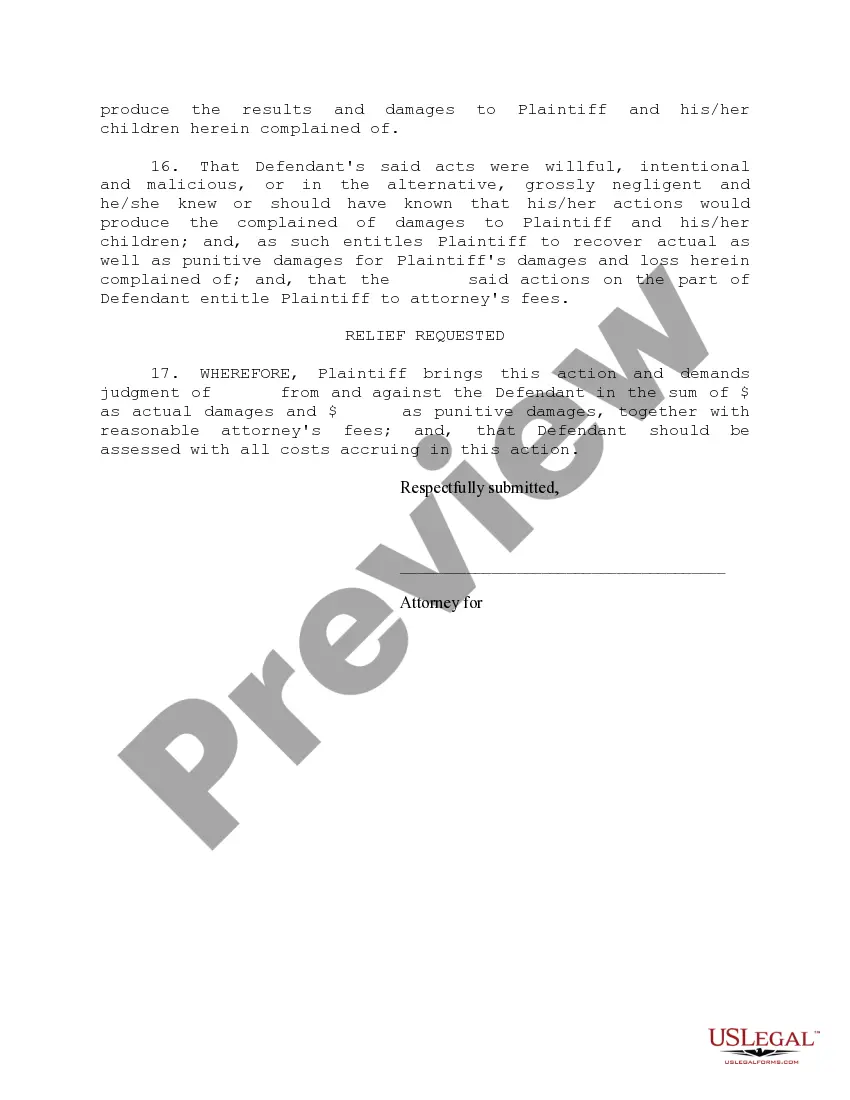
- Request for relief: Specifies the type of compensation or remedy sought by the plaintiff.
- Signature line: Provides space for the plaintiff to sign, affirming the truthfulness of the claims.
When to use this document
This form is typically used when an individual believes that their spouse's affections have been wrongfully alienated by a third party, such as a friend or coworker. It is applicable in situations where emotional suffering has occurred due to another person's actions, which might involve both monetary damages and emotional distress claims. Use this form if you are seeking legal recourse to address these issues in court.
Who this form is for
- Individuals who believe their spouse's affections have been interfered with.
- People seeking legal resolution for emotional distress caused by third-party actions.
- Persons looking to claim damages for loss of companionship and support in a marriage.
How to complete this form
- Identify the parties: Clearly state your name and the name of the defendant.
- Detail the allegations: Provide specific information about how the defendant's actions have interfered with your marital relationship.
- Specify the damages: Outline the emotional and financial effects you have suffered due to the defendant's actions.
- State your request for relief: Clearly articulate what you are seeking from the court, including any financial compensation.
- Sign and date the document: Ensure that you provide your signature to validate the complaint.
Notarization guidance
This form does not typically require notarization unless specified by local law. Always check your stateâs requirements to ensure compliance.
Get your form ready online
Our built-in tools help you complete, sign, share, and store your documents in one place.
Make edits, fill in missing information, and update formatting in US Legal Forms—just like you would in MS Word.
Download a copy, print it, send it by email, or mail it via USPS—whatever works best for your next step.
Sign and collect signatures with our SignNow integration. Send to multiple recipients, set reminders, and more. Go Premium to unlock E-Sign.
If this form requires notarization, complete it online through a secure video call—no need to meet a notary in person or wait for an appointment.
We protect your documents and personal data by following strict security and privacy standards.

Make edits, fill in missing information, and update formatting in US Legal Forms—just like you would in MS Word.

Download a copy, print it, send it by email, or mail it via USPS—whatever works best for your next step.

Sign and collect signatures with our SignNow integration. Send to multiple recipients, set reminders, and more. Go Premium to unlock E-Sign.

If this form requires notarization, complete it online through a secure video call—no need to meet a notary in person or wait for an appointment.

We protect your documents and personal data by following strict security and privacy standards.
Typical mistakes to avoid
- Neglecting to clearly outline specific actions taken by the defendant.
- Failing to attach necessary supporting documentation for claims.
- Not providing sufficient details about the damages suffered.
- Omitting the signature or failing to date the complaint.
Benefits of completing this form online
- Convenience: Download the form anytime and anywhere.
- Editability: Easily tailor the document to fit your specific circumstances.
- Reliability: Access forms that are drafted by licensed attorneys to ensure accuracy and compliance.
Legal use & context
- The Complaint for Alienation of Affections is a recognized legal action in several jurisdictions, though not universally accepted.
- Itâs crucial to understand the laws regarding this claim in your state, as enforceability can vary significantly.
Key takeaways
- The Complaint for Alienation of Affections is intended to seek damages for interference in a marital relationship.
- Understanding when and how to use this form is critical for potential plaintiffs.
- Always verify state-specific legal requirements before filing.
Looking for another form?
Form popularity
FAQ
To prove a claim for alienation of affection, the jilted spouse must prove that, prior to the commencement of the affair, he or she had a loving marriage, that the loving marriage was diminished or destroyed by the paramour's conduct, and that it was that wrongful conduct that led to the diminishment of the marital
To prove a claim for alienation of affection, the jilted spouse must prove that, prior to the commencement of the affair, he or she had a loving marriage, that the loving marriage was diminished or destroyed by the paramour's conduct, and that it was that wrongful conduct that led to the diminishment of the marital
You can defeat an alienation of affection lawsuit by showing your action was innocent or that you weren't the reason the marriage broke down. In addition, there are other defenses which you might have, including the following: The plaintiff consented to the conduct.
The Mississippi Supreme Court has said that to prove adultery, a plaintiff-spouse must show by clear and convincing evidence that the other spouse exhibited both an (1) adulterous inclination and a (2) reasonable opportunity to satisfy that inclination.
According to HG.org, a spouse living in Mississippi, North Carolina, Illinois, New Mexico, South Dakota, Utah, and Hawaii, is allowed to sue the person they believe broke up the marriage. Of course, there has to be proof that the person being sued is actually ruining or ruined the marriage.
Many states have abolished the tort of alienation of affection. However, Mississippi is one of the six states that still recognizes the value of the marital relationship and has refused to abolish this traditional avenue of relief for aggrieved spouses.
Proving an alienation of affection claim? In order to win an alienation of affection claim, the plaintiff must prove: (1) that the defendant engaged in wrongful conduct; (2) that the plaintiff suffered loss of affection or consortium; and (3) that the defendant's conduct was the cause of the loss.
There are two ways of suing a third party who broke up your marriage. The first is where the third party is cited as co-defendant in the main divorce summons and the other way is where the third party is sued alone, without the plaintiff's spouse even being cited as a defendant.
Today, less than 15% of states recognize Alienation of Affection as a viable case, but Mississippi has protected all things related to traditional marriage for a long time.
Proving an alienation of affection claim? In order to win an alienation of affection claim, the plaintiff must prove: (1) that the defendant engaged in wrongful conduct; (2) that the plaintiff suffered loss of affection or consortium; and (3) that the defendant's conduct was the cause of the loss.