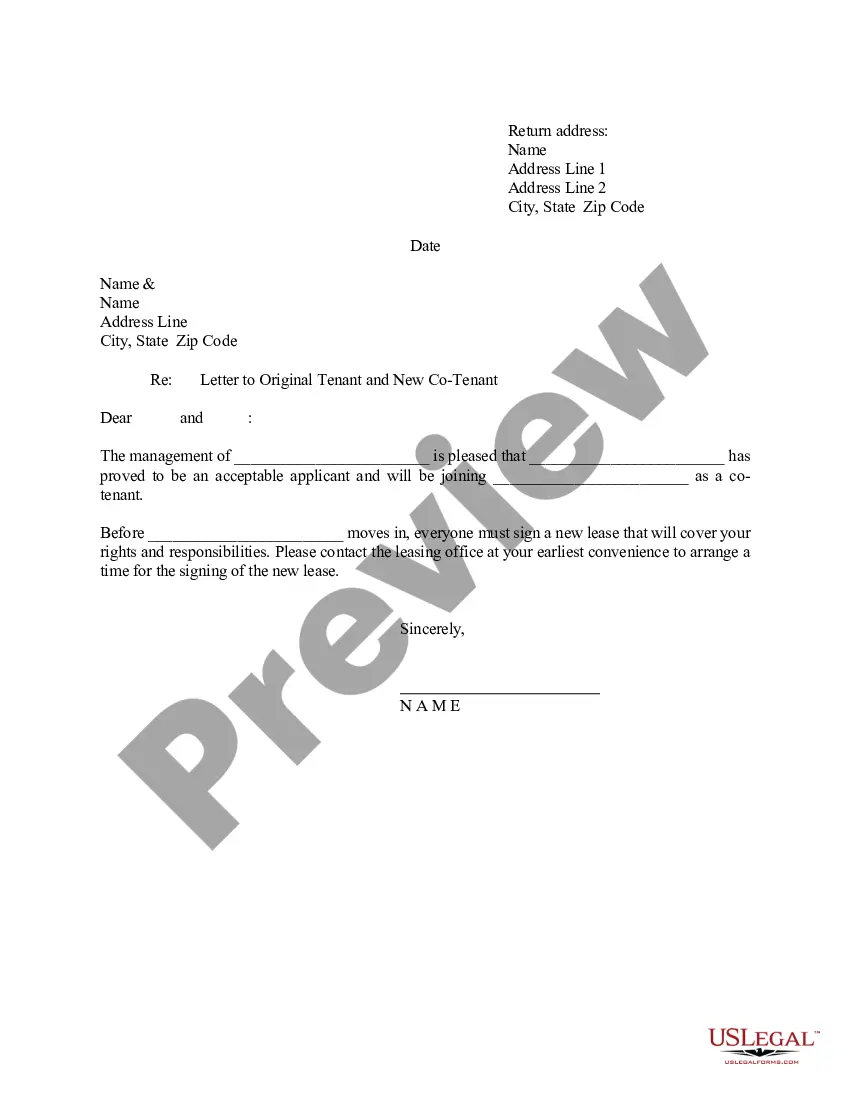
Letter - To Tenant and Their New Co-Tenant
About this form
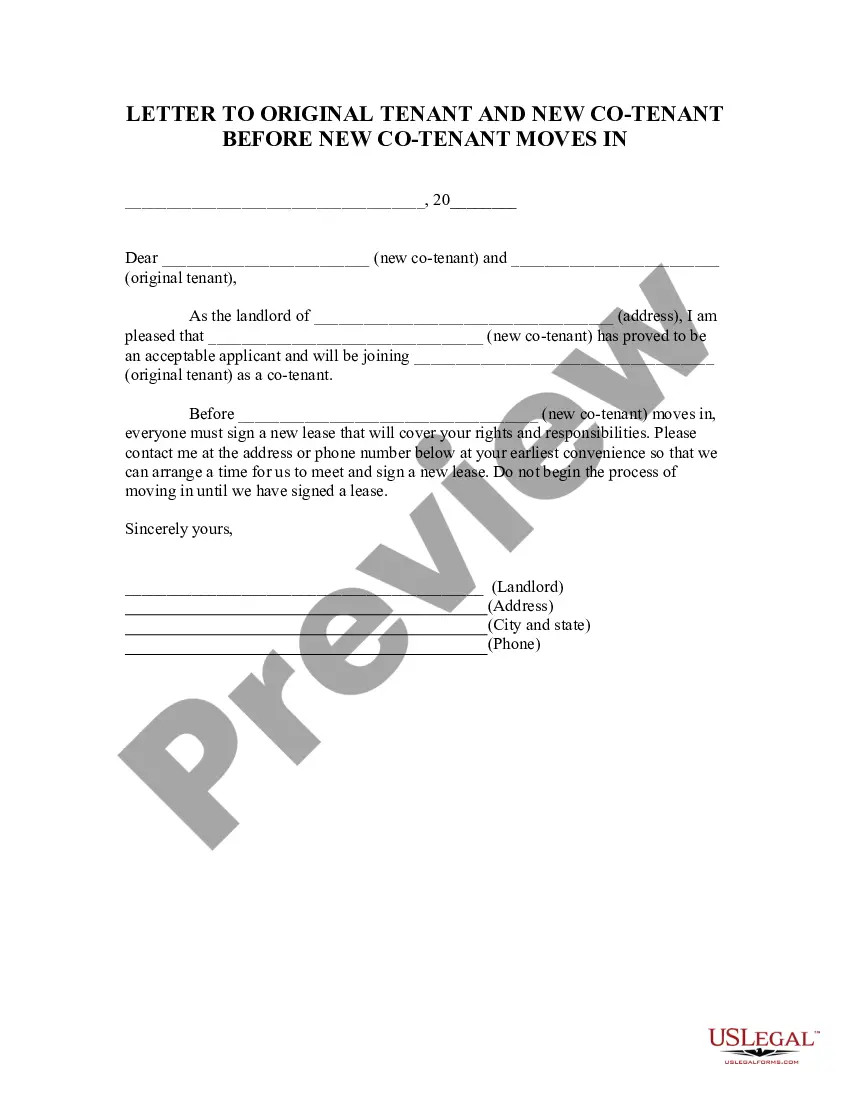
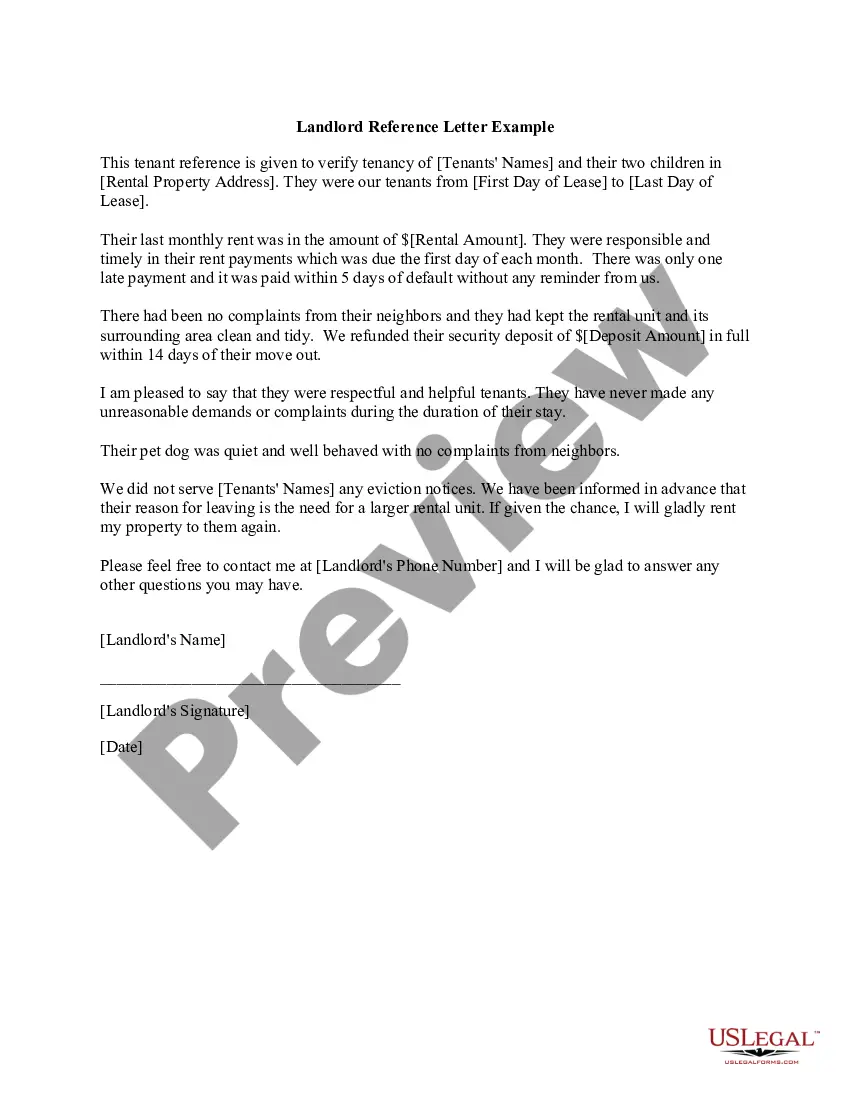
This Letter to Tenant and Their New Co-Tenant is a notification letter designed to inform both the original tenant and their new co-tenant of important rental details. This document helps maintain clear communication regarding tenancy and rental obligations, distinguishing it from other landlord-tenant forms that may not address co-tenancy specifics.
Main sections of this form
- Return address: Includes the sender's name and address
- Date: The date on which the letter is sent
- Recipientâs information: Names and addresses of the original tenant and new co-tenant
- Subject line: Clearly indicates the purpose of the letter
- Body of the letter: Contains important details and instructions related to the tenancy
When to use this form
This form is useful in scenarios where a new co-tenant is moving in with an existing tenant. It serves as an official communication to ensure both parties are informed about the rental agreement, responsibilities, and any other important details. Use this letter to facilitate a smooth transition and avoid misunderstandings regarding lease obligations.
Intended users of this form
- Landlords who want to notify tenants of a new co-tenant
- Original tenants who need to communicate with their landlord about a new co-tenant
- New co-tenants who need awareness of the existing rental agreements before moving in
How to prepare this document
- Identify the parties: Fill in the names and addresses of the original tenant and new co-tenant.
- Specify your address: Include your address at the top of the letter.
- Enter the date: Write the current date to indicate when the letter is issued.
- Draft the body: Clearly state any relevant information or instructions regarding the tenancy.
- Sign the letter: Include your signature if required to authenticate the document.
Notarization guidance
This form does not typically require notarization unless specified by local law. It is always recommended to check local regulations to ensure compliance.
Get your form ready online
Our built-in tools help you complete, sign, share, and store your documents in one place.
Make edits, fill in missing information, and update formatting in US Legal Forms—just like you would in MS Word.
Download a copy, print it, send it by email, or mail it via USPS—whatever works best for your next step.
Sign and collect signatures with our SignNow integration. Send to multiple recipients, set reminders, and more. Go Premium to unlock E-Sign.
If this form requires notarization, complete it online through a secure video call—no need to meet a notary in person or wait for an appointment.
We protect your documents and personal data by following strict security and privacy standards.

Make edits, fill in missing information, and update formatting in US Legal Forms—just like you would in MS Word.

Download a copy, print it, send it by email, or mail it via USPS—whatever works best for your next step.

Sign and collect signatures with our SignNow integration. Send to multiple recipients, set reminders, and more. Go Premium to unlock E-Sign.

If this form requires notarization, complete it online through a secure video call—no need to meet a notary in person or wait for an appointment.

We protect your documents and personal data by following strict security and privacy standards.
Mistakes to watch out for
- Failing to include all relevant partiesâ names and addresses
- Not providing the date, which can lead to confusion about the timeline
- Using unclear language that may lead to misunderstandings about tenancy obligations
- Neglecting to sign the letter if required for formal communication
Why use this form online
- Convenience of downloading and completing the form at your own pace
- Editability to personalize the document to your specific needs
- Access to accurate and lawyer-drafted templates ensuring legal compliance
What to keep in mind
- This letter serves to inform both tenants about changes in tenancy.
- It is important for landlords and tenants to maintain clear communication.
- Using this form can help prevent misunderstandings regarding lease responsibilities.
Looking for another form?









Form popularity
FAQ
Be in writing, Say the full name of the tenant or tenants, Have the address the notice is about, Say everything that the tenant did to break the lease or deserve a 3 day notice to leave, and include details and dates, Say clearly that the tenant has to move out as soon as the 3 days are up, and.
Step 1: Obtain a Written Request. Invite the tenant to submit in writing the request to add another person to the lease. Step 2: Check the Property's Occupancy Limit. Step 3: Acquire a Completed Rental Application. Step 4: Make a Decision. Step 5: Review the Details With the Tenants.
If you're joint tenants and you both want to leave, either you or your ex-partner can end the tenancy by giving notice.If your landlord doesn't update the tenancy agreement, you'll both still be responsible for rent and the person who leaves can still give notice to end the tenancy.
Your contact information. Time and date of the rental walkthrough. Time and location for key collection. Instructions on setting up utilities.
Dear (Name of landlord or manager), This letter constitutes my written (number of days' notice that you need to give based on your lease agreement)-day notice that I will be moving out of my apartment on (date), the end of my current lease. I am leaving because (new job, rent increase, etc.)
Talk to Your LandlordYou can't just move someone in without his permission. If you do, you could be in violation of your lease..For example, adding another person may exceed your apartment's occupancy limit or the landlord may be unable to allow it because of the city's ordinances on apartment occupancy.
Dear (Name of landlord or manager), This letter constitutes my written (number of days' notice that you need to give based on your lease agreement)-day notice that I will be moving out of my apartment on (date), the end of my current lease. I am leaving because (new job, rent increase, etc.)
Write the title for your pay or quit notice across the top of the letter. If not included in the title, the number of days for the notice must be specified. Include the names of each of the tenants. Specify the address of the rental property.
Step 1: Mention the Reason for Giving a Notice. Step 2: Use Formal Language. Step 3: Mention the Date for Vacating. Step 4: Address the Formalities to Be Taken Care Of. Step 5: Proofread the Letter.