Sample Letter for Notification of Opinion - State Supreme Court
What is this form?
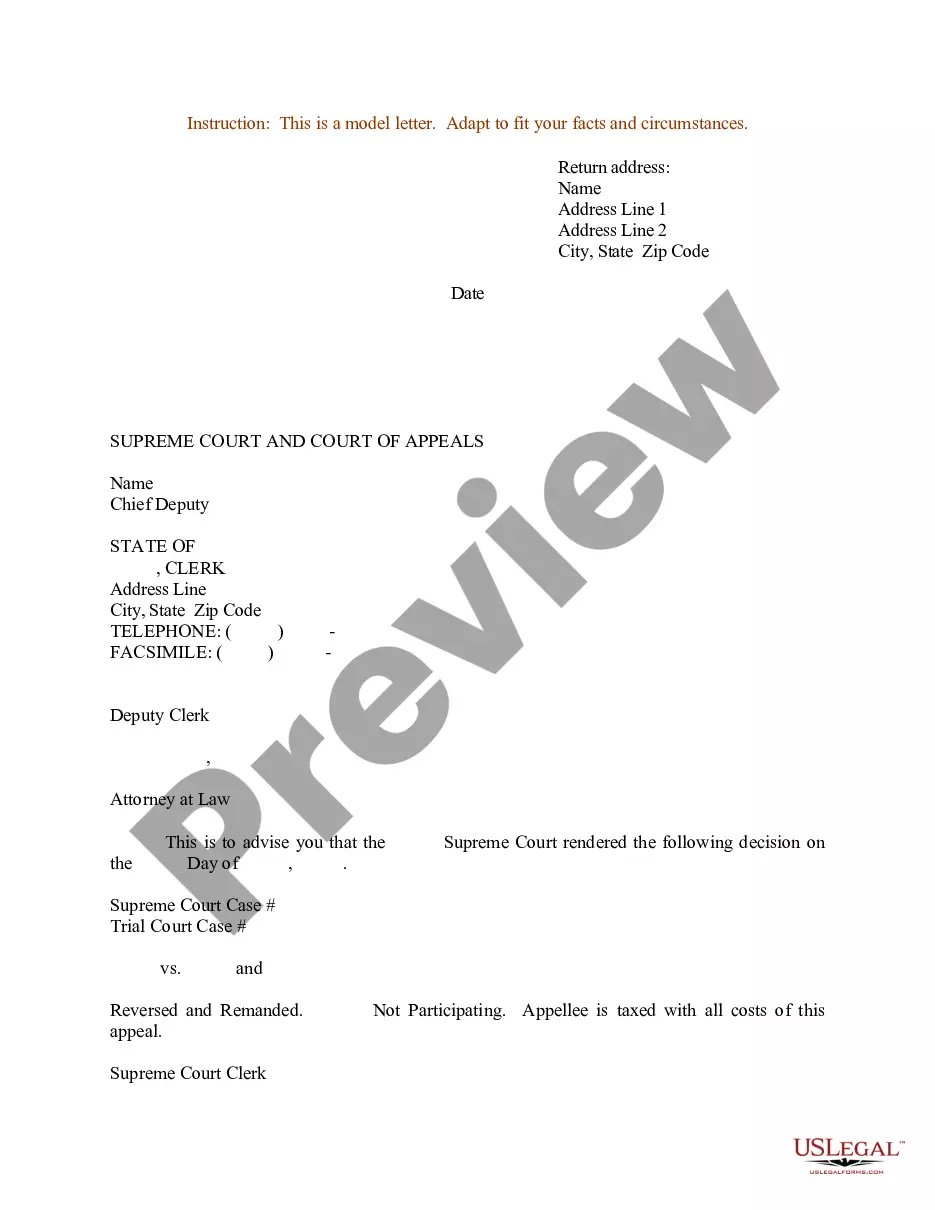
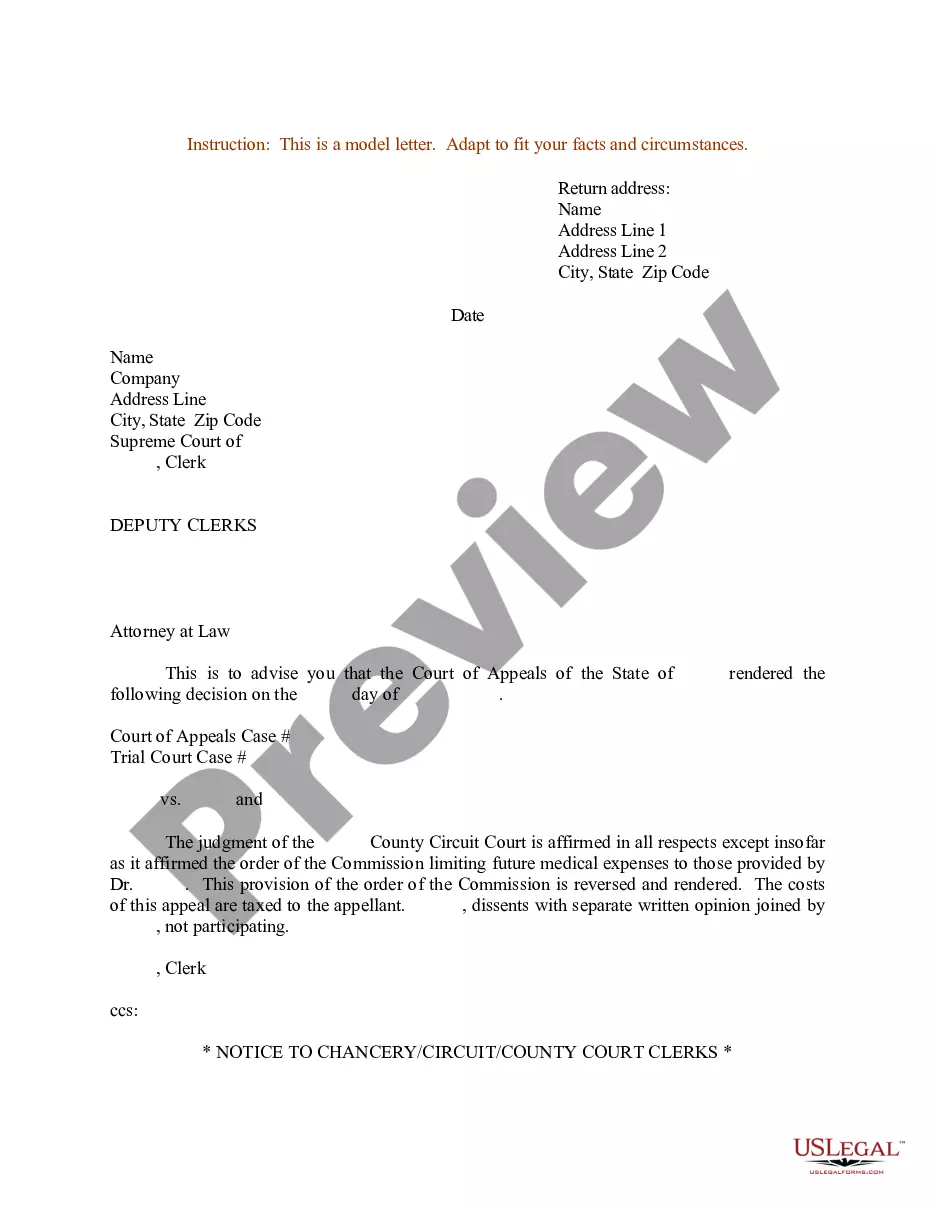
The Sample Letter for Notification of Opinion is a formal document used to communicate important opinions issued by the State Supreme Court. This letter serves as an official notification to relevant parties, distinguishing it from other forms that may not specifically address Supreme Court opinions. It is important for ensuring that recipients are informed timely and accurately about judicial opinions that may impact legal proceedings or decisions.
Key components of this form
- Return address section with the sender's details.
- Date line indicating when the letter is issued.
- Address block for the recipient, typically the Chief Deputy of the Supreme Court.
- Subject line specifying the purpose of the notification.
- Signature section for the sender's authorization.

Situations where this form applies
This form should be used when you need to formally notify individuals or entities about an opinion issued by the State Supreme Court. It is particularly relevant in cases where the opinion may affect ongoing legal matters, clients' rights, or state policy. Using this letter ensures that such notifications are delivered in a professional manner.
Intended users of this form
- Legal practitioners who need to inform clients or stakeholders of court decisions.
- Government officials issuing notifications pertaining to Supreme Court rulings.
- Anyone involved in legal proceedings where knowledge of a Supreme Court opinion is necessary.
How to complete this form
- Enter your return address in the designated section at the top.
- Insert the current date in the date line.
- Fill in the recipient's name and address, including the Chief Deputy's title.
- Clearly state the purpose of the letter in the subject line.
- Sign the letter to authorize the notification.
Notarization requirements for this form
Notarization is not commonly needed for this form. However, certain documents or local rules may make it necessary. Our notarization service, powered by Notarize, allows you to finalize it securely online anytime, day or night.
Get your form ready online
Our built-in tools help you complete, sign, share, and store your documents in one place.
Make edits, fill in missing information, and update formatting in US Legal Forms—just like you would in MS Word.
Download a copy, print it, send it by email, or mail it via USPS—whatever works best for your next step.
Sign and collect signatures with our SignNow integration. Send to multiple recipients, set reminders, and more. Go Premium to unlock E-Sign.
If this form requires notarization, complete it online through a secure video call—no need to meet a notary in person or wait for an appointment.
We protect your documents and personal data by following strict security and privacy standards.

Make edits, fill in missing information, and update formatting in US Legal Forms—just like you would in MS Word.

Download a copy, print it, send it by email, or mail it via USPS—whatever works best for your next step.

Sign and collect signatures with our SignNow integration. Send to multiple recipients, set reminders, and more. Go Premium to unlock E-Sign.

If this form requires notarization, complete it online through a secure video call—no need to meet a notary in person or wait for an appointment.

We protect your documents and personal data by following strict security and privacy standards.
Avoid these common issues
- Neglecting to include the sender's complete return address.
- Failing to provide an accurate date, which can cause confusion.
- Omitting essential recipient details such as title or correct address.
- Not signing the letter, which may render it unofficial.
Why use this form online
- Immediate access to a professionally drafted template.
- Easy editable format to customize for specific needs.
- Time-saving; eliminates the need for manual drafting and research.
Legal use & context
- Legally notifying parties about relevant Supreme Court opinions is vital for upholding legal standards.
- This form provides an official channel for communication, ensuring clarity and formality.
- Failure to properly notify parties could lead to legal complications or misunderstandings.
Key takeaways
- The Sample Letter for Notification of Opinion is essential for formal judicial notifications.
- Ensure all required components are included for clarity and legality.
- Consider state-specific regulations when using or adapting the form.
Looking for another form?


Form popularity
FAQ
State supreme court's interpretation of any state law is generally final and binding to both state and federal courts. Federal courts may overrule a state supreme court decision only when there is a federal question which springs up a federal jurisdiction.
What distinguishes the U.S. Supreme Court from a state supreme court is that state supreme courts have ruling that can be overturned, while U.S. Supreme Court rulings are final. The Supreme Court is the only court established by the Constitution of the United States. All other courts have been created by Congress.
Article III of the Constitution governs the appointment, tenure, and payment of Supreme Court justices, and federal circuit and district judges.Article III judges can be removed from office only through impeachment by the House of Representatives and conviction by the Senate.
No. It is a common misconception among pro se litigants that federal courts can revisit and perhaps overturn a decision of the state courts. Only if a federal issue was part of a state court decision can the federal court review a decision by the state court.
Can State Courts Decide Issues of Federal Law? Yes. State courts can rule on questions of federal law, except where Congress has mandated that a specific kind of case can only be heard in federal court.
Each of the 50 states has its own rules and procedures. The federal courts also have their own rules, which are occasionally interpreted differently in different parts of the country. However, for the most part, they are all very similar. The system is generally a three-tiered one.
The majority of all cases brought in any particular state jurisdiction go to special courts. Special courts exist for both civil and criminal disputes.
Each of the fifty states has at least one supreme court that serves as the highest court in the state; two states, Texas and Oklahoma, have separate supreme courts for civil and criminal matters.The exact duties and powers of the state supreme courts are established by state constitutions and state law.
Each state within the United States, plus the District of Columbia, has at least one supreme court, or court of last resort. The supreme courts do not hear trials of cases.They hear appeals of the decisions made in the lower trial or appellate courts.