Sample Letter for Letter From School to Parents concerning School Science Fair
What is this form?
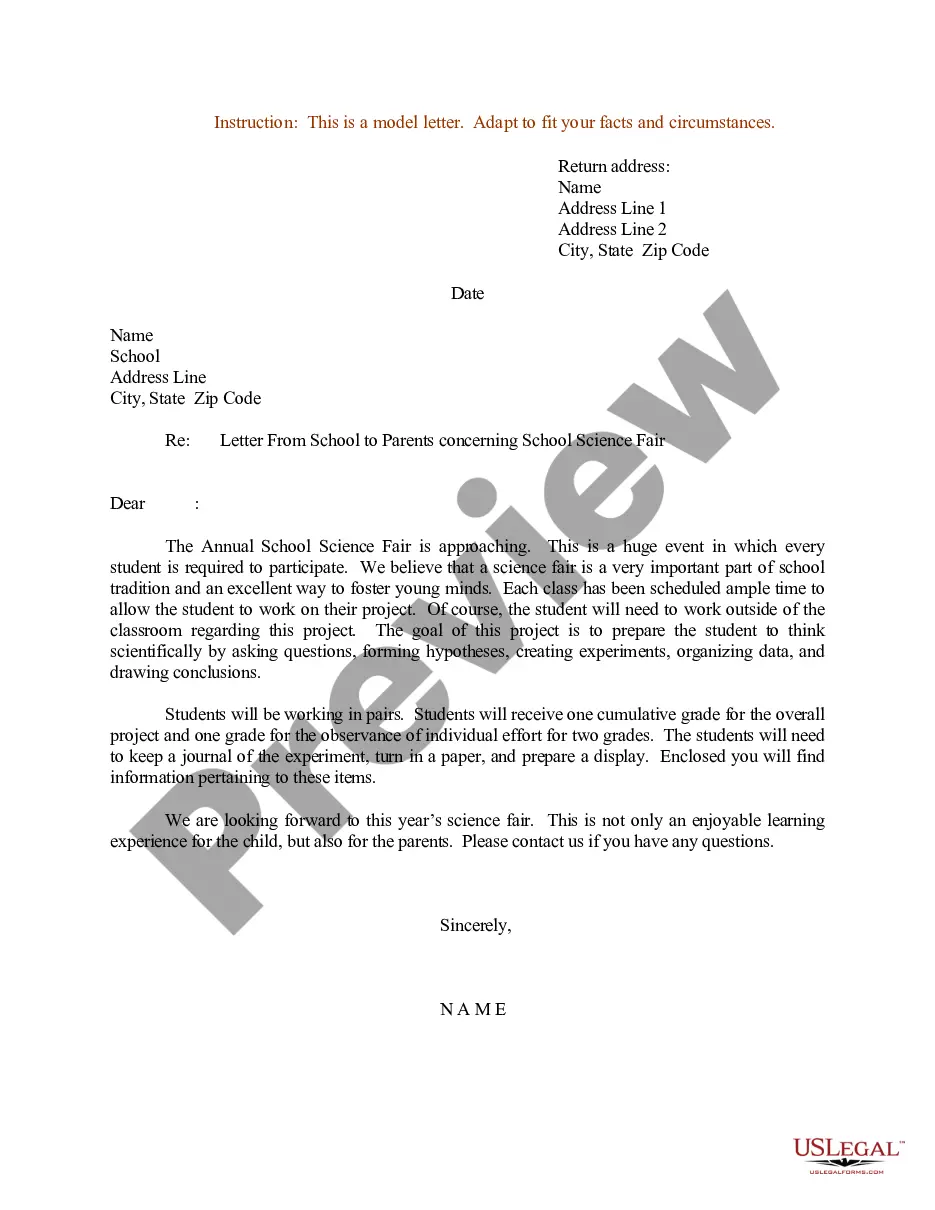
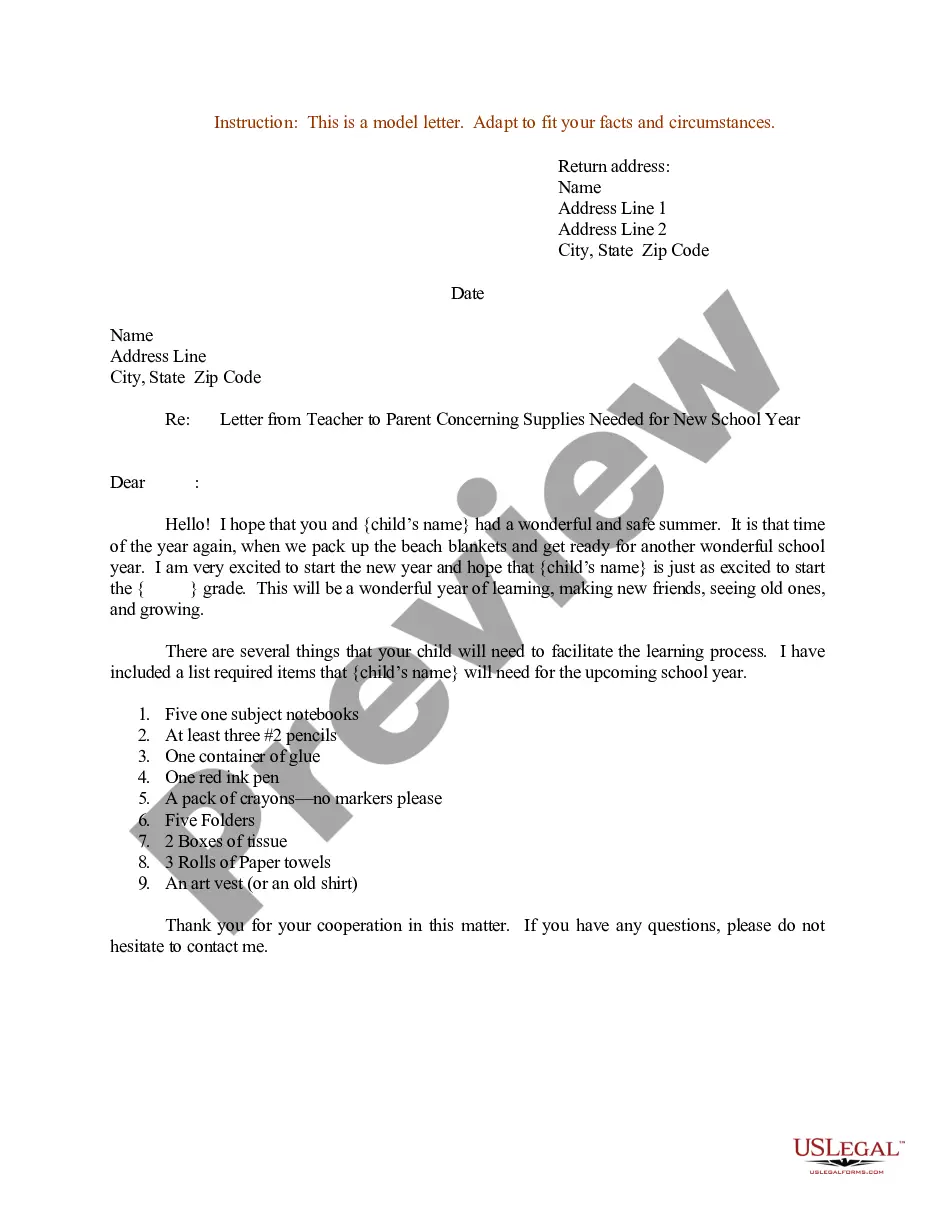
This form is a sample letter designed for schools to communicate with parents regarding the school science fair. It outlines important details such as project requirements, grading criteria, and encourages parental involvement. Unlike other general school communication templates, this letter specifically addresses the science fair and its associated activities.
Main sections of this form
- Return address: Includes the name and full address of the school.
- Date: The date when the letter is sent.
- Greeting: A formal greeting addressed to the parents.
- Project overview: Information about students working in pairs, grading, and required materials.
- Encouragement for questions: An invitation for parents to reach out with any inquiries.
- Closing signature: Ends with a formal sign-off and name of the sender.
Common use cases
This form should be used when a school administrator or teacher needs to inform parents about the details of an upcoming science fair. It is appropriate for sending out to parents well in advance of the event to ensure they are aware of their child's participation, responsibilities, and how they can assist.
Who this form is for
This letter is intended for:
- School administrators responsible for event communications.
- Teachers organizing the science fair.
- School staff involved in student-parent relations.
Completing this form step by step
- Enter the school's return address at the top of the letter.
- Fill in the date to indicate when the letter is being sent.
- Address the letter to the parents or guardians appropriately.
- Provide clear details regarding the science fair, including grading and project requirements.
- Encourage parents to reach out with any questions they may have.
- Include the sender's name and signature at the end of the letter.
Does this document require notarization?
Notarization is generally not required for this form. However, certain states or situations might demand it. You can complete notarization online through US Legal Forms, powered by Notarize, using a verified video call available anytime.
Get your form ready online
Our built-in tools help you complete, sign, share, and store your documents in one place.
Make edits, fill in missing information, and update formatting in US Legal Forms—just like you would in MS Word.
Download a copy, print it, send it by email, or mail it via USPS—whatever works best for your next step.
Sign and collect signatures with our SignNow integration. Send to multiple recipients, set reminders, and more. Go Premium to unlock E-Sign.
If this form requires notarization, complete it online through a secure video call—no need to meet a notary in person or wait for an appointment.
We protect your documents and personal data by following strict security and privacy standards.

Make edits, fill in missing information, and update formatting in US Legal Forms—just like you would in MS Word.

Download a copy, print it, send it by email, or mail it via USPS—whatever works best for your next step.

Sign and collect signatures with our SignNow integration. Send to multiple recipients, set reminders, and more. Go Premium to unlock E-Sign.

If this form requires notarization, complete it online through a secure video call—no need to meet a notary in person or wait for an appointment.

We protect your documents and personal data by following strict security and privacy standards.
Common mistakes
- Failing to include the school's return address.
- Omitting important details about the science fair requirements.
- Not specifying the deadline for parents' questions or submissions.
- Using informal language that may not be appropriate for school correspondence.
Benefits of using this form online
- Convenient: Download and customize the letter quickly to meet your school's needs.
- Editability: Easily modify sections to include school-specific details or updates.
- Reliable format: Ensures that your letter is comprehensible and professionally structured.
Legal use & context
- This letter serves as an official communication from the school to parents.
- It helps establish a record of communication regarding the science fair.
- Using a clear format can enhance transparency and prevent misunderstandings.
What to keep in mind
- The form serves as a template for communicating important information about the science fair to parents.
- Customization is straightforward, making it a practical choice for educators.
- Ensure to check for local requirements that may affect communication protocols.
Looking for another form?
Form popularity
FAQ
When you sample another artist's music without obtaining their permission, you're infringing on the copyright to that work, no matter how big or small of a portion you actually use.Therefore, if you want to legally use a sample of a piece of music in your work, you have to obtain permission, every single time.
One of those common myths is this: you can legally sample a copyrighted song without permission as long as the sample is shorter than 6 seconds, or 11 seconds, or 15 seconds2026
Find the Music Publisher. In order to get these sample clearances, you will first need to find the copyright owners of the song and master recording. Find the Master Recording Owner. Recreate the Music Sample. Seek Copyright Owners who are Happy to Clear Samples. Contact the Artist Directly.
If you decide to use samples without clearance, you might be in the clear in certain situations. Under U.S. copyright law, you do not have to obtain sample clearance if your sample is so altered that it does not infringe on the original, or your use is a fair one.
You CANNOT sample music without permission, no matter how short or long the sample is. Copyright is copyright. And if the sample is recognizable (hell, even if it isn't recognizable), you're using another person's intellectual property in order to construct or enhance your own.
You may have heard of "fair use," a copyright provision that permits you to use 10, 15 or 30 seconds of music without copyright obligation. That is, you understand that you can use a short section of a song without paying a fee.
Going Without Sample Clearance You should avoid using the title of the sampled music in your song title. If you sell only a limited number of recordings of your music and sell them only at performances, you may not face a copyright infringement lawsuit.
Simple random sampling. In a simple random sample, every member of the population has an equal chance of being selected. Systematic sampling. Stratified sampling. Cluster sampling.
What Is Fair Sampling? Accurate, well-drawn samples can be established using several diverse methods. Ideally, these sampling methods make representative assessments of trends within a population of interest. These conditions constitute fair sampling.