Sample Letter for School or College Scholarship Award
What is this form?
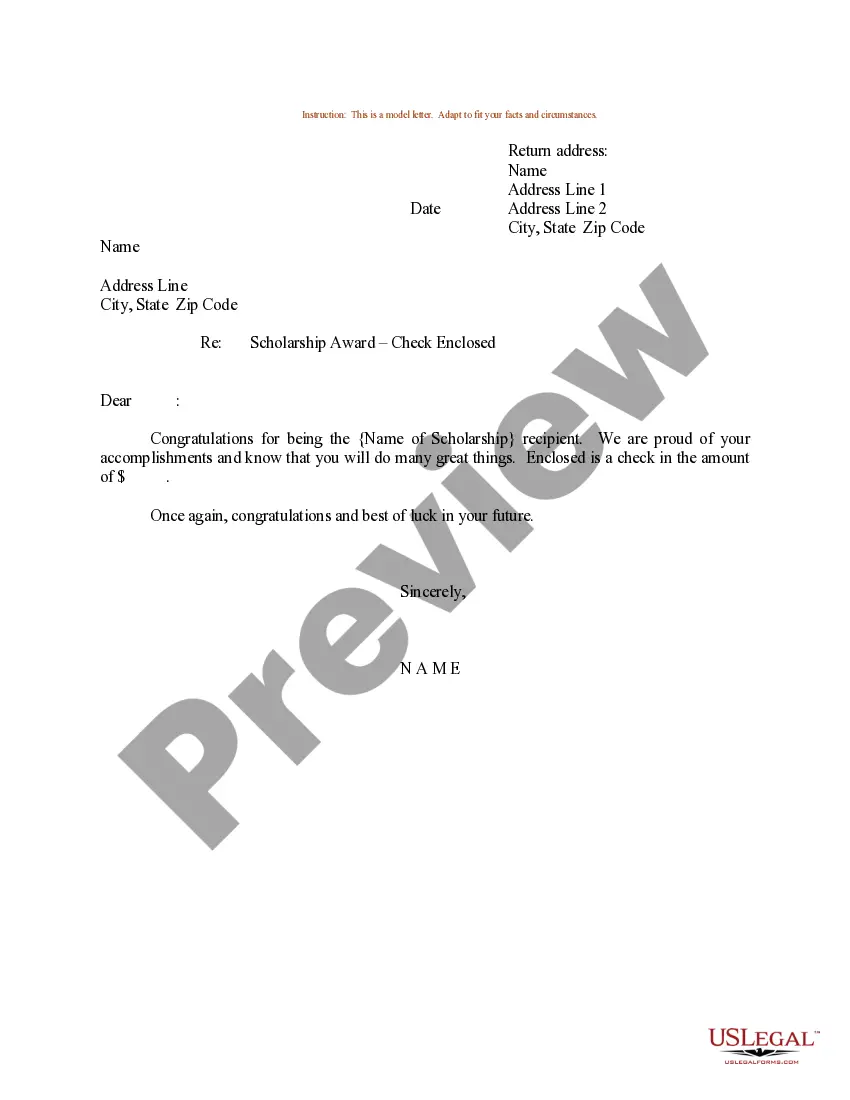
This Sample Letter for School or College Scholarship Award serves as a template for individuals or organizations to formally communicate the details of a scholarship award. It is particularly useful for schools or colleges that wish to notify applicants of their awarded financial aid. Unlike other general letters, this form includes specific components tailored for scholarship notifications, ensuring that all essential information is conveyed clearly and professionally.
Main sections of this form
- Return address: Includes the sender's name and address for correspondence.
- Date: The date when the letter is prepared.
- Addressee's details: Recipient's name and address for delivery.
- Subject line: Clearly states the purpose of the letter regarding the scholarship award.
- Closing section: A polite sign-off that includes the name of the sender.
- Check enclosure: A note indicating any financial aid included with the letter.
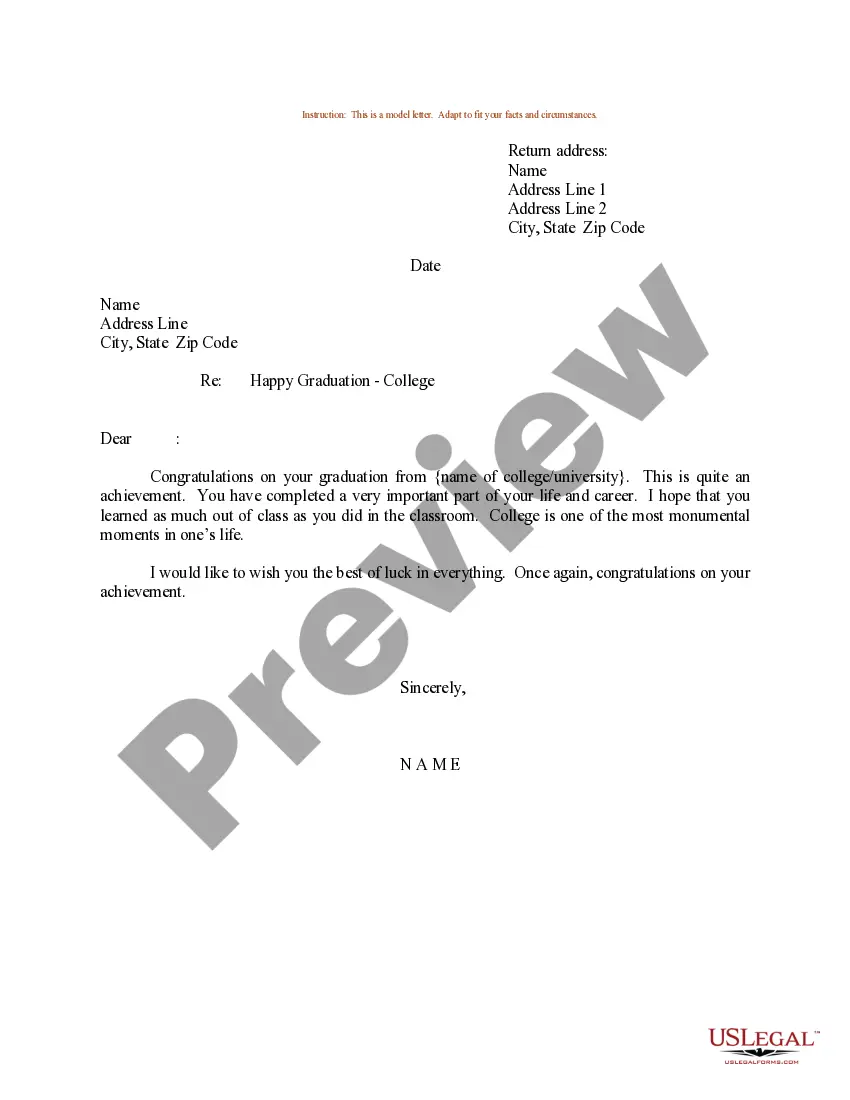
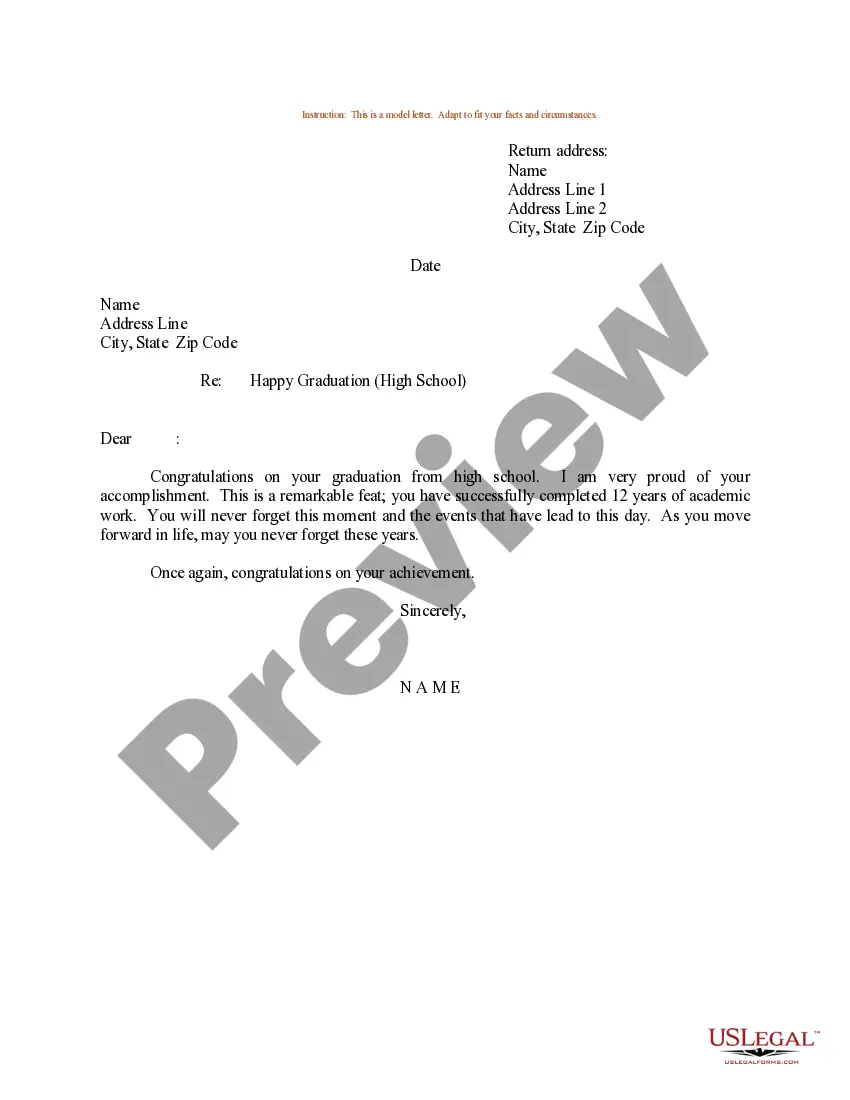
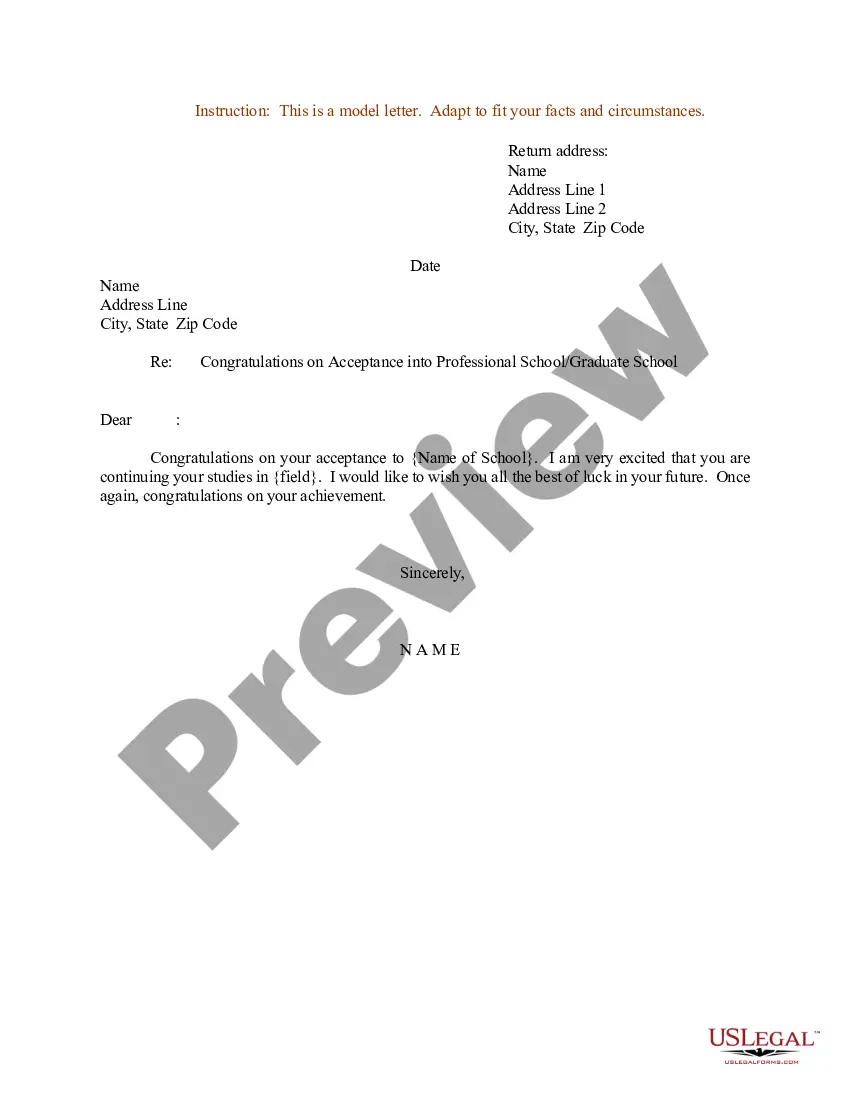
When to use this form
This form should be used when an educational institution has selected a candidate for a scholarship and needs to formally notify the recipient. It is ideal for situations where the scholarship comes with monetary support or specific instructions about the award. It may also be applicable when additional documentation accompanies the scholarship notification.
Intended users of this form
Suitable users of this form include:
- School administrators responsible for scholarship awards.
- College admissions officers conveying scholarship information.
- Organizations granting scholarships to students.
- Individuals managing scholarship funds and notifications.
Completing this form step by step
- Identify the parties involved: Fill in the return address and recipient's address.
- Enter the date: Write the date when the notification is being sent.
- Specify the purpose: Clearly address the letter with a subject line about the scholarship award.
- Add the scholarship details: Include information about the award and any conditions.
- Sign the letter: Conclude with a professional closing and your name.
Does this form need to be notarized?
Notarization is not commonly needed for this form. However, certain documents or local rules may make it necessary. Our notarization service, powered by Notarize, allows you to finalize it securely online anytime, day or night.
Get your form ready online
Our built-in tools help you complete, sign, share, and store your documents in one place.
Make edits, fill in missing information, and update formatting in US Legal Forms—just like you would in MS Word.
Download a copy, print it, send it by email, or mail it via USPS—whatever works best for your next step.
Sign and collect signatures with our SignNow integration. Send to multiple recipients, set reminders, and more. Go Premium to unlock E-Sign.
If this form requires notarization, complete it online through a secure video call—no need to meet a notary in person or wait for an appointment.
We protect your documents and personal data by following strict security and privacy standards.

Make edits, fill in missing information, and update formatting in US Legal Forms—just like you would in MS Word.

Download a copy, print it, send it by email, or mail it via USPS—whatever works best for your next step.

Sign and collect signatures with our SignNow integration. Send to multiple recipients, set reminders, and more. Go Premium to unlock E-Sign.

If this form requires notarization, complete it online through a secure video call—no need to meet a notary in person or wait for an appointment.

We protect your documents and personal data by following strict security and privacy standards.
Mistakes to watch out for
- Not including the recipient's full address or correct name.
- Forgetting to sign the letter before sending.
- Failing to specify the scholarship details clearly.
- Not confirming the financial aid check is enclosed, if applicable.
Advantages of online completion
- Convenient access: Download and fill out the form at any time.
- Editability: Modify the template to fit specific needs quickly.
- Reliability: Use a format recommended by legal professionals.
Legal use & context
- Legally, this form serves to document the scholarship award process.
- It should be sent timely to ensure recipients understand their award status.
- Maintaining copies of such correspondence is recommended for record-keeping.
What to keep in mind
- The Sample Letter for School or College Scholarship Award is an essential tool for formal communication of scholarship funds.
- It includes vital components to ensure clarity and professionalism.
- Use this form to effectively notify students about their scholarship status in various educational contexts.
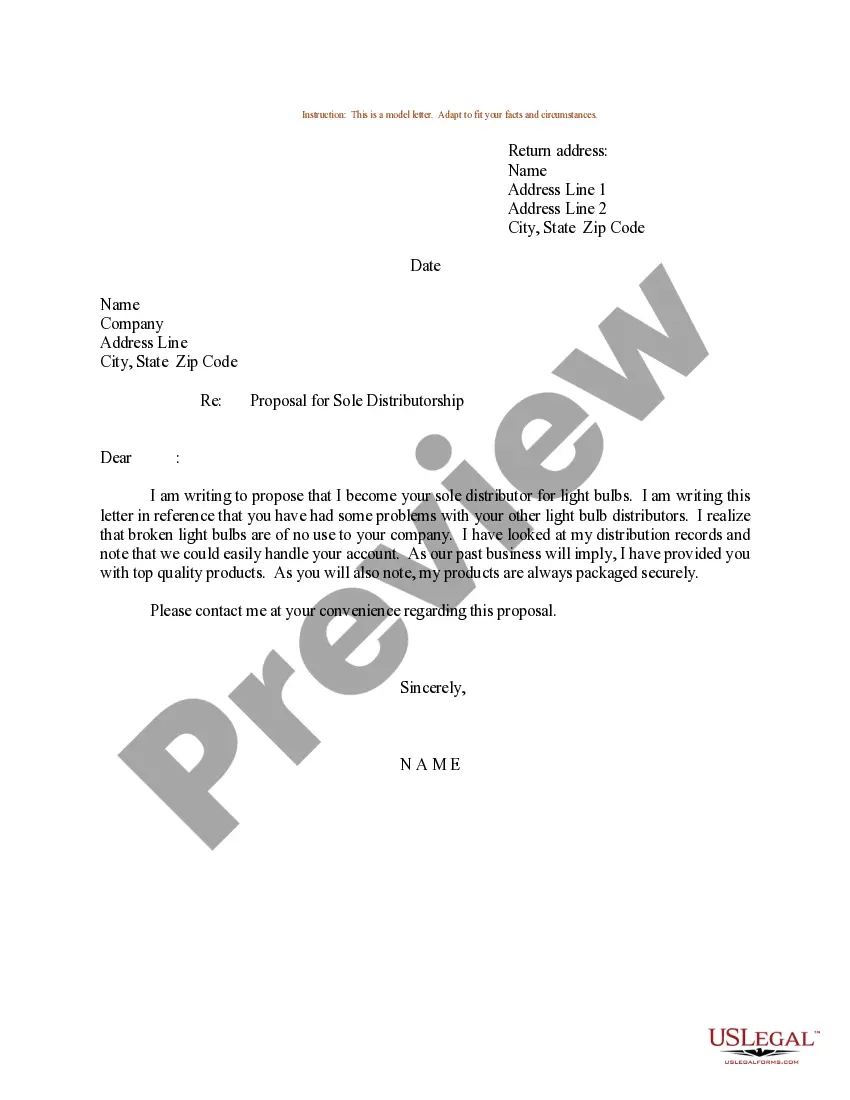
Looking for another form?


Form popularity
FAQ
Fully explain the scholarship (history, previous recipients) and how and why the recipient was selected. Your remarks should characterize the scholarship as coveted and prestigious. Introduce the recipient by name and mention his achievements and contributions.
To Whom It May Concern: {Name} would be an excellent choice for the scholarship you are offering. I have known {Name} for {length of time} in my capacity as {teacher, friend, etc.}, and I have come to know {him/her} quite well in that time.
You should show respect for the receiver. Your letter should be free from grammatical and spelling errors. Do not skip any details. Enclose the letter with a vote of thanks.
Write the name of the student without any error. State the reason for giving the scholarship. Praise the student and wish him luck for his future studies. Be proud of the student and congratulate him for his hard work. Write the letter with a positive attitude.
Teachers and professors. Former or current employers. Clergy members (preachers, pastors, rabbis, imams, etc.) Coaches. School counselors and advisers. Leaders of an organization you are associated with.
A scholarship award speech should detail the reason for the scholarship's existence, describe the background of the recipient and explain why the honoree was chosen over other candidates. If the speaker knows the recipient, it is also appropriate to include personal anecdotes to humanize the speech.
Congratulate your friend or colleague for receiving an honor or scholarship. You need not overdo the praising as it would sound dramatic. Begin by congratulating the person on the accomplishment. Appreciate the efforts and hard work put into it. Acknowledge any sacrifices made for it. Wish well for future endeavors.
An introduction that identifies who you are, your relationship to the student, and how long you've known them. Your general observations and thoughts about the student's academic strengths, personal qualities, and readiness for college.
Think carefully about saying yes. Focus on the particular school. Collect information. Mention how you know the student. Include specific examples. Remain positive. Avoid cliches. Share your contact information.