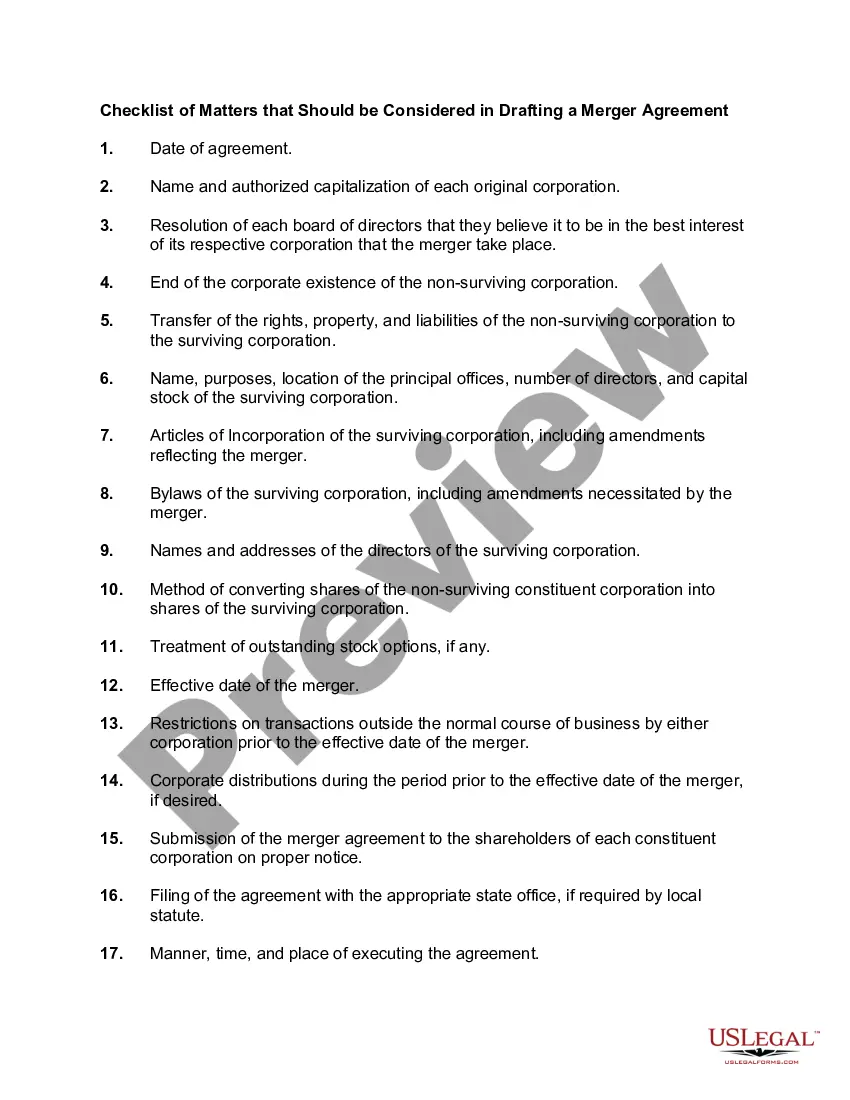
Checklist of Matters that Should be Considered in Drafting a Merger Agreement
Understanding this form
The Checklist of Matters that Should be Considered in Drafting a Merger Agreement is a detailed document designed to guide corporations through the process of merging with another entity. This form serves as a comprehensive outline, ensuring that all critical aspects are addressed in the merger agreement. Unlike other corporate forms, this checklist focuses specifically on the intricacies of merger agreements, helping to prevent oversights that could lead to legal complications.
Key components of this form
- Date of agreement
- Name and authorized capitalization of each original corporation
- Board resolutions indicating the merger is in the best interest of each corporation
- Details on the end of existence for the non-surviving corporation
- Transfer of rights and liabilities to the surviving corporation
- Information about the surviving corporation, including its name, purpose, and structure
- Amendments to the Articles of Incorporation and Bylaws due to the merger
- Share conversion methods for the non-surviving corporation shares
- Effective date of the merger
- Submission of the merger agreement to shareholders for approval
- Filing requirements with state offices
When to use this form
This checklist should be used when a corporation is considering merging with another corporation. It is crucial at the initial stages of merger planning to ensure all necessary matters are accounted for before drafting the formal merger agreement. Incorporating this checklist helps streamline the process and minimizes the risk of overlooking important legal specifications.
Intended users of this form
Intended users of this checklist include:
- Corporate executives and managers involved in the merger process
- Legal counsel advising corporations on merger agreements
- Board members participating in merger discussions
- Shareholders wanting clarity on the merger details
How to complete this form
- Identify the parties involved and enter the date of the agreement.
- Document the names and authorized capitalization of each corporation.
- Include resolutions from each board of directors supporting the merger.
- Specify the transfer of rights and liabilities to the surviving corporation.
- Outline the effective date of the merger and ensure compliance with filing requirements.
Notarization requirements for this form
This form usually doesn’t need to be notarized. However, local laws or specific transactions may require it. Our online notarization service, powered by Notarize, lets you complete it remotely through a secure video session, available 24/7.
Get your form ready online
Our built-in tools help you complete, sign, share, and store your documents in one place.
Make edits, fill in missing information, and update formatting in US Legal Forms—just like you would in MS Word.
Download a copy, print it, send it by email, or mail it via USPS—whatever works best for your next step.
Sign and collect signatures with our SignNow integration. Send to multiple recipients, set reminders, and more. Go Premium to unlock E-Sign.
If this form requires notarization, complete it online through a secure video call—no need to meet a notary in person or wait for an appointment.
We protect your documents and personal data by following strict security and privacy standards.

Make edits, fill in missing information, and update formatting in US Legal Forms—just like you would in MS Word.

Download a copy, print it, send it by email, or mail it via USPS—whatever works best for your next step.

Sign and collect signatures with our SignNow integration. Send to multiple recipients, set reminders, and more. Go Premium to unlock E-Sign.

If this form requires notarization, complete it online through a secure video call—no need to meet a notary in person or wait for an appointment.

We protect your documents and personal data by following strict security and privacy standards.
Common mistakes to avoid
- Failing to include all required corporate resolutions from the boards.
- Not reviewing local laws that could impose additional requirements.
- Omitting important details about stock option treatments or conversion methods.
Benefits of using this form online
- Accessibility: Easy to download and fill out at your convenience.
- Editability: Modify the form as needed to fit your specific merger situation.
- Reliable: Created by licensed attorneys to ensure legal compliance.
Legal use & context
- The form serves as a guide for drafting legally binding merger agreements.
- Following this checklist can help prevent legal disputes arising from incomplete agreements.
- It is important to execute all components properly for enforceability.
Quick recap
- This checklist is vital for ensuring that all necessary elements of a merger agreement are covered.
- Proper documentation and compliance with state laws are crucial for successful mergers.
- Using this form can help facilitate clear communication among stakeholders involved in the merger.
Looking for another form?

Form popularity
FAQ
The most successful merger or acquisition has full buy-in from all parties. This includes not only the owners and stockholders, but the employees and customers. All parties need to understand the vision of the merged companies and see the upside.
Advantages of mergers. Economies of scale bigger firms more efficient. Disadvantages of mergers. Network Economies. Research and development. Other economies of scale. Avoid duplication. Regulation of Monopoly. Prevent unprofitable business from going bust.
Copies of balance sheets, tax returns, and accounting records. A list of assets such as real property. A list of existing and potential customers. A list of employees and employee benefits.
In theory, a merger of equals is where two companies convert their respective stocks to those of the new, combined company. However, in practice, two companies will generally make an agreement for one company to buy the other company's common stock from the shareholders in exchange for its own common stock.
Compare and analyze the corporate structures. Determine the leadership of the new company. Compare the company cultures. Determine the branding of the new company. Analyze all financial positions. Determine operating costs. Do your due diligence. Conduct a valuation of all companies.
Types of Mergers. The three main types of mergers are horizontal, vertical, and conglomerate. In a horizontal merger, companies at the same stage in the same industry merge to reduce costs, expand product offerings, or reduce competition.
Check your own liquidity and financial health. Make sure your people can see clearly. Define your goals and success factors. Consider M&A candidates. Plan and execute due diligence. Create a transition team. Carefully plan and perform the integration. Extra tip: Keep in mind the four C's.
Horizontal - a merger between companies with similiar products. Vertical - a merger that consolidates the supply line of a product. Concentric - a merger between companies who have similar audiences with different products. Conglomerate - a merger between companies who offer diverse products/services.
Conglomerate. A merger between firms that are involved in totally unrelated business activities. Horizontal Merger. A merger occurring between companies in the same industry. Market Extension Mergers. Product Extension Mergers. Vertical Merger.