Certification of Waiver by Attorney for Surviving Spouse
What is this form?
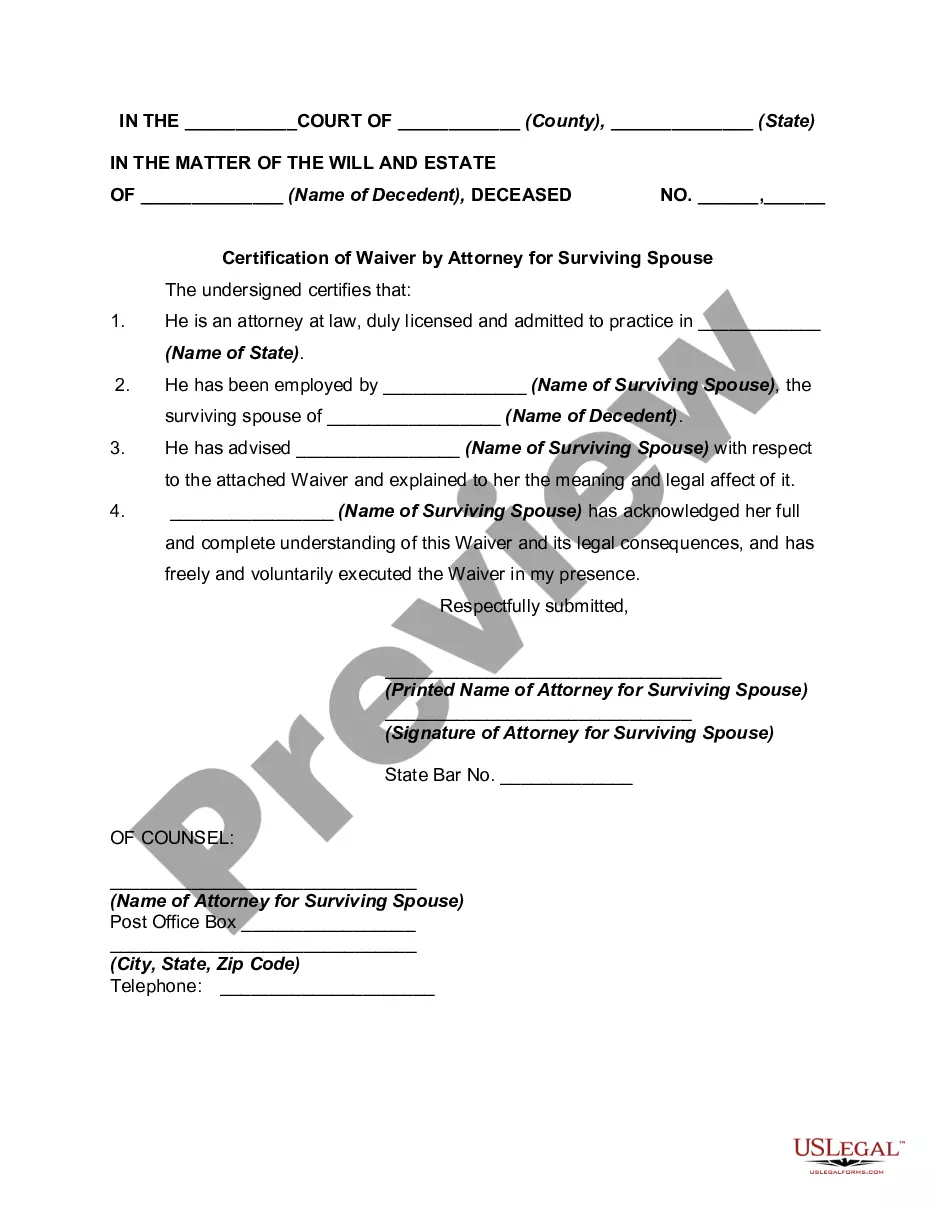
The Certification of Waiver by Attorney for Surviving Spouse is a legal document that allows a surviving spouse to waive their right to an elective share of a deceased spouse's estate. This form certifies that the waiver has been made under the guidance of a licensed attorney, ensuring that the surviving spouse fully understands the legal implications of the waiver. Unlike other estate planning forms, this certification specifically focuses on the legal acknowledgment by an attorney regarding the waiver of rights by the surviving spouse.
Form components explained
- Identification of the decedent and the surviving spouse.
- Certification by the attorney confirming their legal representation of the surviving spouse.
- Statement that the surviving spouse has been informed about the waiver's meaning and consequences.
- Signature of the attorney, affirming that the waiver was executed voluntarily and with understanding.
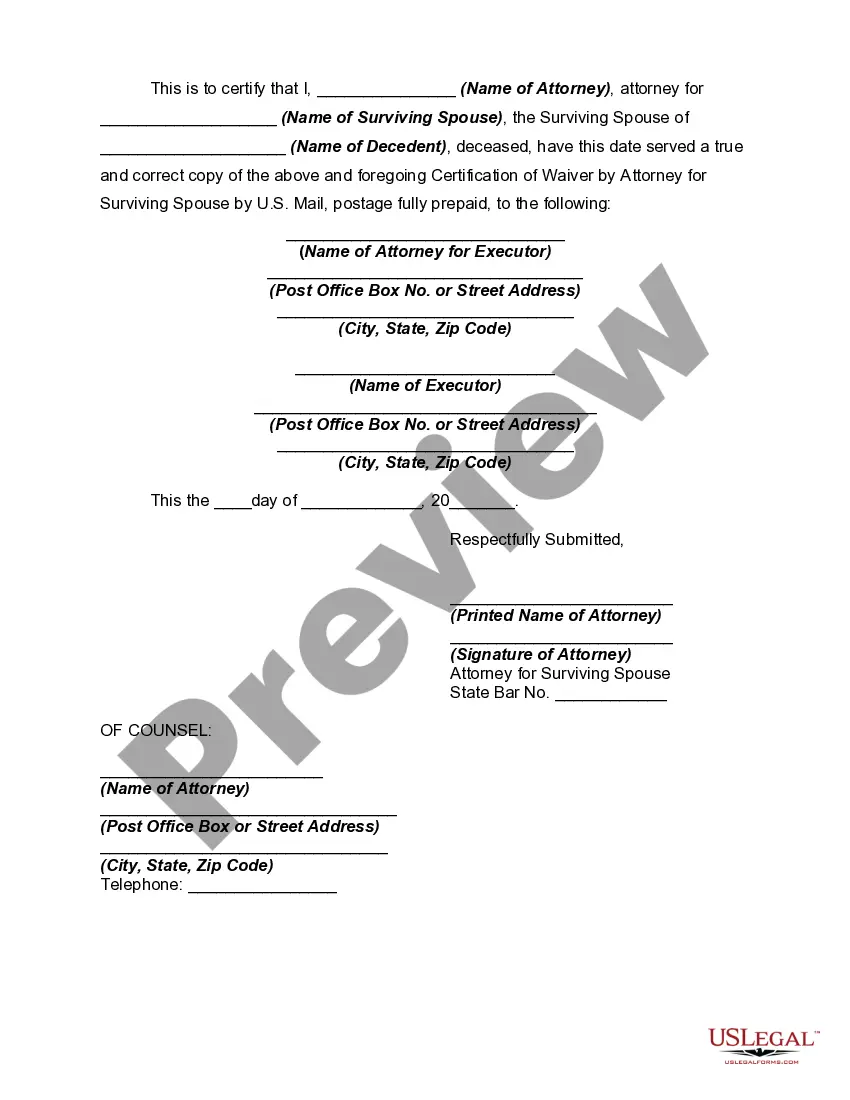
- Certificate of service to confirm delivery of the document to involved parties.
When this form is needed
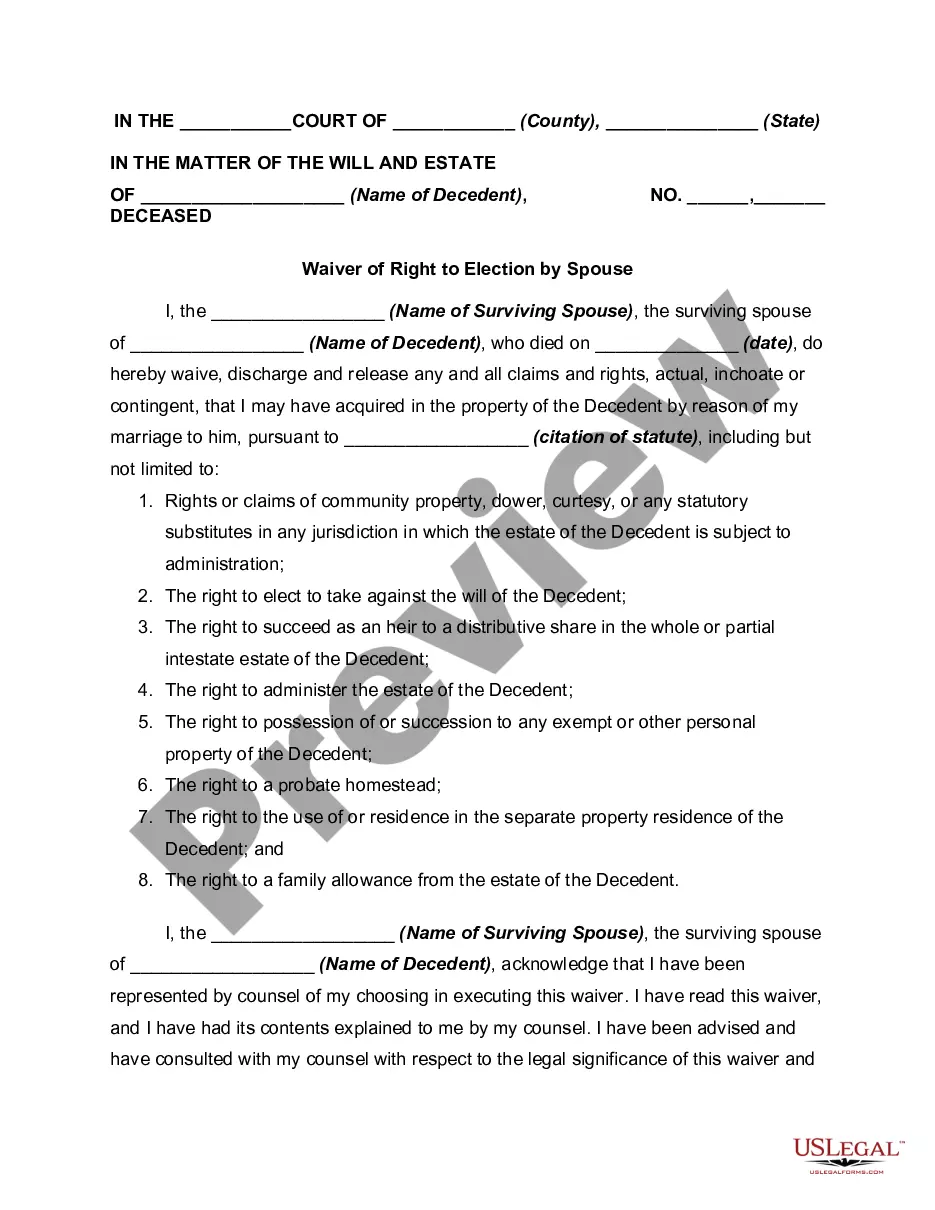
This form is needed when a surviving spouse wishes to waive their right of election against a decedent's will. It is typically used in situations where the decedent's will does not provide for the surviving spouse as per statutory entitlements. Utilizing this form ensures that the waiver is legally recognized and that the surviving spouse has made an informed decision regarding their inheritance rights.
Who can use this document
- Surviving spouses who wish to waive their right to an elective share of their deceased spouse's estate.
- Attorneys representing surviving spouses in estate matters.
- Heirs or beneficiaries involved in estate settlement discussions.
How to complete this form
- Identify the names of the decedent and the surviving spouse at the beginning of the form.
- Have the attorney complete their certification by providing their name, state of licensure, and signature.
- Ensure the surviving spouse acknowledges understanding and signs the waiver in the presence of the attorney.
- Complete the certification of service section by listing the parties to whom copies have been sent.
- Ensure all names and addresses are accurate and legibly filled out.
Notarization requirements for this form
This form does not typically require notarization to be legally valid. However, some jurisdictions or document types may still require it. US Legal Forms provides secure online notarization powered by Notarize, available 24/7 for added convenience.
Get your form ready online
Our built-in tools help you complete, sign, share, and store your documents in one place.
Make edits, fill in missing information, and update formatting in US Legal Forms—just like you would in MS Word.
Download a copy, print it, send it by email, or mail it via USPS—whatever works best for your next step.
Sign and collect signatures with our SignNow integration. Send to multiple recipients, set reminders, and more. Go Premium to unlock E-Sign.
If this form requires notarization, complete it online through a secure video call—no need to meet a notary in person or wait for an appointment.
We protect your documents and personal data by following strict security and privacy standards.

Make edits, fill in missing information, and update formatting in US Legal Forms—just like you would in MS Word.

Download a copy, print it, send it by email, or mail it via USPS—whatever works best for your next step.

Sign and collect signatures with our SignNow integration. Send to multiple recipients, set reminders, and more. Go Premium to unlock E-Sign.

If this form requires notarization, complete it online through a secure video call—no need to meet a notary in person or wait for an appointment.

We protect your documents and personal data by following strict security and privacy standards.
Common mistakes to avoid
- Failing to ensure the surviving spouse is fully informed about the implications of the waiver.
- Not having the waiver signed in the presence of the attorney.
- Inaccurate completion of names and details pertaining to the decedent or surviving spouse.
Advantages of online completion
- Convenient access to legal forms that can be completed at your own pace.
- Editable templates that allow for personalization to meet specific needs.
- Reliable assistance from licensed attorneys providing peace of mind in legal matters.
Looking for another form?

Form popularity
FAQ
If you die without a valid will, Ohio intestacy laws will decide how your property will be distributed and who will receive your property. The descent and distribution section of the intestate statute favors family members and heirs that are closely related to you.
If your spouse passed away in California without a Trust, you may think you'll need to go through probate. However, in many cases, the surviving spouse does not need to probate the estate of their loved one to gain access to his or her assets. Instead, you may only need to file a Spousal Property Petition.
The laws in Texas surrounding intestate wills for married individuals without children are much simpler. The surviving spouse automatically receives all community property.If there are no surviving parents, siblings or descendants of siblings, the spouse gets the remainder of the estate's separate real property.
However, to change the title to some property, the will must be admitted to probate.For example, if a married person dies, and the couple's property is owned with right of survivorship, the property automatically goes to the surviving spouse.
In Texas, you can make a living trust to avoid probate for virtually any asset you ownreal estate, bank accounts, vehicles, and so on. You need to create a trust document (it's similar to a will), naming someone to take over as trustee after your death (called a successor trustee).
If you fail to probate a will within the 4 year time period, then the decedent's estate will be treated as though they died intestate without a will. There are specific laws in Texas that govern which heirs are entitled to the estate's assets when a person dies intestate.
If your spouse passed away in California without a Trust, you may think you'll need to go through probate. However, in many cases, the surviving spouse does not need to probate the estate of their loved one to gain access to his or her assets. Instead, you may only need to file a Spousal Property Petition.
If you die without a will or the person named in the will can't serve as executor, the probate court will choose an executor. State law dictates who has priority to serve. The surviving spouse usually has first priority, followed by children. If there is no spouse or children, then other family members may be chosen.
If your spouse passed away in California without a Trust, you may think you'll need to go through probate. However, in many cases, the surviving spouse does not need to probate the estate of their loved one to gain access to his or her assets. Instead, you may only need to file a Spousal Property Petition.