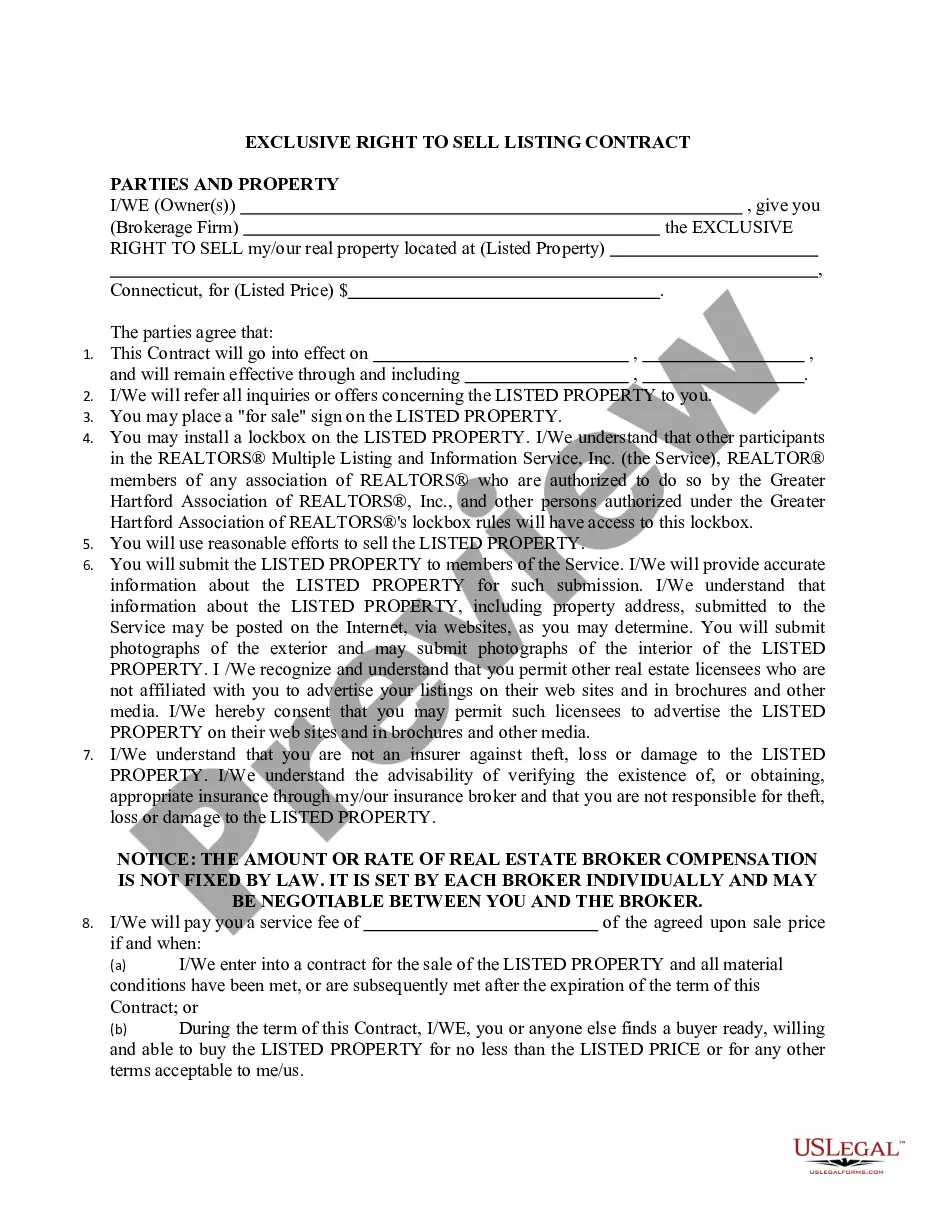
Notice of Election by Surviving Spouse
What this document covers
The Notice of Election by Surviving Spouse is a legal document that allows a surviving spouse to claim a specified portion of a deceased spouse's assets, known as the elective share. This form is essential for those who wish to affirm their right to a share of the estate, rather than what was designated in the will. Unlike a standard will contest, this form specifically invokes statutory rights that ensure a minimum inheritance for the surviving spouse, regardless of the terms laid out in the deceased's will.
Main sections of this form
- Information about the decedent, including their name and the date of their will.
- Identification of the surviving spouse and their declaration of rights.
- Citation of the relevant state statute allowing the election.
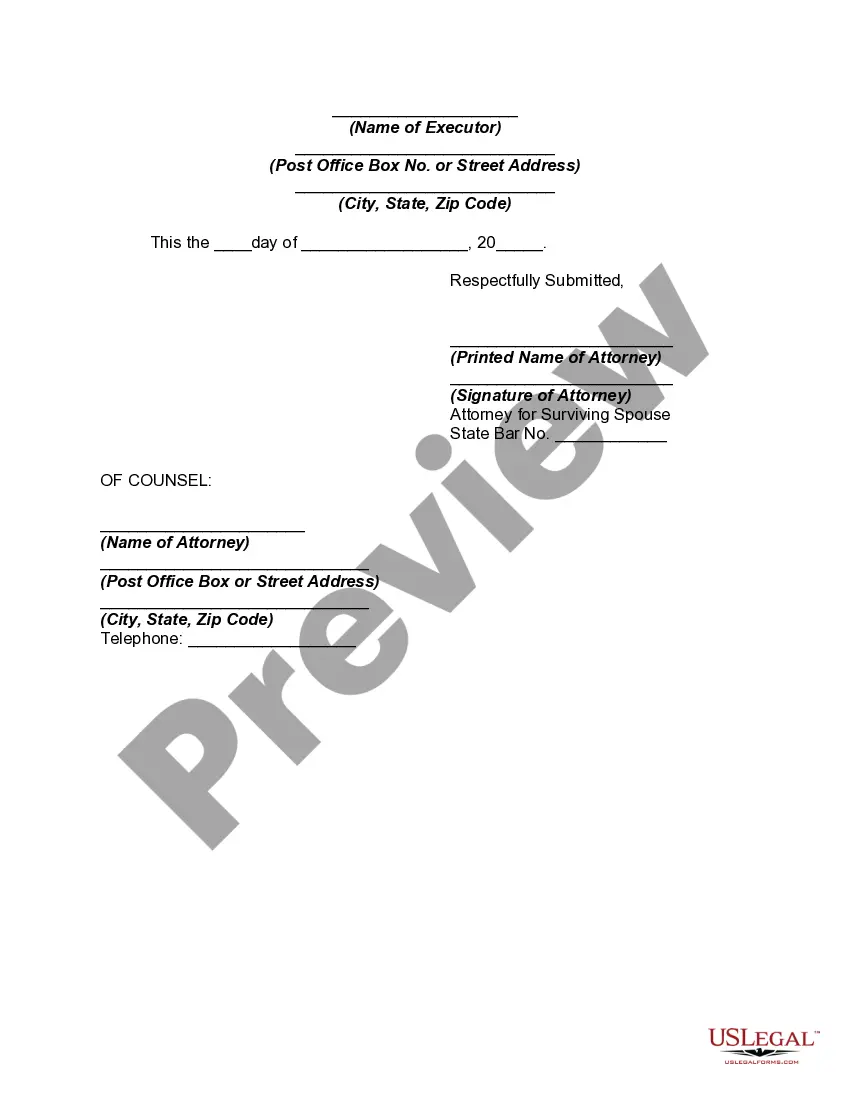
- A certificate of service, detailing how the notice has been communicated to the executor.
- Signature fields for both the surviving spouse and their attorney.
When to use this form
This form should be used when a spouse opts to exercise their statutory right to claim an elective share of the deceased spouse's estate. It is necessary in situations where the surviving spouse believes that the inheritance outlined in the will is insufficient, or when they wish to override the provisions of the will to secure their right to a statutory share of the estate.
Who can use this document
- Surviving spouses who want to claim their elective share of the estate.
- Individuals who believe the will does not provide an equitable inheritance.
- Those needing to formalize their election against the will under state law.
Completing this form step by step
- Identify the decedent and enter their full name and relevant dates.
- Fill in the name of the surviving spouse and their declaration to elect against the will.
- Reference the applicable state statute that governs the elective share.
- Sign and date the form to validate the notice of election.
- Ensure that a copy is served to the executor and their attorney, with proper documentation included.
Is notarization required?
In most cases, this form does not require notarization. However, some jurisdictions or signing circumstances might. US Legal Forms offers online notarization powered by Notarize, accessible 24/7 for a quick, remote process.
Get your form ready online
Our built-in tools help you complete, sign, share, and store your documents in one place.
Make edits, fill in missing information, and update formatting in US Legal Forms—just like you would in MS Word.
Download a copy, print it, send it by email, or mail it via USPS—whatever works best for your next step.
Sign and collect signatures with our SignNow integration. Send to multiple recipients, set reminders, and more. Go Premium to unlock E-Sign.
If this form requires notarization, complete it online through a secure video call—no need to meet a notary in person or wait for an appointment.
We protect your documents and personal data by following strict security and privacy standards.

Make edits, fill in missing information, and update formatting in US Legal Forms—just like you would in MS Word.

Download a copy, print it, send it by email, or mail it via USPS—whatever works best for your next step.

Sign and collect signatures with our SignNow integration. Send to multiple recipients, set reminders, and more. Go Premium to unlock E-Sign.

If this form requires notarization, complete it online through a secure video call—no need to meet a notary in person or wait for an appointment.

We protect your documents and personal data by following strict security and privacy standards.
Avoid these common issues
- Failing to serve the notice to all required parties appropriately.
- Omitting to reference the correct state statute.
- Not including the necessary signatures or dates on the form.
Why complete this form online
- Easy access to legally vetted templates drafted by licensed attorneys.
- Convenient download and printing, allowing quick response to legal needs.
- Time-saving, as users can complete the form at their own pace without the pressure of in-person consultations.
Legal use & context
- The Notice of Election by Surviving Spouse serves to protect the rights of a spouse in the context of estate planning and inheritance.
- It is legally enforceable once properly completed and served according to state laws.
- Understanding the legal environment and potential limitations is crucial for effective use of this form.
Quick recap
- This form is vital for a surviving spouse wanting to ensure their legal rights to a share of the estate.
- Each state has specific regulations regarding the elective share; compliance with these is necessary.
- Completing and serving this form correctly can prevent future legal disputes regarding inheritance.
Looking for another form?


Form popularity
FAQ
The concept of elective share is the modern form of dowry, which is the reserved fraction of a deceaseds estate. It allows a surviving spouse to benefit in the event she is disinherited by the decedent.
California is a community property state, which means that following the death of a spouse, the surviving spouse will have entitlement to one-half of the community property (i.e., property that was acquired over the course of the marriage, regardless of which spouse acquired it).
Many married couples own most of their assets jointly with the right of survivorship. When one spouse dies, the surviving spouse automatically receives complete ownership of the property. This distribution cannot be changed by Will.
California is a community property state, which means that following the death of a spouse, the surviving spouse will have entitlement to one-half of the community property (i.e., property that was acquired over the course of the marriage, regardless of which spouse acquired it).
The surviving spouse has the right to Family Exempt Property.The surviving spouse has the right to receive Letters of Administration, which means that ahead of all other family members, he/she has the right to serve as the Administrator when someone dies intestate.
An elective share is a term used in American law relating to inheritance, which describes a proportion of an estate which the surviving spouse of the deceased may claim in place of what they were left in the decedent's will.
In Massachusetts, like many other states, the elective share statute aims to prevent one from disinheriting a spouse. The elective share statute permits a surviving spouse to set aside their deceased spouse's will and instead claim a statutorily-defined portion of the deceased spouse's probate estate.