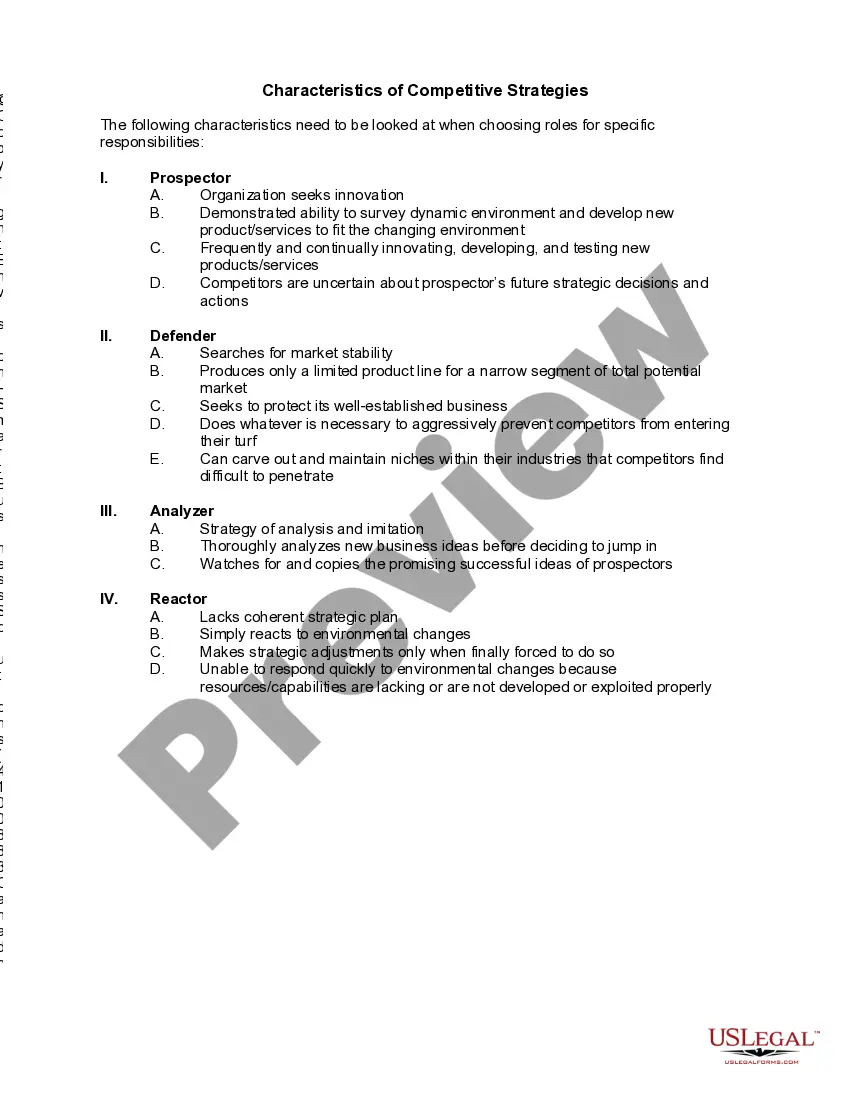
Characteristics of Competitive Strategies
About this form
The Characteristics of Competitive Strategies form is a template designed to help individuals and organizations outline how a company competes in its industry. This form specifically details different strategic roles a company can assume, such as Prospector, Defender, Analyzer, and Reactor. It serves to illustrate how a company can achieve a competitive advantage through distinct methods of competition, making it a vital tool for business planning and strategic analysis.
Key parts of this document
- Definition of the Prospector role and its focus on innovation.
- Description of the Defender role and strategies for market stability.
- Explanation of the Analyzer role and its method of cautious imitation.
- Overview of the Reactor role, emphasizing lack of strategic planning.
Common use cases
This form is useful for businesses assessing their competitive strategies. It is ideal for startup companies evaluating their market entry approach, established companies seeking to maintain their market position, or any organization looking to redefine their strategic roles in a changing environment. The form aids in understanding varied approaches to competition, helping companies align their strategies accordingly.
Intended users of this form
- Business owners and entrepreneurs developing a strategic plan.
- Marketing and management professionals seeking to analyze competitive positioning.
- Consultants and advisors providing guidance on business strategy.
- Students and educators studying competitive strategies in business courses.
How to prepare this document
- Identify the company and the industry it operates within.
- Determine the strategic role the company currently adopts or aims to adopt.
- Assess the market environment and identify areas for innovation or stability.
- Document potential competition and how the company intends to respond.
- Review and finalize the strategies outlined in the form with relevant stakeholders.
Notarization requirements for this form
This form does not typically require notarization to be legally valid. However, some jurisdictions or document types may still require it. US Legal Forms provides secure online notarization powered by Notarize, available 24/7 for added convenience.
Get your form ready online
Our built-in tools help you complete, sign, share, and store your documents in one place.
Make edits, fill in missing information, and update formatting in US Legal Forms—just like you would in MS Word.
Download a copy, print it, send it by email, or mail it via USPS—whatever works best for your next step.
Sign and collect signatures with our SignNow integration. Send to multiple recipients, set reminders, and more. Go Premium to unlock E-Sign.
If this form requires notarization, complete it online through a secure video call—no need to meet a notary in person or wait for an appointment.
We protect your documents and personal data by following strict security and privacy standards.

Make edits, fill in missing information, and update formatting in US Legal Forms—just like you would in MS Word.

Download a copy, print it, send it by email, or mail it via USPS—whatever works best for your next step.

Sign and collect signatures with our SignNow integration. Send to multiple recipients, set reminders, and more. Go Premium to unlock E-Sign.

If this form requires notarization, complete it online through a secure video call—no need to meet a notary in person or wait for an appointment.

We protect your documents and personal data by following strict security and privacy standards.
Common mistakes to avoid
- Failing to thoroughly assess the competitive landscape.
- Ignoring the nuances of each strategic role and their implications.
- Not involving key stakeholders in the strategic planning process.
Benefits of completing this form online
- Convenient download and immediate access to a professionally drafted template.
- Easy to customize based on specific business needs and industry contexts.
- Reliable format that complies with general guidelines for strategic planning.
Legal use & context
- This form serves as a strategic planning tool rather than a legally binding document.
- Effective use of this form can help businesses avoid competition-related legal disputes.
- It provides a framework for understanding competitive strategies in a legal context.
Main things to remember
- The Characteristics of Competitive Strategies form is essential for assessing a company's market position.
- Understanding different strategic roles can help businesses optimize their competitive advantages.
- Proper completion of the form involves careful analysis of both internal capabilities and external market conditions.
Looking for another form?

Form popularity
FAQ
Strong research and development capabilities. Access to intellectual properties. Exclusive re-selling or distribution rights. Ownership of capital equipment. Superior product or customer support. Low cost or high volume production. Economic factors. Superior database management and data processing capabilities.
Competitive advantages are attributed to a variety of factors including cost structure, branding, the quality of product offerings, the distribution network, intellectual property, and customer service.
The idea here is that if a firm is to maintain sustainable competitive advantage, it must control a set of exploitable resources that have four critical characteristics. These resources must be (1) valuable, (2) rare, (3) imperfectly imitable (tough to imitate), and (4) nonsubstitutable.
According to Porter's Generic Strategies model, there are three basic strategic options available to organizations for gaining competitive advantage. These are: Cost Leadership, Differentiation and Focus.
Product quality. Strategic pricing. Customer service. Market positioning. Distribution networks. Innovation and access to new technologies.
The four primary methods of gaining a competitive advantage are cost leadership, differentiation, defensive strategies and strategic alliances.
Cost Leadership Strategy or Low-cost strategy. Differentiation strategy. Best-cost strategy. Market-niche or focus strategy.
WHAT IS A COMPETITIVE STRATEGY? A competitive strategy may be defined as a long-term plan of action that a company devises towards achieving a competitive advantage over its competitors after examining the strengths and weaknesses of the latter and comparing them to its own.