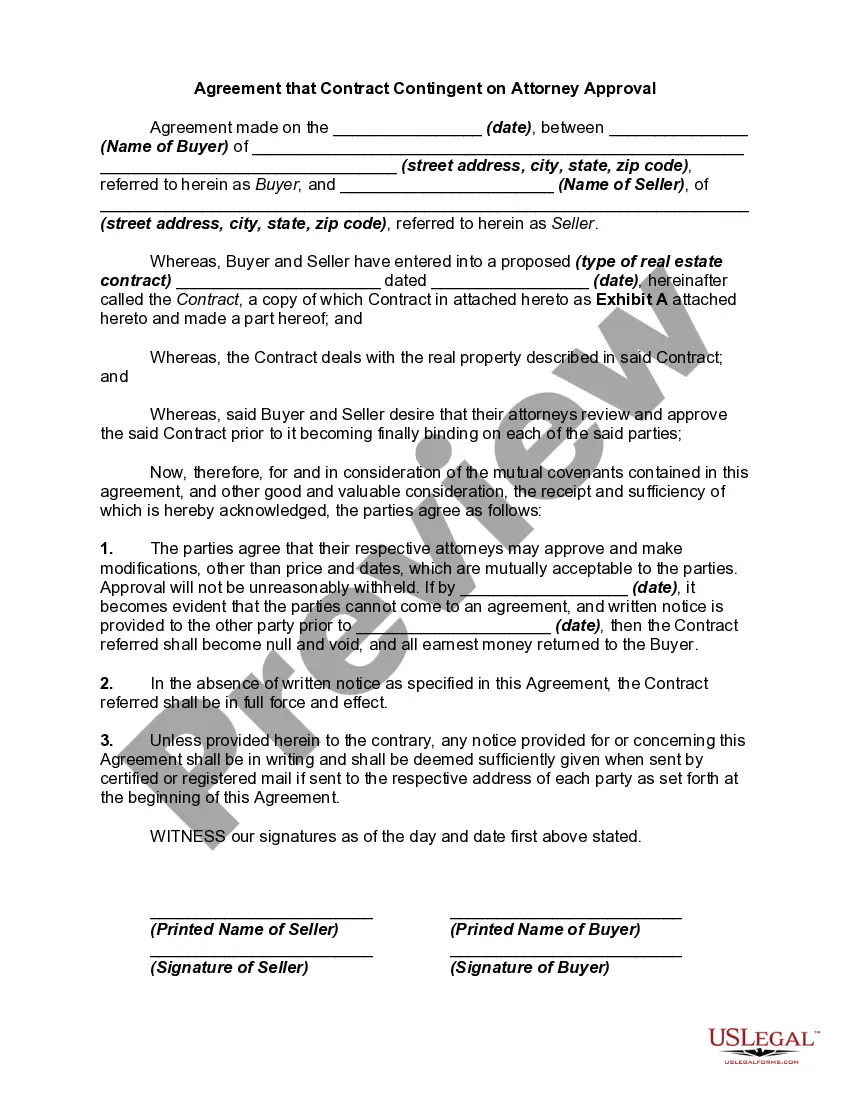
Agreement that Contract Contingent on Attorney Approval
Understanding this form
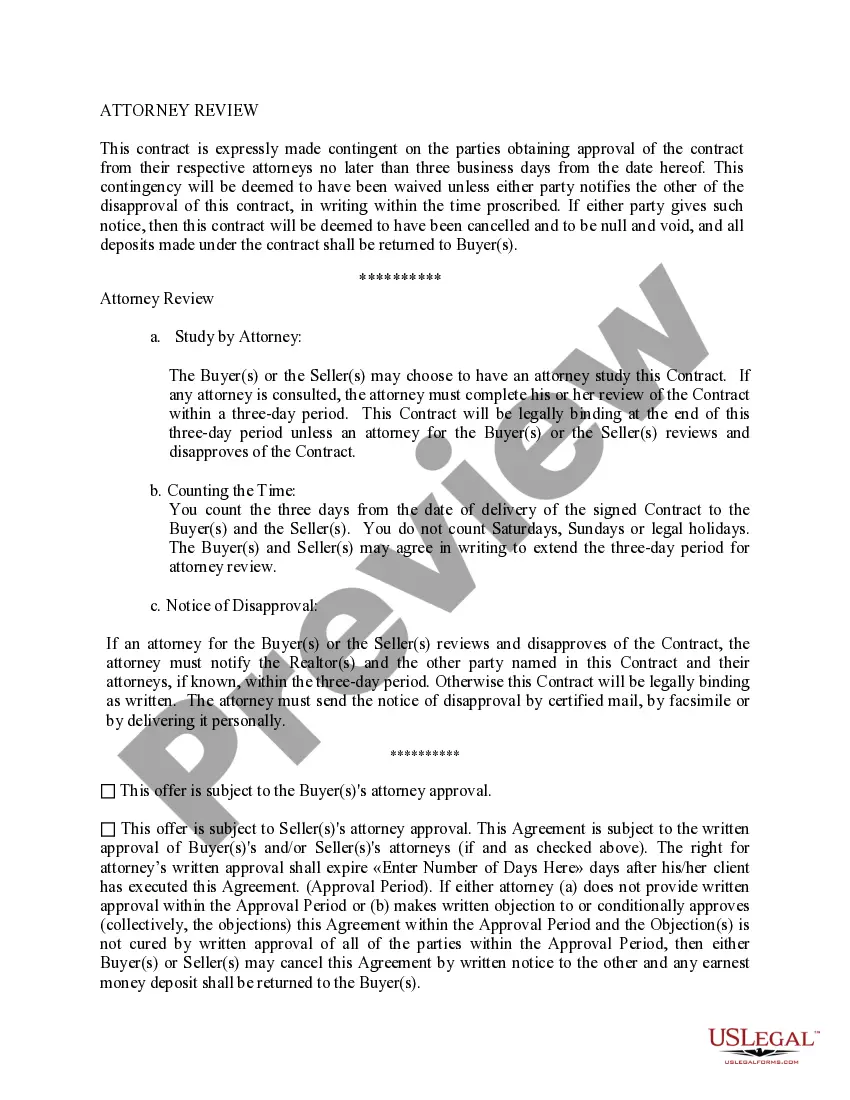
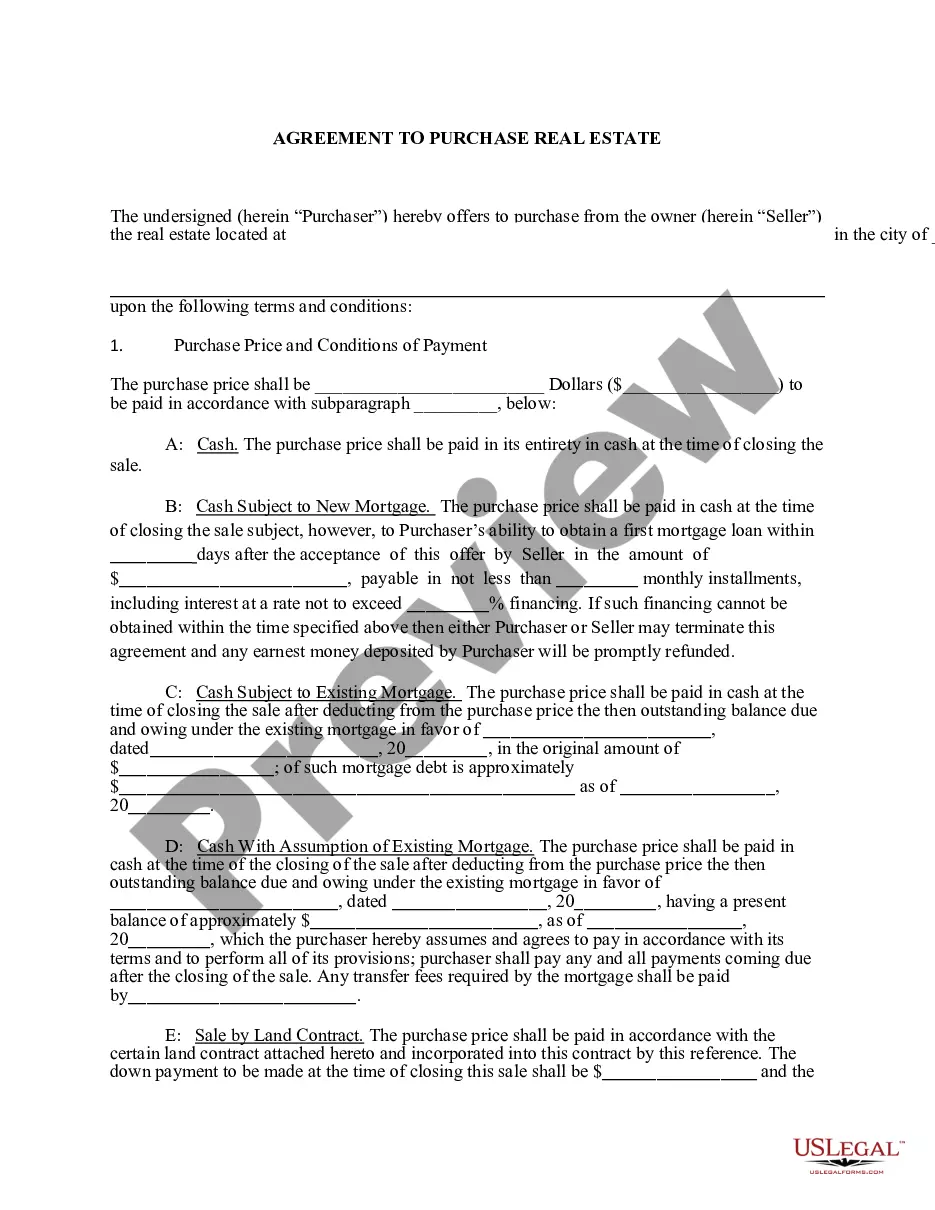
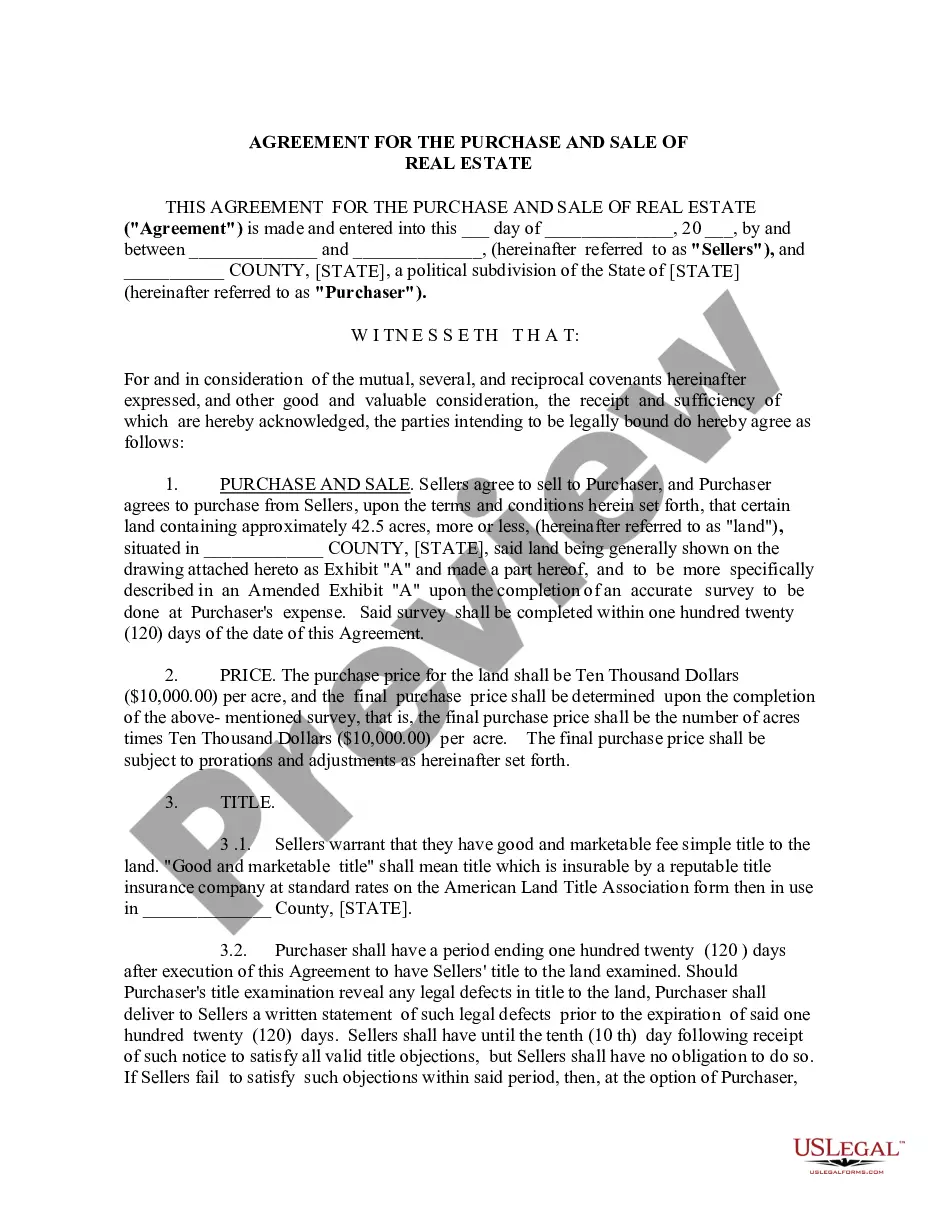
The Agreement that Contract Contingent on Attorney Approval is a legal document that ensures the finalization of a contract is subject to review and approval by the attorneys of both parties. This form distinguishes itself from standard contracts by explicitly allowing for legal scrutiny, ensuring that both Buyer and Seller are protected before the agreement becomes binding. It facilitates clarity and trust during the real estate transaction process.
What’s included in this form
- Date of the agreement and details of the parties involved.
- Description of the contract subject to attorney approval.
- Provision for modifications to be made by attorneys, excluding price and dates.
- Conditions under which the contract becomes null and void.
- Notices regarding the agreement are to be provided in writing.
- Space for signatures and printed names of Buyer and Seller.
When this form is needed
This form should be used when a Buyer and Seller agree to a real estate contract but want to ensure that their attorneys review and approve it before the contract becomes binding. It is particularly useful in scenarios where either party may have concerns about the contract's terms and wishes to have legal assurance prior to finalizing the agreement.
Who this form is for
- Buyers and Sellers involved in real estate transactions.
- Parties who want legal counsel to assess the terms of a contract.
- Individuals looking to protect their interests during contract negotiations.
Instructions for completing this form
- Identify the date of the agreement.
- Fill in the names and addresses of both the Buyer and Seller.
- Specify the type of real estate contract and include the date.
- Ensure both parties understand the conditions regarding attorney review and approval.
- Obtain signatures from both parties along with printed names.
Is notarization required?
Notarization is not commonly needed for this form. However, certain documents or local rules may make it necessary. Our notarization service, powered by Notarize, allows you to finalize it securely online anytime, day or night.
Get your form ready online
Our built-in tools help you complete, sign, share, and store your documents in one place.
Make edits, fill in missing information, and update formatting in US Legal Forms—just like you would in MS Word.
Download a copy, print it, send it by email, or mail it via USPS—whatever works best for your next step.
Sign and collect signatures with our SignNow integration. Send to multiple recipients, set reminders, and more. Go Premium to unlock E-Sign.
If this form requires notarization, complete it online through a secure video call—no need to meet a notary in person or wait for an appointment.
We protect your documents and personal data by following strict security and privacy standards.

Make edits, fill in missing information, and update formatting in US Legal Forms—just like you would in MS Word.

Download a copy, print it, send it by email, or mail it via USPS—whatever works best for your next step.

Sign and collect signatures with our SignNow integration. Send to multiple recipients, set reminders, and more. Go Premium to unlock E-Sign.

If this form requires notarization, complete it online through a secure video call—no need to meet a notary in person or wait for an appointment.

We protect your documents and personal data by following strict security and privacy standards.
Typical mistakes to avoid
- Failing to include accurate names or addresses of the parties involved.
- Not specifying the type of contract being reviewed.
- Overlooking the deadline for attorney approval.
- Not ensuring both parties understand their rights and obligations under the agreement.
Advantages of online completion
- Convenient access to a ready-made legal template.
- Editable to meet specific needs or preferences.
- Ensures compliance with standard legal language and requirements.
- Available for immediate download, saving time for users.
Looking for another form?
Form popularity
FAQ
A contingency clause often states that your offer to buy property is contingent upon X,Y, & Z. For example, the contingency clause may state, The buyer's obligation to purchase the real property is contingent upon the property appraising for a price at or above the contract purchase price.
Contingency means something that could happen or come up depending on other occurrences. An example of a contingency is the unexpected need for a bandage on a hike. The definition of a contingency is something that depends on something else in order to happen.
A contingent offer that's been agreed to by a seller is an accepted offer. Once all stipulated contingencies have been met, the status of the offer changes to pending. A pending offer simply means that the parties are preparing to close on the deal.
Most purchase agreements are contingent upon a satisfactory home inspection and mortgage financing approval. There are other types of contingencies as well, in addition to the most common ones mentioned above.
Buyer and seller information. Property details. Pricing and financing. Fixtures and appliances included/excluded in the sale. Closing and possession dates. Earnest money deposit amount. Closing costs and who is responsible for paying.
Earnest money. Requests for seller concessions. Inspection contingency. Inclusions. Include proof of funds to close if a cash offer, or a lender's preapproval letter. Include any requested addendums and documentation with the offer. Present it in person.
A home sale contingency gives the buyer a specified amount of time to sell and settle their existing home in order to finance the new one. This type of contingency protects buyers because, if an existing home doesn't sell for at least the asking price, the buyer can back out of the contract without legal consequences.
Standard contingencies include things like a buyer's inspection of the house and satisfaction with the condition that the house is in. Contingencies such as these are often considered a matter of course and their presence within a purchase agreement will likely not be contested.