Sale of Copyright to Published Book along with Rights under Publishing
What is this form?
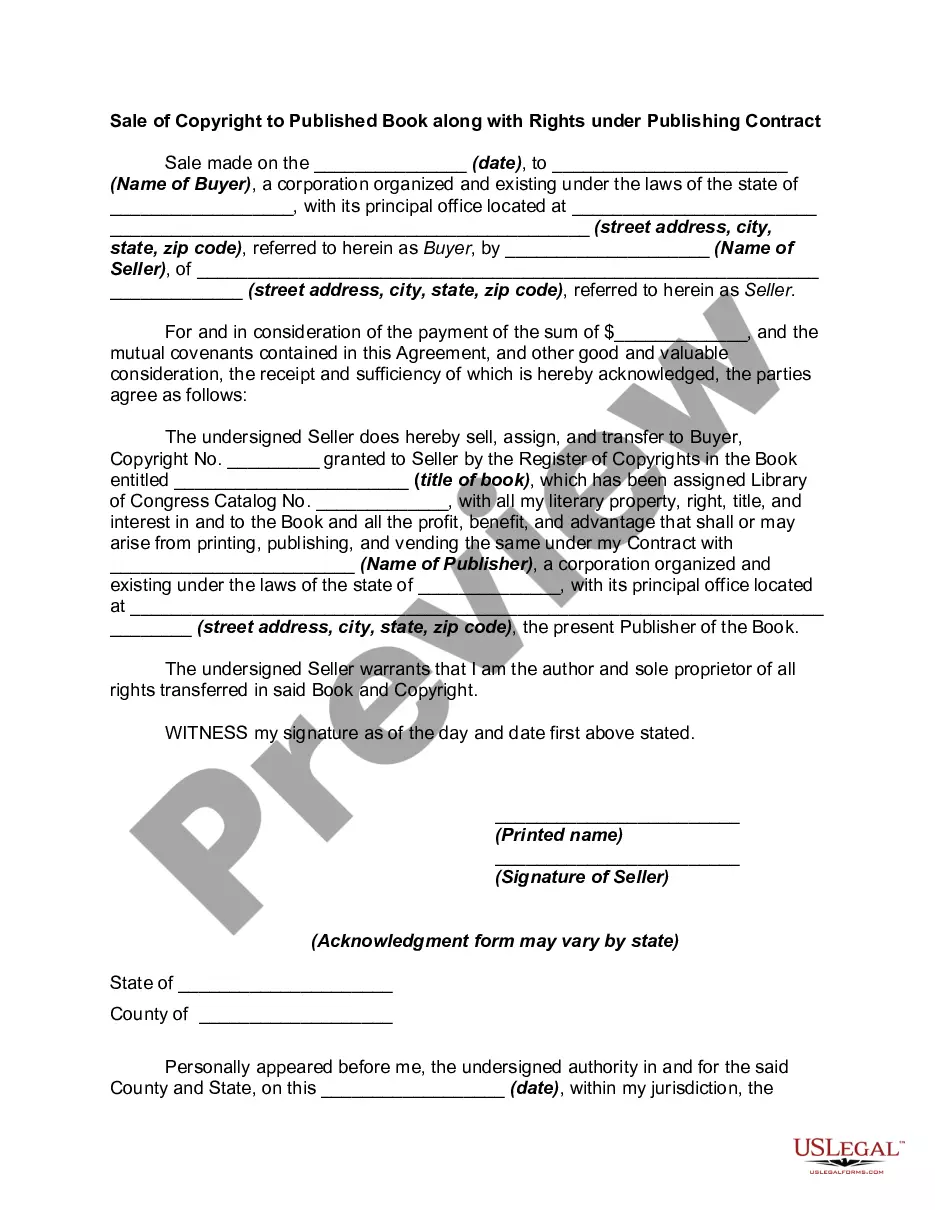
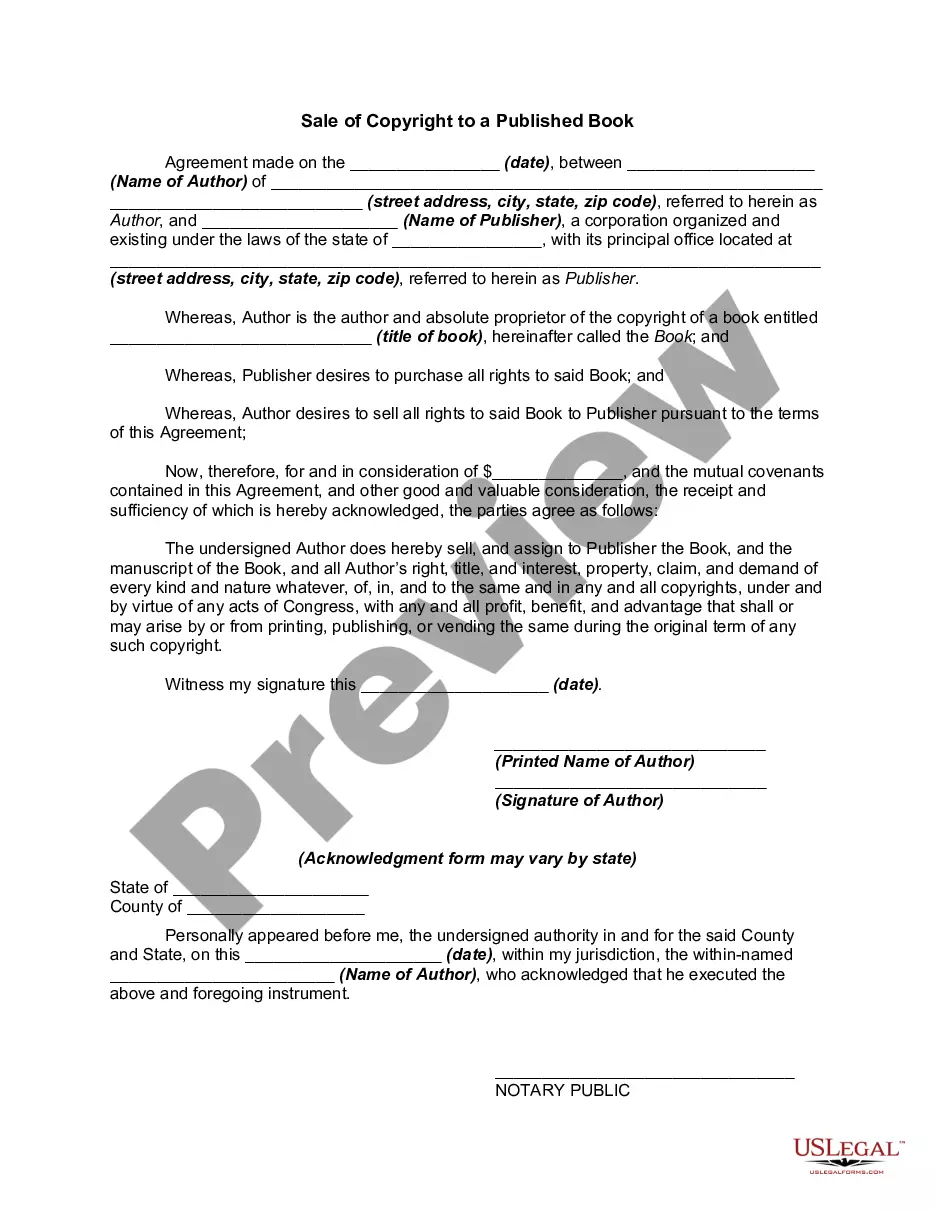
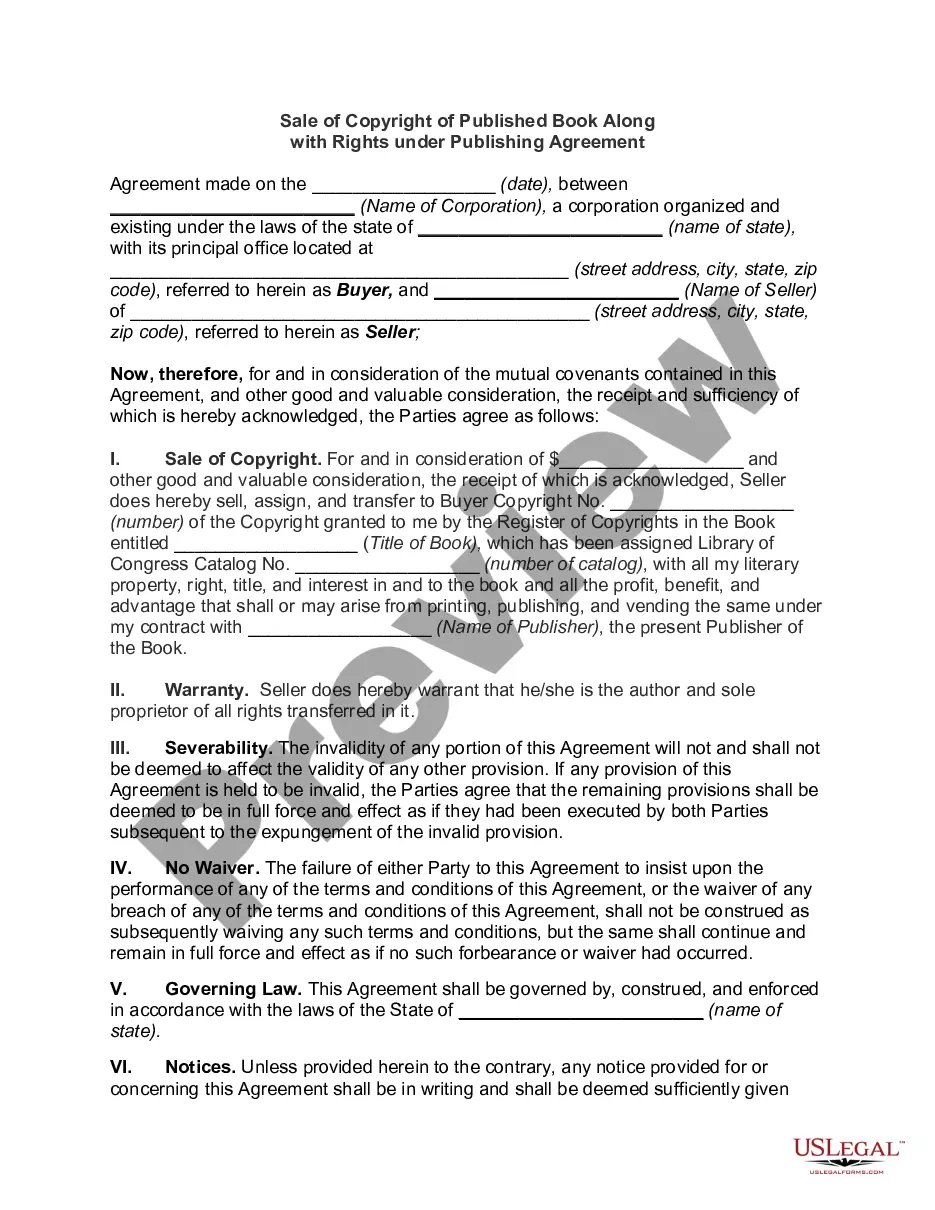
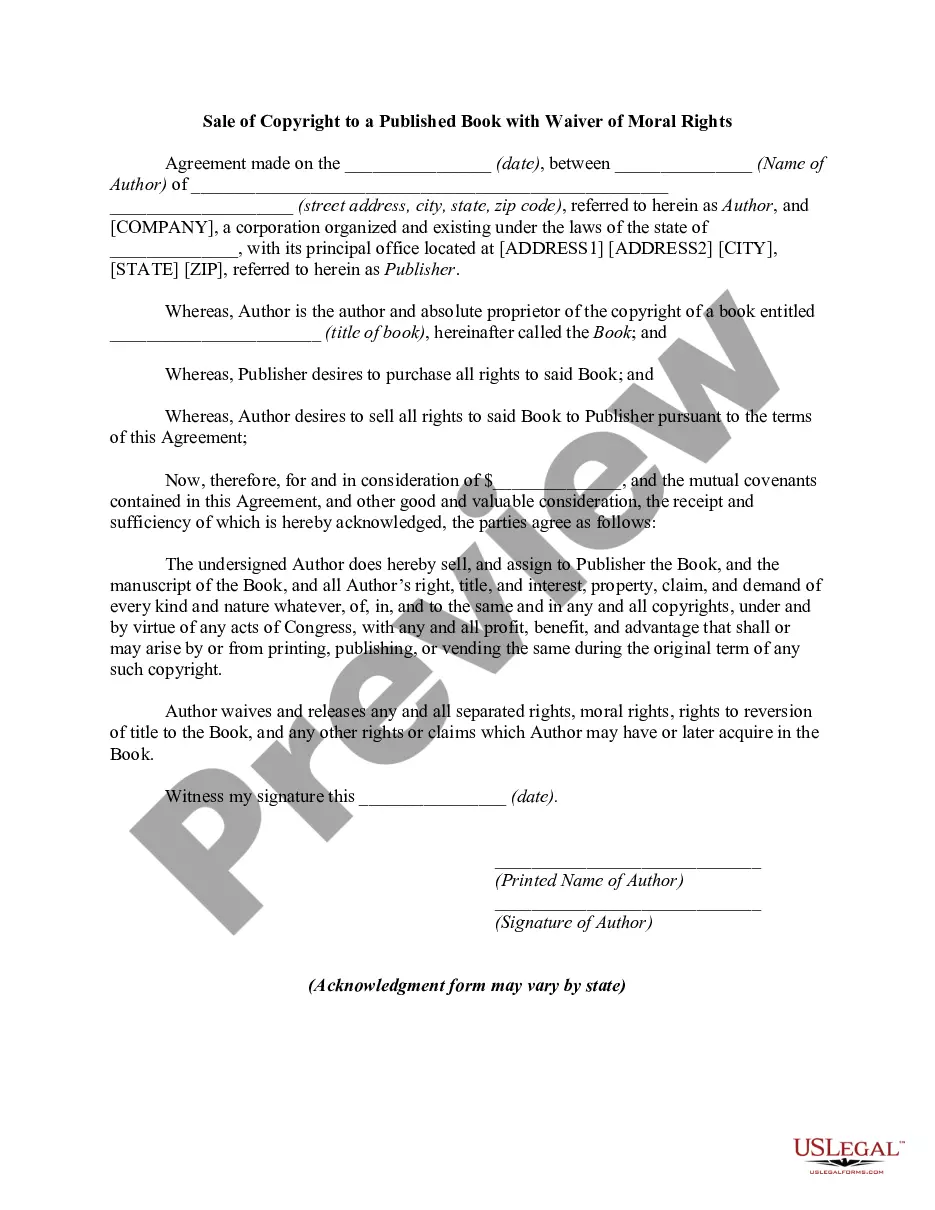
The Sale of Copyright to Published Book along with Rights under Publishing is a legal document that transfers ownership of copyright from the seller to the buyer. This form is essential for authors who wish to sell their rights to a published book, clarifying the terms of ownership transfer and ensuring that all legal rights associated with the work are properly assigned. It differs from general copyright licensing agreements by facilitating a complete transfer of ownership rather than a temporary licensing arrangement.
Key components of this form
- Date of the sale
- Name and details of the buyer and seller
- Description of the copyrighted work, including title and copyright number
- Consideration or payment details for the sale
- Statement of ownership and a warranty by the seller
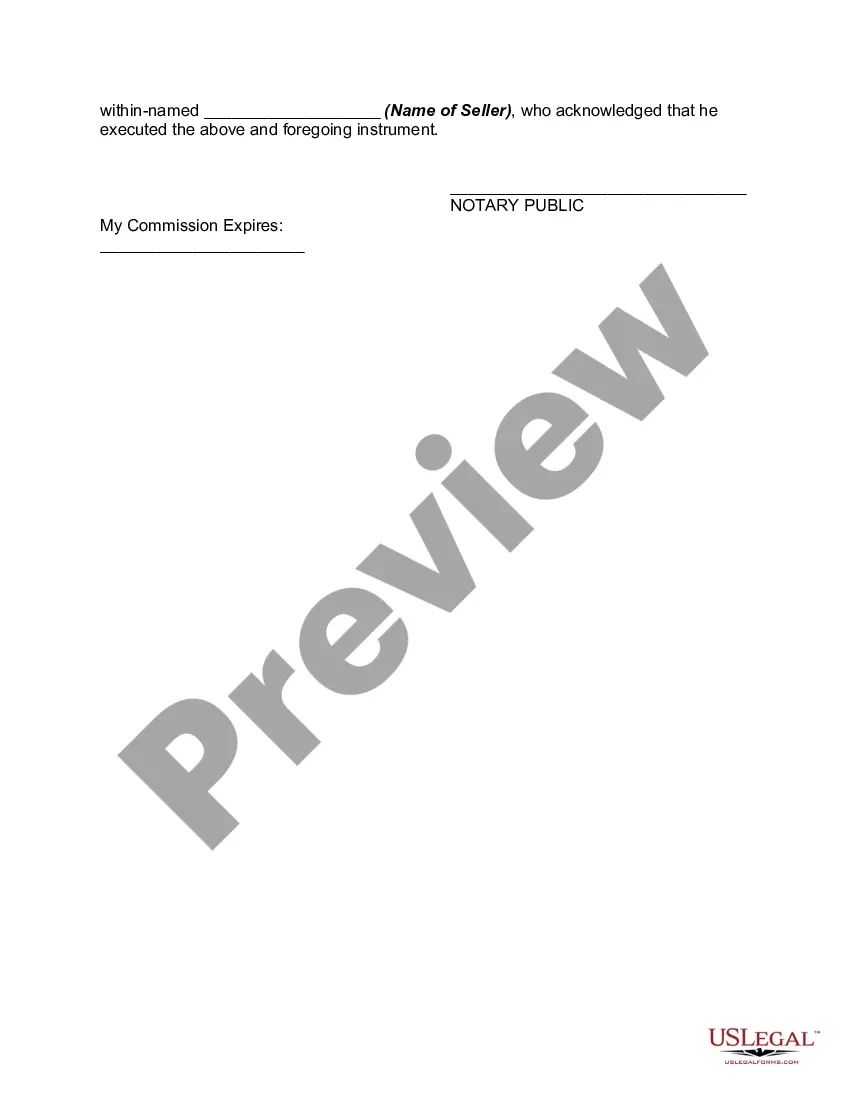
- Signature lines for the seller and a notary acknowledgment section
Common use cases
This form should be used when an author or copyright holder wishes to sell the copyright of their published book to another party. It is also applicable when there is a desire to transfer any associated rights under a publishing contract. Using this form helps in establishing a clear record of ownership and the terms of the transfer, protecting both parties involved in the transaction.
Who this form is for
This form is intended for:
- Authors looking to sell their copyright to their published works
- Publishers acquiring copyrights for books
- Literary agents or representatives acting on behalf of the author or buyer
- Corporations or individuals involved in the buying and selling of literary rights
How to prepare this document
- Identify the date of the sale at the top of the form.
- Enter the names and addresses of both the buyer and seller accurately.
- Specify the payment amount in the consideration section.
- Provide the title and copyright number of the book being sold.
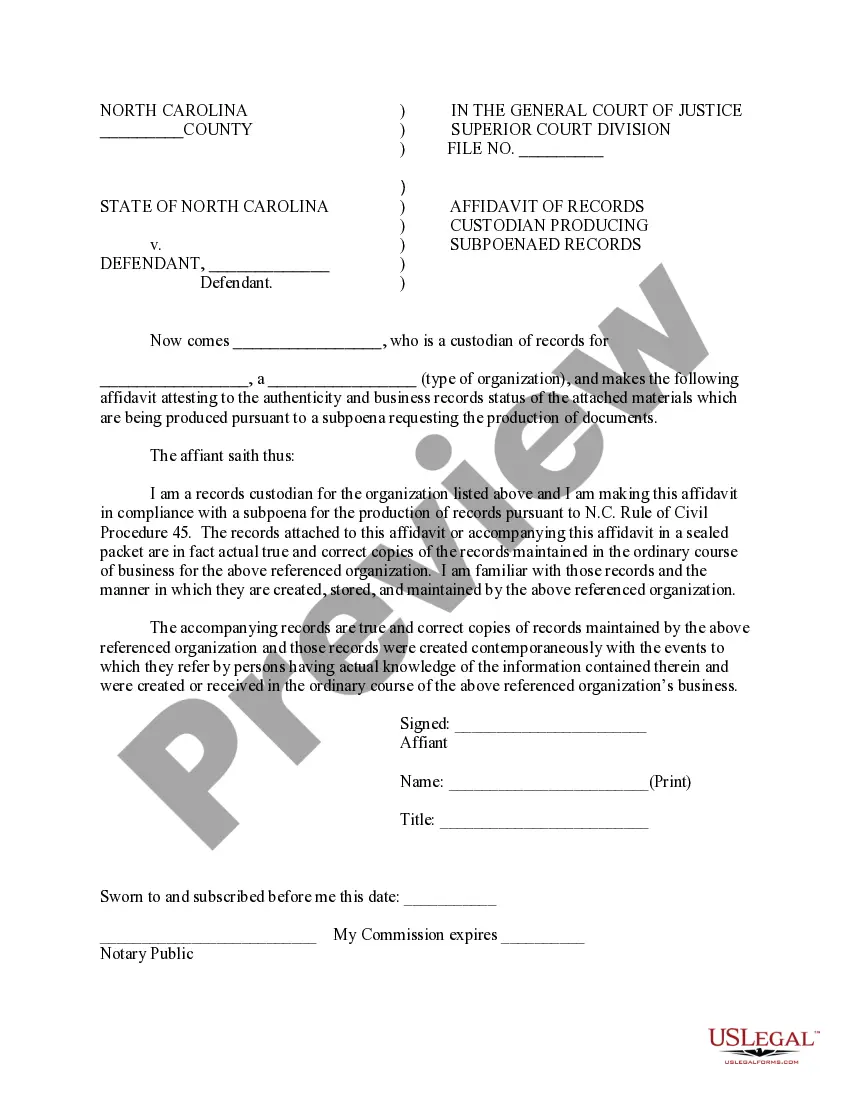
- Ensure the seller signs the document and complete the notary acknowledgment if required.
Does this document require notarization?
Notarization is required for this form to take effect. Our online notarization service, powered by Notarize, lets you verify and sign documents remotely through an encrypted video session, available 24/7.
Get your form ready online
Our built-in tools help you complete, sign, share, and store your documents in one place.
Make edits, fill in missing information, and update formatting in US Legal Forms—just like you would in MS Word.
Download a copy, print it, send it by email, or mail it via USPS—whatever works best for your next step.
Sign and collect signatures with our SignNow integration. Send to multiple recipients, set reminders, and more. Go Premium to unlock E-Sign.
If this form requires notarization, complete it online through a secure video call—no need to meet a notary in person or wait for an appointment.
We protect your documents and personal data by following strict security and privacy standards.

Make edits, fill in missing information, and update formatting in US Legal Forms—just like you would in MS Word.

Download a copy, print it, send it by email, or mail it via USPS—whatever works best for your next step.

Sign and collect signatures with our SignNow integration. Send to multiple recipients, set reminders, and more. Go Premium to unlock E-Sign.

If this form requires notarization, complete it online through a secure video call—no need to meet a notary in person or wait for an appointment.

We protect your documents and personal data by following strict security and privacy standards.
Avoid these common issues
- Failing to include complete names and addresses for both parties.
- Not specifying the correct copyright number or title of the book.
- Inaccurate payment details that do not match what was agreed upon by both parties.
- Overlooking the notary acknowledgment when state law requires it.
Why use this form online
- Convenience of downloading and completing the form at your own pace.
- Editable fields allow for customization based on specific transaction details.
- Access to professionally drafted forms ensures legal compliance.
Main things to remember
- The form is essential for legal transfer of copyright ownership.
- It includes both copyright and publishing rights for comprehensive coverage.
- Accurate completion and signature are crucial for enforceability.
- Consulting with a legal professional can provide additional guidance.
Looking for another form?
Form popularity
FAQ
Usually, the author of the creative work is the owner of the copyright. But in the publishing industry, the owner of the copyright may be the publishing company due to an agreement between the author and the publisher.Sometimes, even though a book is published by a major publisher, the author still owns the copyright.
When a book publisher contracts with an author to publish a book, in essence, the author (who is the copyright holder) grants the publisher the right to publish the work for an agreed-upon amount of money. This money is called a royalty and is expressed as a percentage of sales.
Copyright pages in books published by traditional publishers will include the name of the publisher, address (sometimes just the city), and URL. If you're self-publishing, you can include your name or create a name for your imprint along with an address and URL, if you choose.
Once your book is published, it's important that you remain in control of your work. Intellectual property laws make the foundation of copyrighting a book easy, but you can still take it a step further to make certain that you remain in control, by registering it with the Copyright Office, Library of Congress.
But, it does contain lots of technical information about a book: the Author's name, the year the book was published, its ISBN, its Library of Congress Control Number, legal disclaimers, etc. Copyright protects your work.A copyright page is optional. Even without it, your work is protected.
The symbol © (letter C in a circle), the word Copyright, or the abbreviation Copr. The year of first publication. The name of the copyright owner, an abbreviation by which the name can be recognized, or a generally known alternative designation of owner.
The symbol ©, or the word Copyright, or the abbreviation, Copr. The first year of publication. The name of the copyright holder (presumably, your name)
Head over to the copyright.gov portal. Click on Literary Works, then Register A Literary Work. Take a minute to create an account with the U.S. Copyright Office if you didn't do so already. Go to Copyright Registration on the left side of your screen and click on Register A New Claim.
There is no need to copyright your book (with the U.S. Copyright Office) before submitting it.The publisher merely handles the paperwork on behalf of the author, and the copyright is the author's property.