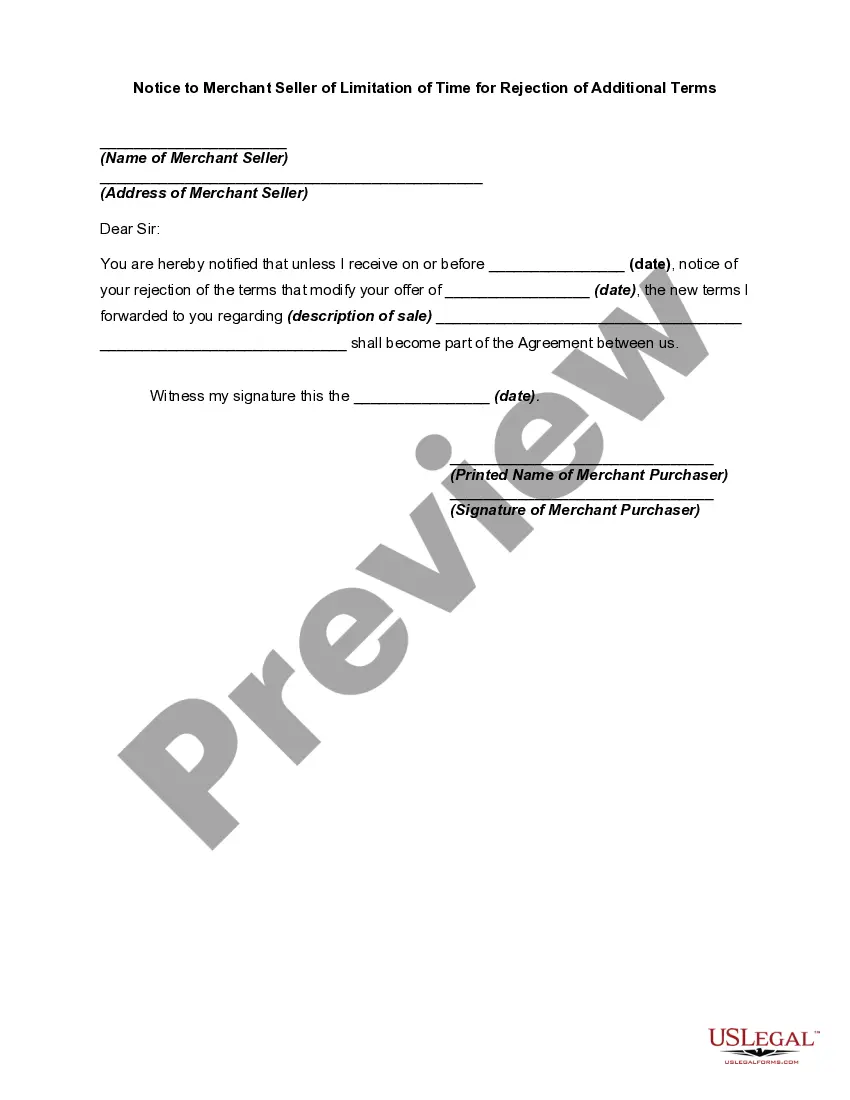
Notice to Merchant Seller of Limitation of Time for Rejection of Additional Terms
What this document covers
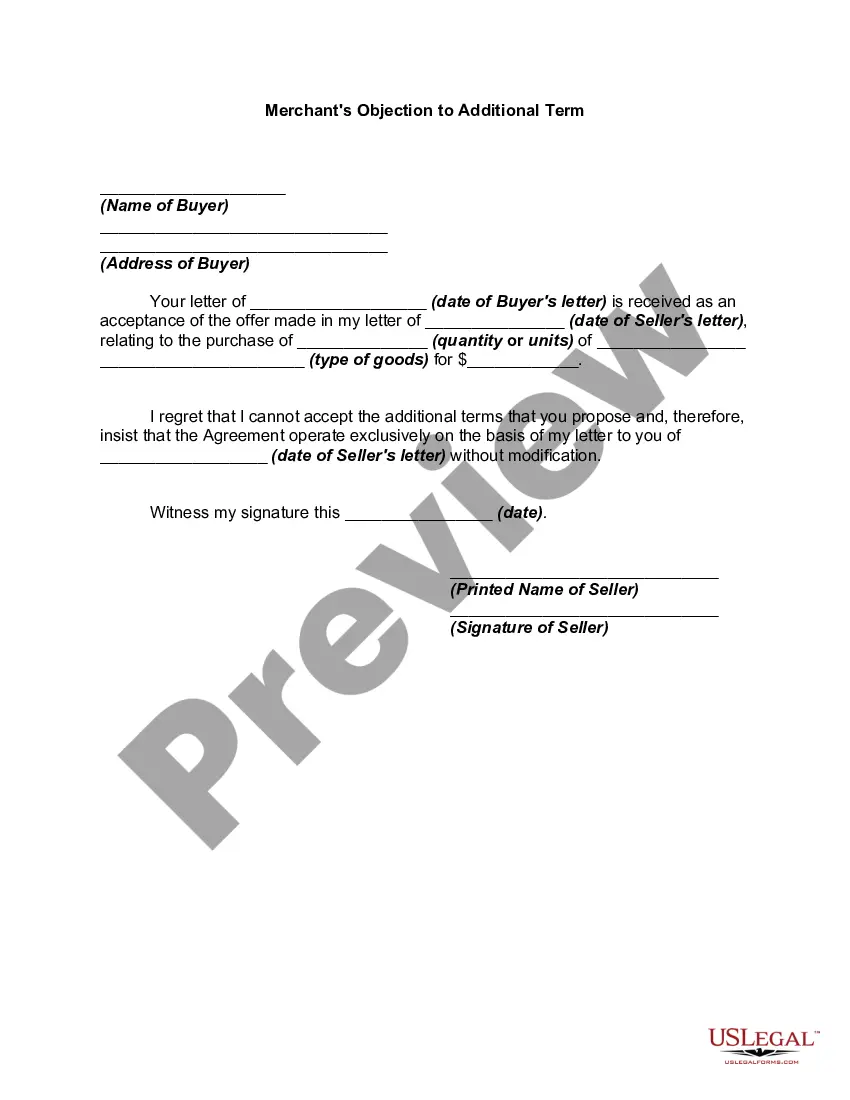
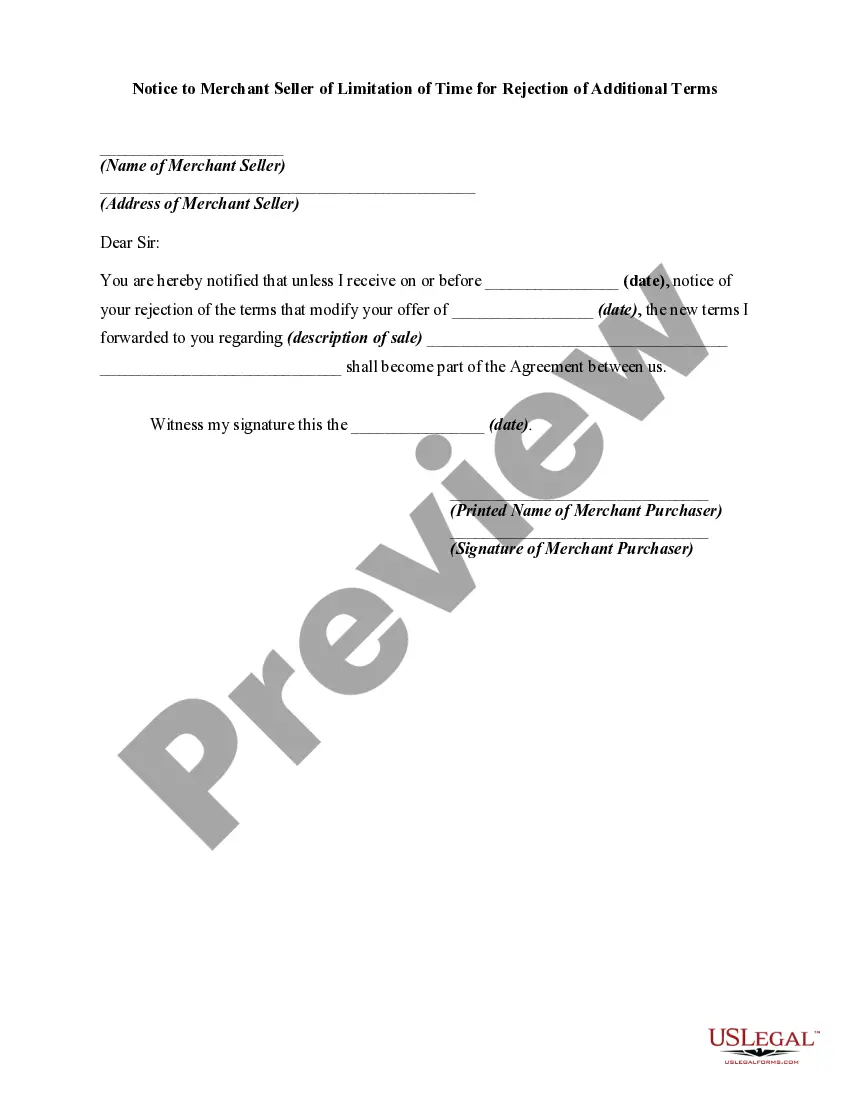
The Notice to Merchant Seller of Limitation of Time for Rejection of Additional Terms is a legal document that notifies a merchant seller about modifications to an existing agreement. This notice sets a deadline for the seller to reject the new terms. If no rejection is received by the specified date, the additional terms become part of the original agreement, establishing clear expectations and minimizing disputes. This form is essential for both parties to avoid misunderstandings regarding contract modifications.
What’s included in this form
- Name and address of the merchant seller
- Notification deadline for rejecting the new terms
- Description of the original offer date
- Details of the modifications being proposed
- Signature and printed name of the merchant purchaser
When to use this document
This form is needed when a purchaser wants to propose new terms to an existing agreement with a merchant seller. It is particularly useful in situations where time is of the essence, and the purchaser wants to ensure their modifications are acknowledged. Use this form to formally communicate changes before the original agreement can be considered fulfilled.
Who can use this document
- Merchants looking to formalize terms of sale
- Purchasers who wish to modify existing contracts
- Any party involved in a sales agreement seeking to ensure clarity and adherence to new terms
Steps to complete this form
- Identify and enter the name and address of the merchant seller.
- Specify the deadline date for rejection of the new terms.
- Include the date of the original offer.
- Describe the modifications to the terms clearly.
- Sign and print your name as the merchant purchaser, along with the date of signing.
Notarization guidance
In most cases, this form does not require notarization. However, some jurisdictions or signing circumstances might. US Legal Forms offers online notarization powered by Notarize, accessible 24/7 for a quick, remote process.
Get your form ready online
Our built-in tools help you complete, sign, share, and store your documents in one place.
Make edits, fill in missing information, and update formatting in US Legal Forms—just like you would in MS Word.
Download a copy, print it, send it by email, or mail it via USPS—whatever works best for your next step.
Sign and collect signatures with our SignNow integration. Send to multiple recipients, set reminders, and more. Go Premium to unlock E-Sign.
If this form requires notarization, complete it online through a secure video call—no need to meet a notary in person or wait for an appointment.
We protect your documents and personal data by following strict security and privacy standards.

Make edits, fill in missing information, and update formatting in US Legal Forms—just like you would in MS Word.

Download a copy, print it, send it by email, or mail it via USPS—whatever works best for your next step.

Sign and collect signatures with our SignNow integration. Send to multiple recipients, set reminders, and more. Go Premium to unlock E-Sign.

If this form requires notarization, complete it online through a secure video call—no need to meet a notary in person or wait for an appointment.

We protect your documents and personal data by following strict security and privacy standards.
Avoid these common issues
- Failing to set a clear rejection deadline.
- Not detailing the modifications accurately.
- Leaving out necessary signatures or dates.
Benefits of using this form online
- Easy access and instant download of the form.
- Ability to edit the form to fit specific needs.
- Convenient and reliable process without the need for physical visits.
Summary of main points
- The notice serves as a formal communication regarding changes in contractual terms.
- Use this form to ensure that modifications are clearly outlined and recognized legally.
- Make sure to complete all fields accurately to avoid potential disputes.
Looking for another form?

Form popularity
FAQ
(2) Revocation of acceptance must occur within a reasonable time after the buyer discovers or should have discovered the ground for it and before any substantial change in condition of the goods which is not caused by their own defects. It is not effective until the buyer notifies the sellerof it.
These exceptions are admission, performance, and promissory estoppel. Admission means that an oral contract can be enforced without meeting the requirements of a statute of frauds if the other party admits under oath that the oral contract was made. Performance can mean full performance or partial performance.
Article 2 of the UCC deals with the sale of goods. Goods means all things, including specially manufactured goods, which are tangible and moveable at the time of identification to the contract for sale. This includes unborn animals, growing crops and other identified things attached to realty.
The statute of frauds is a common law concept that requires written contracts for certain agreements to be binding. The statute applies to land sales and most purchases of goods over $500. There are significant exceptions, such as oral contracts where work has already started.
Statute of frauds: Main exceptions Merchant's Exception (UCC 2-201 (2)): If you and your Buyer are both merchants, and you sent him something in writing memorializing the oral agreement (some courts consider detailed invoices sufficient), and he did not object, the oral contract is enforceable.
Article 2 is a vast segment of the UCC that specifically addresses contracts for the sale of goods. A good is any movable property identified at the time of the contract. 'Goods' are also sometimes known as 'chattels.Under the UCC, a sale of goods is the transfer of title from seller to buyer for a price.
This mnemonic stands for Marriage, Year, Land, Executor, Guarantor, and Sales. The statutes usually cover: Promises that involve marriage as consideration. Contracts that can't be performed within one year.
At the conclusion of this podcast you should (1) be able to explain and apply the statute of frauds under § 2-201, in particular that: (i) it applies to contracts for the sale of goods of $500 or more; (ii) when applicable, it requires a writing signed by the party against whom enforcement is sought; and (iii) the