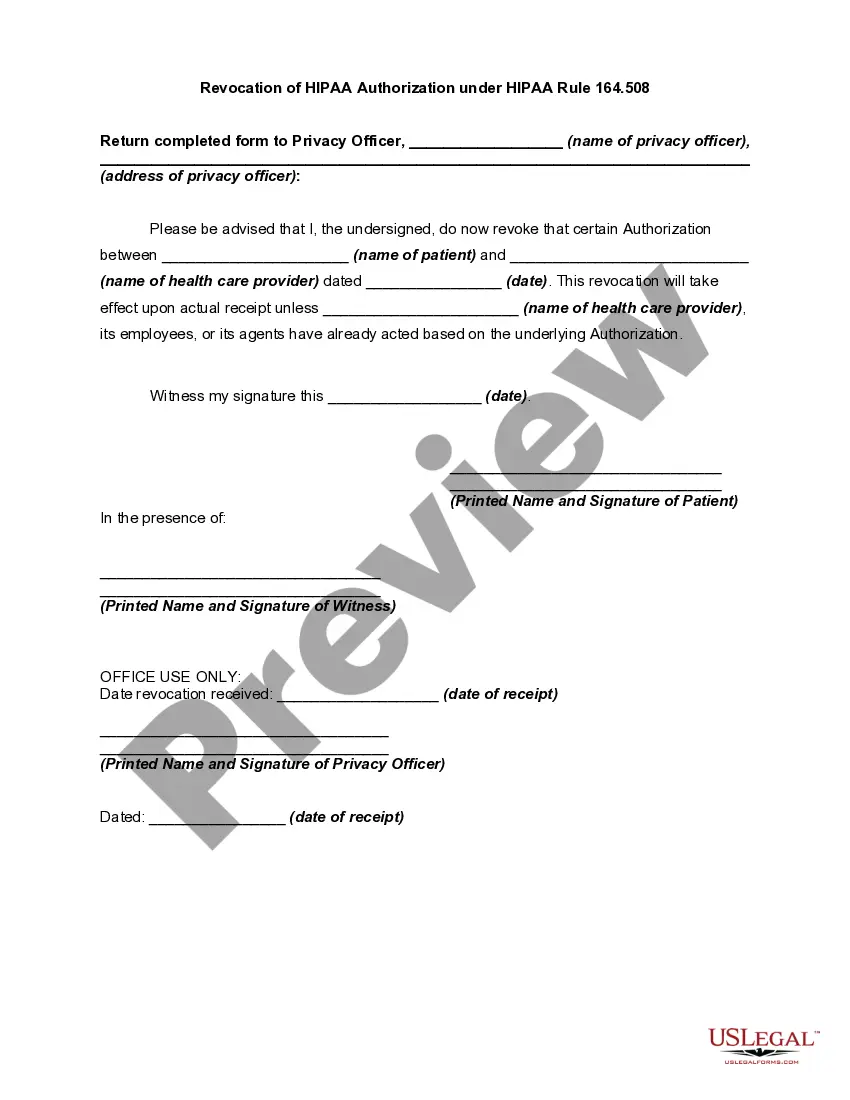
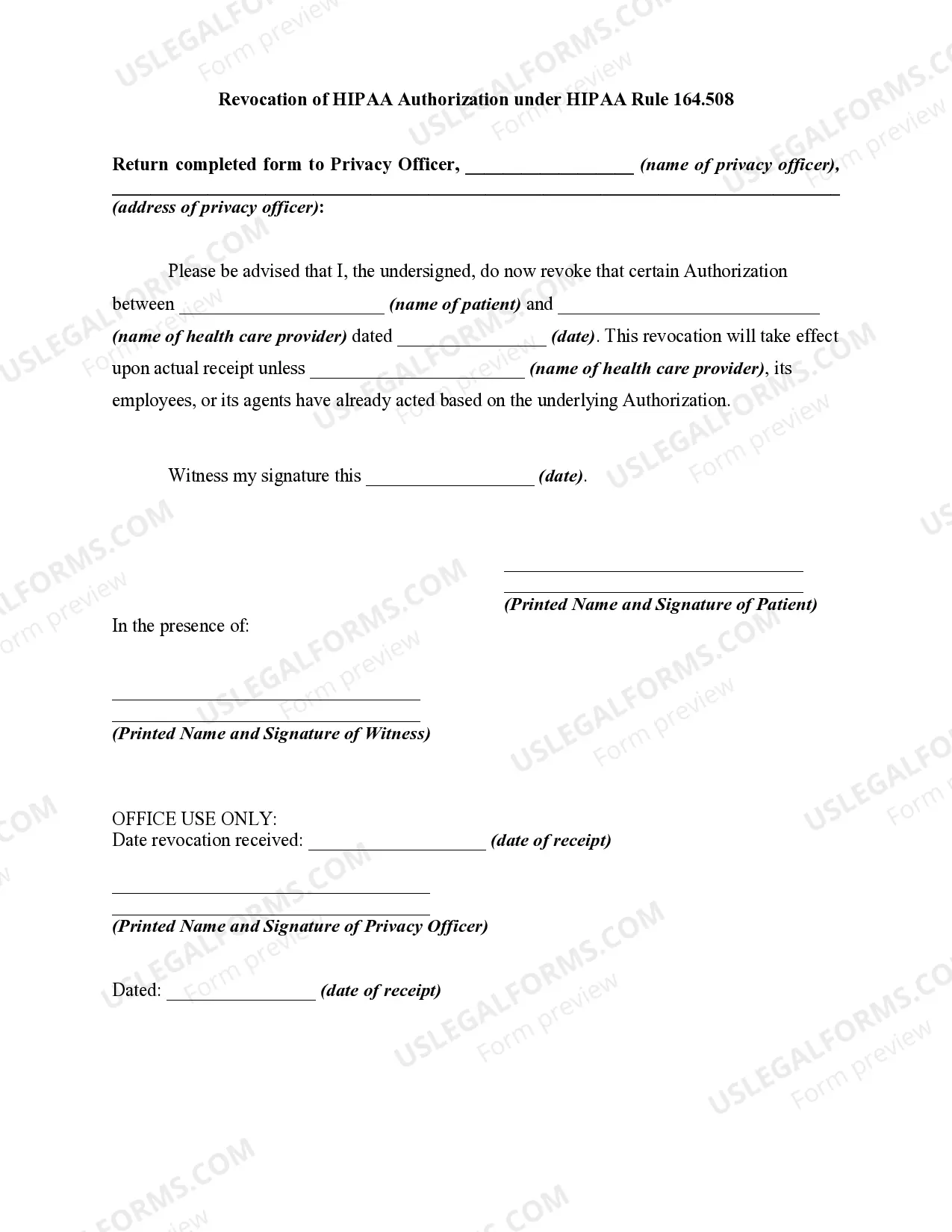
Revocation of HIPAA Authorization under HIPAA Rule 164.508
About this form
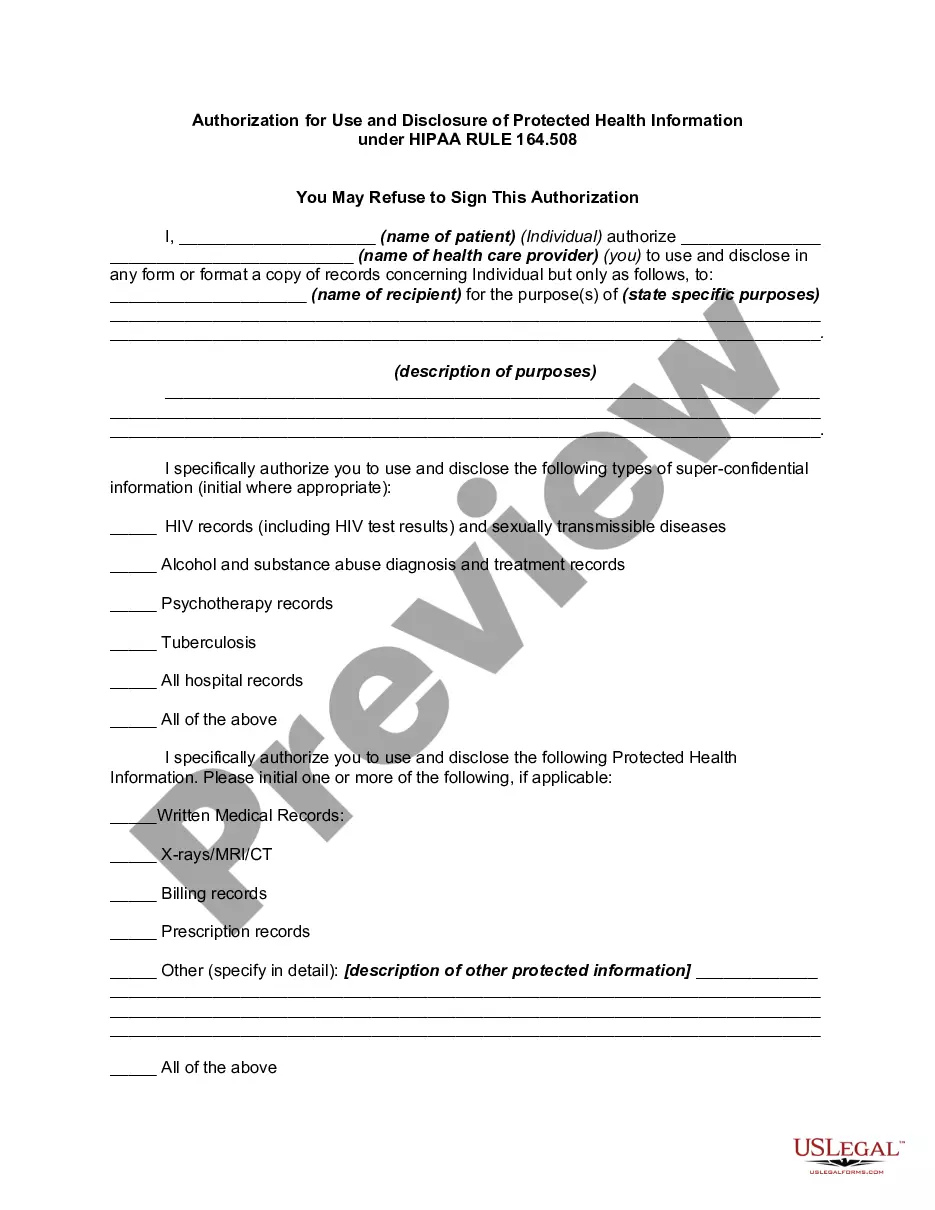
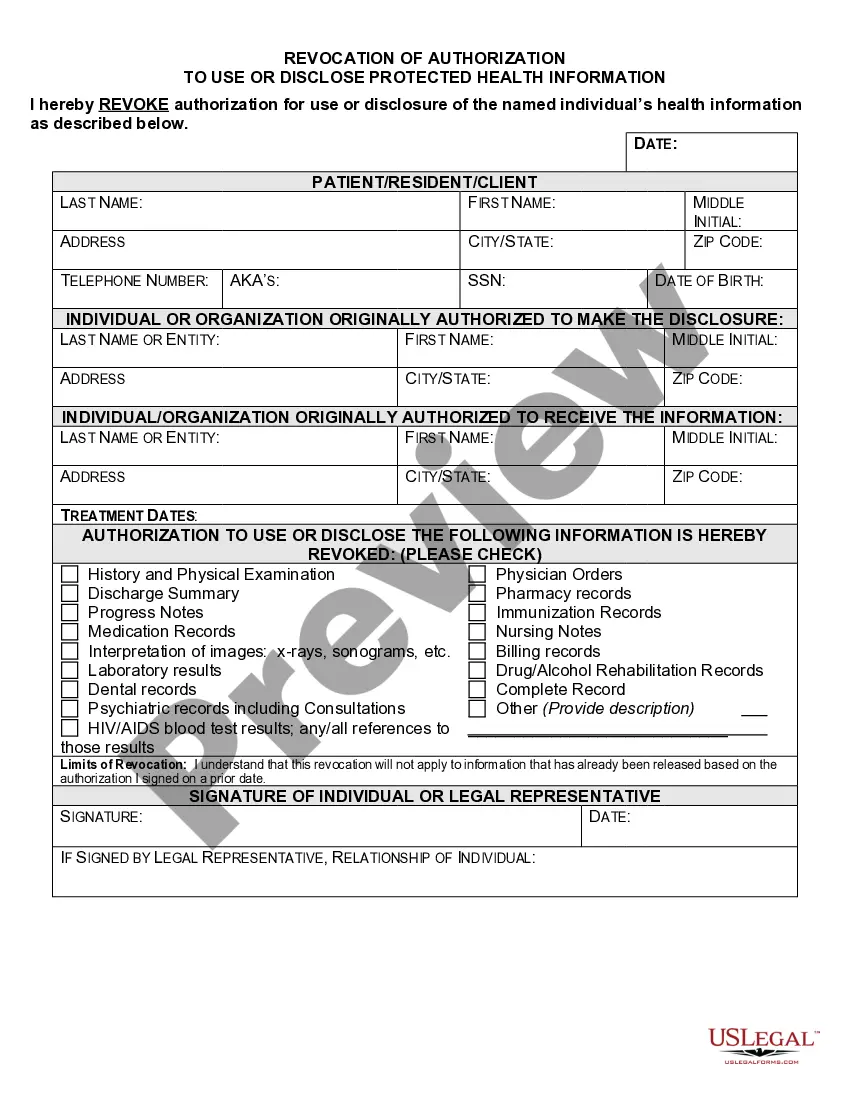
The Revocation of HIPAA Authorization under HIPAA Rule 164.508 is a legal document that allows individuals to revoke their prior authorization for the use or disclosure of their protected health information. This form is especially important when a patient no longer wishes for their health information to be shared with a specific healthcare provider or entity. Unlike other forms related to HIPAA, this document specifically addresses the cessation of previously granted consent.
Main sections of this form
- Identification of the patient and healthcare provider involved.
- The date of the original authorization that is being revoked.
- Clear statement of revocation that complies with HIPAA regulations.
- Signature and printed name of the patient revoking the authorization.
- Space for a witness signature and printed name, if required.
- Section for the privacy officer's acknowledgment of receipt.
When to use this document
This form should be used when an individual decides to withdraw their consent for a healthcare provider or entity to use or disclose their personal health information. Common scenarios include a change in healthcare providers, a disagreement regarding the use of health information, or simply a personal choice to limit information sharing.
Who can use this document
- Patients who have previously authorized a healthcare provider to share their health information.
- Individuals who want to stop their health information from being disclosed for any reason.
- Anyone looking to ensure their health data privacy under HIPAA guidelines.
Steps to complete this form
- Enter your full name as the patient in the specified field.
- Fill in the name of the healthcare provider whose authorization you are revoking.
- Provide the date of the original authorization document.
- Sign and date the form to indicate your decision clearly.
- Have a witness sign the document, if necessary, along with their printed name.
- Return the completed form to the designated Privacy Officer indicated on the document.
Does this form need to be notarized?
Notarization is generally not required for this form. However, certain states or situations might demand it. You can complete notarization online through US Legal Forms, powered by Notarize, using a verified video call available anytime.
Get your form ready online
Our built-in tools help you complete, sign, share, and store your documents in one place.
Make edits, fill in missing information, and update formatting in US Legal Forms—just like you would in MS Word.
Download a copy, print it, send it by email, or mail it via USPS—whatever works best for your next step.
Sign and collect signatures with our SignNow integration. Send to multiple recipients, set reminders, and more. Go Premium to unlock E-Sign.
If this form requires notarization, complete it online through a secure video call—no need to meet a notary in person or wait for an appointment.
We protect your documents and personal data by following strict security and privacy standards.

Make edits, fill in missing information, and update formatting in US Legal Forms—just like you would in MS Word.

Download a copy, print it, send it by email, or mail it via USPS—whatever works best for your next step.

Sign and collect signatures with our SignNow integration. Send to multiple recipients, set reminders, and more. Go Premium to unlock E-Sign.

If this form requires notarization, complete it online through a secure video call—no need to meet a notary in person or wait for an appointment.

We protect your documents and personal data by following strict security and privacy standards.
Typical mistakes to avoid
- Failing to date the revocation, which can cause confusion regarding its effectiveness.
- Not providing the full name of the patient or healthcare provider involved.
- Leaving out the witness signature when required.
- Not returning the form to the correct Privacy Officer's address.
Benefits of completing this form online
- Convenient access and downloading from anywhere at any time.
- Editable fields allow you to customize the form to your needs easily.
- Reliable formats ensuring compliance with legal standards.
Legal use & context
- The revocation is legally binding once delivered to the relevant parties.
- Healthcare providers must cease use or disclosure upon receiving the revocation.
- Individuals retain the right to revoke authorization at any time, ensuring control over their health information.
Main things to remember
- This form allows individuals to revoke prior HIPAA authorizations.
- Completing the form ensures that health information is no longer shared without consent.
- The revocation takes effect upon receipt by the healthcare provider and must be in writing.
Looking for another form?





Form popularity
FAQ
Revoking authorization means that the transaction and all subsequent transactions from that originator with that dollar amount are no longer allowed. Your customer is saying "you no longer have permission to draft my account for this."
Research subjects have had a longstanding right to revoke their consent to participate in research. The researchers must honor this request, except to the extent they have already relied on the permission.
The revocation must be in writing. An oral discussion between the subject and member of the research team does not revoke a HIPAA authorization. If the intent of the subject is to revoke, the principle investigator must provide a revocation form to the subject or request the subject's revocation in writing.
Definition from Nolo's Plain-English Law Dictionary Annulment or cancellation of a statement, document, or offer not yet accepted, or cancellation of a contract by the parties to it. For example, a person can revoke a will or revoke an offer to enter into a contract, and a government agency can revoke a license.
Yes. The Privacy Rule gives individuals the right to revoke, at any time, an Authorization they have given. The revocation must be in writing, and is not effective until the covered entity receives it.
To revoke your permission, write a letter, sign it, and deliver it to the Privacy Management Office, 10833 Le Conte Ave., Room BH265, Los Angeles, CA 900757305, Telephone number (310) 8255958.
The topic of access revocation tends to be a confusing one in the context of encryption and data sharing.Revocation in this context means that from that point onwards, any newly generated data will no longer be shared with a recipient previously granted access to the data.