Agreement between Informant and Police Department or Other Law Enforcement Agency
About this form
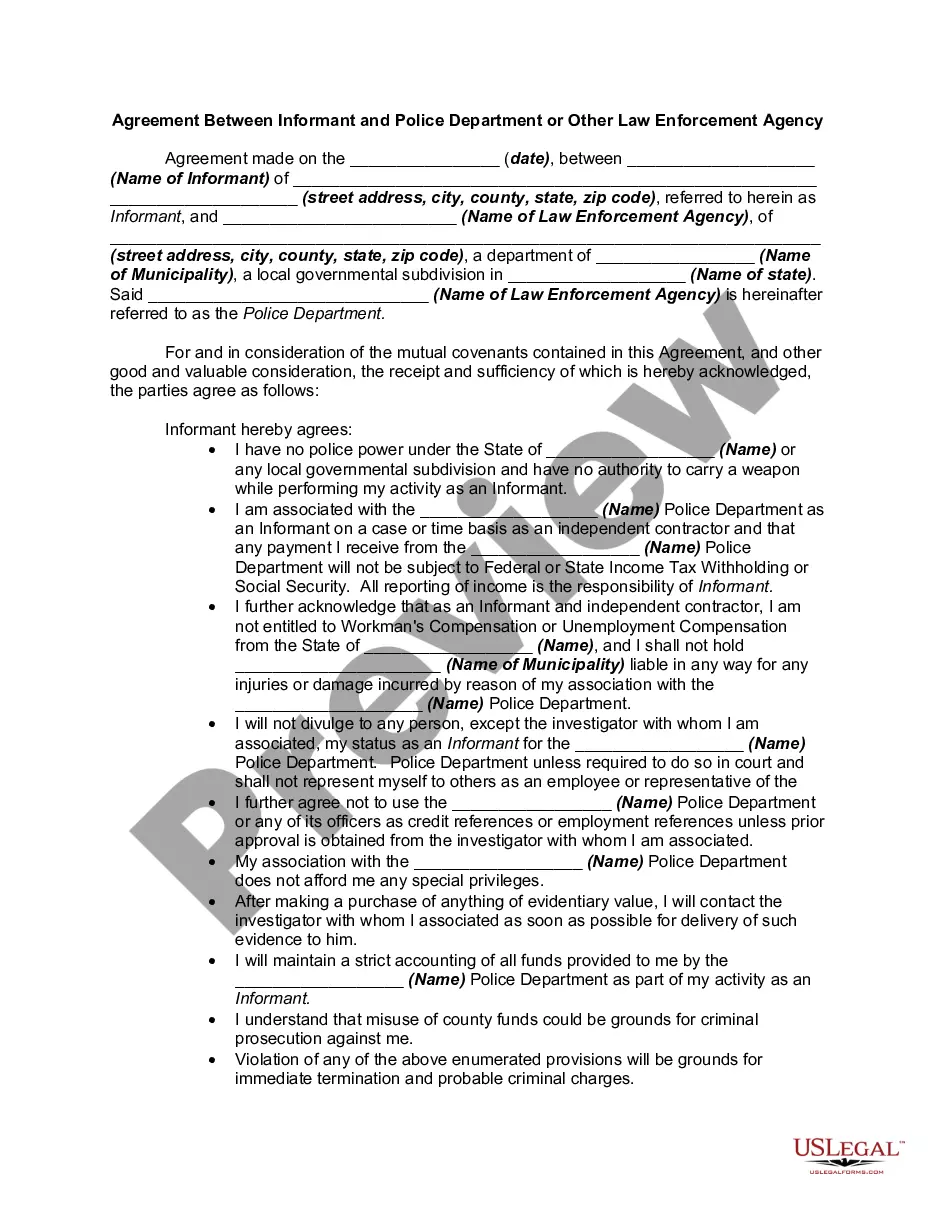
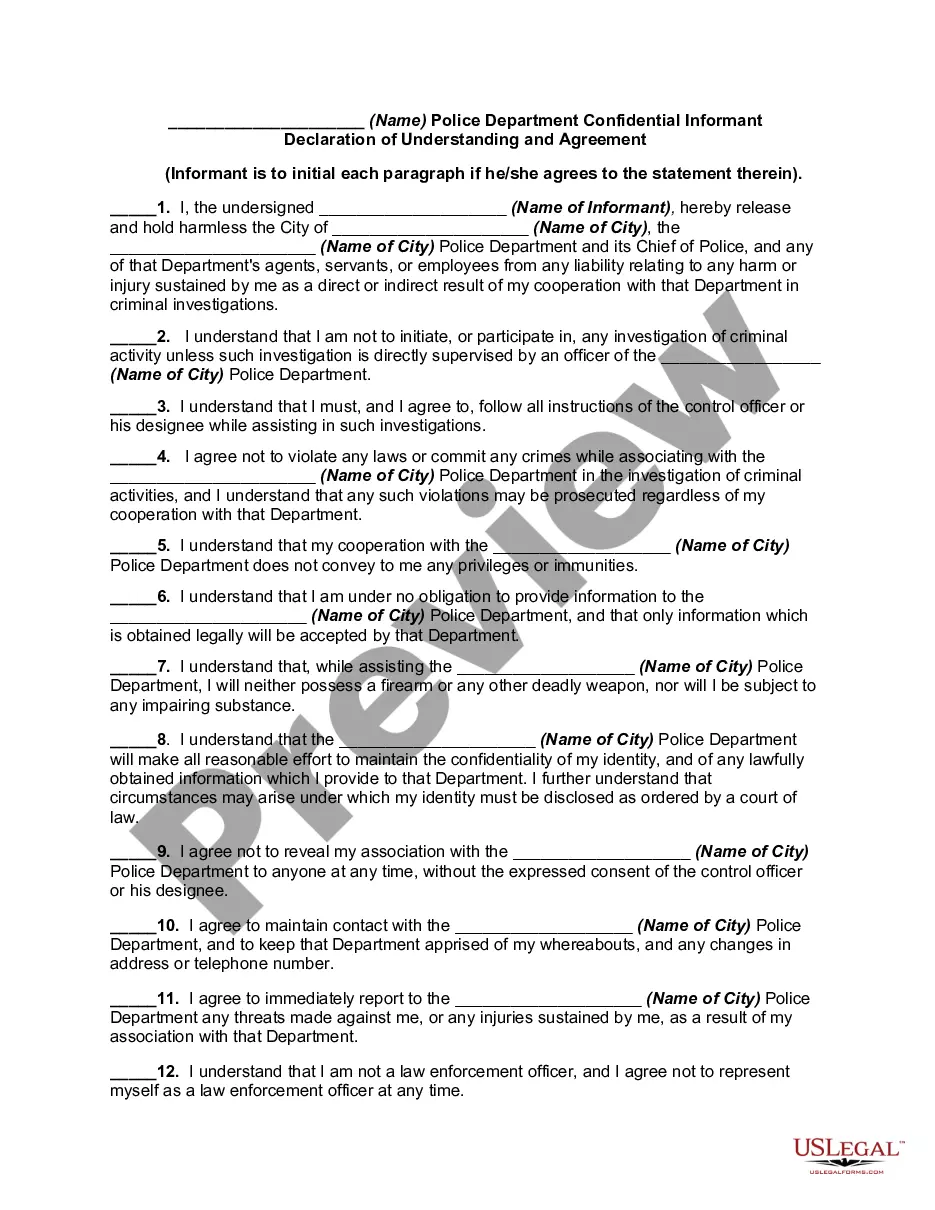
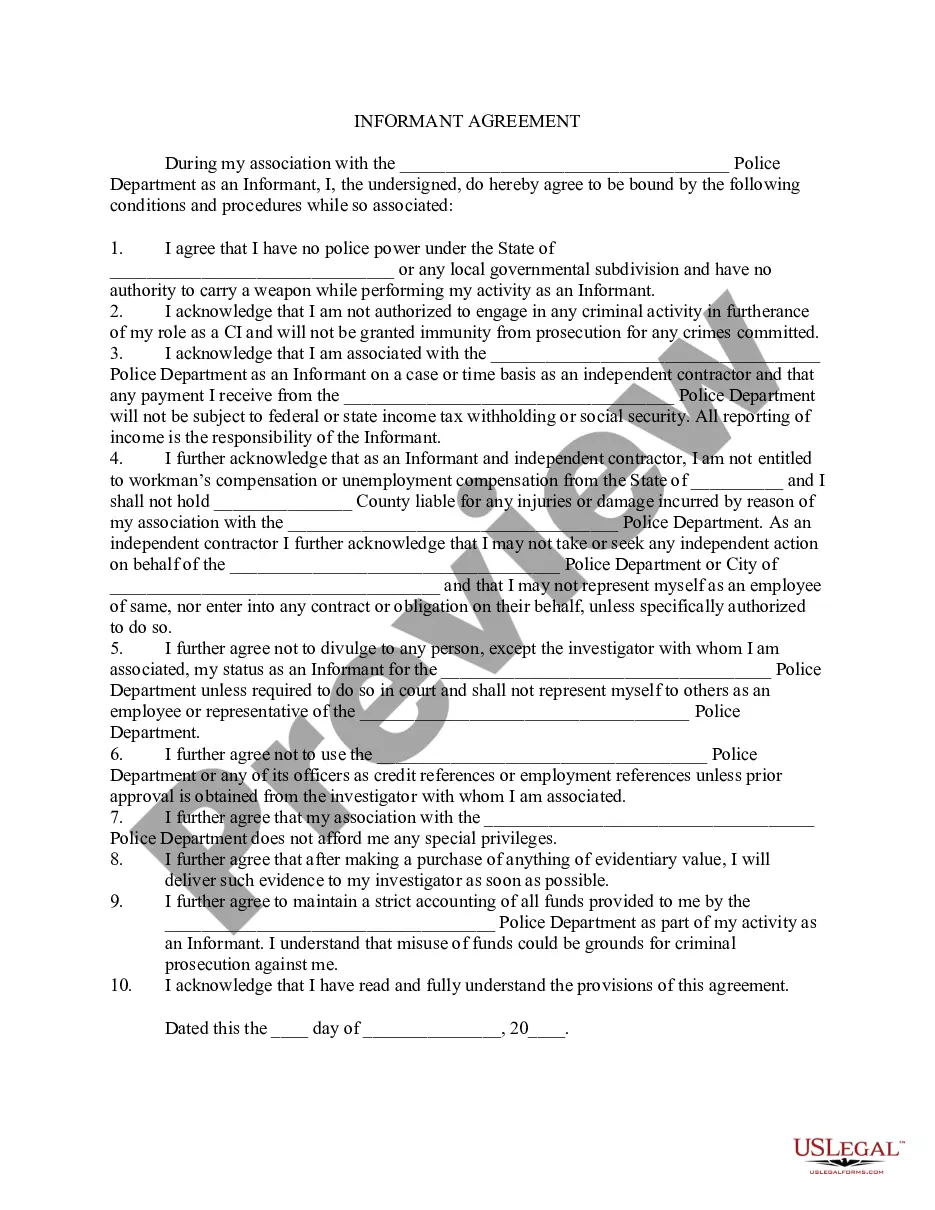
This Agreement between Informant and Police Department or Other Law Enforcement Agency establishes the legal framework for a confidential informant's relationship with law enforcement. It clearly outlines the informant's role and responsibilities while ensuring their protection and confidentiality. Distinct from other legal agreements, this form is specifically tailored to the unique nature of informants who provide crucial information to assist in law enforcement efforts.
Form components explained
- Date of the agreement.
- Name and address of the informant.
- Name and address of the law enforcement agency.
- Formal declaration of the informant's independent contractor status.
- Responsibilities regarding tax and income reporting.
- Confidentiality and non-disclosure provisions.
Situations where this form applies
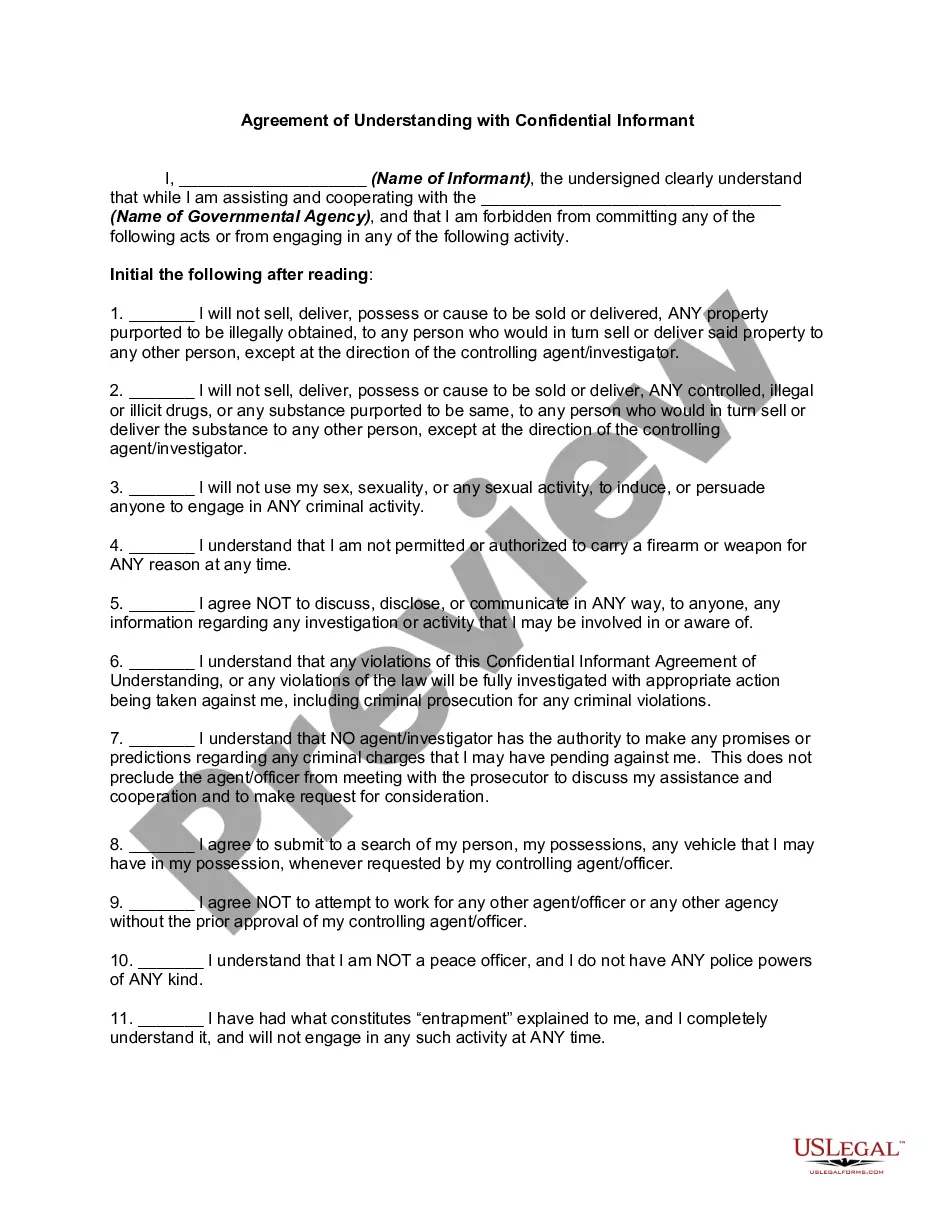
This form is essential when a person agrees to act as a confidential informant for law enforcement. It is commonly used when individuals provide information related to criminal activities in exchange for potential rewards, such as cash or reduced charges. Situations that may necessitate this form include drug investigations, undercover operations, or other law enforcement activities where confidential information is required.
Who can use this document
- Individuals serving as confidential informants.
- Police departments or law enforcement agencies seeking to formalize an informant's status.
- Legal representatives of informants who need to ensure compliance with legal requirements.
Steps to complete this form
- Identify and enter the date of the agreement at the top of the form.
- Provide the full name and address of the informant.
- Fill in the name and address of the law enforcement agency involved.
- Include the name of the municipality and state where the agency operates.
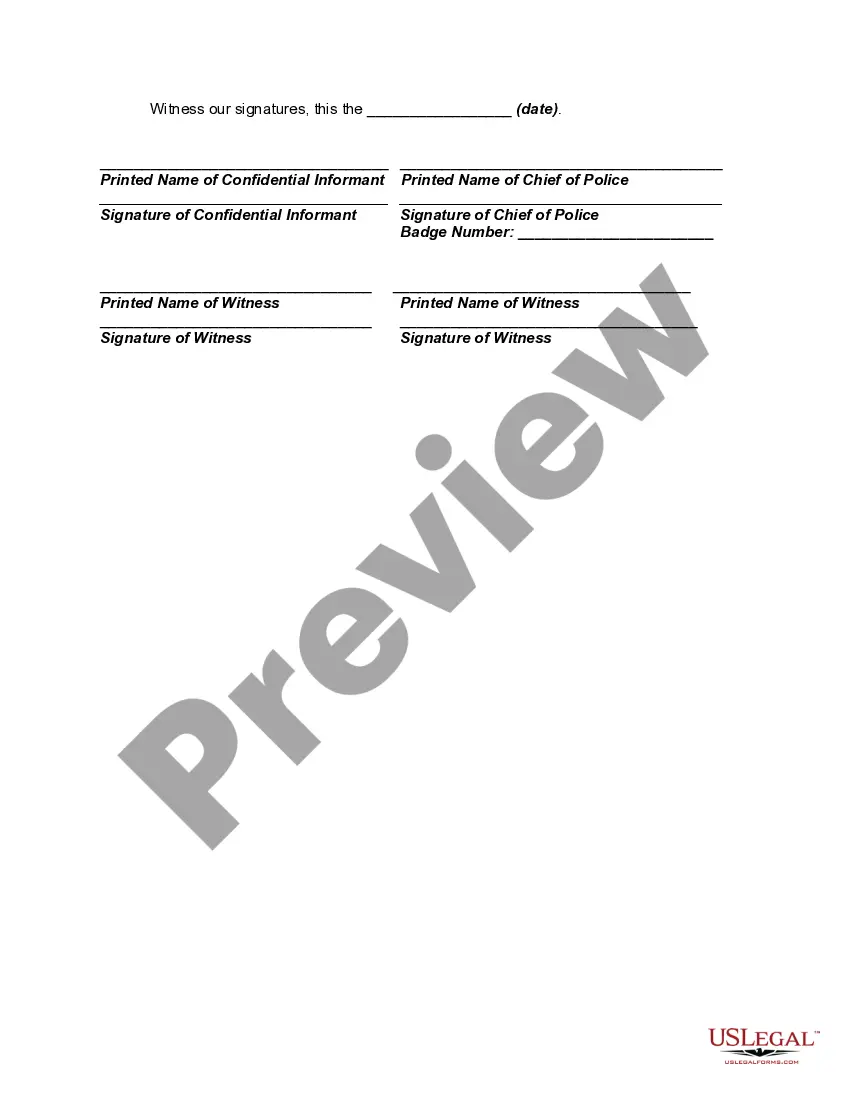
- Complete the signature section for both the informant and the chief of police, along with their printed names and badge number.
Does this document require notarization?
This form does not typically require notarization to be legally valid. However, some jurisdictions or document types may still require it. US Legal Forms provides secure online notarization powered by Notarize, available 24/7 for added convenience.
Get your form ready online
Our built-in tools help you complete, sign, share, and store your documents in one place.
Make edits, fill in missing information, and update formatting in US Legal Forms—just like you would in MS Word.
Download a copy, print it, send it by email, or mail it via USPS—whatever works best for your next step.
Sign and collect signatures with our SignNow integration. Send to multiple recipients, set reminders, and more. Go Premium to unlock E-Sign.
If this form requires notarization, complete it online through a secure video call—no need to meet a notary in person or wait for an appointment.
We protect your documents and personal data by following strict security and privacy standards.

Make edits, fill in missing information, and update formatting in US Legal Forms—just like you would in MS Word.

Download a copy, print it, send it by email, or mail it via USPS—whatever works best for your next step.

Sign and collect signatures with our SignNow integration. Send to multiple recipients, set reminders, and more. Go Premium to unlock E-Sign.

If this form requires notarization, complete it online through a secure video call—no need to meet a notary in person or wait for an appointment.

We protect your documents and personal data by following strict security and privacy standards.
Avoid these common issues
- Failing to accurately fill in names and addresses.
- Not including the required date of the agreement.
- Neglecting to have all parties sign the document.
- Forgetting to clarify the confidentiality clause properly.
Benefits of using this form online
- Convenient download for immediate use without the need for in-person visits.
- Editability allows users to input specific details before printing.
- Access to legally vetted templates drafted by licensed attorneys.
Legal use & context
- This agreement is enforceable as long as both parties understand the terms clearly.
- Confidentiality provisions protect informants from exposing their identity during legal proceedings.
- Failure to adhere to the agreement can result in termination and possible criminal charges against the informant.
Quick recap
- This agreement is vital for establishing a legal relationship between informants and law enforcement.
- Completing the form accurately is essential to protect all parties involved.
- Consult local legal requirements to ensure proper execution of the agreement.
Looking for another form?

Form popularity
FAQ
The general rule is that the prosecution doesn't have to disclose the identity of a confidential informant. However, this rule has many exceptions; if a criminal defendant can show the importance of the CI's identity to the case, it may be possible to find out who's been talking to the cops.
Yes: confidential informants can and do sell drugs and then their buyers may be arrested and charged with drug possession.
If you become a confidential informant for a local, state, or federal law enforcement agency, you could have your charges dropped, or more likely, have them and the potential punishment reduced. Being a confidential information can be helpful to your case. However, it is not always the best arrangement.
Can a confidential informant hurt my case? Absolutely. A confidential informant's information can possibly be used against you for your arrest and later in your trial if you request a jury trial. The reason for this is the police use the CI to gain probable cause for your arrest.
What do confidential informants do? CI's are regular folks that provide law enforcement with confidential, possibly damning, information against you.The CI may be charged with a serious drug (or other) criminal offense. The CI is assigned a CI number and agrees to provide information about your case to the police.
The general rule is that the prosecution doesn't have to disclose the identity of a confidential informant. However, this rule has many exceptions; if a criminal defendant can show the importance of the CI's identity to the case, it may be possible to find out who's been talking to the cops.
"Rachel's Law" requires law enforcement agencies to provide special training for officers who recruit confidential informants, instruct informants that reduced sentences may not be provided in exchange for their work, and permit informants to request a lawyer if they want one.
Exempt. The identity of confidential informants and any statements made by them are expressly exempt from disclosure. Cal. Gov't Code § 6254(f). California Evidence Code Section 1041 also protects the identity of confidential informants upon a proper showing.