Police Department Confidential Informant Declaration of Understanding and Agreement
Overview of this form
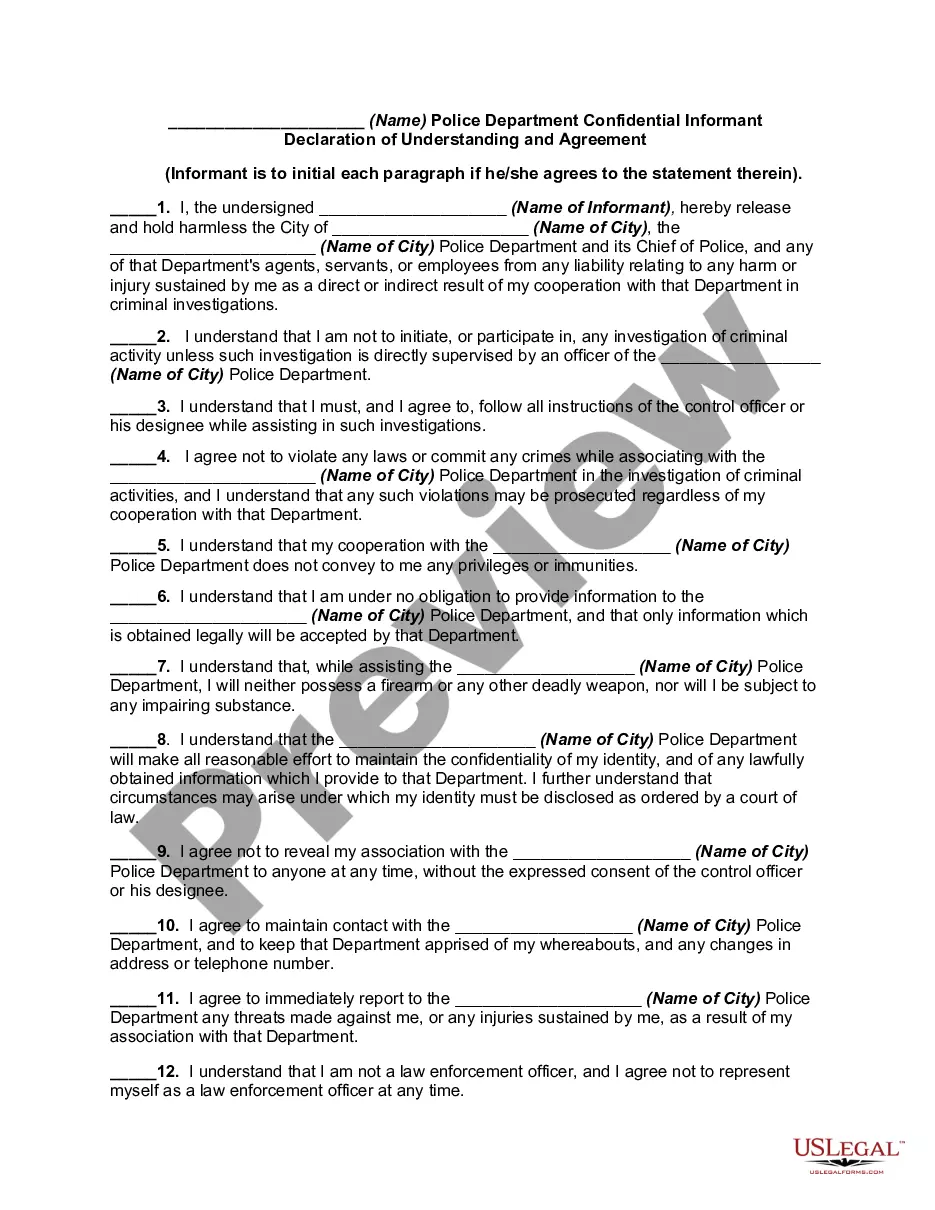
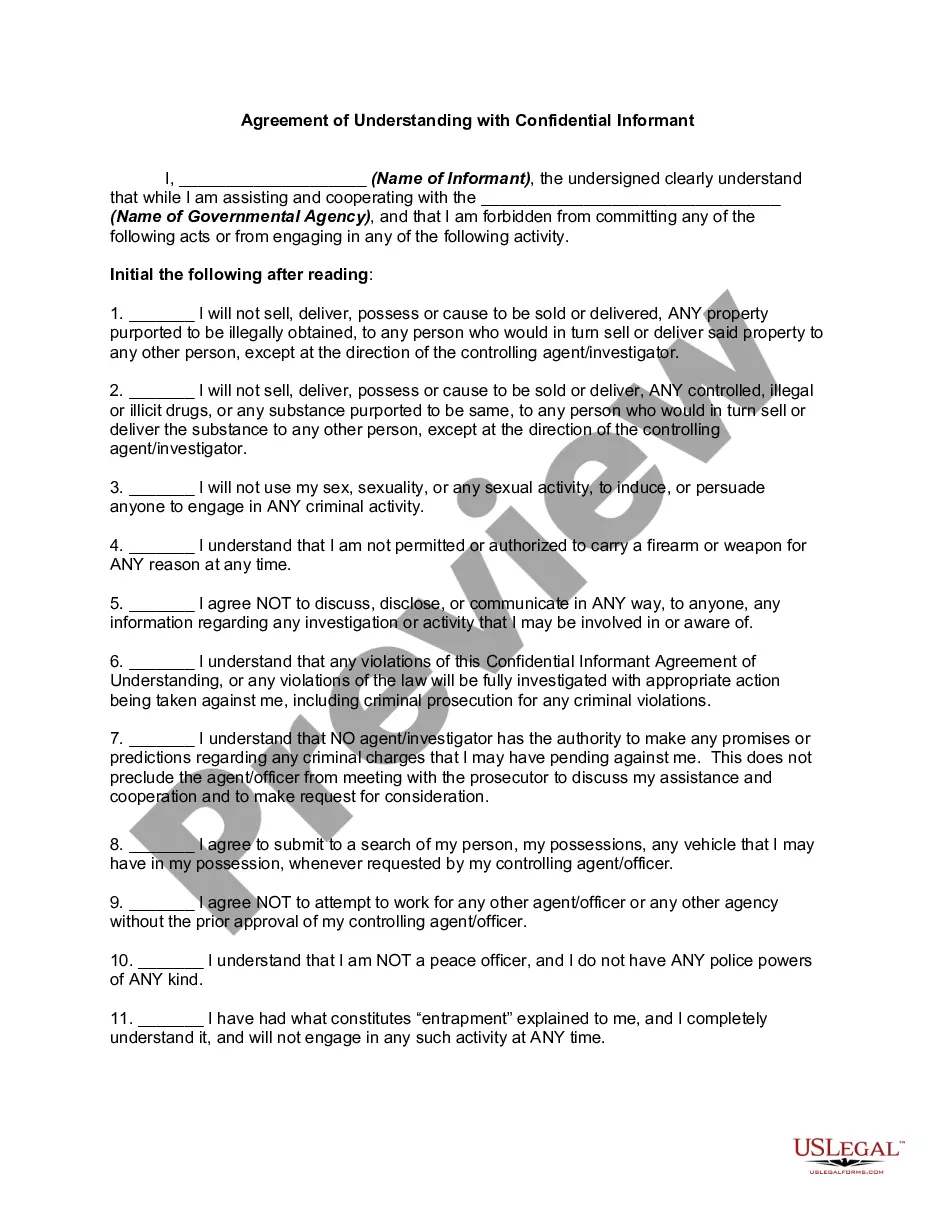
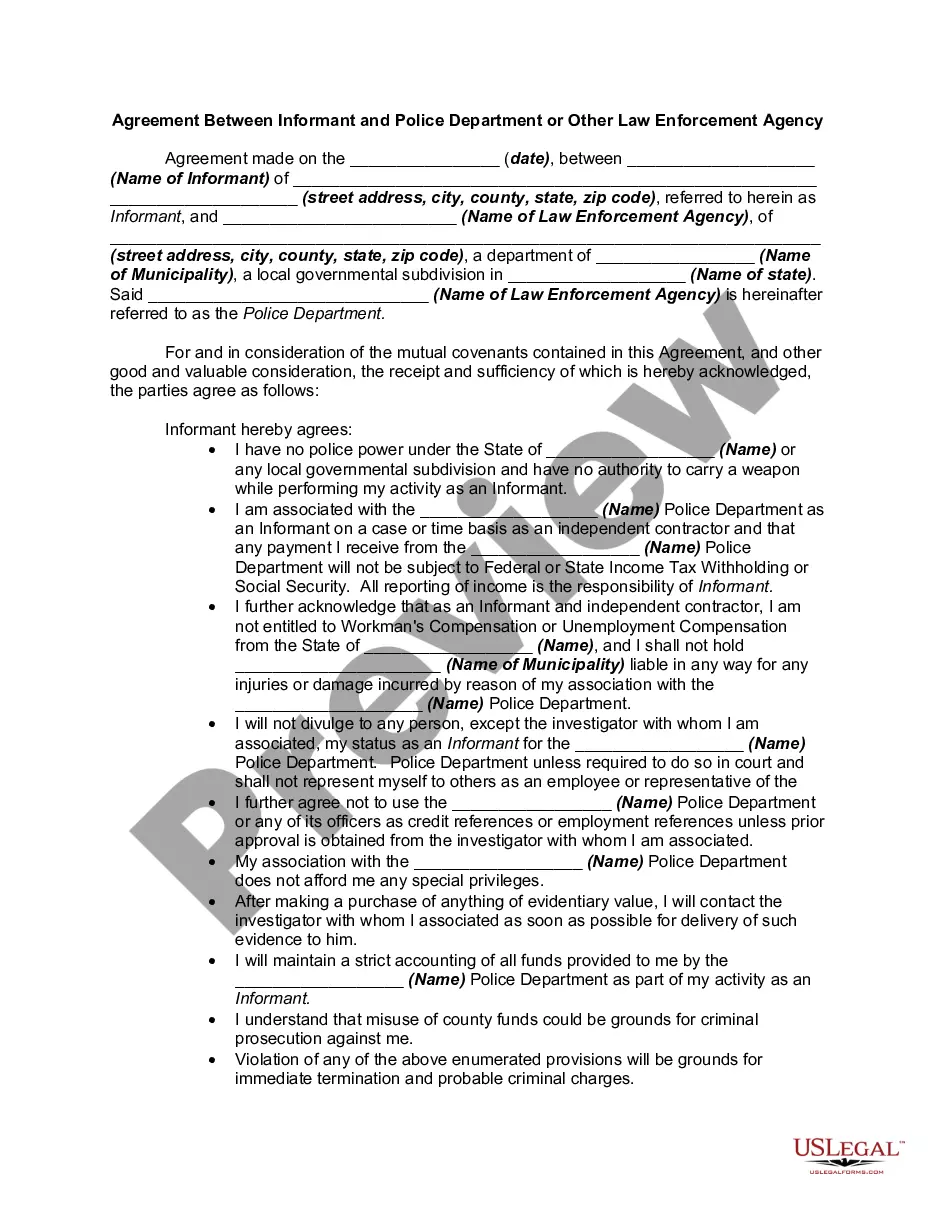
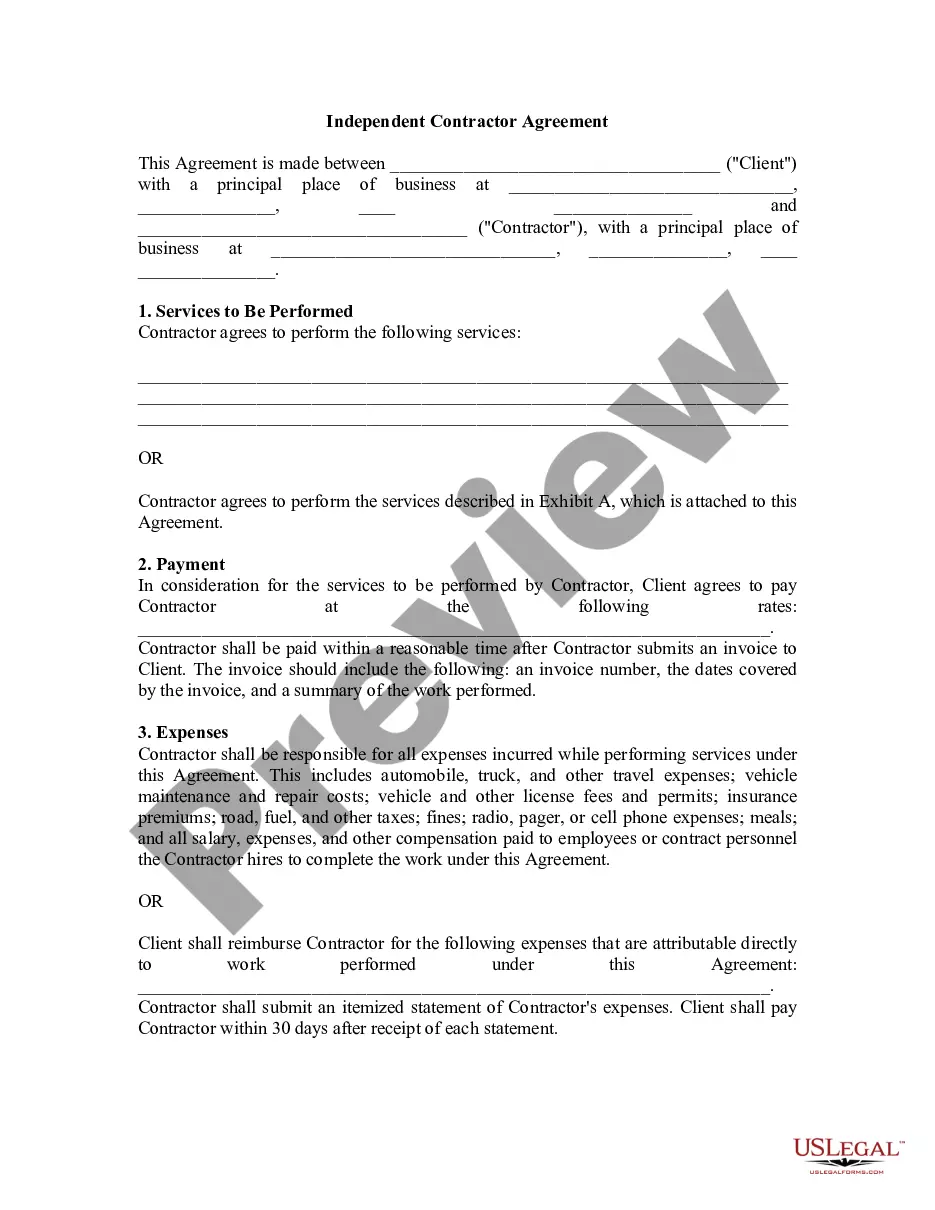
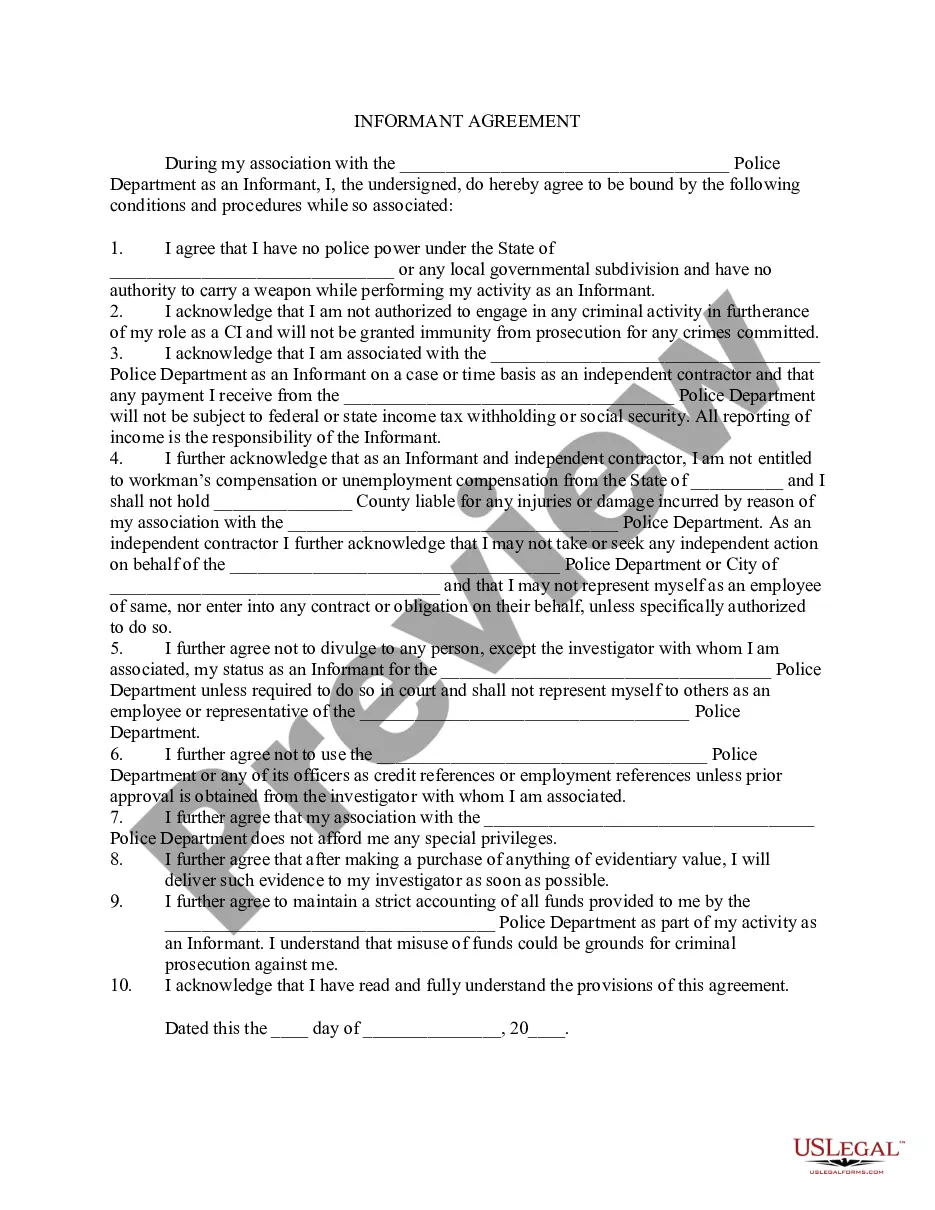
The Police Department Confidential Informant Declaration of Understanding and Agreement is a legal document used by individuals who agree to act as confidential informants for law enforcement agencies. This form clarifies the rights and responsibilities of the informant, ensuring that they understand their role and the legal implications of providing information to the police. Unlike other agreements, this form emphasizes the confidentiality of the informant's identity and the legal protection they receive while cooperating with criminal investigations.
Form components explained
- Release of liability for the police department and its employees.
- Agreement to only participate in investigations under police supervision.
- Affirmation to follow all instructions given by the control officer.
- Commitment to not violate any laws during cooperation.
- Understanding of the lack of privileges or immunities in cooperation.
- Confidentiality agreement regarding the informant's identity.
- Requirement to report any threats or injuries related to their cooperation.
When to use this form
Who should use this form
- Individuals who have agreed to act as confidential informants for law enforcement.
- Law enforcement agencies needing a formal agreement with informants.
- Attorneys representing clients involved in confidential informant arrangements.
Completing this form step by step
- Identify the parties involved, including the informant and police department.
- If required, enter the name of the city and the chief of police.
- Review each clause and ensure you understand the implications; initial each paragraph as a form of agreement.
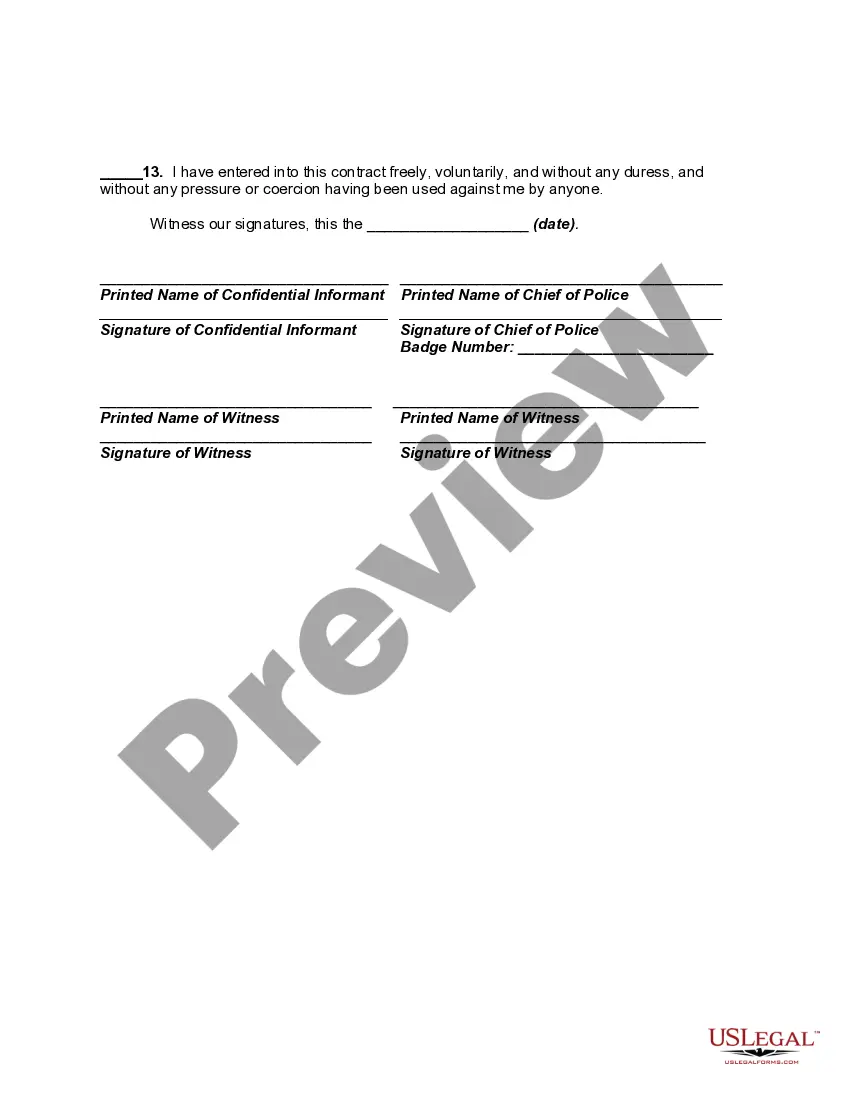
- Provide your full name and signature as the informant, along with the date.
- Ensure that the police chief or authorized officer also signs, along with witnesses if necessary.
Does this form need to be notarized?
This form does not typically require notarization unless specified by local law. Always check local regulations to ensure compliance with any requirements relating to informant agreements.
Get your form ready online
Our built-in tools help you complete, sign, share, and store your documents in one place.
Make edits, fill in missing information, and update formatting in US Legal Forms—just like you would in MS Word.
Download a copy, print it, send it by email, or mail it via USPS—whatever works best for your next step.
Sign and collect signatures with our SignNow integration. Send to multiple recipients, set reminders, and more. Go Premium to unlock E-Sign.
If this form requires notarization, complete it online through a secure video call—no need to meet a notary in person or wait for an appointment.
We protect your documents and personal data by following strict security and privacy standards.

Make edits, fill in missing information, and update formatting in US Legal Forms—just like you would in MS Word.

Download a copy, print it, send it by email, or mail it via USPS—whatever works best for your next step.

Sign and collect signatures with our SignNow integration. Send to multiple recipients, set reminders, and more. Go Premium to unlock E-Sign.

If this form requires notarization, complete it online through a secure video call—no need to meet a notary in person or wait for an appointment.

We protect your documents and personal data by following strict security and privacy standards.
Avoid these common issues
- Failing to initial each paragraph, which indicates agreement to the terms.
- Providing false information or failing to disclose relevant past actions.
- Not keeping updated contact information, potentially jeopardizing confidentiality and safety.
Why use this form online
- Convenience of completing the form from any location at any time.
- Easy edits to customize according to specific requirements or circumstances.
- Access to templates drafted by licensed attorneys, ensuring legal reliability.
- This form is enforceable as it outlines clear terms between the informant and law enforcement.
- Both parties should keep a signed copy to protect their interests.
- Confidentiality provisions are understood but not absolute, as legal requirements may necessitate disclosure.
Key takeaways
- The form is crucial for protecting the informant's identity while outlining their duties.
- Filling out the form accurately and completely is essential for legal validity.
- Consult local laws to ensure compliance with specific state requirements.
Looking for another form?








Form popularity
FAQ
Something feels off. Something about them just doesn't line up. Despite the misgivings of some members, the individual quickly rises to a leadership position. S/he photographs actions, meetings, and people that should not be photographed. S/he is a liar.
An informant (also called an informer) is a person who provides privileged information about a person or organization to an agency. The term is usually used within the law enforcement world, where they are officially known as confidential human source (CHS), or criminal informants (CI).
Yes: confidential informants can and do sell drugs and then their buyers may be arrested and charged with drug possession.
"Rachel's Law" requires law enforcement agencies to provide special training for officers who recruit confidential informants, instruct informants that reduced sentences may not be provided in exchange for their work, and permit informants to request a lawyer if they want one.
The general rule is that the prosecution doesn't have to disclose the identity of a confidential informant. However, this rule has many exceptions; if a criminal defendant can show the importance of the CI's identity to the case, it may be possible to find out who's been talking to the cops.
The Confidential Informant may be a drug dealer, a significant other, someone you are friends with, someone that works for you, someone that you work for, etc. The CI may be charged with a serious drug (or other) criminal offense.The CI knows he/she is working as a snitch, but you do not. You order drugs from the CI.
A confidential informant (CI) is someone that is typically facing criminal charges and law enforcement convinces the CI to work off their criminal charges. In other words, the police claim that your charge will be lessened or maybe even go away if you work as a snitch for the police.
Across the country, close to 700 witnesses and informants believed to have cooperated with the government have been threatened, wounded or killed over a recent three-year period, including 61 murdered, according to estimates from a recent survey by the federal judiciary's research arm.