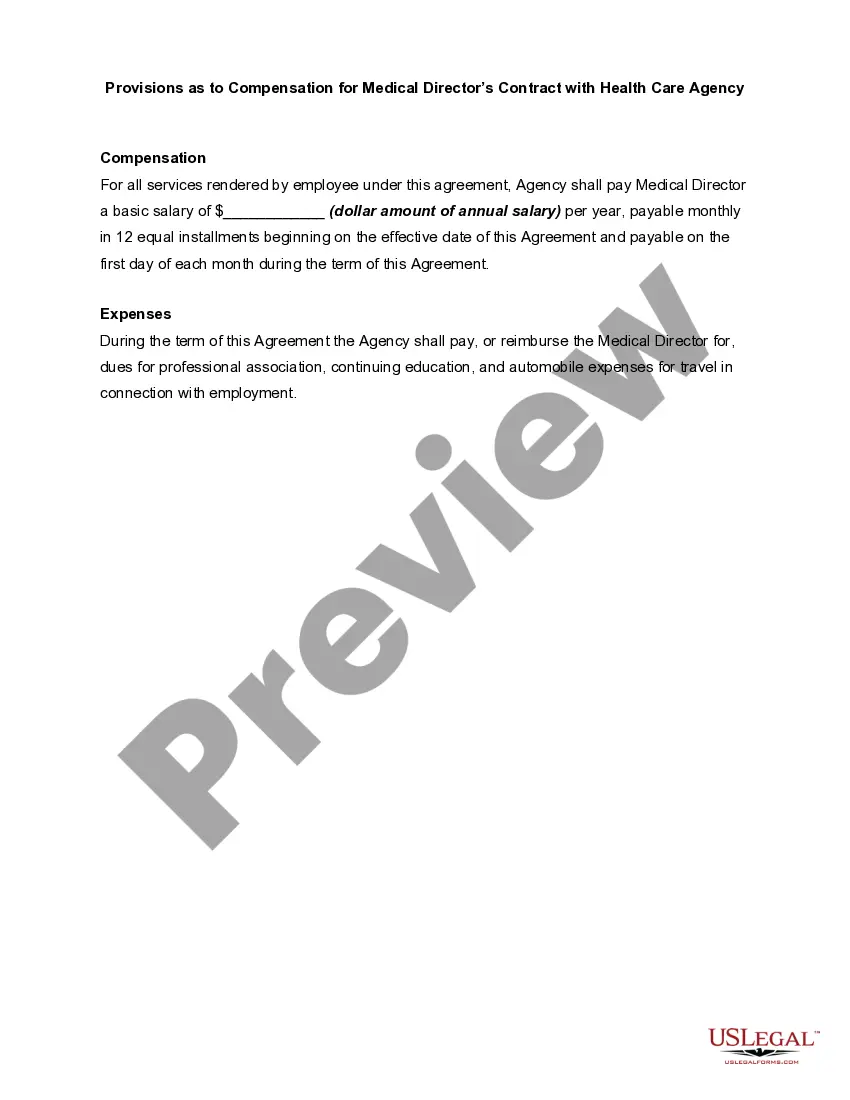
Provisions as to Compensation for Medical Director's Contract with Health Care Agency
About this form
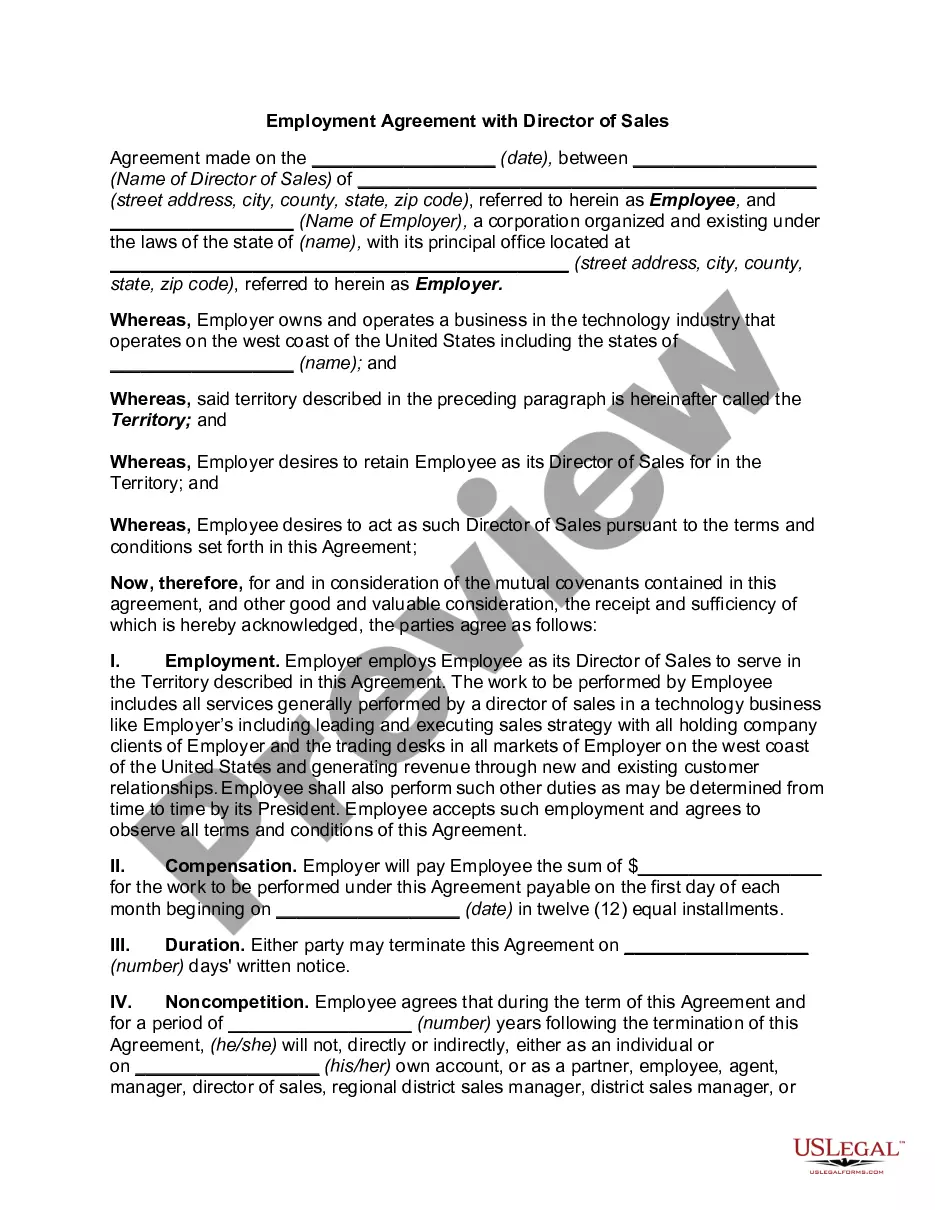
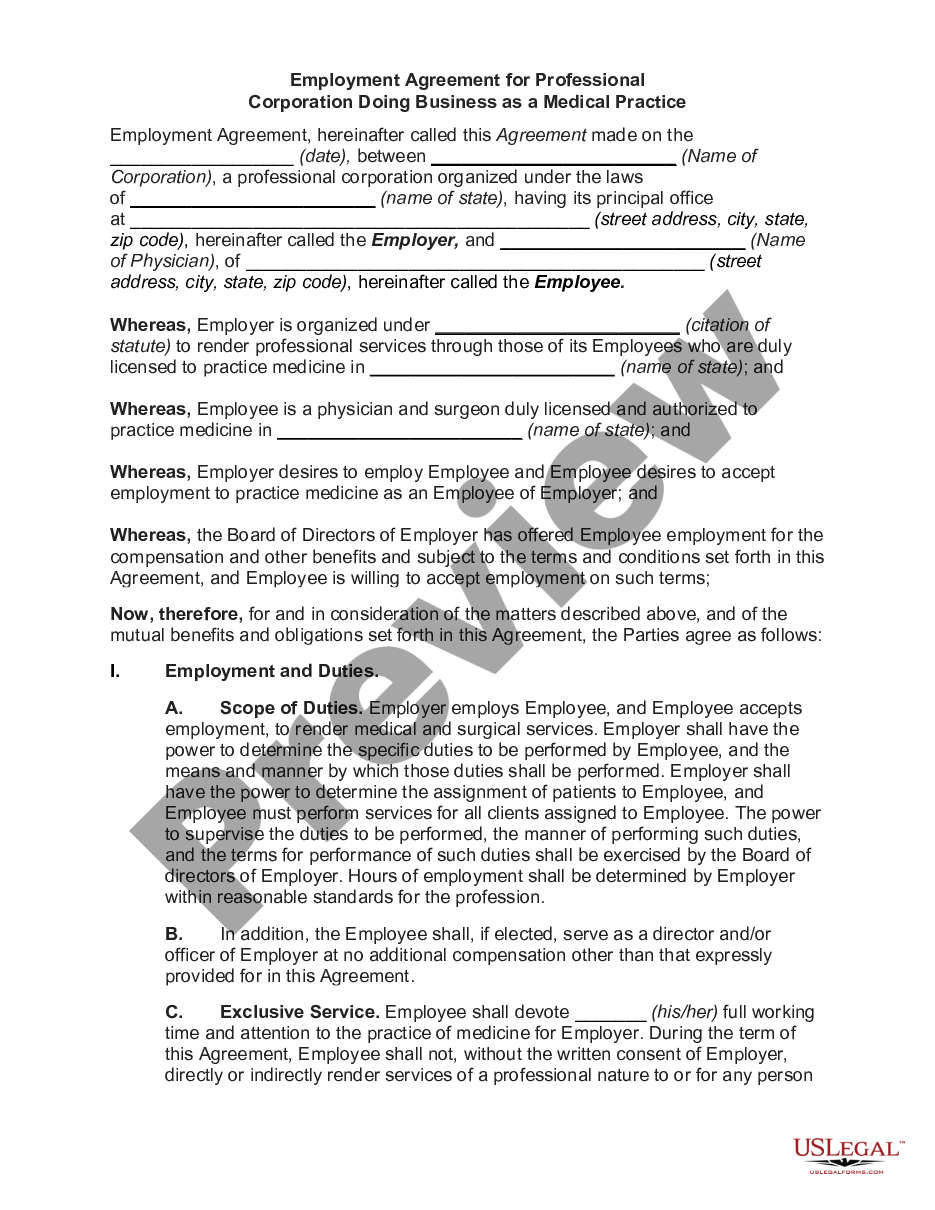
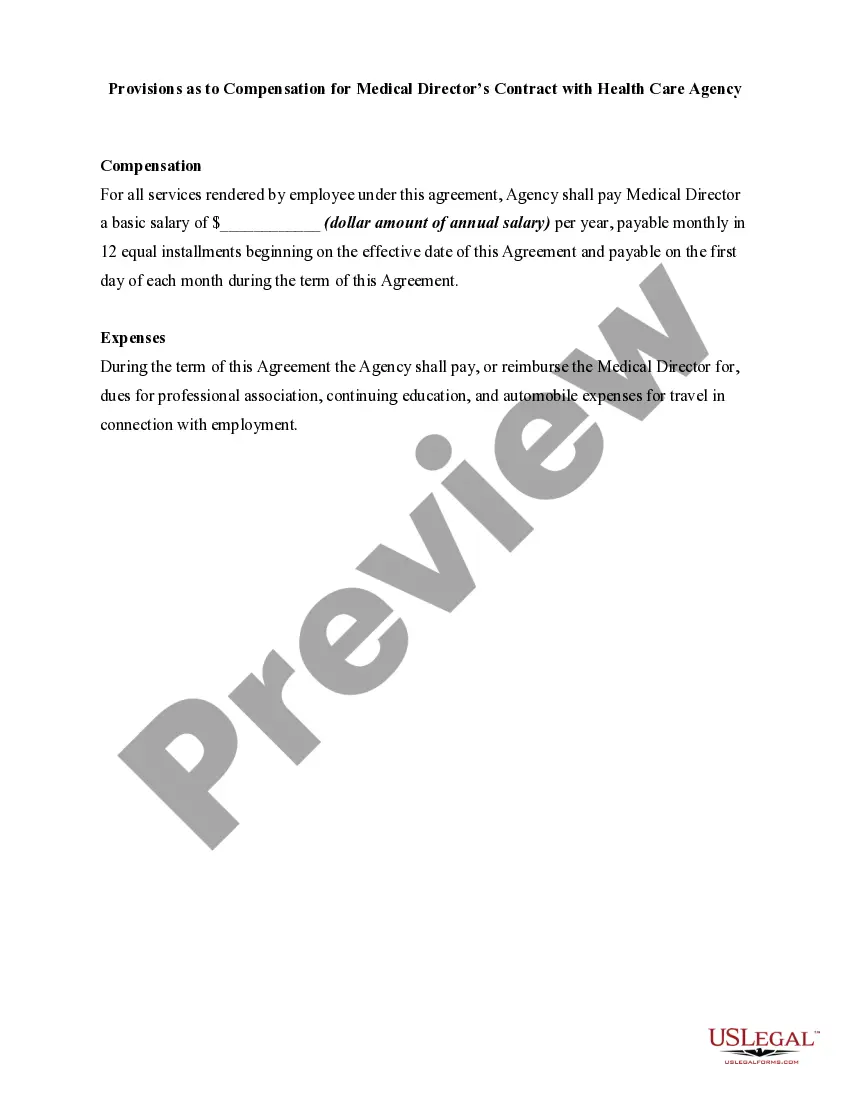
The Provisions as to Compensation for Medical Director's Contract with Health Care Agency form outlines the compensation details and benefits for a medical director employed by a health care agency. This legal document is designed to clarify the terms of salary, reimbursements, and other perks, ensuring both parties have a clear understanding of the agreement. This form is particularly important for health care agencies looking to define the employment terms for their medical directors, which can vary widely in structure and benefits compared to other employment contracts.
Key components of this form
- Basic salary details, specifying the annual dollar amount and payment schedule.
- Reimbursement clauses for professional dues, continuing education, and travel-related automobile expenses.
- Definitions of the terms of engagement between the medical director and the health care agency.
Situations where this form applies
This form should be used when a health care agency needs to establish a formal compensation agreement with a medical director. It is applicable in scenarios such as onboarding a new medical director, revising an existing contract, or negotiating employment terms to attract qualified candidates in the health care sector.
Intended users of this form
- Health care agencies seeking to hire a medical director.
- Medical directors who require a clear understanding of their compensation and benefits.
- Legal professionals drafting employment contracts in the health care field.
Steps to complete this form
- Enter the basic salary amount to be paid to the medical director.
- Specify the payment schedule, including the date of the first payment.
- Detail any additional reimbursements for professional dues, education, and travel expenses.
- Review the document for accuracy and ensure that both parties understand the terms.
- Have both parties sign and date the agreement to formalize it.
Notarization requirements for this form
This form does not typically require notarization unless specified by local law. However, having it notarized can provide an extra layer of validation for the agreement.
Get your form ready online
Our built-in tools help you complete, sign, share, and store your documents in one place.
Make edits, fill in missing information, and update formatting in US Legal Forms—just like you would in MS Word.
Download a copy, print it, send it by email, or mail it via USPS—whatever works best for your next step.
Sign and collect signatures with our SignNow integration. Send to multiple recipients, set reminders, and more. Go Premium to unlock E-Sign.
If this form requires notarization, complete it online through a secure video call—no need to meet a notary in person or wait for an appointment.
We protect your documents and personal data by following strict security and privacy standards.

Make edits, fill in missing information, and update formatting in US Legal Forms—just like you would in MS Word.

Download a copy, print it, send it by email, or mail it via USPS—whatever works best for your next step.

Sign and collect signatures with our SignNow integration. Send to multiple recipients, set reminders, and more. Go Premium to unlock E-Sign.

If this form requires notarization, complete it online through a secure video call—no need to meet a notary in person or wait for an appointment.

We protect your documents and personal data by following strict security and privacy standards.
Typical mistakes to avoid
- Failing to specify the total compensation package clearly.
- Not including all potential reimbursements or expenses.
- Leaving out important details about payment schedules.
- Not having both parties sign the document.
Why complete this form online
- Convenience of downloading and filling out the form at your own pace.
- Editability allows for customization to meet specific needs.
- Access to a legal document drafted by licensed attorneys, ensuring reliability.
- This form is legally binding upon proper completion and signing by all parties involved.
- Local laws may apply; therefore, consultation with a legal professional is recommended.
Summary of main points
- A Medical Director's Contract is essential for defining compensation and benefits.
- This form should be tailored to state-specific laws for enforceability.
- Complete the contract accurately to avoid common mistakes.
Looking for another form?







Form popularity
FAQ
Yes, one person (U.S. or foreign) can be the President, Secretary, Treasurer, Sole Director and sole stockholder of a Delaware Corporation. Also, one person (U.S. or foreign) can be the member and manager of an LLC.
According to the Companies Act, only an individual can be appointed as a member of the board of directors. Usually, the appointment of directors is done by shareholders. A company, association, a legal firm with an artificial legal personality cannot be appointed as a director.
Continuing director is mentioned in Section 174(2) in the context if total number of directors goes below the statutory limit or the limit specified in AOA, then such directors are termed as 'Continuing Directors'.
Because a director must also be a shareholder, there can be no more than 15 directors in a corporation.
According to the Companies Act, only an individual can be appointed as a member of the board of directors. Usually, the appointment of directors is done by shareholders. A company, association, a legal firm with an artificial legal personality cannot be appointed as a director.
Keep in mind there are no stated required officer positions that a Delaware corporation must have, as opposed to other states. One person can comprise an entire Delaware corporation. Most Delaware companies have at least a president as well as a secretary.
There must be at least one director. There is no maximum number of directors, but the number of directors should be stated in the certificate of incorporation or bylaws. A director must be a person, but a director does not need to own stock in the corporation.
If your startup is a corporation incorporated in Delaware or Washington, you must have a board of directors. The Delaware General Corporation Law provides that the business and affairs of every Delaware corporation shall be managed by or under the supervision of a board of directors.
Mala fide acts: Directors are the trustees for the money and property of the company. They hold an office of trust and if they misuse their powers they will be liable for breach of trust and may be required indemnify the losses incurred due to.