Real Estate Investment Trust - REIT
About this form
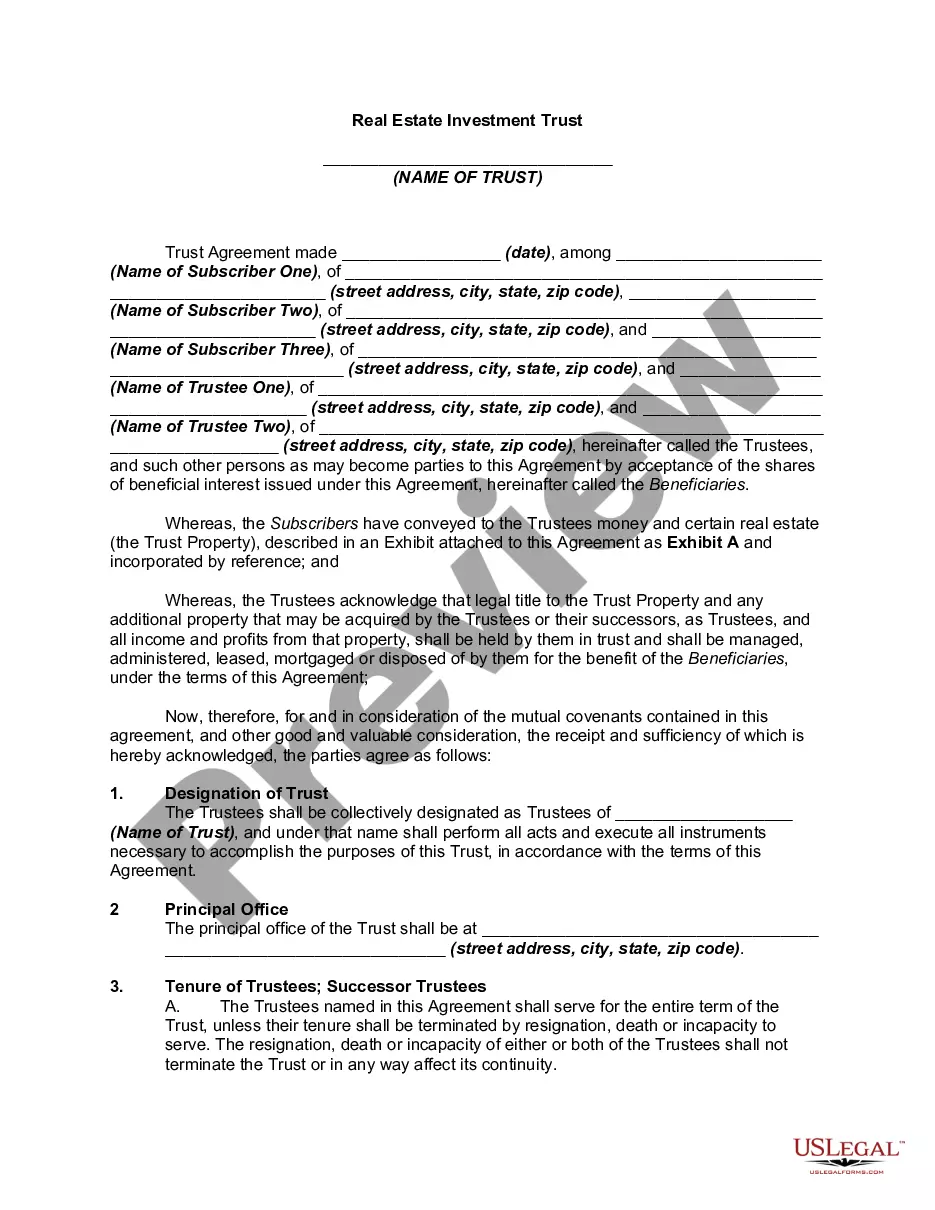
A Real Estate Investment Trust (REIT) is a legal form used for structuring an entity that invests in real estate. This form helps reduce or eliminate corporate income taxes while requiring that ninety percent of income be distributed to its investors. It functions similarly to a mutual fund for real estate, offering a framework that allows multiple investors to benefit from real estate investments. The REIT can be publicly traded on stock exchanges or privately held, distinguishing it from other business structures used for real estate investment.
Main sections of this form
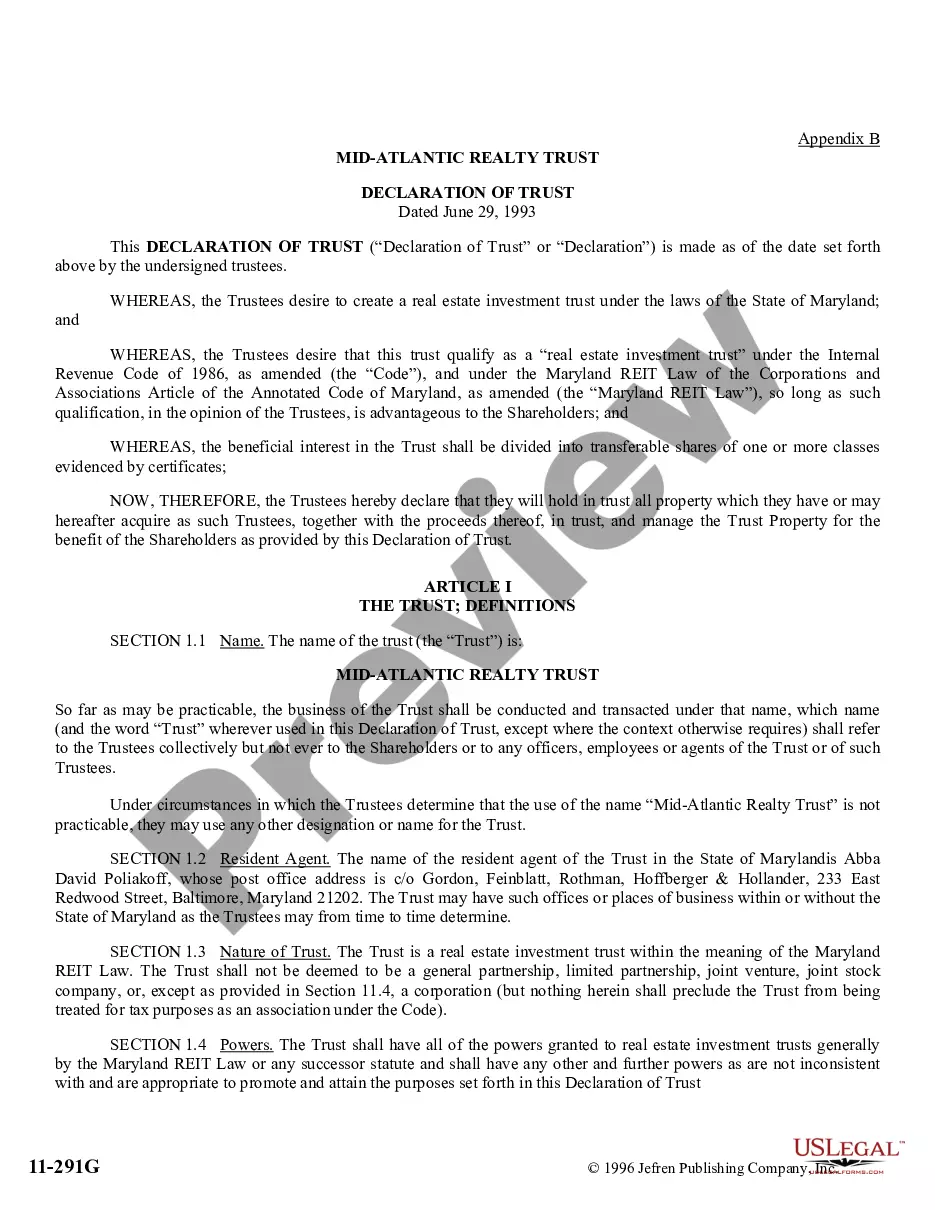
- Designation of the trust and the roles of trustees
- Principal office location of the trust
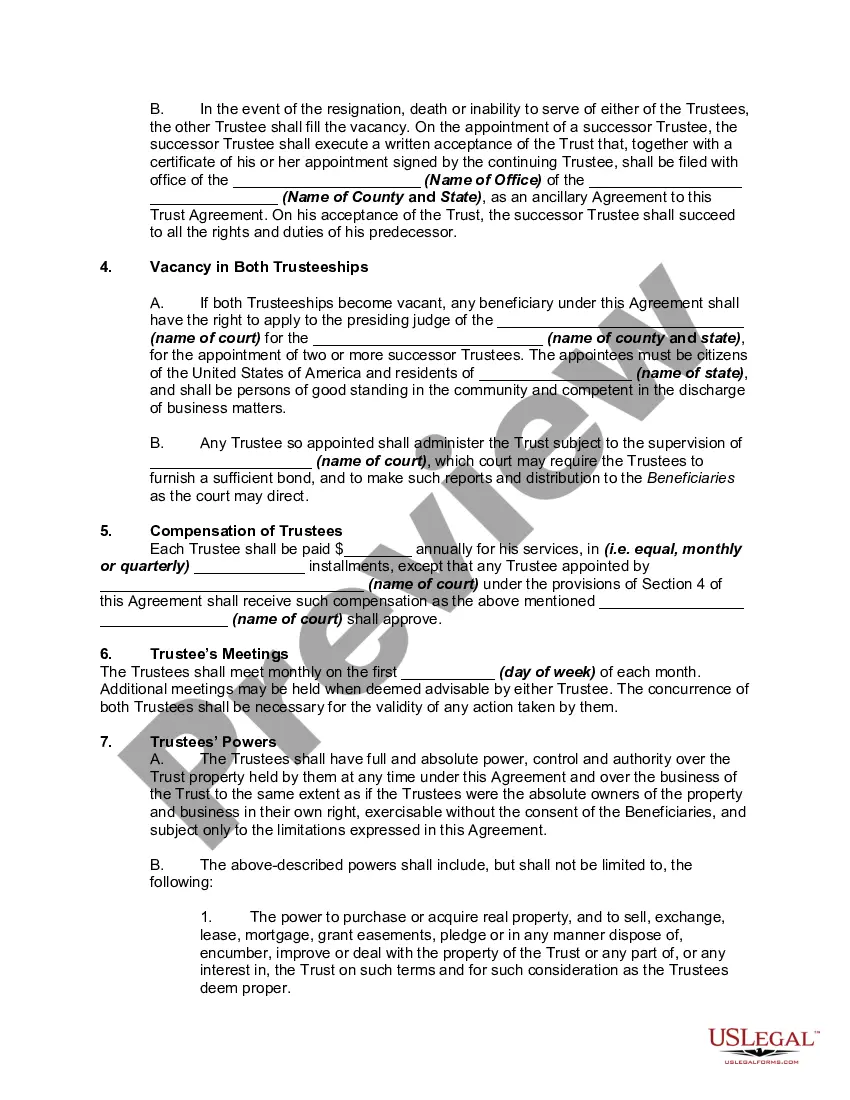
- Tenure and succession procedures for trustees
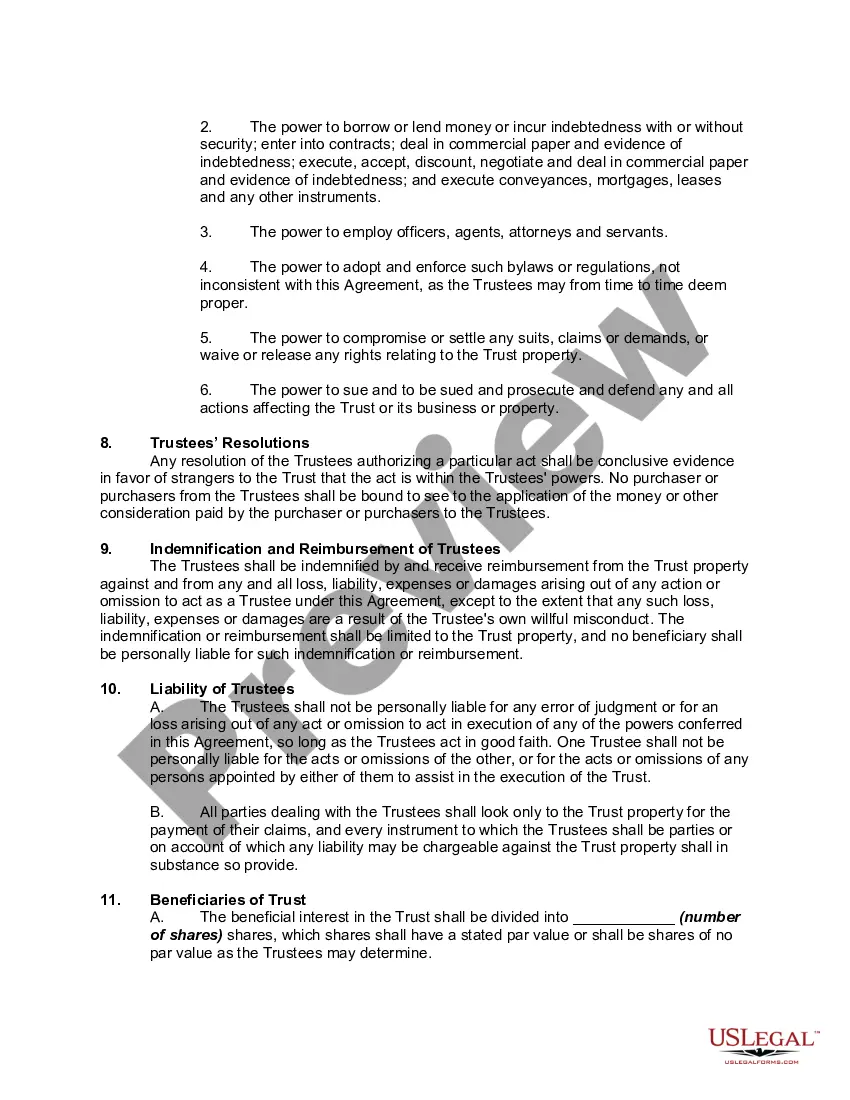
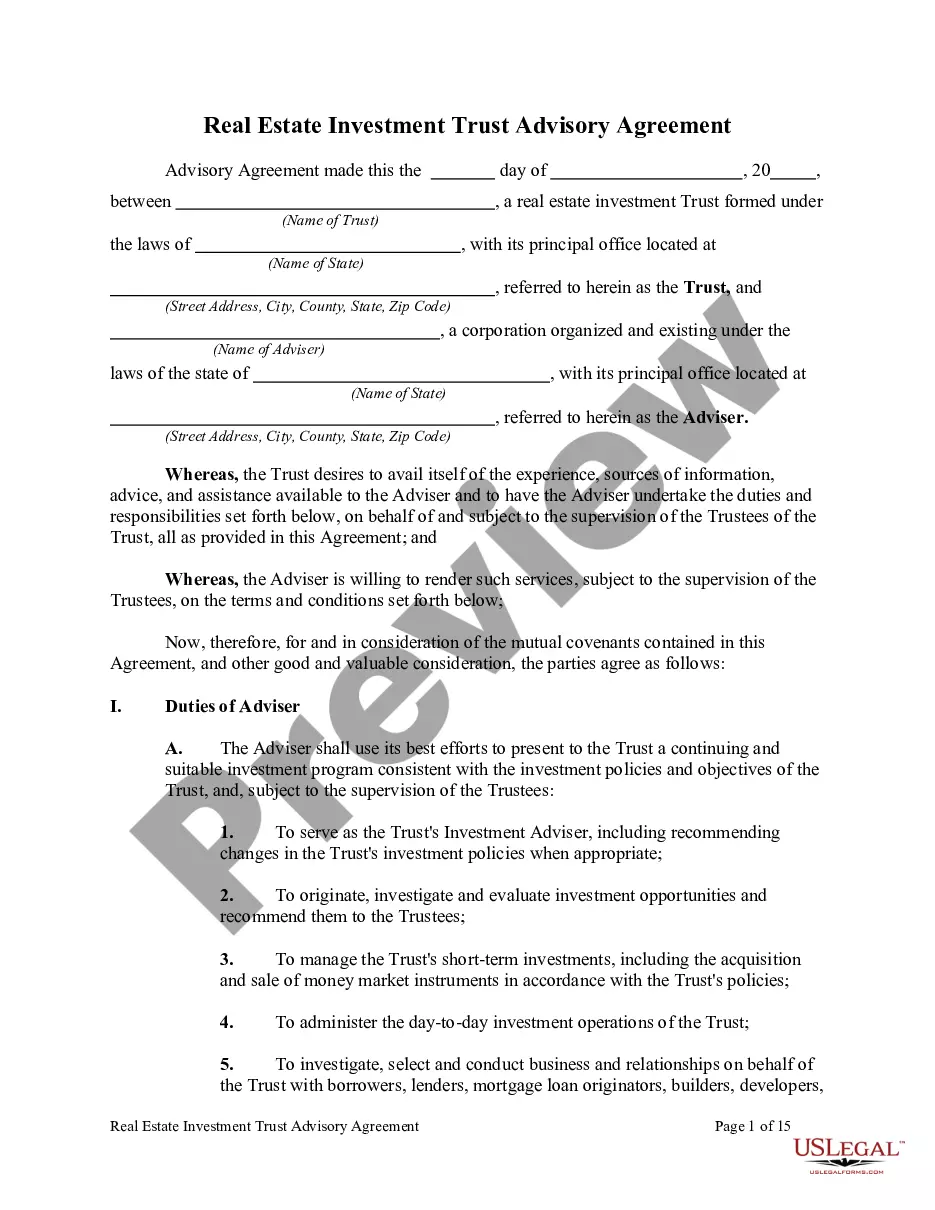
- Powers and responsibilities of the trustees
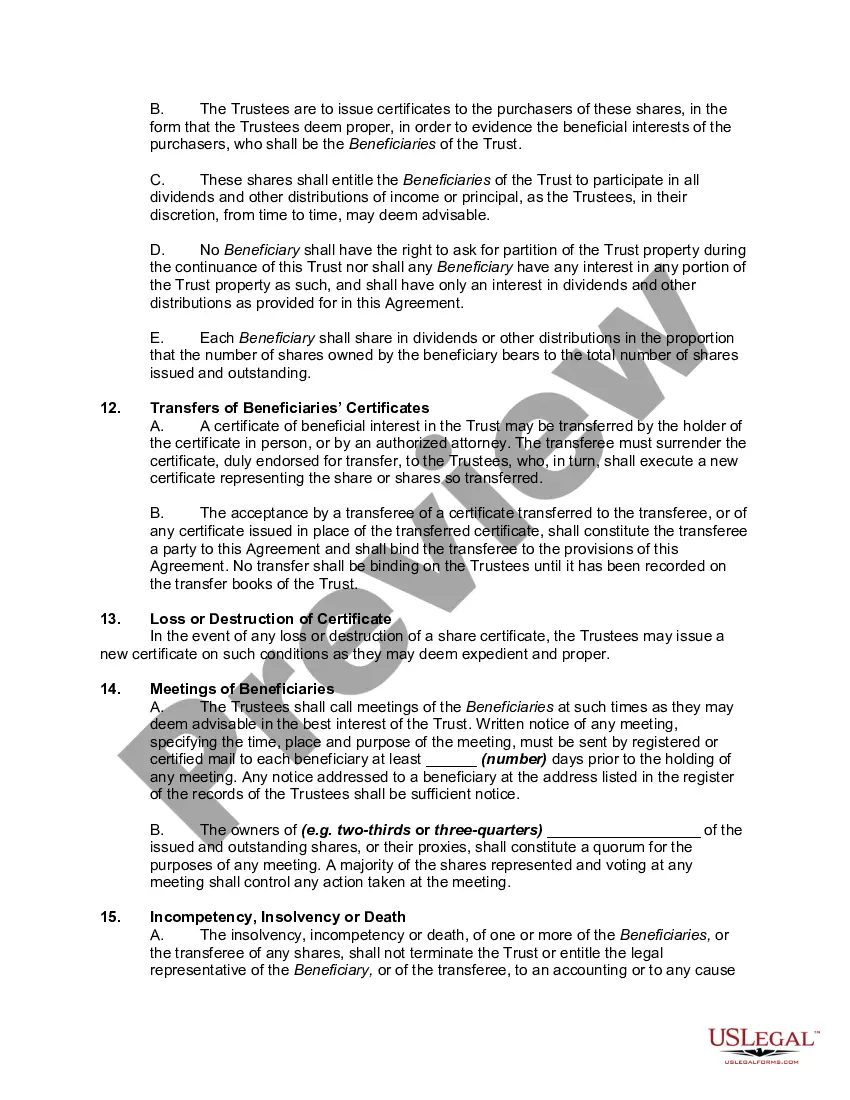
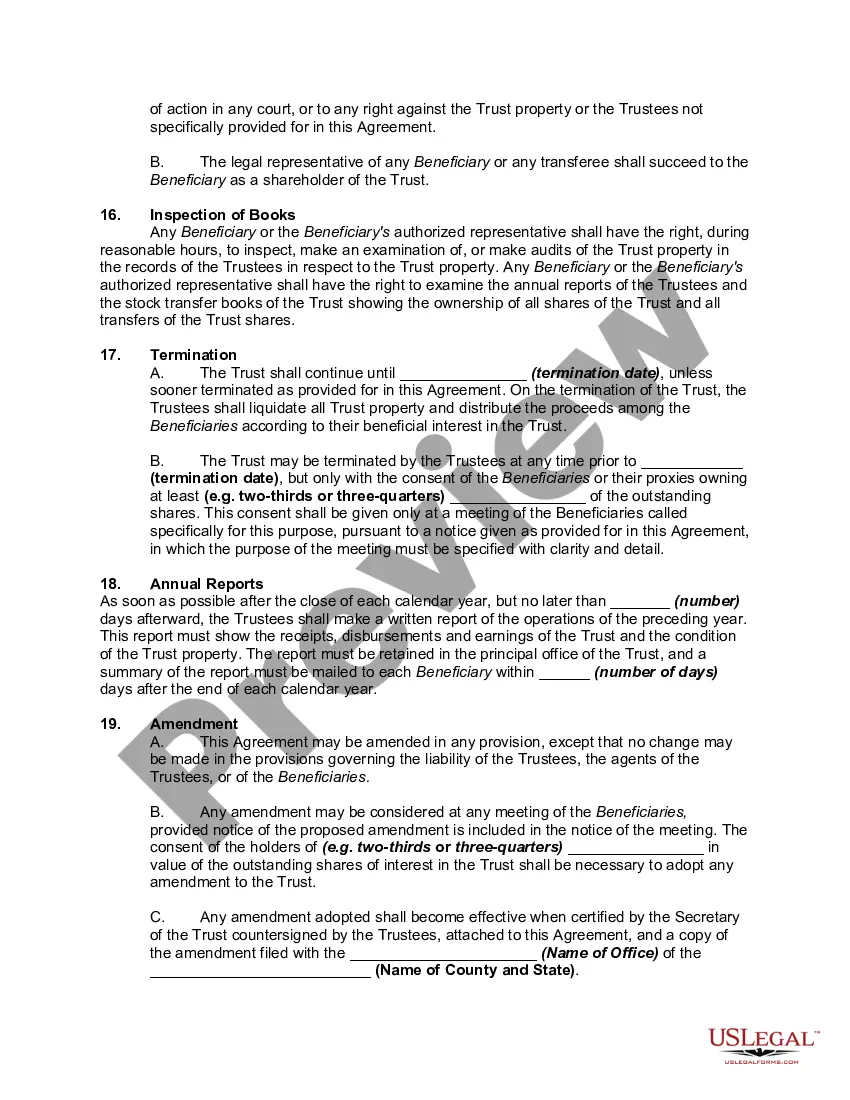
- Distribution of beneficial interest among shareholders
- Provisions for meetings of trustees and beneficiaries

When this form is needed
This form is used when individuals or entities wish to create a Real Estate Investment Trust. It is beneficial for investing in diverse real estate properties and for managing finances while benefiting from favorable tax treatments. You should use this form when establishing a partnership for property investment that allows for the distribution of income to investors.
Who can use this document
This form is appropriate for:
- Individuals or groups interested in collective real estate investment.
- Entities seeking tax advantages through structured real estate investments.
- Investors looking to pool resources for large-scale property purchases.
- Real estate professionals who aim to manage investments on behalf of multiple stakeholders.
How to prepare this document
- Identify the parties involved, including subscribers and trustees.
- Specify the name of the trust and the principal office address.
- Detail the terms related to the tenure and succession of trustees.
- Outline the powers granted to the trustees for managing the trust assets.
- Determine the distribution of beneficial interests among beneficiaries and complete certificates as needed.
Notarization requirements for this form
This form does not typically require notarization unless specified by local law. It's recommended to check specific state regulations to confirm any requirements surrounding notarization and formal execution.
Get your form ready online
Our built-in tools help you complete, sign, share, and store your documents in one place.
Make edits, fill in missing information, and update formatting in US Legal Forms—just like you would in MS Word.
Download a copy, print it, send it by email, or mail it via USPS—whatever works best for your next step.
Sign and collect signatures with our SignNow integration. Send to multiple recipients, set reminders, and more. Go Premium to unlock E-Sign.
If this form requires notarization, complete it online through a secure video call—no need to meet a notary in person or wait for an appointment.
We protect your documents and personal data by following strict security and privacy standards.

Make edits, fill in missing information, and update formatting in US Legal Forms—just like you would in MS Word.

Download a copy, print it, send it by email, or mail it via USPS—whatever works best for your next step.

Sign and collect signatures with our SignNow integration. Send to multiple recipients, set reminders, and more. Go Premium to unlock E-Sign.

If this form requires notarization, complete it online through a secure video call—no need to meet a notary in person or wait for an appointment.

We protect your documents and personal data by following strict security and privacy standards.
Avoid these common issues
- Failing to detail the powers of the trustees adequately.
- Not providing complete addresses for all parties involved.
- Neglecting to specify the termination date of the trust clearly.
- Overlooking the requirements for adding or substituting trustees.
Benefits of completing this form online
- Quick and easy access to a customizable legal template.
- Convenience of completing forms from anywhere at any time.
- Reliability of attorney-reviewed content to ensure legal compliance.
- Editability that allows adjustments to be made as necessary.
Looking for another form?
Form popularity
FAQ
Draw up a partnership agreement that designates the percent ownership, financial contributions and responsibilities of each partner in the REIT. Incorporate your management company with the secretary of state in the state in which your REIT will operate. Draft an offering prospectus.
To qualify as a REIT, a company must have the bulk of its assets and income connected to real estate investment and must distribute at least 90 percent of its taxable income to shareholders annually in the form of dividends.
The majority of REIT dividends are taxed as ordinary income up to the maximum rate of 37% (returning to 39.6% in 2026), plus a separate 3.8% surtax on investment income. Taxpayers may also generally deduct 20% of the combined qualified business income amount which includes Qualified REIT Dividends through Dec.
Any entity that would be treated as a domestic corporation for federal income tax purposes but for the ReIT election may qualify for treatment as a ReIT.The net effect of these rules is that an entity formed as a trust, partnership, limited liability company or corporation can be a ReIT.
Find investors Your company will need at least 100 investors to be classified as a REIT. You don't necessarily need to get all 100 up front, since the IRS only requires you to meet that threshold by the beginning of the REIT's second tax year.
Invest at least 75% of total assets in real estate, cash, or U.S. Treasuries. Derive at least 75% of gross income from rents, interest on mortgages that finance real property, or real estate sales. Pay a minimum of 90% of taxable income in the form of shareholder dividends each year.
Most REITs have a straightforward business model: The REIT leases space and collects rents on the properties, then distributes that income as dividends to shareholders. Mortgage REITs don't own real estate, but finance real estate, instead. These REITs earn income from the interest on their investments.
If you own shares in a REIT, you should receive a copy of IRS Form 1099-DIV each year. This tells you how much you received in dividends and what kind of dividends they were: Ordinary income dividends are reported in Box 1. Capital gains distributions are generally reported in Box 2a.
Earning money from a publicly owned real estate investment trust (REIT) is like earning money from stocks. You receive dividends from the profits of the company and can sell your shares at a profit when their value in the marketplace increases.