Affidavit Regarding Consent to Cremation of Remains
About this form
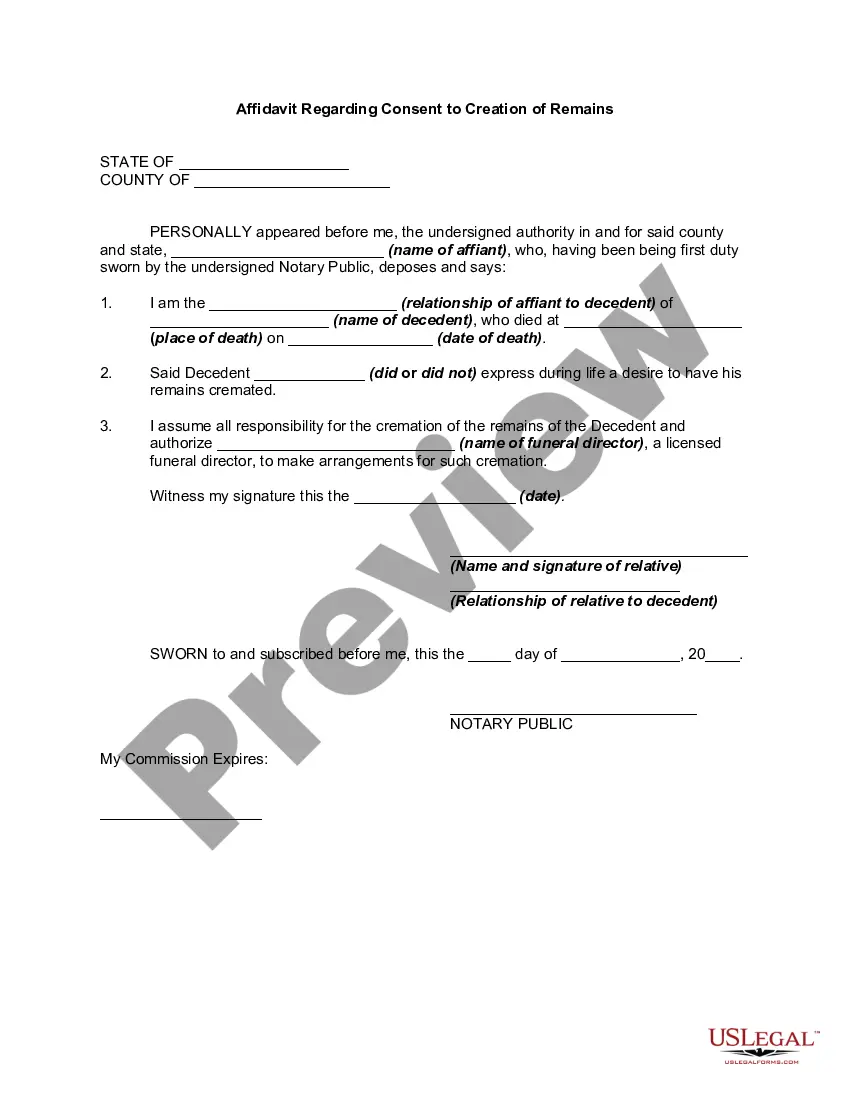
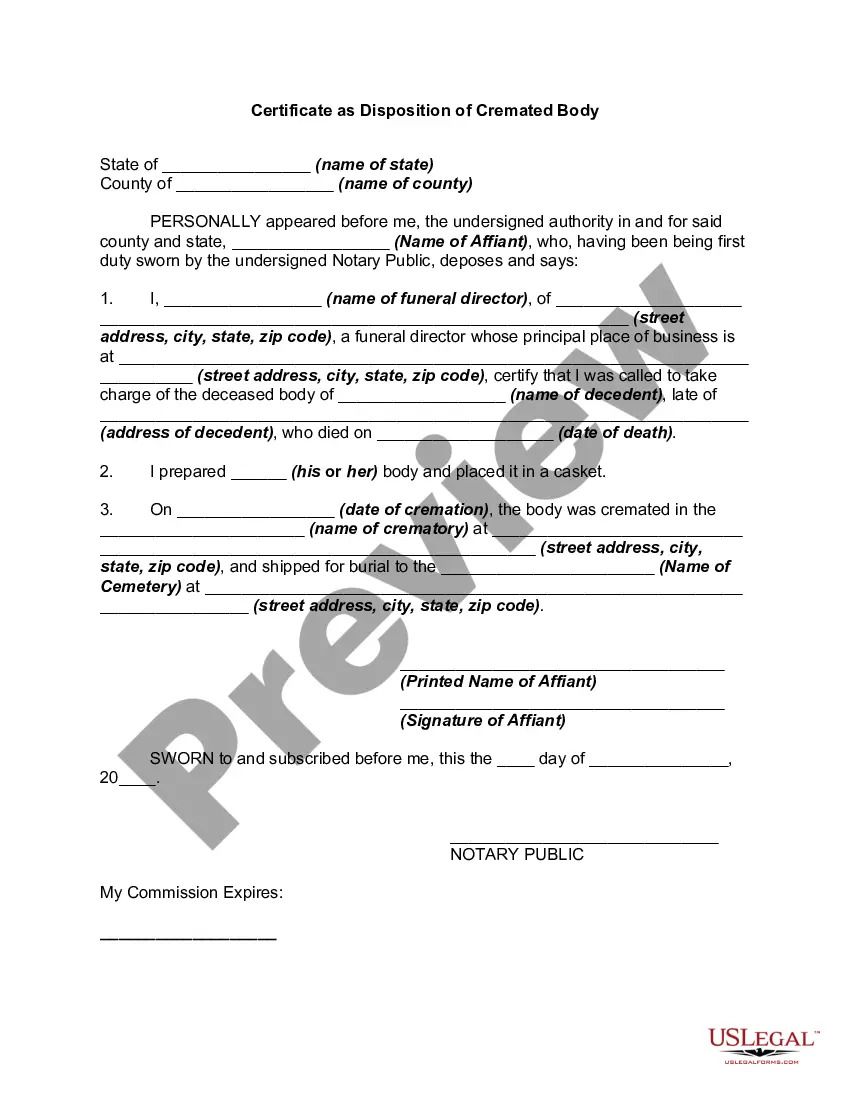
The Affidavit Regarding Consent to Cremation of Remains is a legal document that allows an affiant to confirm their authority to authorize the cremation of a deceased person's remains. This form is essential for ensuring that the proper consent is obtained, particularly if the decedent had not previously made their wishes known. Unlike other forms related to disposition of remains, this affidavit specifically addresses the consent required for cremation.
What’s included in this form
- Affiant's name and relationship to the decedent.
- Name of the decedent and details regarding their death.
- Statement regarding the decedent's wishes for cremation.
- Authorization granted to a licensed funeral director for cremation arrangements.
- Signatures of the affiant and a notary public.
When to use this document
This form should be used when an individual wishes to facilitate the cremation of a deceased loved one and needs to legally establish their authority to do so. It is particularly useful when the decedent's wishes regarding cremation are unclear, or when no prior documentation exists. Utilizing this form helps avoid potential disputes or legal issues concerning consent.
Who needs this form
- Immediate family members of the decedent, such as parents, spouses, or adult children.
- Individuals designated by the decedent to handle their remains.
- Legal representatives of the decedent, who may need to provide consent on behalf of the deceased.
Steps to complete this form
- Identify the affiant: Enter your name and your relationship to the decedent.
- Provide decedent details: Fill in the name of the deceased and where they passed away.
- State the decedent's wishes: Indicate whether the decedent expressed a desire for cremation.
- Authorize cremation: Name the licensed funeral director responsible for the cremation arrangements.
- Sign and date the form in the presence of a notary public to complete the affidavit.
Notarization guidance
Yes, this form must be notarized to be legally valid. A notary public will witness your signature, which helps verify your identity and the authenticity of the document. US Legal Forms offers integrated online notarization services, available 24/7 via secure video call, ensuring a hassle-free experience without the need to travel.
Get your form ready online
Our built-in tools help you complete, sign, share, and store your documents in one place.
Make edits, fill in missing information, and update formatting in US Legal Forms—just like you would in MS Word.
Download a copy, print it, send it by email, or mail it via USPS—whatever works best for your next step.
Sign and collect signatures with our SignNow integration. Send to multiple recipients, set reminders, and more. Go Premium to unlock E-Sign.
If this form requires notarization, complete it online through a secure video call—no need to meet a notary in person or wait for an appointment.
We protect your documents and personal data by following strict security and privacy standards.

Make edits, fill in missing information, and update formatting in US Legal Forms—just like you would in MS Word.

Download a copy, print it, send it by email, or mail it via USPS—whatever works best for your next step.

Sign and collect signatures with our SignNow integration. Send to multiple recipients, set reminders, and more. Go Premium to unlock E-Sign.

If this form requires notarization, complete it online through a secure video call—no need to meet a notary in person or wait for an appointment.

We protect your documents and personal data by following strict security and privacy standards.
Common mistakes to avoid
- Failing to confirm the decedent's wishes before signing.
- Not including all required personal information about the affiant and decedent.
- Omitting to have the document notarized, if required by local law.
- Signing the form before consulting a legal advisor about local requirements.
Why use this form online
- Convenience of downloading and printing the form directly from home.
- Editable fields make it easier to personalize the document for your needs.
- Access to professionally drafted templates ensuring legal compliance.
What to keep in mind
- The Affidavit Regarding Consent to Cremation of Remains confirms legal authority for cremation.
- It is important to adhere to state-specific requirements when using the form.
- Notarization is a critical step in the validity of the affidavit.
Looking for another form?
Form popularity
FAQ
In one reported case, seven months passed, during which time the deceased's body remained in the custody of the coroner. The statutory rules and orders that regulate cremation determine that ashes can only be handed over to the person who delivered the body for cremation (usually the executor).
There are no state laws in West Virginia prohibiting home burial, but local governments may have rules governing private burials. Before burying a body on private property or establishing a family cemetery, you should check with the county or town clerk for any zoning laws you must follow.
Laws governing cremation in West Virginia A body can only be cremated if the legal next of kin has signed a 'Cremation Authorization Form'. This form can be signed and self-authorized if you are preplanning a cremation.
Before a cremation takes place, law-abiding funeral homes require positive identification of a deceased body. This means you or a trusted family member or friend must give the funeral home consent that the body shown is, in fact, your loved one.
Despite this preference, cremation is now permitted as long as it is not done to express a refusal to believe in the resurrection of the body. Until 1997, Church regulations used to stipulate that cremation has to take place after a funeral service.
It is possible to conduct a basic cremation (a cremation without any services) for just $1,125. However, you will find that the average cost of a direct cremation in West Virginia is nearer to $2,400. A direct cremation is the cheapest means to conduct a funeral disposition.
Your spouse or registered domestic partner. your adult child, or a majority of your children if you have more than one. your parents. your siblings.
If the parents are deceased, then the remaining living siblings must sign the cremation order. If the decedent is predeceased by the parents and all siblings, then uncles, aunts, cousins (in order) would be responsible for the signature of cremation.
(7) any adult person in the next degree of kinship in the order named by law to inherit the estate of the decedent. (B) a person in a different priority class, in the priority listed in Subsection (a).