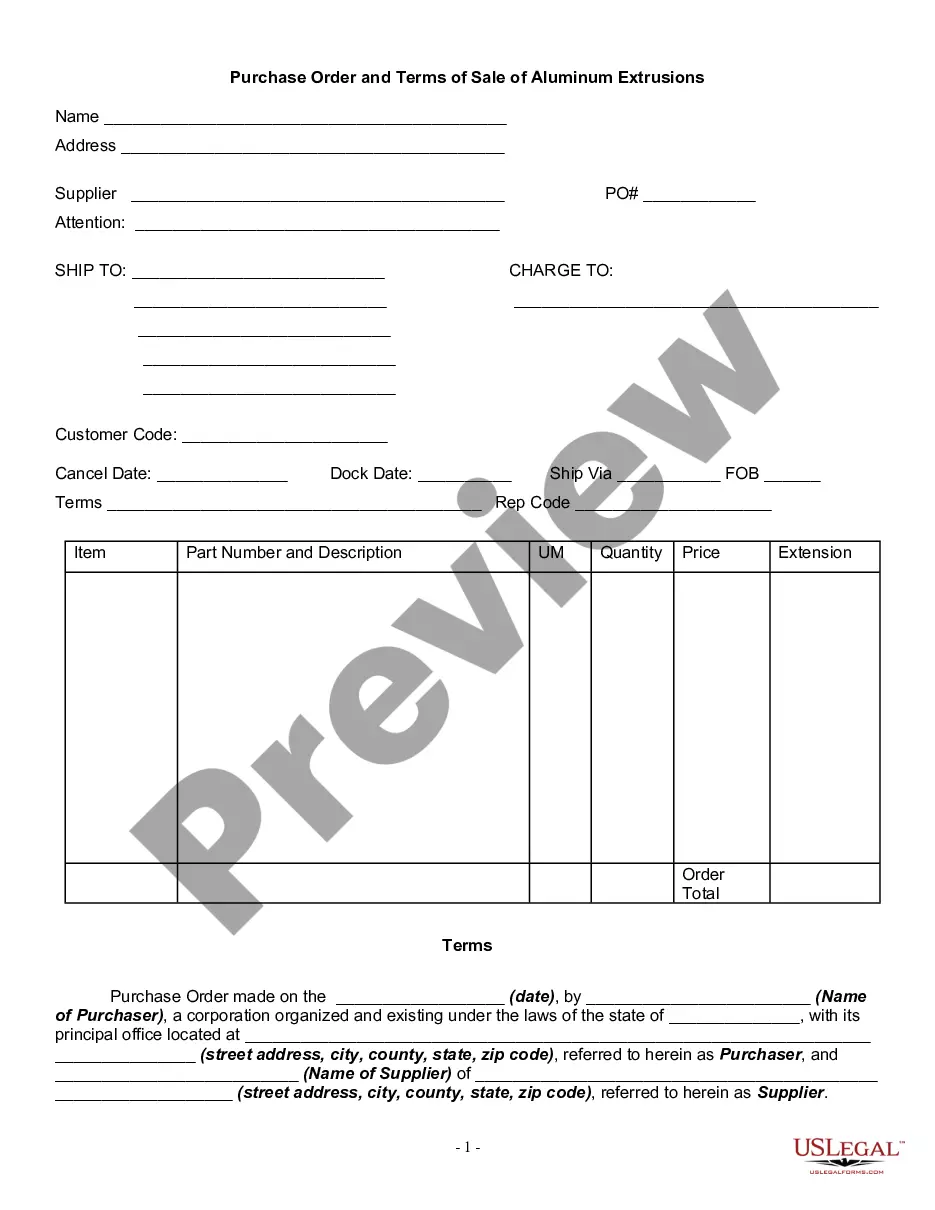
Purchase Order and Terms of Sale of Aluminum Extrusions
What this document covers
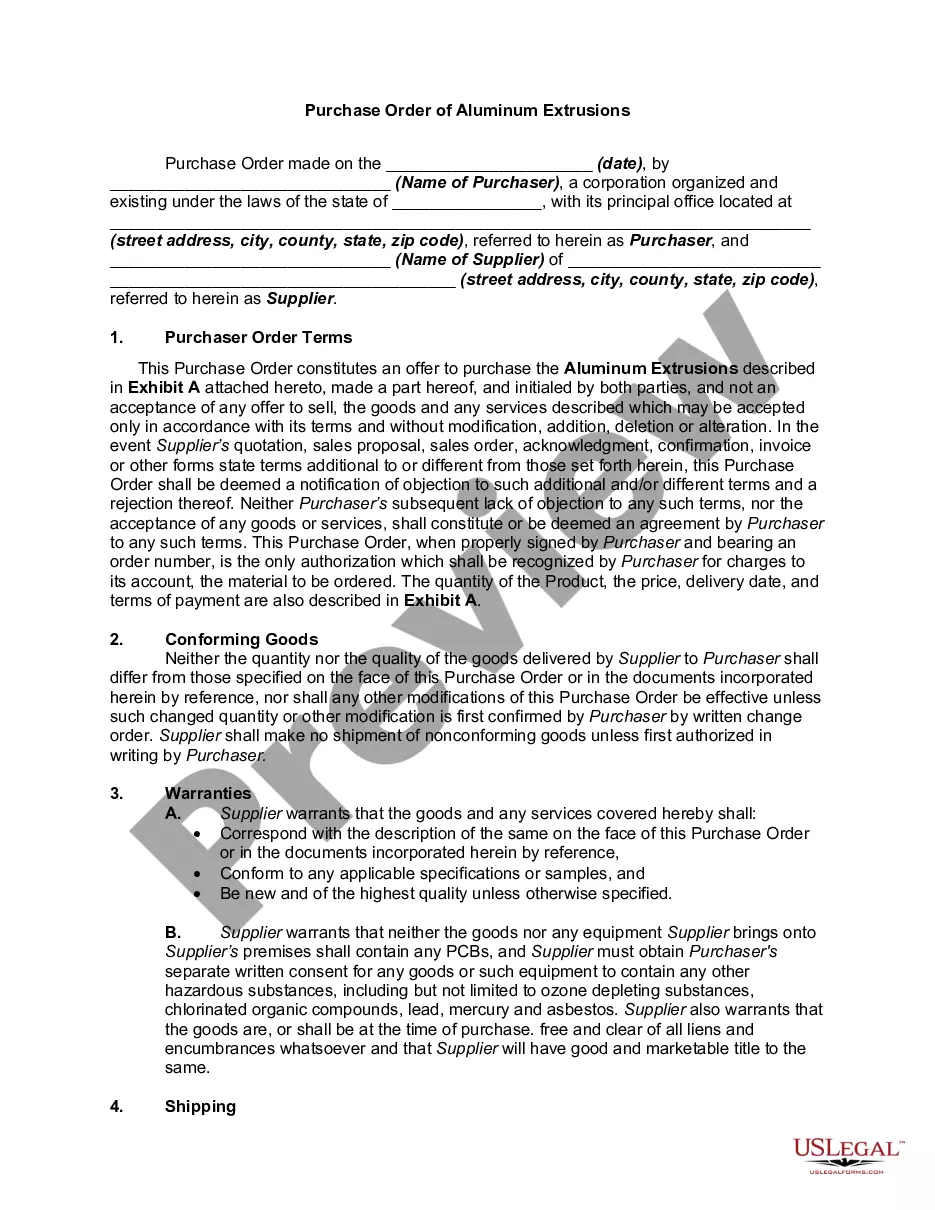
The Purchase Order and Terms of Sale of Aluminum Extrusions is a formal agreement between a purchaser and a supplier for the purchase of aluminum extrusions. This legal document specifies key details such as the vendor's name, ordered materials, quantities, pricing, delivery dates, and payment terms. Unlike informal purchase agreements or verbal arrangements, this purchase order confirms the terms of the sale and helps ensure all parties understand their obligations, thereby reducing the risk of disputes.
Form components explained
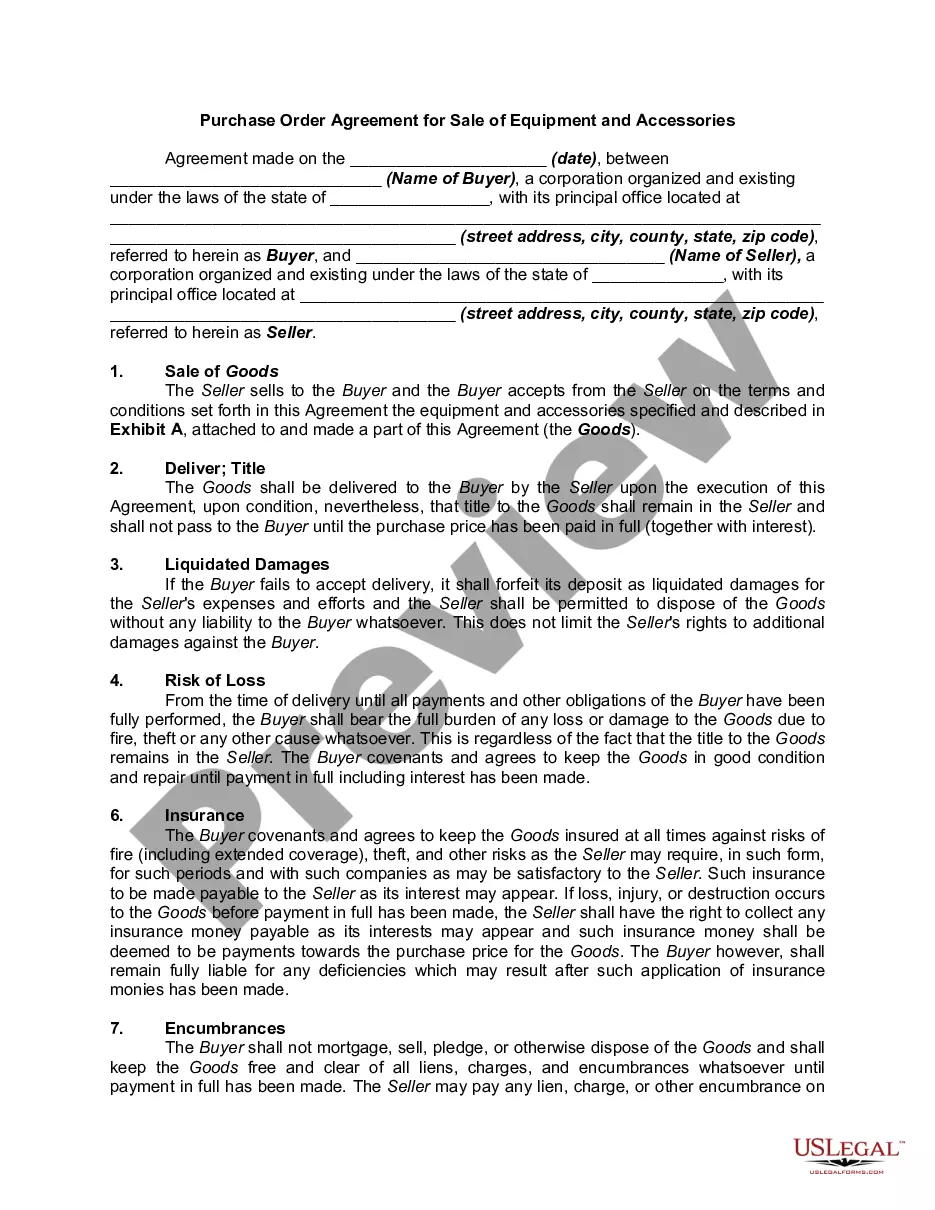
- Parties Involved: Identifies the purchaser and supplier.
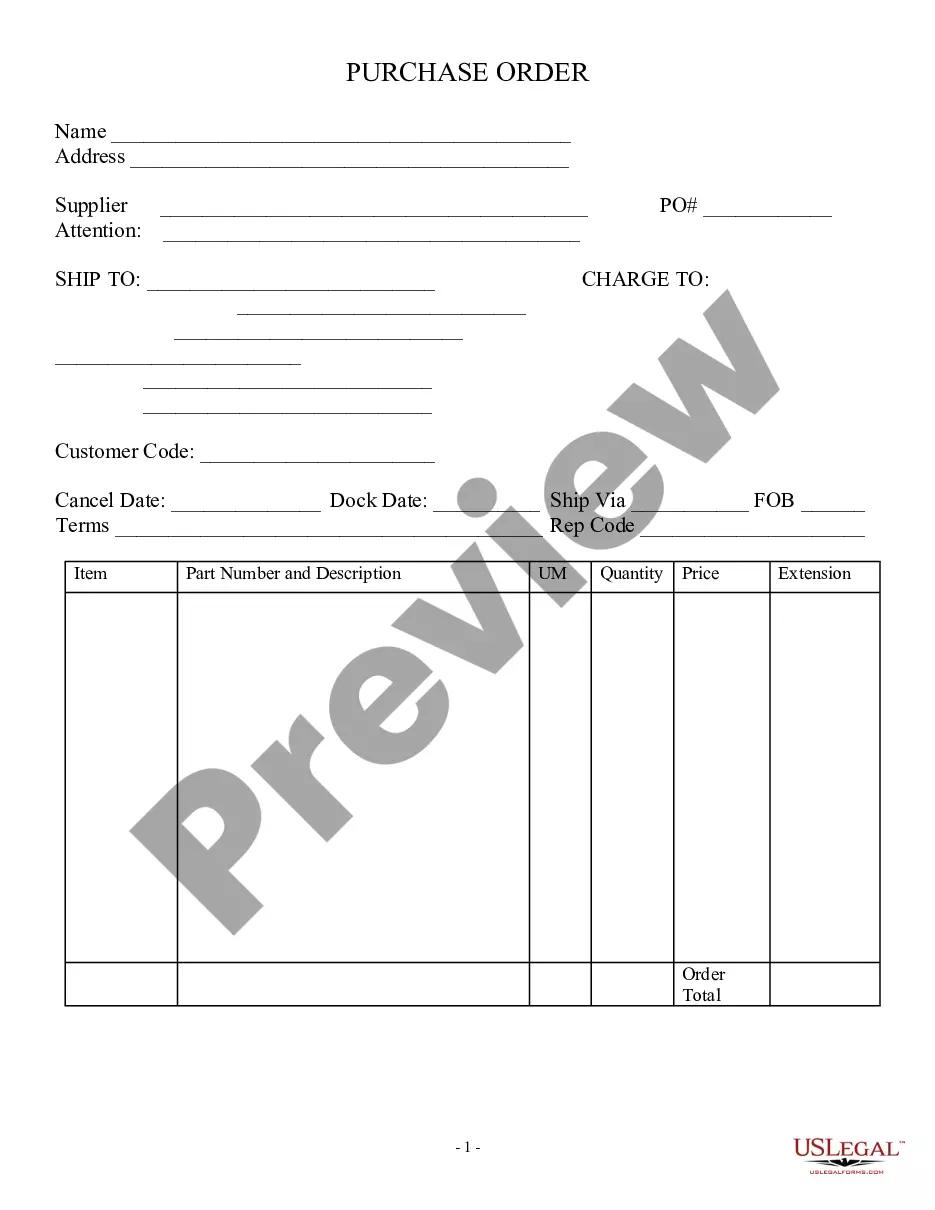
- Purchase Details: Specifies item descriptions, quantities, and pricing.
- Delivery Terms: Outlines delivery dates and conditions for shipment.
- Payment Terms: Details the terms of payment expected for the order.
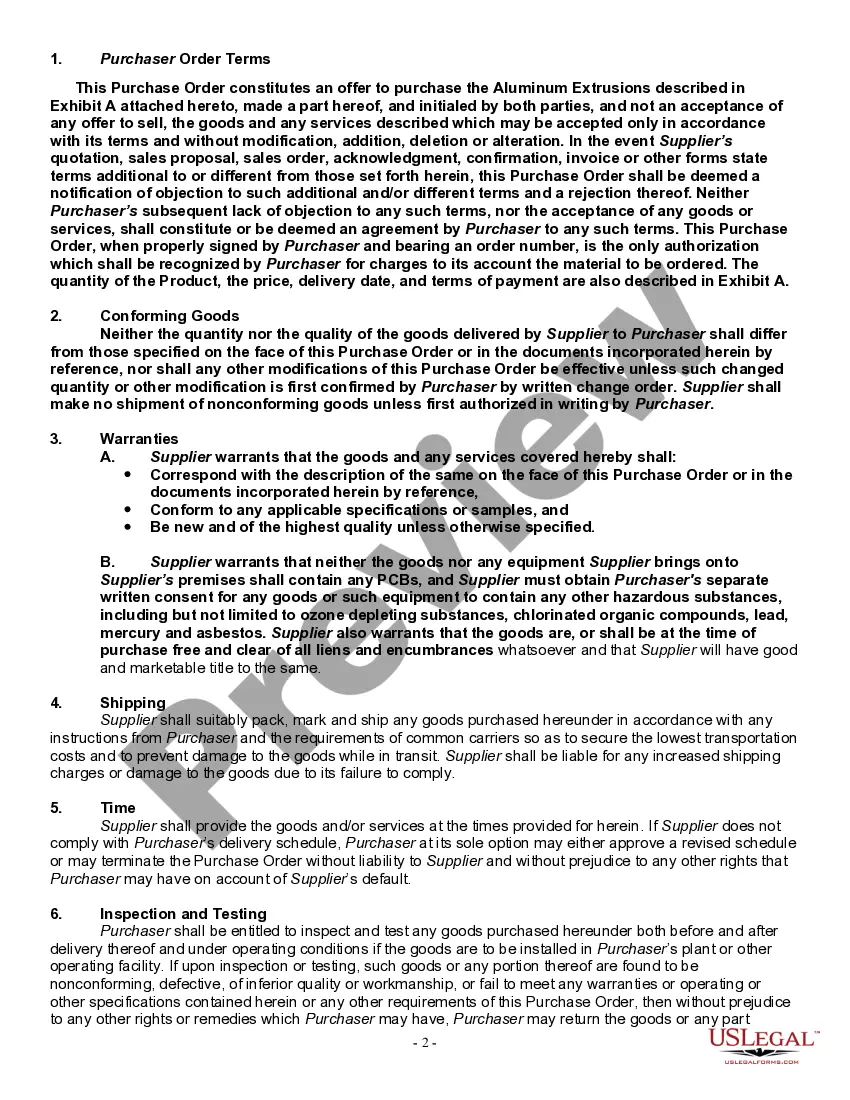
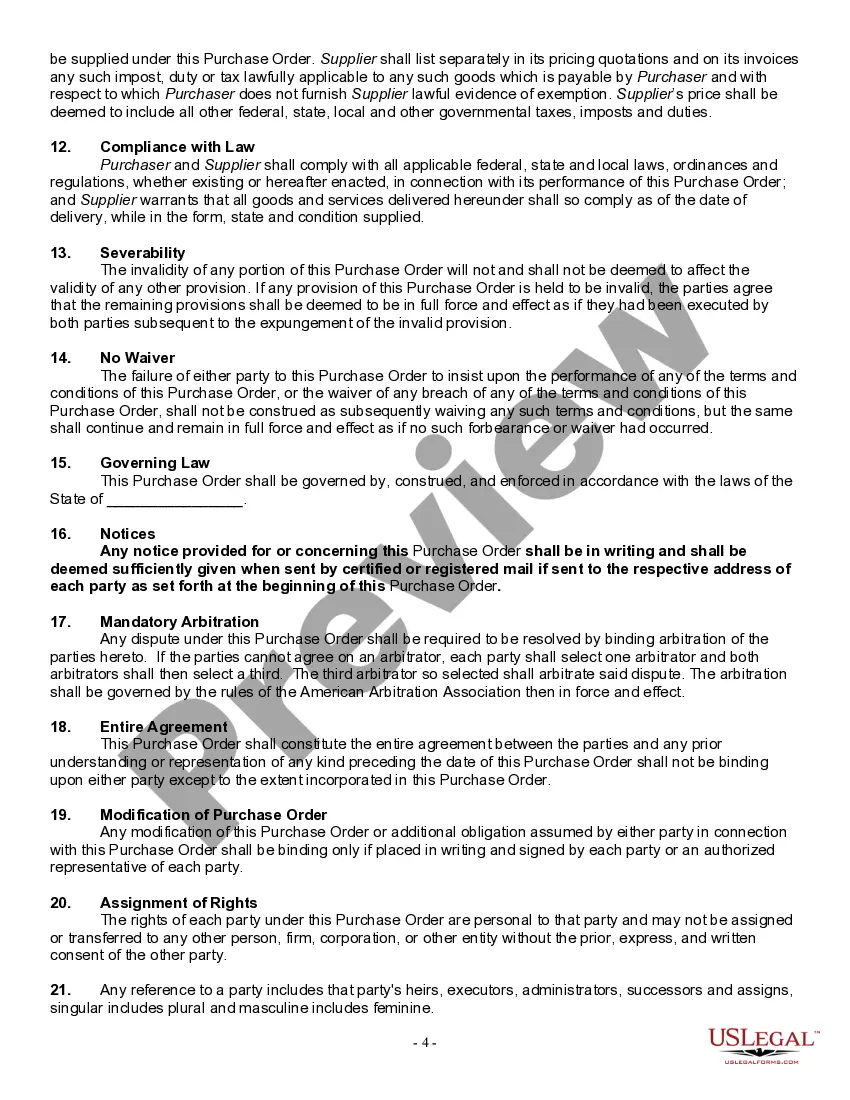
- Warranties: Lists guarantees provided by the supplier regarding the quality and compliance of goods.
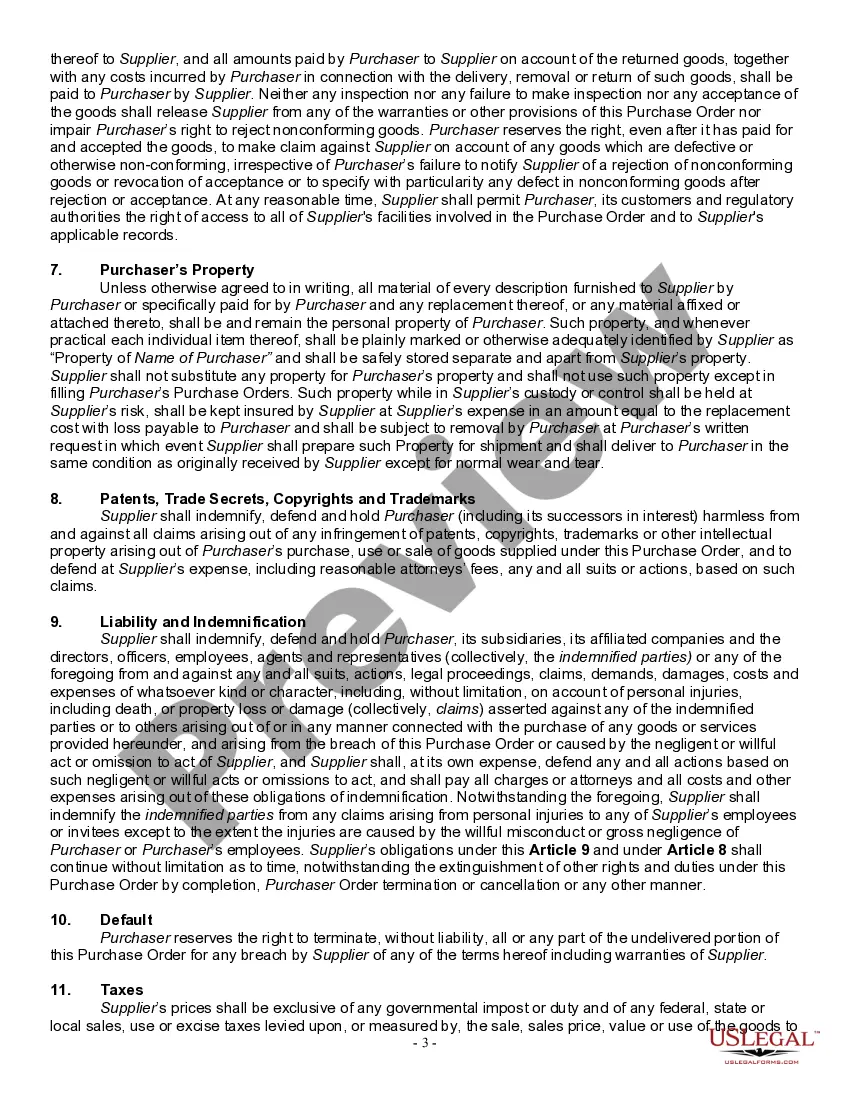
- Liability and Indemnification: Defines responsibilities related to damages or disputes arising from the purchase.
Situations where this form applies
This purchase order should be used in any business transaction involving the purchase of aluminum extrusions. It is particularly useful in situations where precise specifications and terms are required. Use this form when placing an order with a new or existing supplier, when detailed terms need to be agreed upon, or when establishing a formal understanding of delivery and payment conditions to protect your business interests.
Who can use this document
This form is intended for:
- Businesses purchasing aluminum extrusions for manufacturing or construction purposes.
- Procurement departments seeking to formalize orders with suppliers.
- Suppliers who want to ensure clarity and enforceability in their sales transactions.
- Legal teams needing a structured agreement to manage vendor relationships.
How to prepare this document
- Identify the parties: Fill in the names and addresses of both the purchaser and supplier.
- Enter order details: Specify the materials being ordered, including part numbers and descriptions.
- Indicate quantities and prices: Clearly state the quantity of each item and associated price.
- Set delivery and payment terms: Provide the expected delivery date and payment conditions.
- Sign the document: Ensure that the authorized representatives of both parties sign the form to validate the agreement.
Does this document require notarization?
This form does not typically require notarization to be legally valid. However, some jurisdictions or document types may still require it. US Legal Forms provides secure online notarization powered by Notarize, available 24/7 for added convenience.
Get your form ready online
Our built-in tools help you complete, sign, share, and store your documents in one place.
Make edits, fill in missing information, and update formatting in US Legal Forms—just like you would in MS Word.
Download a copy, print it, send it by email, or mail it via USPS—whatever works best for your next step.
Sign and collect signatures with our SignNow integration. Send to multiple recipients, set reminders, and more. Go Premium to unlock E-Sign.
If this form requires notarization, complete it online through a secure video call—no need to meet a notary in person or wait for an appointment.
We protect your documents and personal data by following strict security and privacy standards.

Make edits, fill in missing information, and update formatting in US Legal Forms—just like you would in MS Word.

Download a copy, print it, send it by email, or mail it via USPS—whatever works best for your next step.

Sign and collect signatures with our SignNow integration. Send to multiple recipients, set reminders, and more. Go Premium to unlock E-Sign.

If this form requires notarization, complete it online through a secure video call—no need to meet a notary in person or wait for an appointment.

We protect your documents and personal data by following strict security and privacy standards.
Mistakes to watch out for
- Failing to specify all required details about the delivery terms, leading to misunderstandings.
- Not including accurate item descriptions or part numbers, which can cause errors in order fulfillment.
- Omitting signatures from both parties, which is essential for validating the agreement.
Why use this form online
- Convenient access: Download and fill out your purchase order form at any time from anywhere.
- Editability: Easily update information as needed before finalizing the order.
- Compliance: Forms are drafted to meet legal standards, providing assurance of validity.
Summary of main points
- This purchase order formalizes the agreement between purchaser and supplier, ensuring clarity and legal compliance.
- It is essential to accurately complete all sections to prevent disputes.
- The form is adaptable for use in multiple states, but local laws should be considered.
Looking for another form?






Form popularity
FAQ
What should I do? A: By all means, avoid welding 7075 series aluminum. You need to remember that some aluminum alloys are just not arc-weldable.
Material Strength Specifications80/20's 6105-T5 alloy yield strength of 35,000 psi compares to A36 carbon steel's yield strength of 36,000 psi. Volume for volume, aluminum weights about 1/3 as much as iron, steel, copper or brass.
However, depending on the part complexity and raw materials, one could estimate the costs starting at less than $1,000.
80/20 profiles come in a range of shapes and tubes so you can find the option that's right for your project. They are made of 6105-T5 aluminum (or comparable), which has a wide range of benefits - for instance, it's lightweight yet strong, resilient, corrosion-resistant, nontoxic, and aesthetic.
The typical tooling cost for an extrusion die is $900 to $1,500 and the normal lead time to produce an extrusion is about 10 to 14 days. Other processes such as roll forming, injection molding, and die casting can take up to 20 weeks.
3. Strong, Reliable Structure. Extruded aluminum is a very strong material and in manufacturing industry applications is capable of handling high load applications. Think: machine bases and frames, conveyors, cutting tables, pick and place units.
Why did they choose this name? According to 80/20, they named their company and product line after Pareto's Law (from Vilfredo Pareto (1843 1923)), an Italian economist and sociologist who said that 80% of your results come from 20% of your efforts.
Extrusion dies are essentially thick, circular steel disks containing one or more openings to create the desired profile. They are normally constructed from H-13 die steel and heat-treated to withstand the pressure and heat of hot aluminum as it is pushed through the die.
The basic process for extruding aluminum is, outwardly, as simple to understand as the extrusion process used by a 3D-printer: heat material and force it through a die with the desired shape and size.More friction means more force, which means bigger presses, more wear on the dies, and generally higher costs.