Reciprocal Agreement Between Homeowners Associations
What is this form?
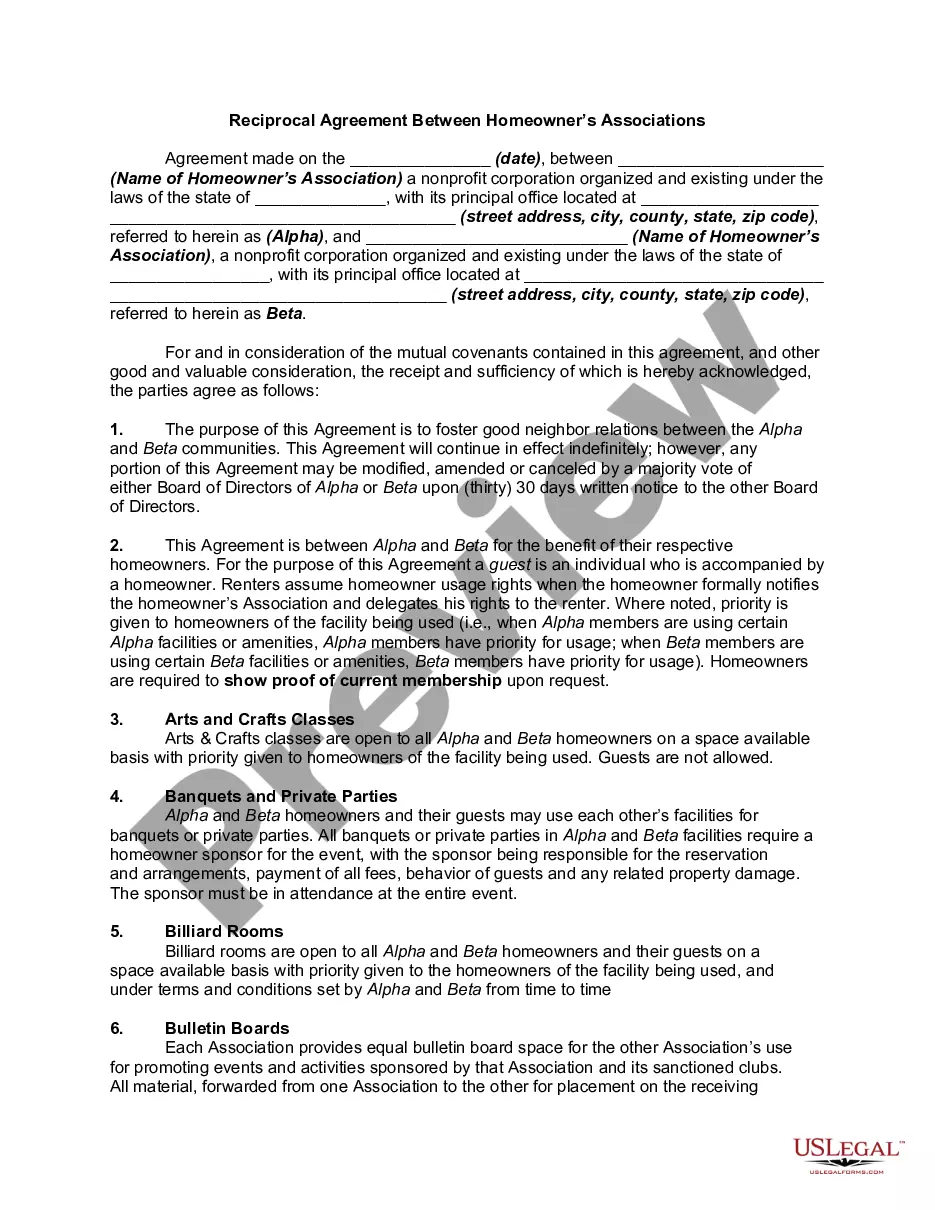
A reciprocal agreement between homeowners associations is a contract that creates a structured partnership between two homeowners associations (HOAs). This contract allows both parties to share resources and benefit from each other's facilities and services. Unlike standard agreements that may only govern one association's policies, this form promotes cooperation, enabling residents of both communities to access amenities and activities in a mutually beneficial arrangement.
Form components explained
- Names and addresses of both homeowners associations involved.
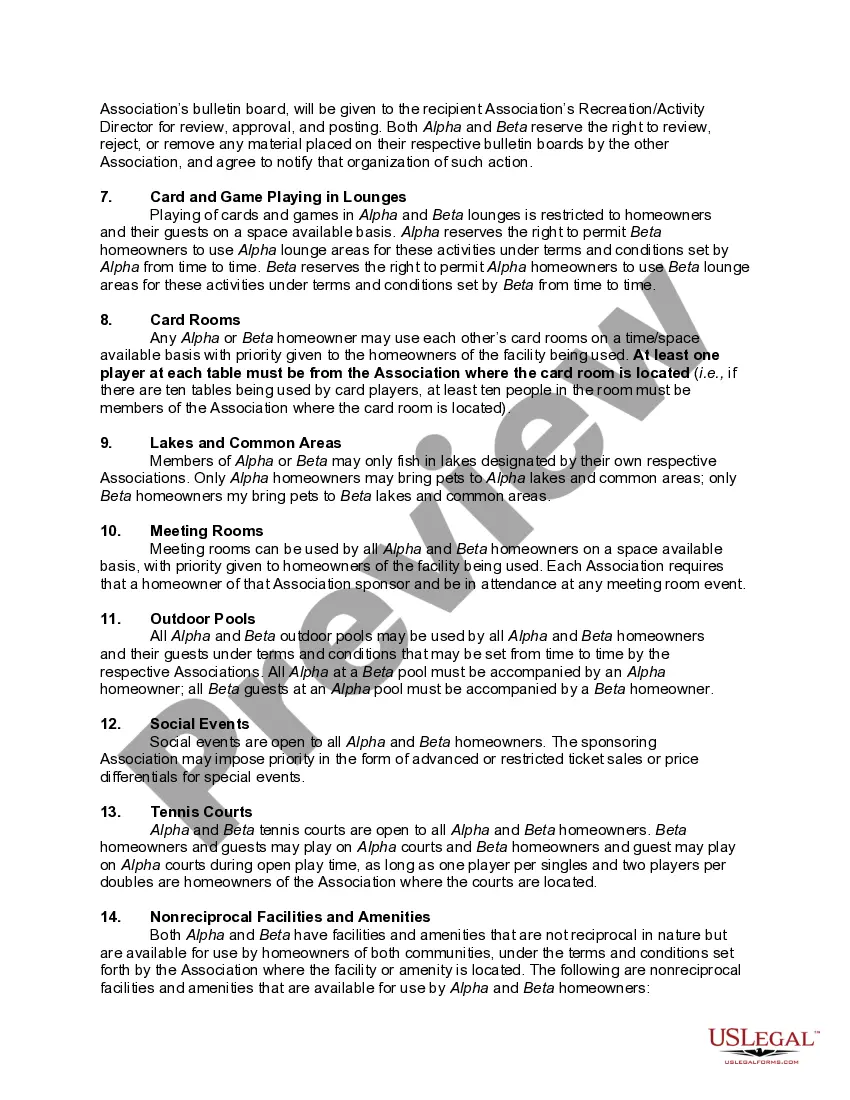
- Details about shared amenities, such as arts and crafts classes, billiard rooms, and tennis courts.
- Rules governing the use of facilities, including who can participate and under what conditions.
- Provisions for bulletin board space and communication between the two associations.
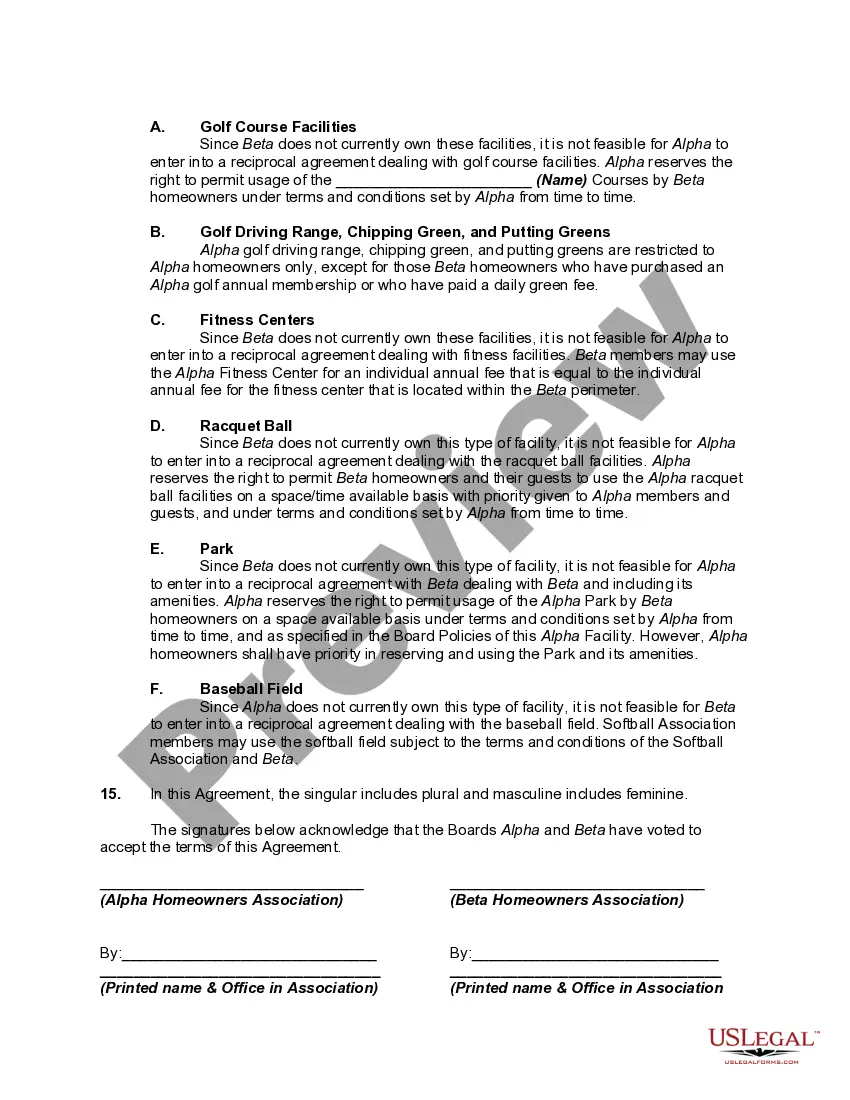
- Terms regarding nonreciprocal facilities that may contain specific limitations or fees.
Common use cases
This form should be used when two homeowners associations wish to establish a formal partnership for sharing amenities and resources. It is particularly useful for communities that want to enhance their residents' living experience by allowing access to each other's facilities, such as pools, fitness centers, and recreational areas. This agreement can help streamline the usage of these facilities while clarifying responsibilities and regulations for each HOA.
Who should use this form
- Homeowners associations looking to formalize agreements with other associations.
- HOA boards seeking to enhance community engagement through shared resources.
- Residents of participating associations who want to understand the terms of their access to additional amenities.
Steps to complete this form
- Identify and write down the full names and addresses of both homeowners associations.
- Enter the date the agreement is being made.
- Specify the shared amenities and detailed terms for their use by members of both associations.
- Include rules regarding bulletin board communications and other shared resources.
- Ensure that authorized representatives from both associations sign the agreement.
Does this form need to be notarized?
Notarization is not commonly needed for this form. However, certain documents or local rules may make it necessary. Our notarization service, powered by Notarize, allows you to finalize it securely online anytime, day or night.
Get your form ready online
Our built-in tools help you complete, sign, share, and store your documents in one place.
Make edits, fill in missing information, and update formatting in US Legal Forms—just like you would in MS Word.
Download a copy, print it, send it by email, or mail it via USPS—whatever works best for your next step.
Sign and collect signatures with our SignNow integration. Send to multiple recipients, set reminders, and more. Go Premium to unlock E-Sign.
If this form requires notarization, complete it online through a secure video call—no need to meet a notary in person or wait for an appointment.
We protect your documents and personal data by following strict security and privacy standards.

Make edits, fill in missing information, and update formatting in US Legal Forms—just like you would in MS Word.

Download a copy, print it, send it by email, or mail it via USPS—whatever works best for your next step.

Sign and collect signatures with our SignNow integration. Send to multiple recipients, set reminders, and more. Go Premium to unlock E-Sign.

If this form requires notarization, complete it online through a secure video call—no need to meet a notary in person or wait for an appointment.

We protect your documents and personal data by following strict security and privacy standards.
Common mistakes
- Failing to include complete information about each HOA, leading to confusion about the parties involved.
- Not specifying the terms and conditions for using shared facilities, which can result in misunderstandings.
- Omitting the signatures or printed names of authorized officials, making the agreement unenforceable.
Benefits of using this form online
- Immediate access to legally drafted templates tailored for your needs.
- The ability to edit and customize the form as per your specific agreement requirements.
- Quick download options that save time, allowing for a faster implementation of your agreement.
Looking for another form?

Form popularity
FAQ
All HOAs must file a tax return each and every year. If your HOA is among the vast majority of HOAs that has no non-exempt function expenses we invite you to learn how to prepare your own Form 1120-H.
All HOAs must file a tax return each and every year. If your HOA is among the vast majority of HOAs that has no non-exempt function expenses we invite you to learn how to prepare your own Form 1120-H.
Association information. Tax year. Name. Gross Income. Dividends. Deductions. Salaries and wages. Tax and Payments. Taxable income. Signature. Signature of officer. Paid Preparer's Information. Authorization for IRS to discuss return with preparer.
At least 90% of annual expenses should be for the association's business. No private shareholder or individual should benefit from the association's earnings. At least 85% of housing units should be residential. The association must file Form 1120-H to enjoy Section 528 benefits.
Are HOAs tax exempt? Generally speaking, homeowners associations are tax-exempt. But, an HOA can apply for both federal and state income tax exemption. To qualify for federal tax exemption, an HOA would need to achieve 501(c)(4) or 501(c)(7) status.
The 1120H, U.S. Income Tax return for a Homeowners Association, cannot be electronically filed.
IRS Form 1120-H Filing Requirements At least 85% of the units are used by individuals for residential purposes. At least 60% of the gross income is derived from the membership fees, dues or assessments of owners in the association. This would also be called exempt function income.
In California, community associations are primarily nonprofit mutual benefit corporations.Even though they are nonprofit corporations, homeowner associations must file tax returns and pay taxes. Following is a summary of some of the more common 501(c) tax categories: 501(c)(3).