Release, Waiver of Liability, Assumption of all Risks of Personal Bodily Injury and Damage, and Indemnity Agreement Regarding Use of Owner's Snow Plough Truck
Overview of this form
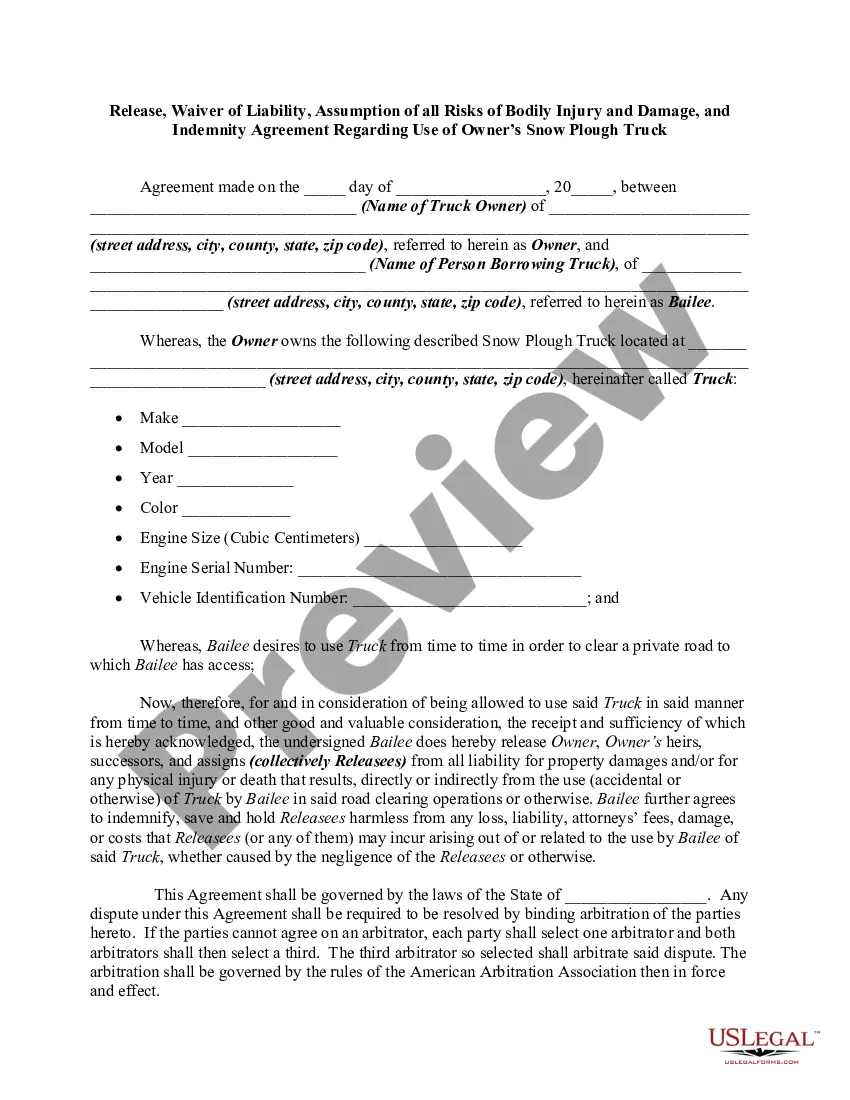
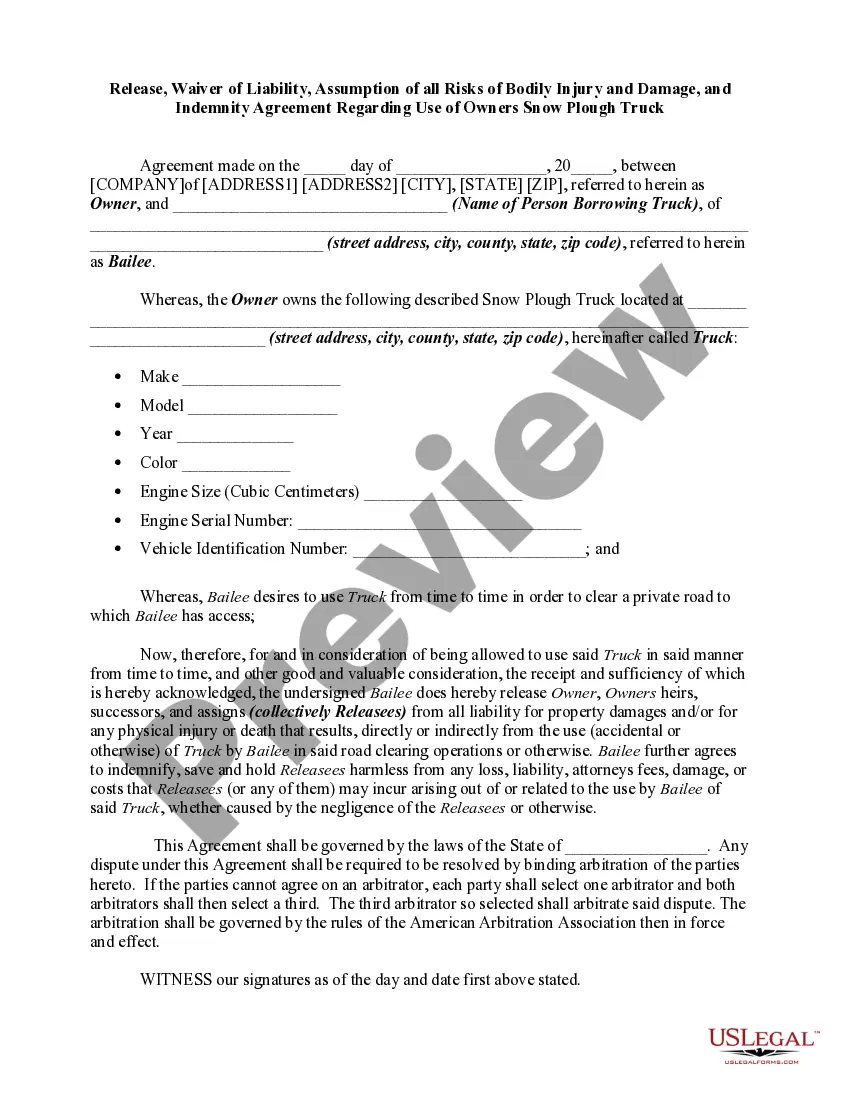
The Release, Waiver of Liability, Assumption of all Risks of Personal Bodily Injury and Damage, and Indemnity Agreement Regarding Use of Owner's Snow Plough Truck is a legal document designed to protect the owner of a snow plough truck from liability for injuries or damages that may occur while the truck is in use. It enables the user, referred to as the Bailee, to acknowledge the risks associated with using the vehicle and agree to release the owner from any legal claims arising from its operation. This form differs from other liability waivers by specifically addressing the use of a snow plough truck and providing additional indemnification provisions.
Form components explained
- Agreement date and parties involved: Names, addresses, and roles of the Truck Owner and Bailee.
- Description of the snow plough truck: Make, model, year, color, engine size, serial number, and vehicle identification number.
- Release clause: Agreement by the Bailee to waive any claims against the Owner for property damage or personal injury.
- Indemnification clause: The Bailee agrees to hold the Owner harmless for any damages incurred during the use of the truck.
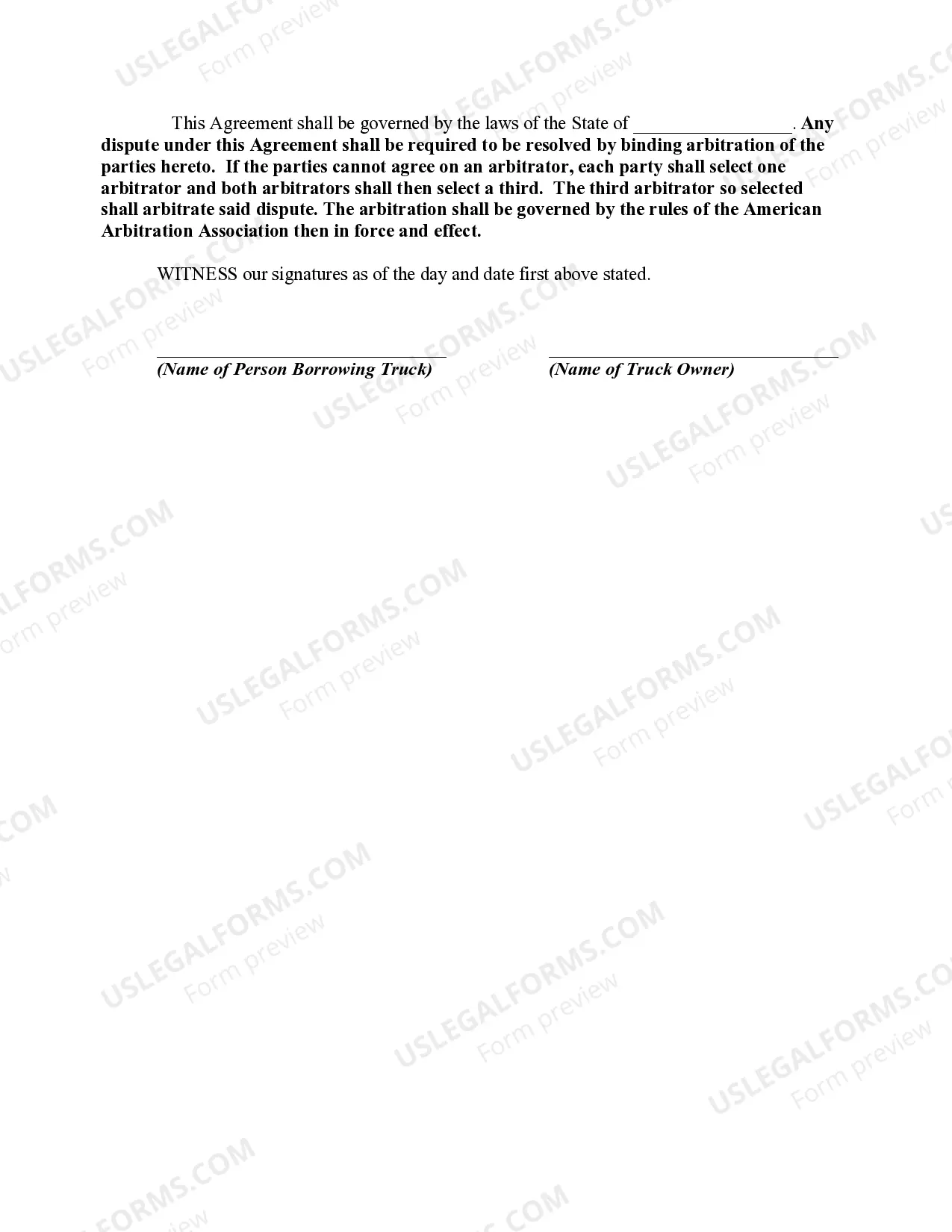
- Governing law and arbitration: Specification of applicable state law and the method for resolving disputes.
Common use cases
This form is typically used when a person (the Bailee) borrows a snow plough truck from the owner to perform services such as clearing a private road. It is advisable to use this form whenever there is a transfer of ownership for the duration of operation to protect against potential liability resulting from accidents or damages that may occur during the use of the vehicle.
Who this form is for
This form is suitable for:
- Individuals borrowing a snow plough truck for personal or business use.
- Truck owners who wish to protect themselves from potential legal claims associated with the use of their vehicles.
- Parties involved in any informal agreements regarding the use of heavy equipment in private or commercial settings.
Steps to complete this form
- Identify the parties: Fill in the names and addresses of both the Truck Owner and the Bailee.
- Describe the truck: Provide detailed information about the snow plough truck including make, model, year, and identifying numbers.
- Specify the terms: Clearly state the agreement to release the Owner from liability and the assumption of risk by the Bailee.
- Sign and date the agreement: Ensure both parties sign and date the document to officially recognize the terms.
- Consider notarization: Depending on jurisdiction, decide if a notary public is necessary for the document's validity.
Does this form need to be notarized?
This form does not typically require notarization unless specified by local law. However, it is recommended to check state requirements to ensure the form is legally binding.
Get your form ready online
Our built-in tools help you complete, sign, share, and store your documents in one place.
Make edits, fill in missing information, and update formatting in US Legal Forms—just like you would in MS Word.
Download a copy, print it, send it by email, or mail it via USPS—whatever works best for your next step.
Sign and collect signatures with our SignNow integration. Send to multiple recipients, set reminders, and more. Go Premium to unlock E-Sign.
If this form requires notarization, complete it online through a secure video call—no need to meet a notary in person or wait for an appointment.
We protect your documents and personal data by following strict security and privacy standards.

Make edits, fill in missing information, and update formatting in US Legal Forms—just like you would in MS Word.

Download a copy, print it, send it by email, or mail it via USPS—whatever works best for your next step.

Sign and collect signatures with our SignNow integration. Send to multiple recipients, set reminders, and more. Go Premium to unlock E-Sign.

If this form requires notarization, complete it online through a secure video call—no need to meet a notary in person or wait for an appointment.

We protect your documents and personal data by following strict security and privacy standards.
Typical mistakes to avoid
- Failing to provide complete details about the truck may lead to disputes.
- Not including all required signatures can invalidate the agreement.
- Ignoring local regulations about liability waivers might result in unenforceability.
Why use this form online
- Convenience of downloading a customizable form that can be completed at any time.
- Editability allows users to modify sections according to specific needs.
- Access to attorney-drafted templates ensures legal reliability and compliance with relevant laws.
Key takeaways
- This form provides a legal framework for borrowing a snow plough truck while protecting the owner from liability.
- It includes essential clauses regarding indemnity and the assumption of risks by the borrower.
- Proper completion and signing of the form are critical to its enforceability in legal matters.
Looking for another form?
Form popularity
FAQ
In California, a liability waiver must be clear, unambiguous, and explicit. In other words, waivers cannot be printed in faded ink, in small font, on the back of a paper, or in an otherwise ambiguous form. If the waiver that you sign is not represented clearly, it may not hold up in the event of a lawsuit.
A waiver/release is an exculpatory contract that attempts to excuse or relieve a party, for injuries to a participant that arise out of the known and unknown risks in an activity. This includes the inherent risks that arise from the sports organization's ordinary negligence.
200bStart the letter off with a clear explanation regarding your request. For instance, explain that you're requesting certain fees or charges to be waived or to be released from a previous engagement. Communicate any supporting or relative dates, names of parties, monetary figures, or venues as facts.
All parties involved in the incident. A statement saying you were involved in the accident that caused the injury. The total amount of the property damage. A statement that releases the defendant from any future claims or damages that are related to the incident.
A liability waiver, or release waiver, is a legal document that a company or organization requires members of the public to sign in order to protect their organization from being sued if you sustain an injury.Depending on the facts of your case, you may still be able to file a lawsuit and recover damages.
The General Release is a broad release from all possible civil claims resulting from a dispute. Since the Releasing Party is giving up all known and unknown claims against the other party, care should be taken to ensure that the Releasor is fully aware of their rights.
A waiver is a legally binding provision where either party in a contract agrees to voluntarily forfeit a claim without the other party being liable. Waivers can either be in written form or some form of action.
In California, a liability waiver must be clear, unambiguous, and explicit. In other words, waivers cannot be printed in faded ink, in small font, on the back of a paper, or in an otherwise ambiguous form. If the waiver that you sign is not represented clearly, it may not hold up in the event of a lawsuit.
Get help. Writing a waiver should not be complicated. Use the correct structure. Proper formatting. Include a subject line. Include a caution! Talk about the activity risks. Do not forget an assumption of risk. Hold harmless.