Disclosure by Letter from Client to Attorney Regarding Division of Fees between Attorneys
Overview of this form
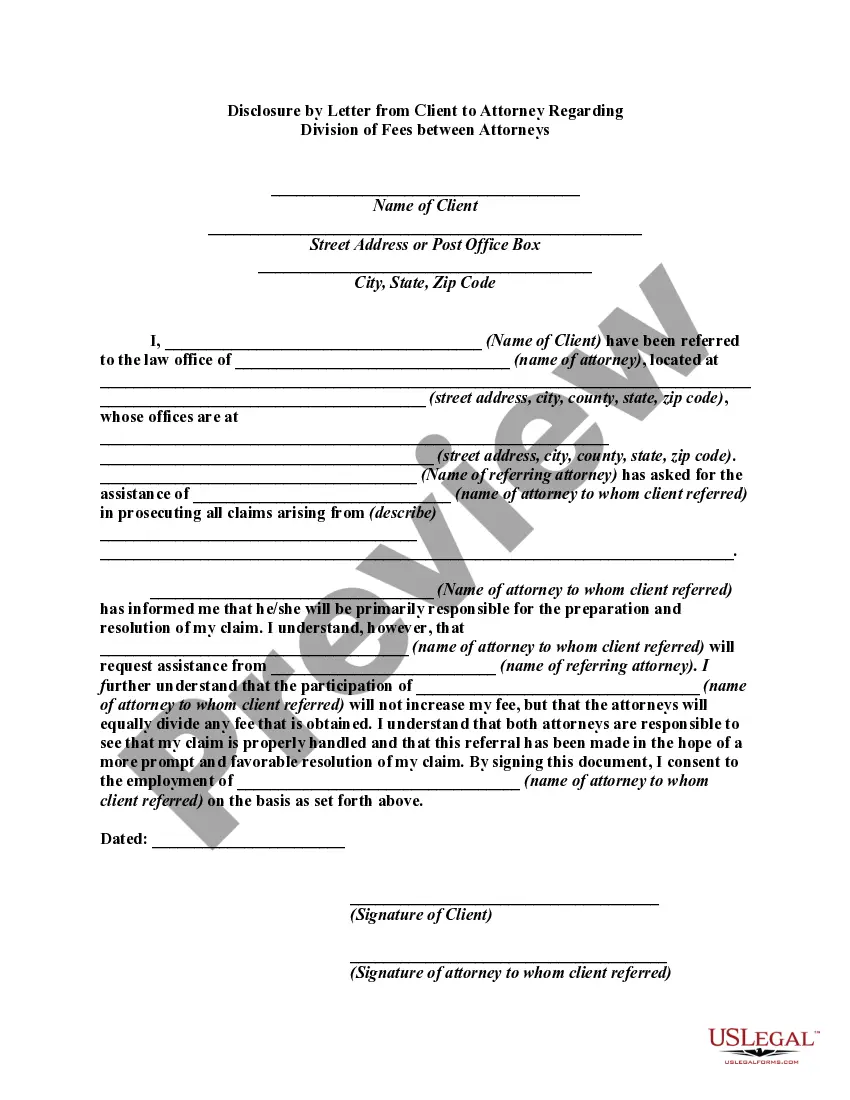
The Disclosure by Letter from Client to Attorney Regarding Division of Fees between Attorneys is a legal document that clarifies the fee-sharing arrangement between two attorneys representing a client. This form ensures that clients understand how fees will be divided and emphasizes that no additional fees will be incurred by involving multiple attorneys. Unlike an attorney-client agreement, this form focuses specifically on fee disclosures and agreements in joint representation scenarios.
Form components explained
- Name and address of the client.
- Name and address of the referring attorney.
- Name and address of the attorney to whom the client is referred.
- Description of the claims to be prosecuted.
- Signatures of the client and the referred attorney.


When this form is needed
This form should be used when a client is referred to another attorney for assistance in a legal matter and wants to establish clarity about how the fees will be shared between the involved attorneys. It is essential when clients utilize the services of multiple attorneys, ensuring transparency and agreement on fee distribution to avoid misunderstandings later on.
Who can use this document
- Clients who are referred to a new attorney for assistance.
- Attorneys who are collaborating to represent a client while ensuring clear fee arrangements.
- Individuals seeking legal representation involving more than one attorney.
How to prepare this document
- Enter the full name and address of the client clearly.
- Fill in the names and addresses of both the referring attorney and the attorney being referred to.
- Provide a description of the legal claims for which the referral is made.
- Ensure that the client understands the fee-sharing arrangement and that it is documented.
- Obtain signatures from both the client and the referred attorney for validation.
Notarization guidance
This form does not typically require notarization unless specified by local law. It is advised to check your jurisdictionâs regulations to confirm any additional requirements.
Get your form ready online
Our built-in tools help you complete, sign, share, and store your documents in one place.
Make edits, fill in missing information, and update formatting in US Legal Forms—just like you would in MS Word.
Download a copy, print it, send it by email, or mail it via USPS—whatever works best for your next step.
Sign and collect signatures with our SignNow integration. Send to multiple recipients, set reminders, and more. Go Premium to unlock E-Sign.
If this form requires notarization, complete it online through a secure video call—no need to meet a notary in person or wait for an appointment.
We protect your documents and personal data by following strict security and privacy standards.

Make edits, fill in missing information, and update formatting in US Legal Forms—just like you would in MS Word.

Download a copy, print it, send it by email, or mail it via USPS—whatever works best for your next step.

Sign and collect signatures with our SignNow integration. Send to multiple recipients, set reminders, and more. Go Premium to unlock E-Sign.

If this form requires notarization, complete it online through a secure video call—no need to meet a notary in person or wait for an appointment.

We protect your documents and personal data by following strict security and privacy standards.
Common mistakes
- Not clearly identifying all parties involved.
- Failing to provide a detailed description of the claims being prosecuted.
- Omitting signatures from either the client or the referred attorney.
- Misunderstanding the fee division, leading to disputes later.
Advantages of online completion
- Convenient access for immediate download and use.
- Edit and customize the form easily to meet specific needs.
- Reliable templates created by licensed attorneys, ensuring compliance with legal standards.
Legal use & context
This form is legally binding once properly executed, provided that all parties agree to the terms set forth. It serves to protect the interests of all involved attorneys and the client by clarifying roles and financial obligations.
Main things to remember
- This form is essential for outlining fee division between referring and referred attorneys.
- It ensures that clients are informed about who will handle their case and how fees will be divided.
- Proper completion and signature of this form secures legal clarity and accountability.
Looking for another form?


Form popularity
FAQ
If there is no local bar program, the State Bar may provide fee arbitration. To start the process, complete a fee arbitration request form from the local bar association and submit the filing fee. Include information about the attorney's fees and costs and explain why you believe the attorney's fees are excessive.
When to Negotiate Attorney Fees Rarely will an attorney, or any other professional, offer to reduce their fees. If you want to negotiate the fee schedule with your attorney, you must be the one to bring it up. The time to discuss a fee reduction is at your initial consultation.
If you think that you were overcharged by your lawyer, you can apply to have the bill assessed. The Costs Assessment Scheme is used to make sure that legal fees were reasonable, and comparative to the amount, and type, of work carried out. The work must have also been done in a reasonable amount of time.
Let the client make the contact. Inform the client. Say thank you, repeatedly. Work out the details, and inform the client. Identify a good match for your client. Always give at least two names. Let the client make the contact, but give a heads-up if you can.
Under crime-fraud exception, an attorney is required to disclose information if a client reveals that he or she is planning to carry out a crime or fraud, or is even in the process of doing so. However, an attorney is not required to reveal whether a past crime has been committed.
(A) While representing a client, a member shall not communicate directly or indirectly about the subject of the representation with a party the member knows to be represented by another lawyer in the matter, unless the member has the consent of the other lawyer.
At their outset, the ABA Model Rules of Professional Conduct (referenced herein throughout as the Model Rules or, individual, the Rule) require lawyers to serve their clients with competence (Rule 1.1), diligence (Rule 1.3) and loyalty requiring them to avoid, or at least disclose, ways in which the attorney's
Client is the term in the US. In the case of a criminal charge the client might also be a defendant, and in the case of a civil court case the client might be either defendant or plaintiff. Hot Licks Jul 11 '16 at . 1. If you really want to confuse people, use attorney/attorner.
If you have received a bill from your solicitor which you think is unreasonable, or you have to pay the costs of the other side, either by agreement or by a court order, and believe their costs are not reasonable, the only way to challenge them is by applying to the court for a detailed assessment of the costs.