Privacy and Confidentiality Policy for Credit Counseling Services
What is this form?
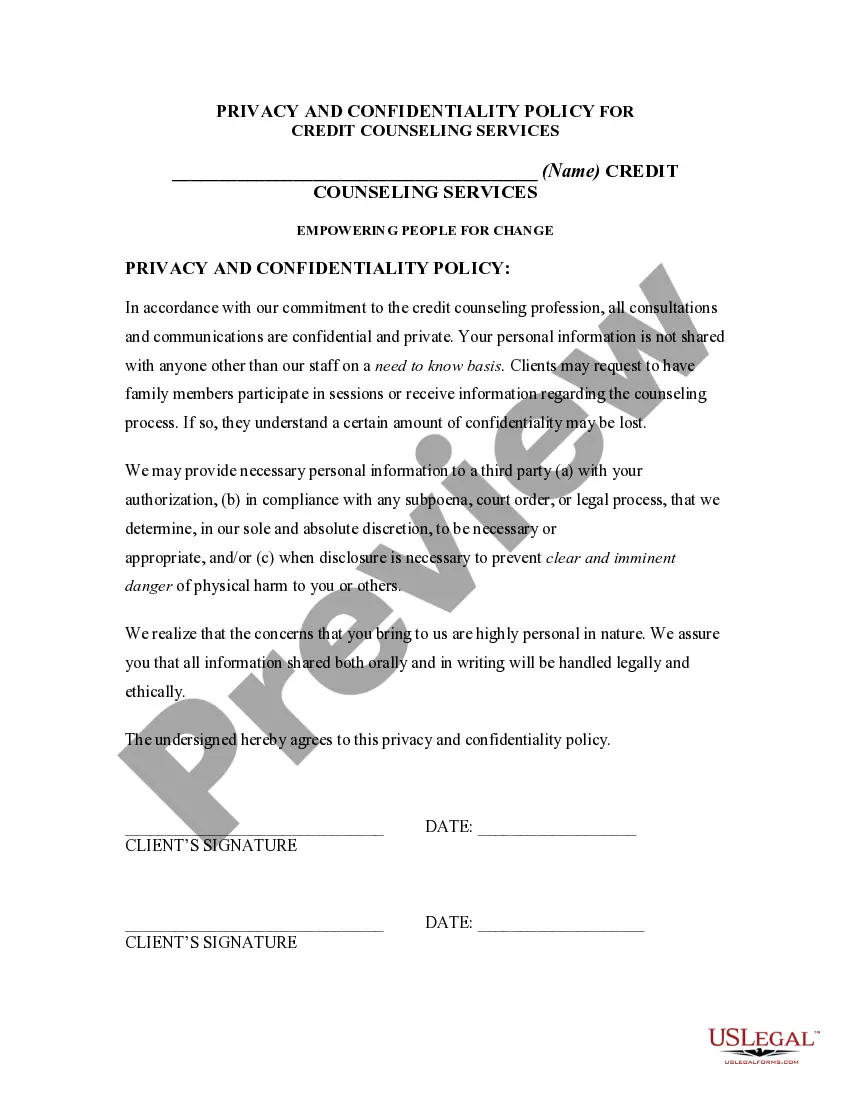
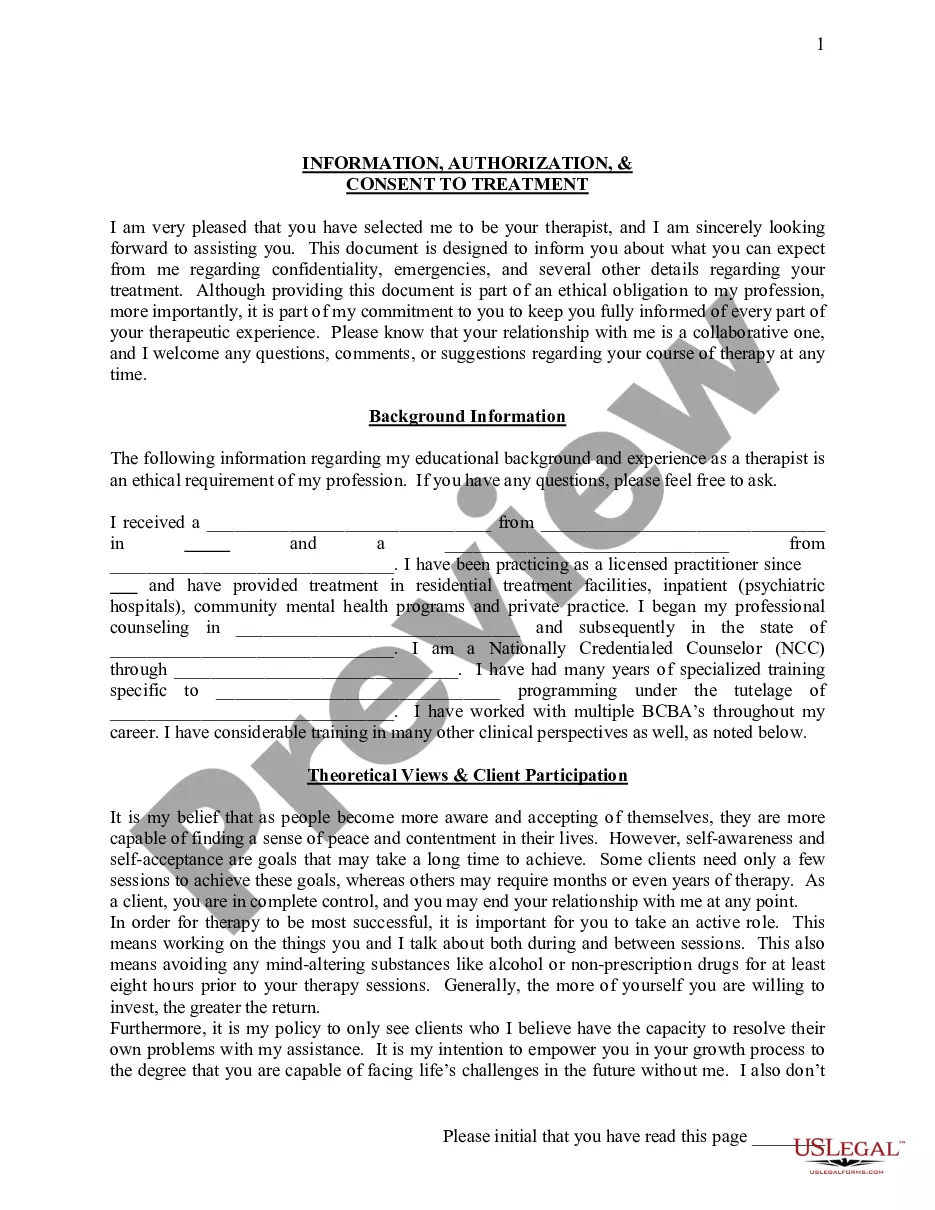
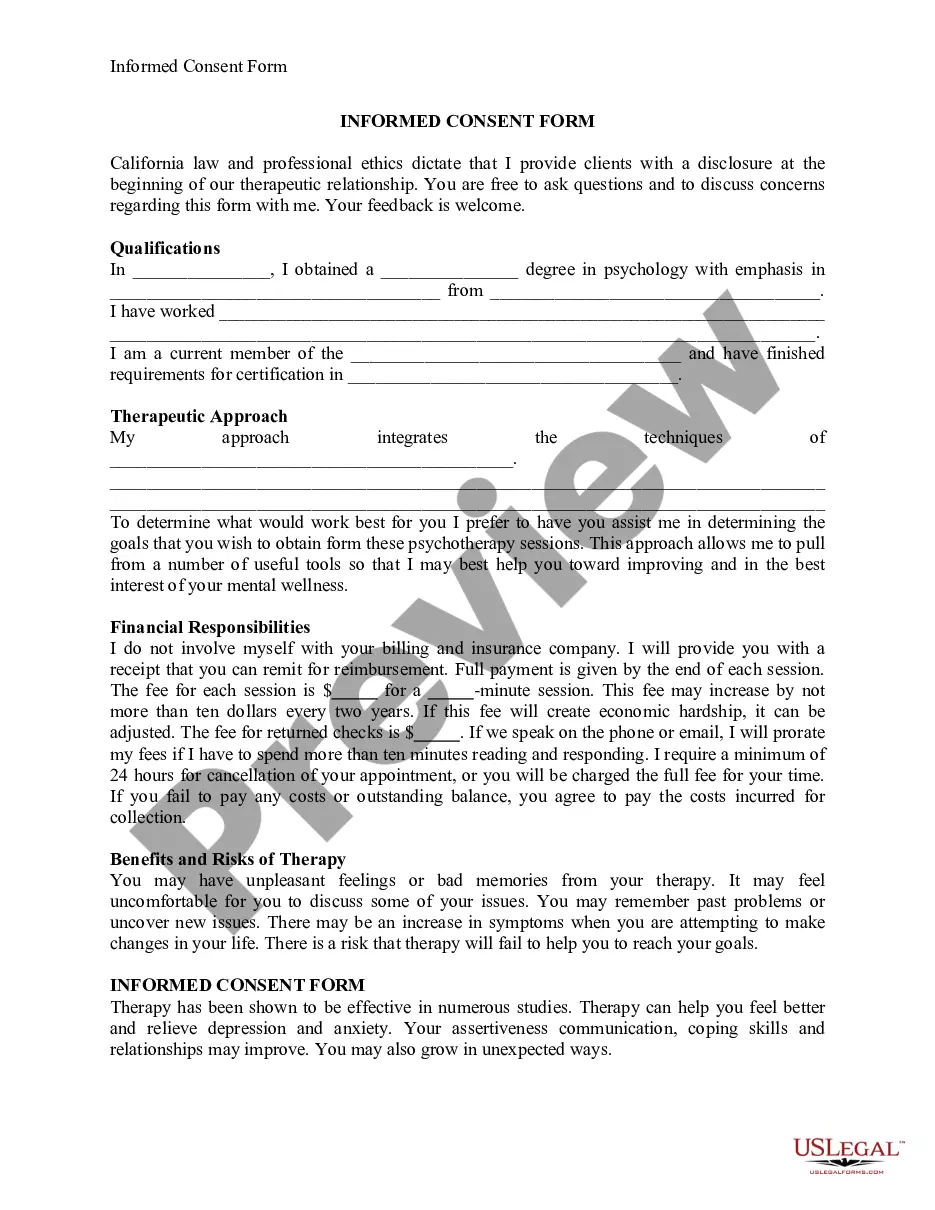
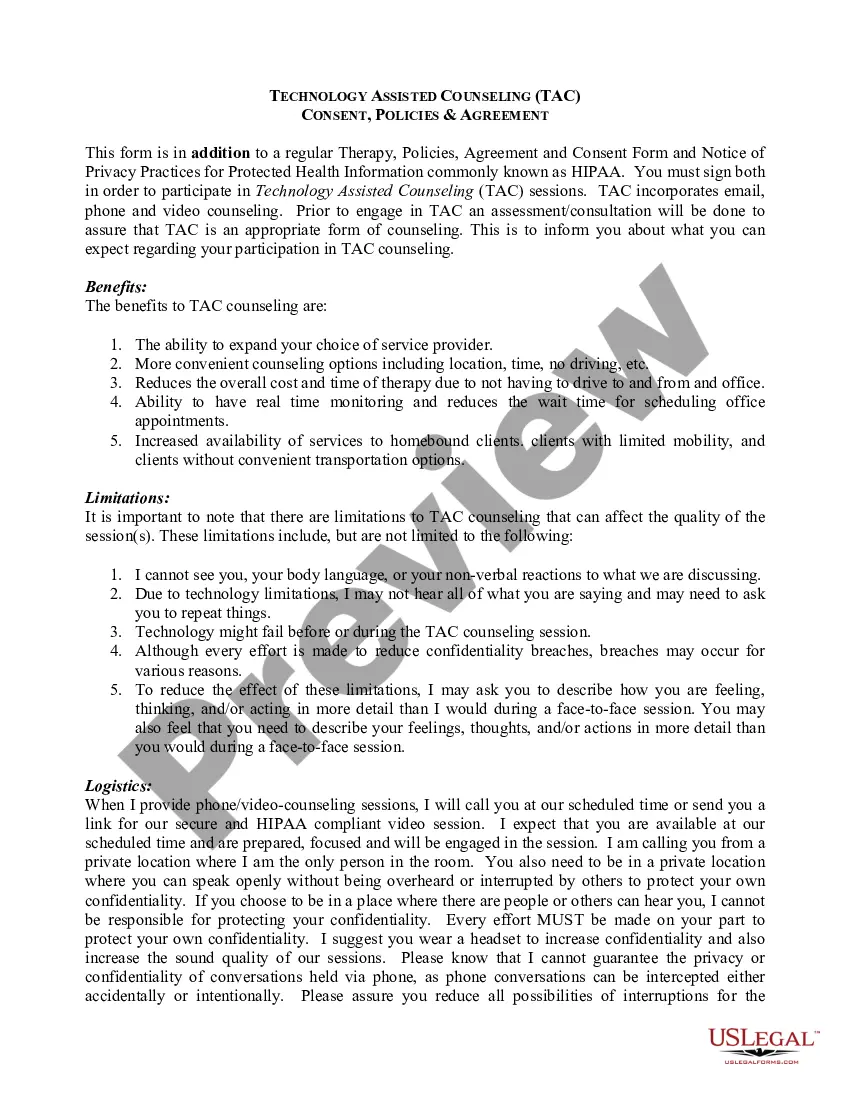
The Privacy and Confidentiality Policy for Credit Counseling Services is a legal document that outlines how personal information shared during credit counseling sessions will be handled. This form is essential for ensuring that clients understand their privacy rights and the limits of confidentiality, particularly in a setting where sensitive financial information is discussed. Unlike other forms, this document is tailored specifically for credit counseling scenarios, ensuring comprehensive coverage of confidentiality practices applicable in these sessions.
What’s included in this form
- Client identity section for personal details.
- Statement of confidentiality assurance regarding client information.
- Conditions under which personal information may be disclosed.
- Client signature lines to acknowledge understanding and agreement.
- Date fields for accuracy and record-keeping.
When to use this form
This form should be used during initial consultations in credit counseling services. It ensures that clients are informed about their rights related to privacy and confidentiality before they share personal financial information. Additionally, it can be utilized in group counseling sessions where individual privacy may also be a concern.
Who this form is for
- Credit counseling agencies providing individual or group sessions.
- Clients seeking credit counseling services to address personal financial issues.
- Professionals facilitating credit counseling seminars.
How to prepare this document
- Enter the names of the credit counseling services and the client's name at the top of the form.
- Review the privacy and confidentiality statement with the client to ensure understanding.
- Obtain the signatures of all clients participating in the counseling process.
- Include the dates next to each signature to document when the agreement was made.
- Keep a copy of the signed form for your records and provide one to the client.
Notarization guidance
This form usually doesn’t need to be notarized. However, local laws or specific transactions may require it. Our online notarization service, powered by Notarize, lets you complete it remotely through a secure video session, available 24/7.
Get your form ready online
Our built-in tools help you complete, sign, share, and store your documents in one place.
Make edits, fill in missing information, and update formatting in US Legal Forms—just like you would in MS Word.
Download a copy, print it, send it by email, or mail it via USPS—whatever works best for your next step.
Sign and collect signatures with our SignNow integration. Send to multiple recipients, set reminders, and more. Go Premium to unlock E-Sign.
If this form requires notarization, complete it online through a secure video call—no need to meet a notary in person or wait for an appointment.
We protect your documents and personal data by following strict security and privacy standards.

Make edits, fill in missing information, and update formatting in US Legal Forms—just like you would in MS Word.

Download a copy, print it, send it by email, or mail it via USPS—whatever works best for your next step.

Sign and collect signatures with our SignNow integration. Send to multiple recipients, set reminders, and more. Go Premium to unlock E-Sign.

If this form requires notarization, complete it online through a secure video call—no need to meet a notary in person or wait for an appointment.

We protect your documents and personal data by following strict security and privacy standards.
Mistakes to watch out for
- Failing to discuss the implications of the confidentiality policy with clients.
- Missing signatures or dates, which could invalidate the agreement.
- Not tailoring the form to comply with specific state privacy laws.
Benefits of using this form online
- Convenient access to downloadable forms at any time.
- Editable templates allow for personal customization.
- Reliability from forms drafted by licensed attorneys.
Legal use & context
- The form is legally binding upon signing, ensuring confidentiality is upheld.
- Helps mitigate risks associated with data breaches in counseling sessions.
- Establishes a formal understanding between the counseling provider and clients regarding privacy practices.
What to keep in mind
- This form protects client confidentiality in credit counseling services.
- It outlines when and how personal information may be shared.
- Proper completion and understanding of this form help ensure client rights are maintained.
Looking for another form?





Form popularity
FAQ
Name, date of birth, age, sex and address. current contact details of family, guardian etc. bank details. medical history or records. personal care issues. service records and file progress notes. individual personal plans. assessments or reports.
To provide a simple answer: you may, in certain circumstances, override your duty of confidentiality to patients and clients if it's done to protect their best interests or the interests of the public. This means you may override your duty if: You have information that suggests a patient or client is at risk of harm.
A breach of confidentiality is when information is told about a patient to another person without the patient's consent. A patient needs to know that they can disclose all information in regards to their situation and it will be kept private. The physician/patient relationship is based on trust.
The principle of confidentiality is about privacy and respecting someone's wishes. It means that professionals shouldn't share personal details about someone with others, unless that person has said they can or it's absolutely necessary.
The types of information that is considered confidential can include: name, date of birth, age, sex and address. current contact details of family, guardian etc. bank details.
As the National Association of Social Workers' (NASW) Code of Ethics states: The general expectation that social workers will keep information confidential does not apply when disclosure is necessary to prevent serious, foreseeable, and imminent harm to a client or other identifiable person (standard 1.07c).
Limits Imposed Voluntarily (i.e., Not Legally Required) Limits That Can Be Imposed by Law (i.e., Possible Involuntary Disclosures) Possible Limitations on Confidentiality Created by Use of Technology in the Setting. Possible Re-Disclosure by Others of Information a Therapist Discloses to Them.
The client is an imminent and violent threat towards themselves or others. There is a billing situation which requires a condoned disclosure.
This procedure implements the Information Governance Policy providing information on Confidentiality and outlining the processes needed to ensure compliance with all legislative, regulatory and best practice requirements.