Notice by Lessor to Lessee of Termination of Tenancy at Will - Past Due Rent
About this form
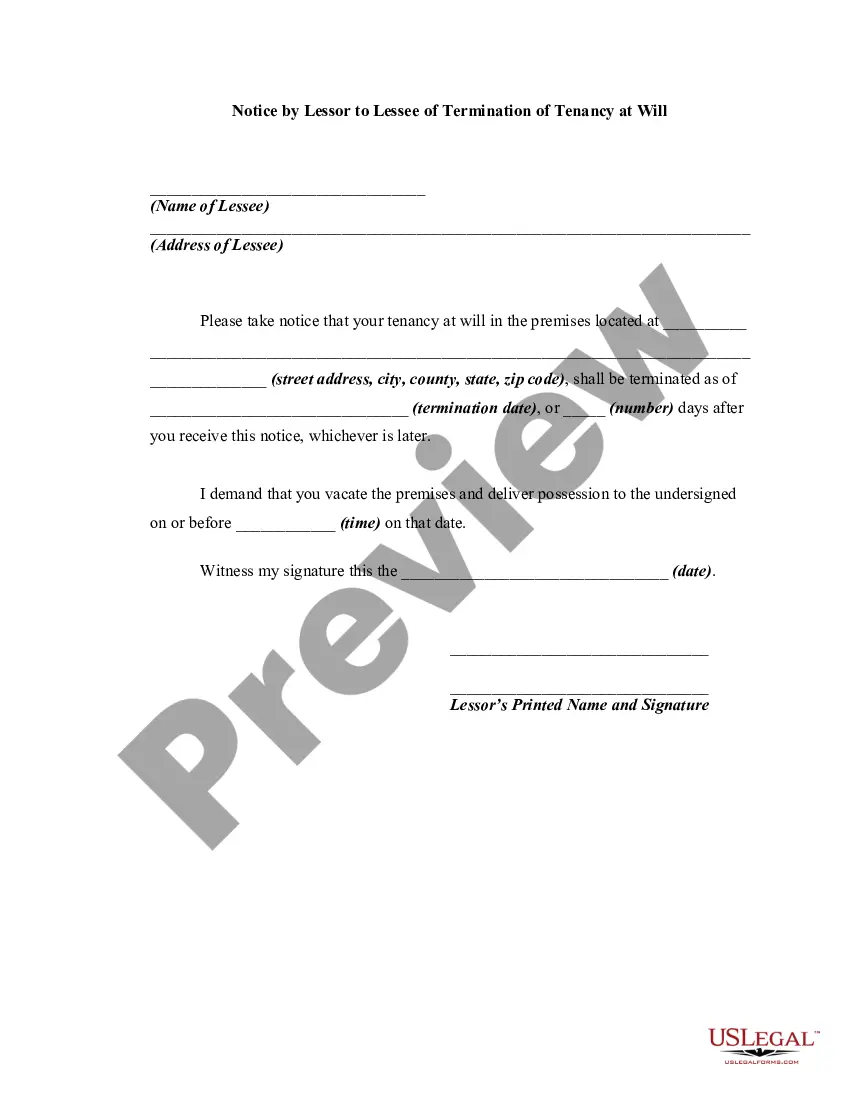
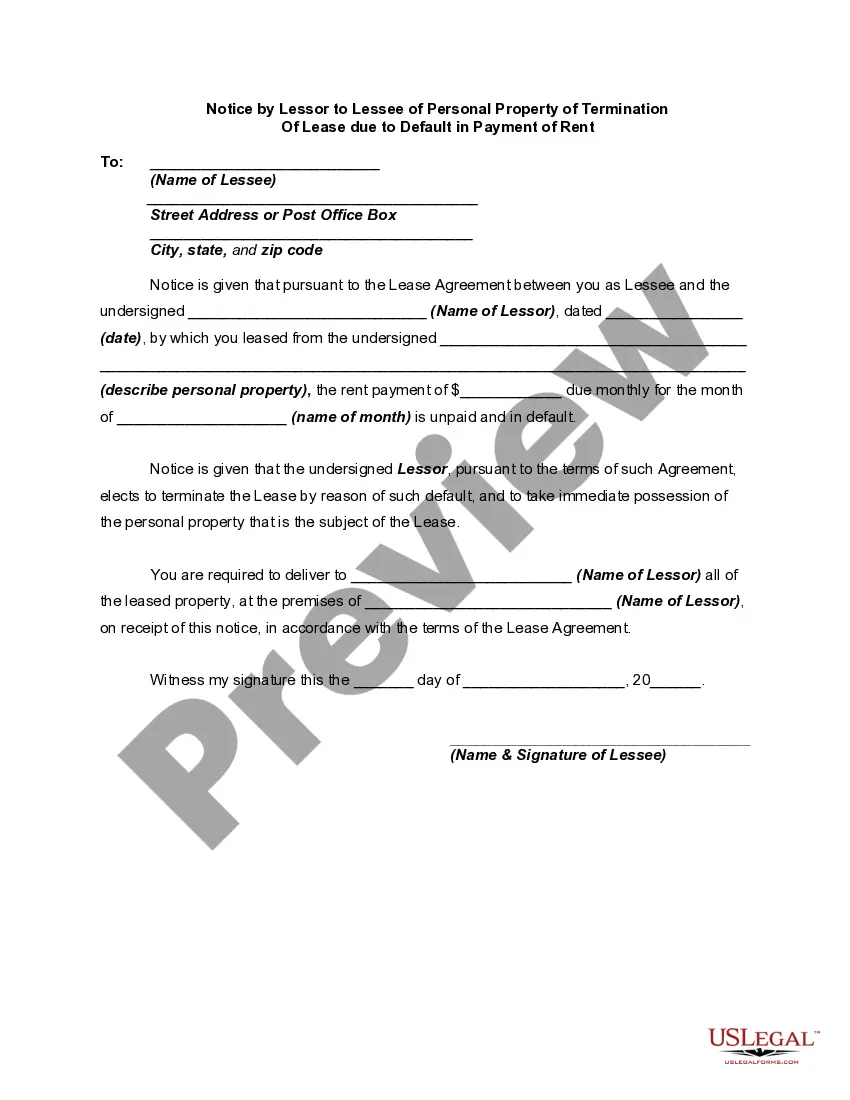
The Notice by Lessor to Lessee of Termination of Tenancy at Will - Past Due Rent is a legal document that allows a landlord to formally notify a tenant that their tenancy is being terminated due to overdue rent payments. This form is essential for landlords to ensure they adhere to legal requirements when ending a tenancy-at-will arrangement, distinguishing it from informal notices or verbal communications. The form provides clear documentation of the landlord's intention to reclaim possession of the rental property.
What’s included in this form
- Name and contact information of the lessee (tenant).
- The address of the rental property being terminated.
- Termination date or the number of days after the notice is received for vacating the premises.
- A demand for the lessee to vacate the property.
- The landlord's signature and printed name for validation.


When to use this form
This form should be used when a landlord needs to terminate a tenancy-at-will due to past due rent. It is particularly useful in situations where the rental agreement has expired or where no formal lease exists, and the landlord has allowed the tenant to remain on the property. Using this notice helps ensure that the landlord follows the legal process for eviction and protects their rights to the property.
Intended users of this form
- Landlords who rent property on a month-to-month or at-will basis.
- Property managers acting on behalf of landlords.
- Real estate professionals involved in managing rental agreements.
Steps to complete this form
- Identify the name and address of the tenant who is being served notice.
- Specify the complete address of the rental property involved.
- Enter the termination date or the number of days required for the tenant to vacate.
- Include a demand for the tenant to leave the property by a specific time on the termination date.
- Sign the document and print your name to validate the notice.
Is notarization required?
Notarization is not commonly needed for this form. However, certain documents or local rules may make it necessary. Our notarization service, powered by Notarize, allows you to finalize it securely online anytime, day or night.
Get your form ready online
Our built-in tools help you complete, sign, share, and store your documents in one place.
Make edits, fill in missing information, and update formatting in US Legal Forms—just like you would in MS Word.
Download a copy, print it, send it by email, or mail it via USPS—whatever works best for your next step.
Sign and collect signatures with our SignNow integration. Send to multiple recipients, set reminders, and more. Go Premium to unlock E-Sign.
If this form requires notarization, complete it online through a secure video call—no need to meet a notary in person or wait for an appointment.
We protect your documents and personal data by following strict security and privacy standards.

Make edits, fill in missing information, and update formatting in US Legal Forms—just like you would in MS Word.

Download a copy, print it, send it by email, or mail it via USPS—whatever works best for your next step.

Sign and collect signatures with our SignNow integration. Send to multiple recipients, set reminders, and more. Go Premium to unlock E-Sign.

If this form requires notarization, complete it online through a secure video call—no need to meet a notary in person or wait for an appointment.

We protect your documents and personal data by following strict security and privacy standards.
Typical mistakes to avoid
- Failing to provide the correct address of the rental property.
- Not indicating the precise termination date or notice period.
- Neglecting to sign the form, which may render it invalid.
Advantages of online completion
- Convenience of downloading and editing the form easily.
- Assurance that the document is drafted with legal accuracy by licensed attorneys.
- Access to the form anytime, allowing you to act promptly when necessary.
Looking for another form?









Form popularity
FAQ
Dear (Name of landlord or manager), This letter constitutes my written (number of days' notice that you need to give based on your lease agreement)-day notice that I will be moving out of my apartment on (date), the end of my current lease. I am leaving because (new job, rent increase, etc.)
If the lease expired and the tenant won't leave you'll need to either file an eviction or let the tenant be. If you do nothing than the tenant will become a holdover tenant as discussed earlier in this post. If you're going to proceed forward with an eviction be sure to follow all the proper legal procedures.
In Colorado, evictions are sometimes referred to as forcible entry & detainer (FED). Before you can file for eviction, you must generally provide 10 days' notice (increased from 3 days prior) for tenants to correct a deficiency or leave the property, except in certain circumstances.
Evicting a tenant in Colorado can take around 2 weeks to 4 months, depending on whether the eviction is for illegal activity or another type of eviction. If the tenant files an answer with the court, the process could take longer (read more).
Dear (Name of landlord or manager), This letter constitutes my written (number of days' notice that you need to give based on your lease agreement)-day notice that I will be moving out of my apartment on (date), the end of my current lease. I am leaving because (new job, rent increase, etc.)
Dear your landlord or property manager's name, I am writing to inform you I will be vacating my rental unit on date you intend to vacate. This letter meets the 30-day notice requirement outlined in my lease agreement.
In Illinois, if there is no lease or if the lease does not specify a move out date, the Landlord must give at least 30 days of notice to a tenant that the landlord wants to move out. This notice must be in writing and must arrive to the tenant at least 30 days prior to their move out date.
Substantial Violation If the landlord is evicting the tenant for any of these reasons, the landlord must give the tenant a three-day notice to quit. (Colo. Rev.If the tenant does not move out of the rental unit by the end of three days, then the landlord can file an eviction lawsuit against the tenant.