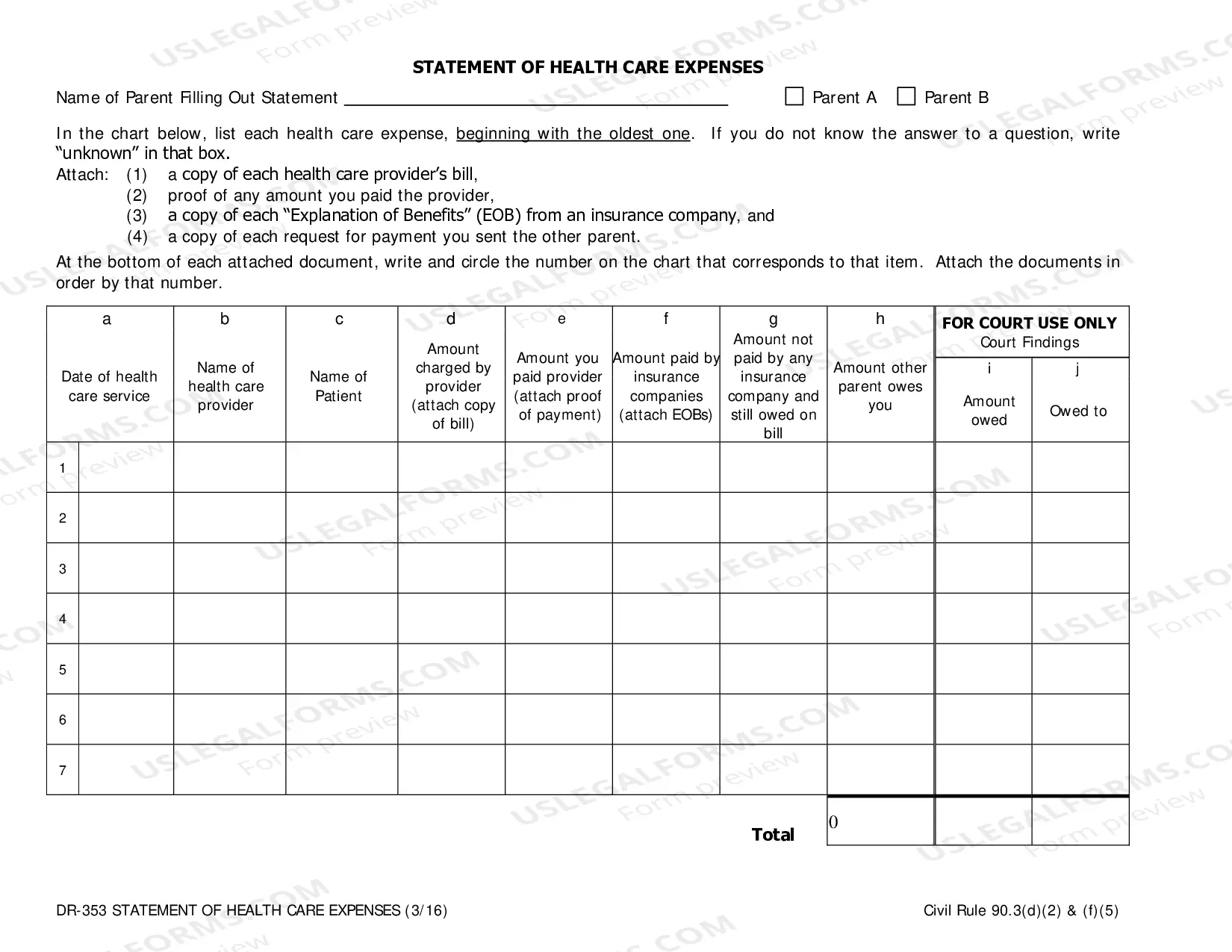
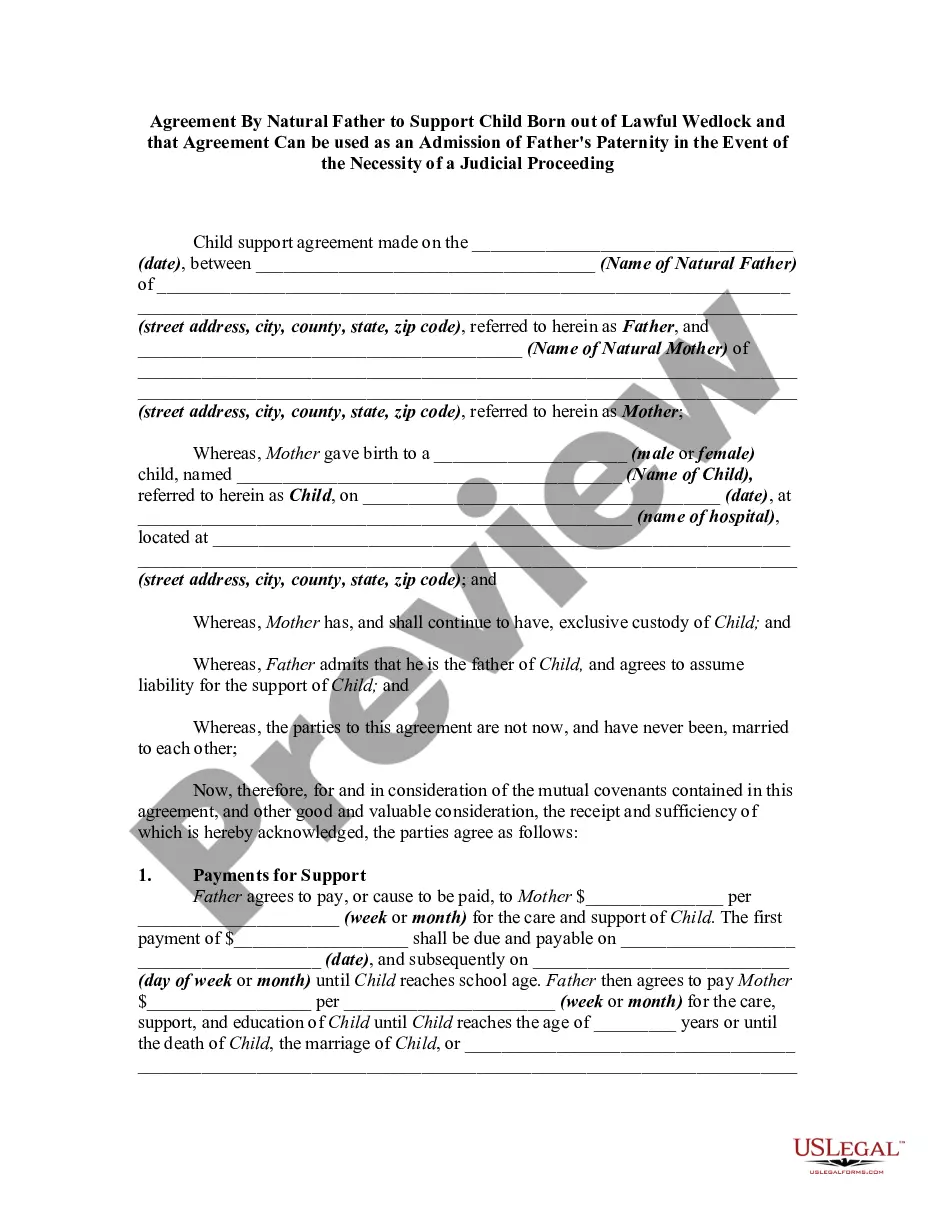
Agreement By Natural Father to Support Child Born out of Lawful Wedlock and that Agreement Can be used as an Admission of Father's Paternity in the Event of the Necessity of a Judicial Proceeding
What this document covers
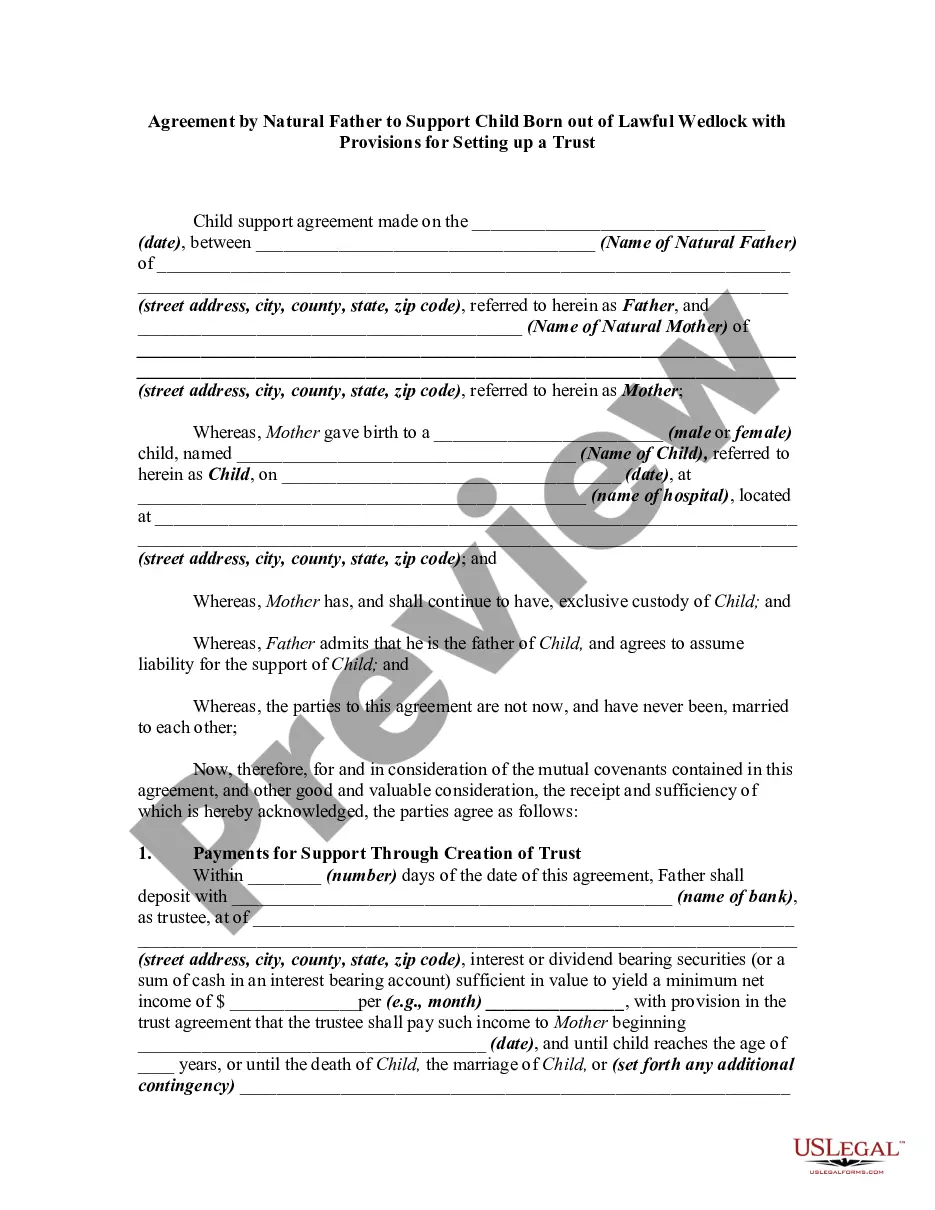
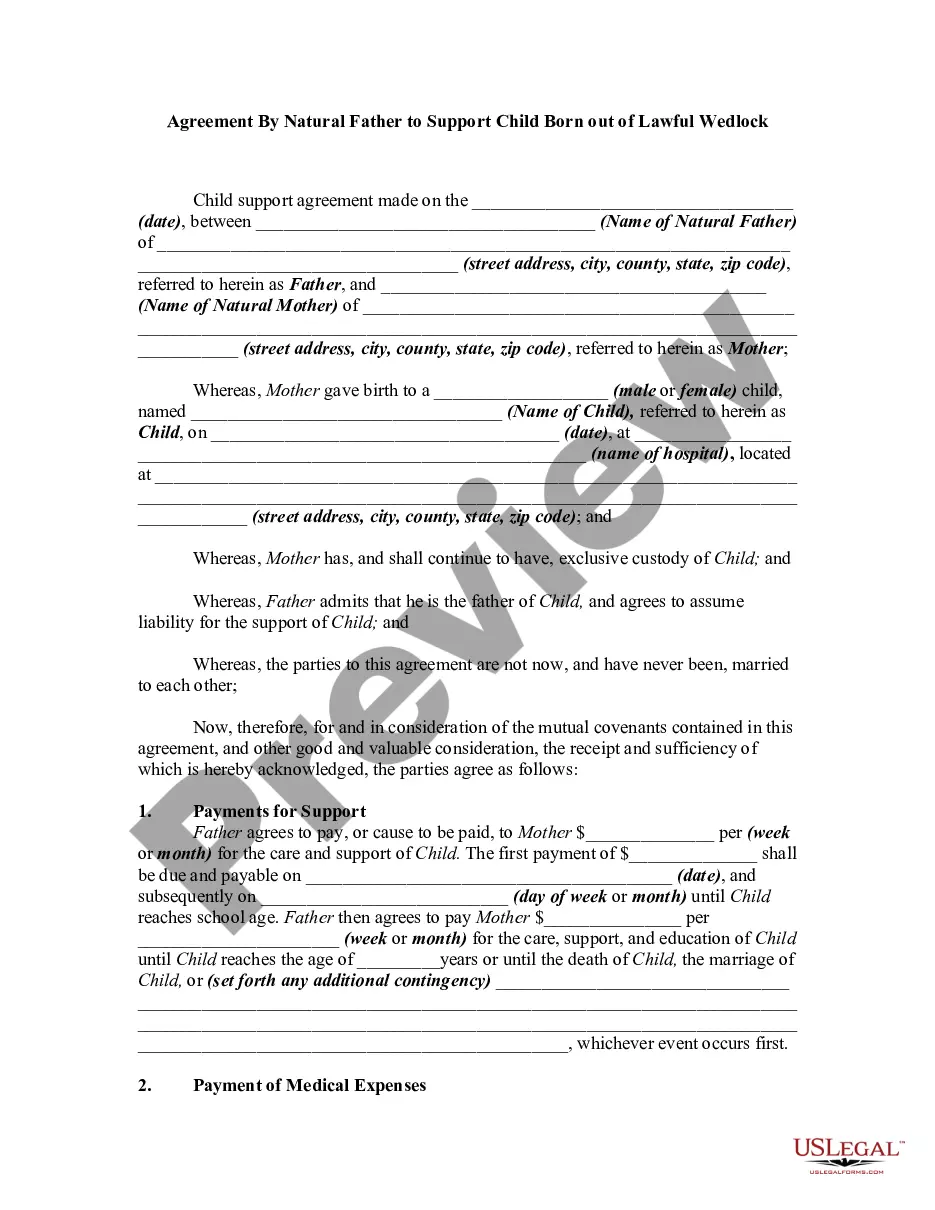
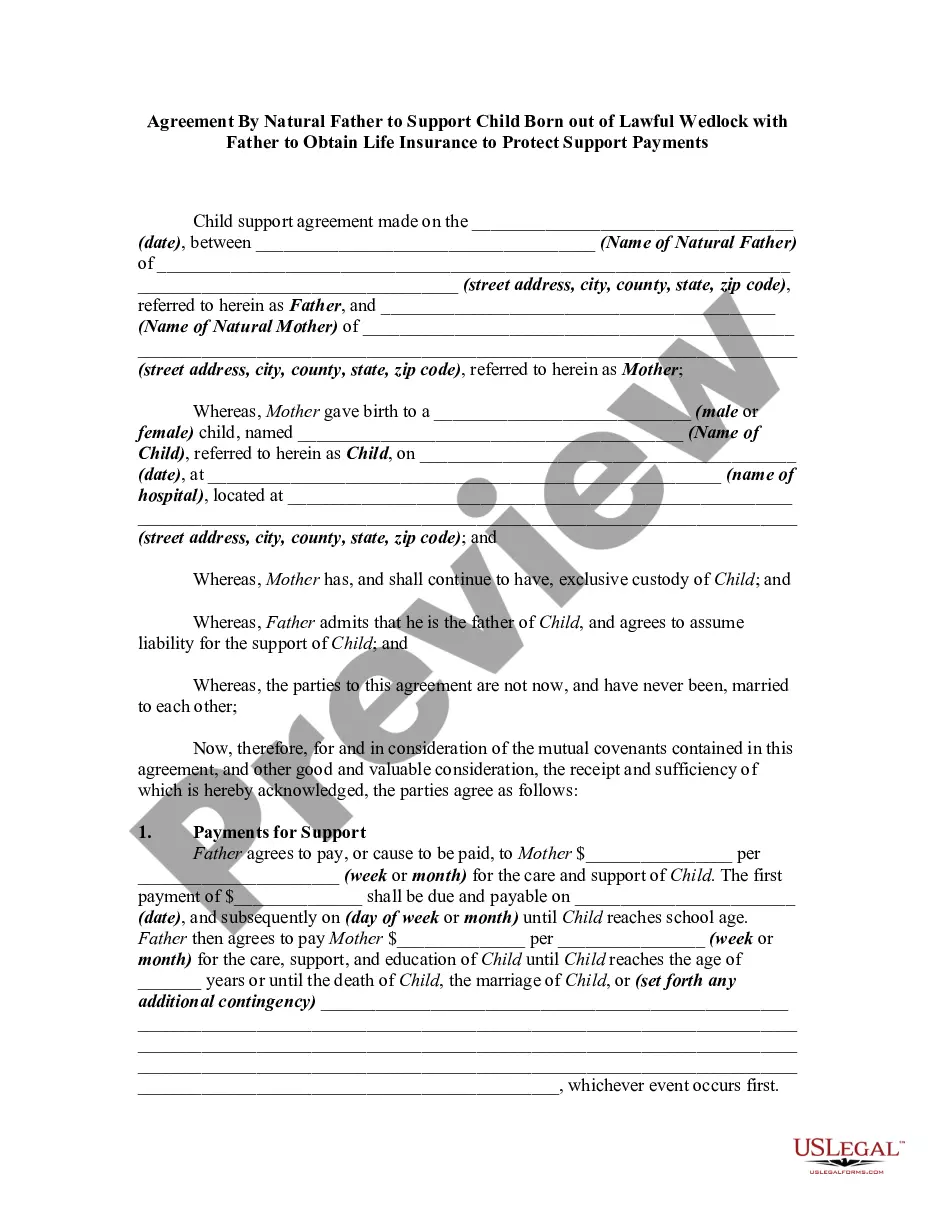
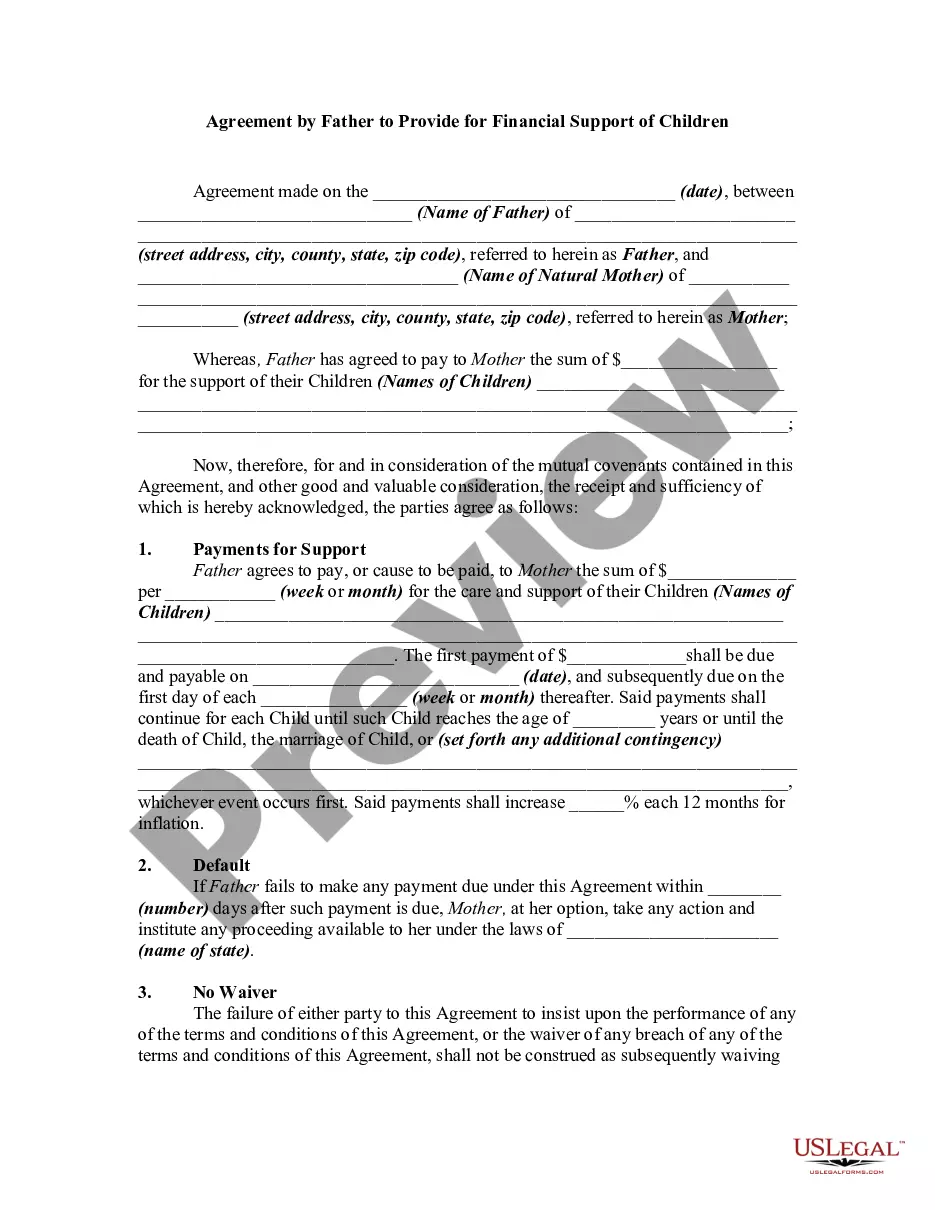
This Agreement by Natural Father to Support Child Born out of Lawful Wedlock is a legal document that establishes a child support arrangement between a natural father and mother for a child conceived and born out of wedlock. This agreement serves both as a commitment from the father to provide financial support for the child and as an admission of paternity, which can be useful in any future legal proceedings concerning custody or support. Unlike other agreements, this form specifically addresses the unique circumstances of children born outside of marriage.
Key parts of this document
- Child support payment details, including amounts and frequency.
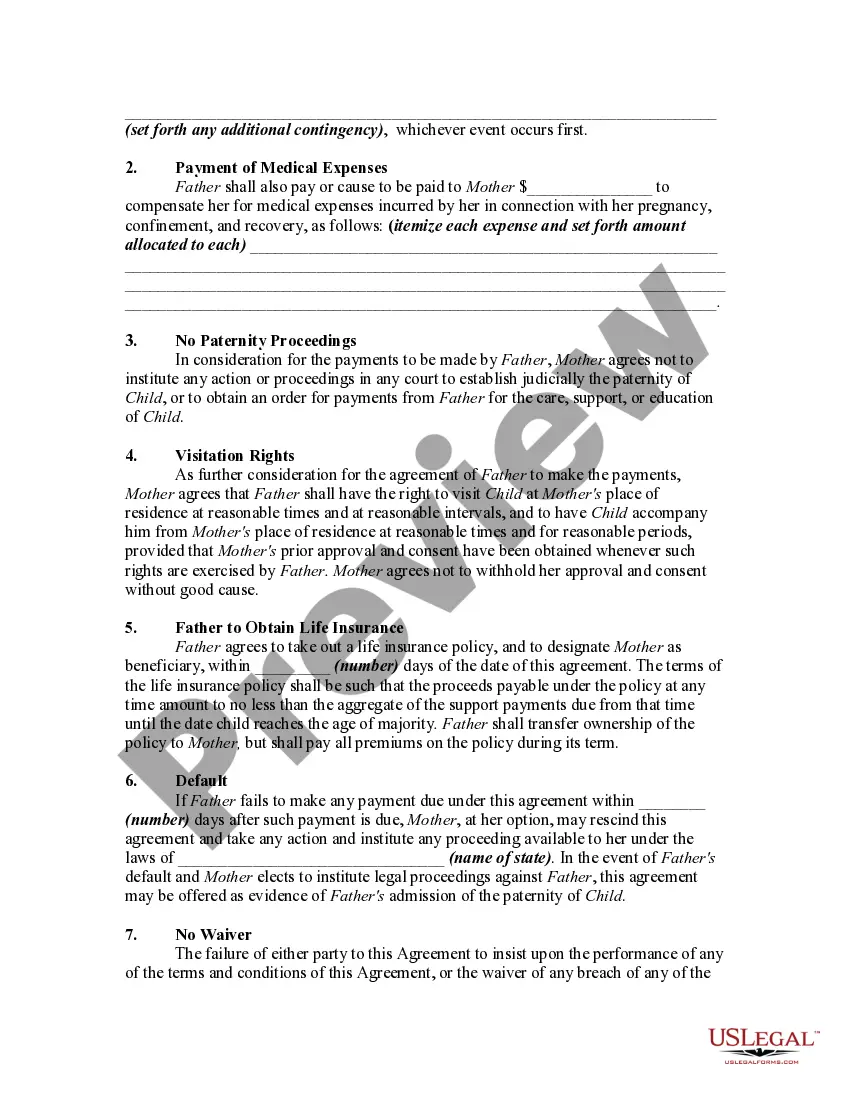
- Provisions for the payment of medical expenses related to the mother's pregnancy and childbirth.
- Clauses regarding visitation rights for the father.
- Life insurance requirements to secure child support payments.
- Default provisions detailing actions the mother can take if the father fails to meet obligations.
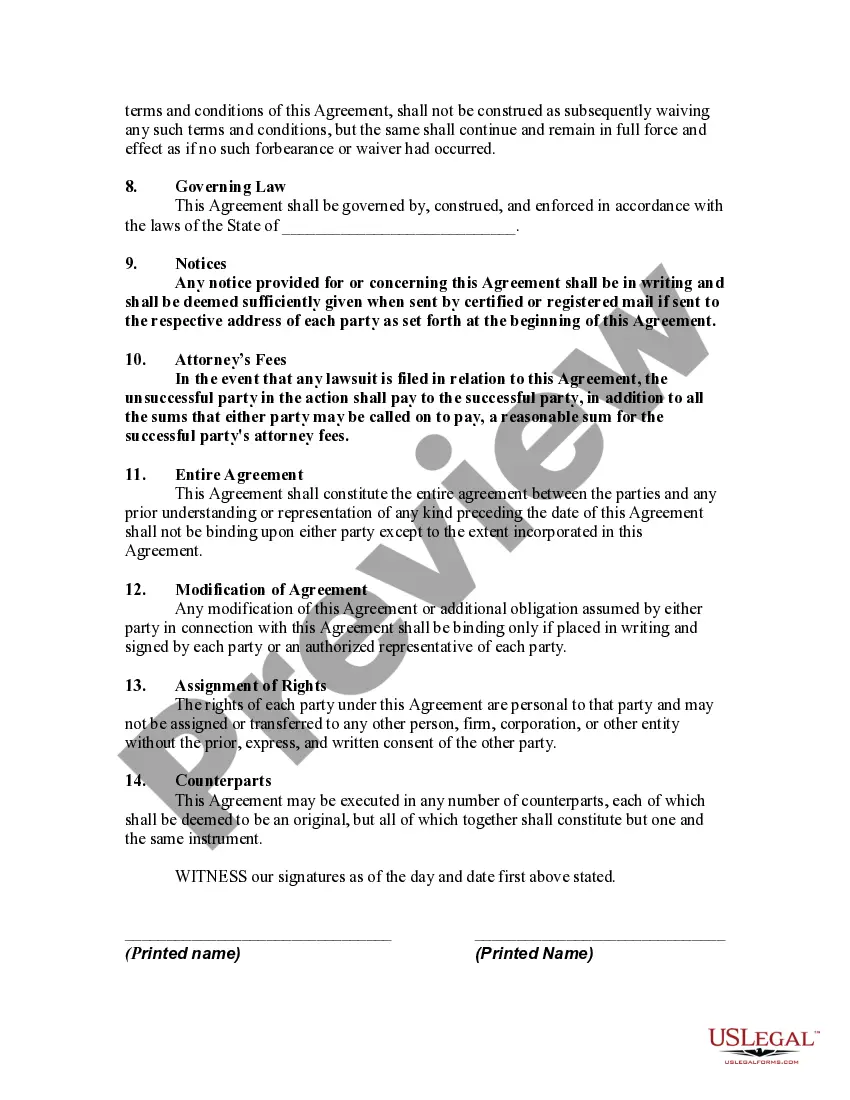
- Conditions related to the modification, assignment of rights, and governing law for the agreement.

When to use this document
This form is recommended in situations where a father wishes to acknowledge his paternity and establish a formal arrangement for child support for a child born outside of marriage. It is particularly beneficial when both parents agree on the terms and want to avoid litigation regarding custody and financial obligations, or when the mother needs assurance of financial support for the child's upbringing.
Who this form is for
The following individuals may find this form useful:
- Natural fathers who wish to acknowledge and support their child conceived out of wedlock.
- Natural mothers seeking an enforceable agreement for child support from the child's father.
- Parents who want to establish clear, agreed-upon terms of support without involving the court.
- Individuals living in states that recognize such agreements and their validity in establishing paternity.
Completing this form step by step
- Identify the parties involved: enter the names and addresses of the natural father and mother.
- Specify the child's details: include the name and date of birth of the child.
- Detail the support payments: specify the amount, frequency of payments, and any conditions related to their duration.
- Include provisions for visitation rights: outline when and how the father may visit the child.
- Incorporate life insurance terms if required: include details regarding life insurance policies meant to secure child support payments.
- Sign and date the agreement once all fields are completed and agreed upon by both parties.
Does this form need to be notarized?
In most cases, this form does not require notarization. However, some jurisdictions or signing circumstances might. US Legal Forms offers online notarization powered by Notarize, accessible 24/7 for a quick, remote process.
Get your form ready online
Our built-in tools help you complete, sign, share, and store your documents in one place.
Make edits, fill in missing information, and update formatting in US Legal Forms—just like you would in MS Word.
Download a copy, print it, send it by email, or mail it via USPS—whatever works best for your next step.
Sign and collect signatures with our SignNow integration. Send to multiple recipients, set reminders, and more. Go Premium to unlock E-Sign.
If this form requires notarization, complete it online through a secure video call—no need to meet a notary in person or wait for an appointment.
We protect your documents and personal data by following strict security and privacy standards.

Make edits, fill in missing information, and update formatting in US Legal Forms—just like you would in MS Word.

Download a copy, print it, send it by email, or mail it via USPS—whatever works best for your next step.

Sign and collect signatures with our SignNow integration. Send to multiple recipients, set reminders, and more. Go Premium to unlock E-Sign.

If this form requires notarization, complete it online through a secure video call—no need to meet a notary in person or wait for an appointment.

We protect your documents and personal data by following strict security and privacy standards.
Common mistakes to avoid
- Failing to accurately state the child's name and birth details.
- Not specifying clear payment terms, including amounts and deadlines.
- Omitting visitation rights, which can lead to future disputes.
- Neglecting to provide for unexpected circumstances that may affect support payments.
- Not having the agreement signed by both parties.
Benefits of using this form online
- Convenience of filling out and downloading the form from anywhere, at any time.
- Editability allows for customization to meet specific needs and preferences.
- Access to expert-reviewed templates ensures legal compliance and thoroughness.
- Time-saving compared to hiring an attorney for drafting a similar agreement.
Legal use & context
- This agreement provides enforceable terms for child support and paternity acknowledgment.
- Courts may use this document as evidence of paternity in child support proceedings.
- Compliance with specific state rules and statutes is essential for enforceability.
Summary of main points
- The form provides a clear framework for establishing paternity and child support obligations.
- It facilitates a mutual understanding between unmarried parents regarding child care responsibilities.
- Proper completion and execution of the form help prevent future legal complications.
Looking for another form?

Form popularity
FAQ
Whether you are married or not, you don't have to give the baby the last name of either parent if you don't want to, and the child does not have to have the father's last name to be considered legitimate. (See the article Legitimacy of Children Born to Unmarried Parents for more on the subject.)
The legal father is the man the law recognizes as the father of the child. When a married couple has a child, the law automatically recognizes the husband as the child`s legal father; therefore, paternity does not need to be determined.
In case there was any infidelity, a paternity test also provides the father with rights. If the child isn't biologically his, he has no legal obligation to the child.In this case, custody is the father's choice he can choose to establish joint custody or other parental rights.
Paternity fraud A man who has been told by the mother that he is the father of her child can sue her if she is lying.He may also bring a civil action for paternity fraud against the mother to recover damages and any emotional distress.
Often a father may claim paternity of a child by filing a paternity affidavit with a court. Paternity of a child born out of wedlock can be established by court order. Additionally, many state courts may establish paternity when genetic testing determines that a man is the biological father of a child.
Children who are adopted have the right, once they have reached 18, to find out who their biological parents are.However this right is not absolute and other factors could override the right. If your father refuses to have a DNA test, you could apply to a court for an order forcing your father to take a test.
A DNA paternity test is nearly 100% accurate at determining whether a man is another person's biological father. DNA tests can use cheek swabs or blood tests. You must have the test done in a medical setting if you need results for legal reasons. Prenatal paternity tests can determine fatherhood during pregnancy.
Fathers' rights can include a father's right to parenting time with his children, the right to be consulted before adoption, and the right to time off from work to raise his child.
Fathers who were not married when their child was born must legally establish paternity in order to gain access to father's rights.Once paternity is established, a father may pursue child visitation or other custody rights.