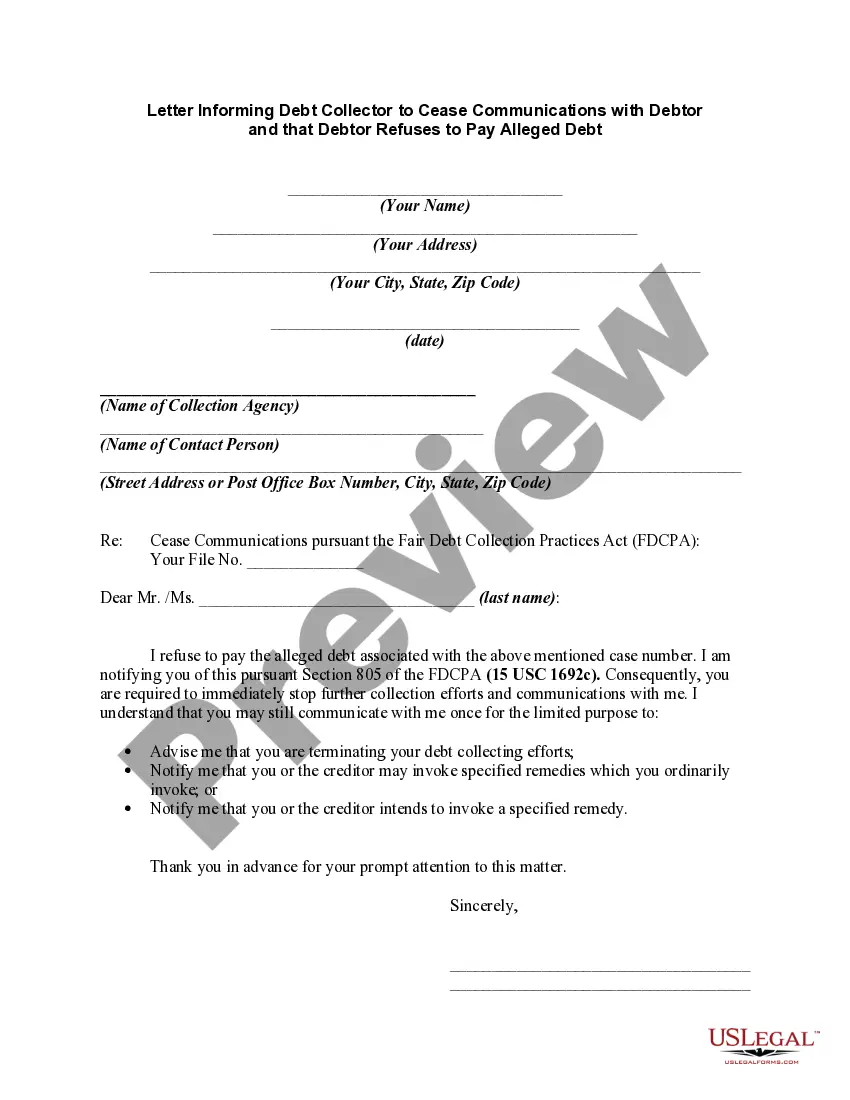
Letter Informing Debt Collector to Cease Communications with Debtor and that Debtor Refuses to Pay Alleged Debt
What this document covers
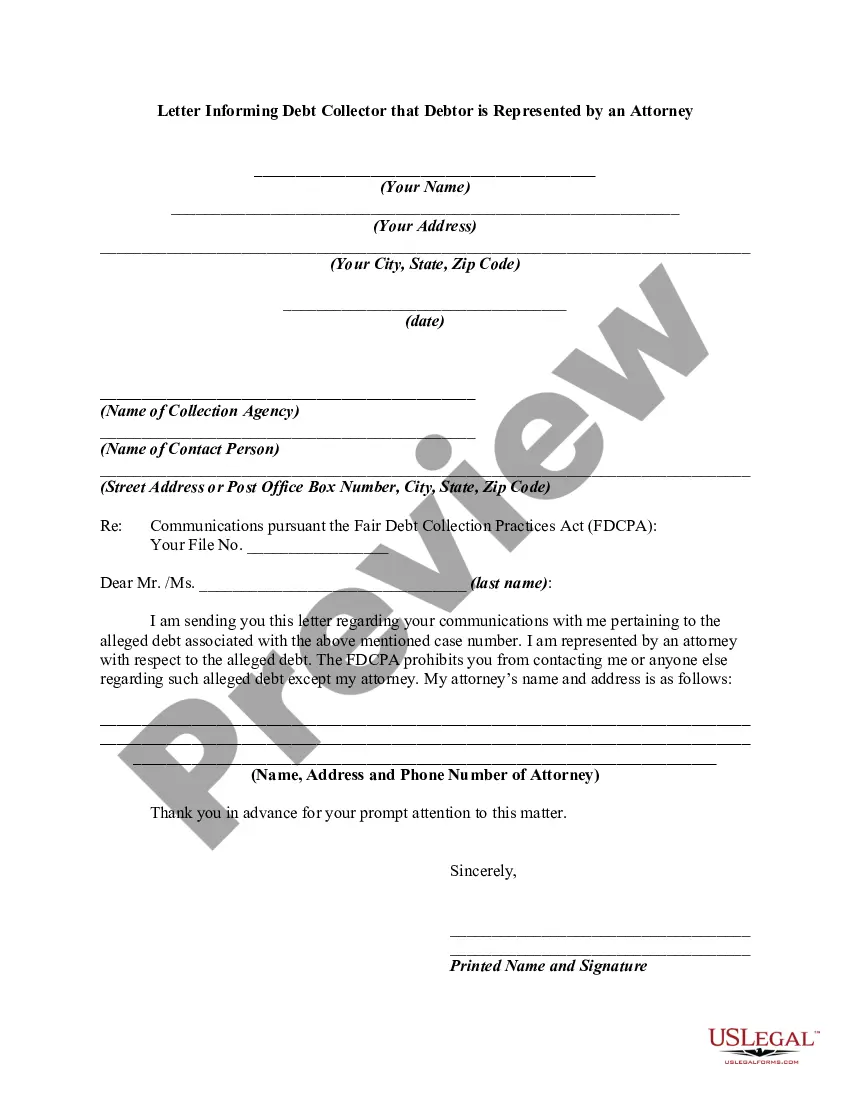
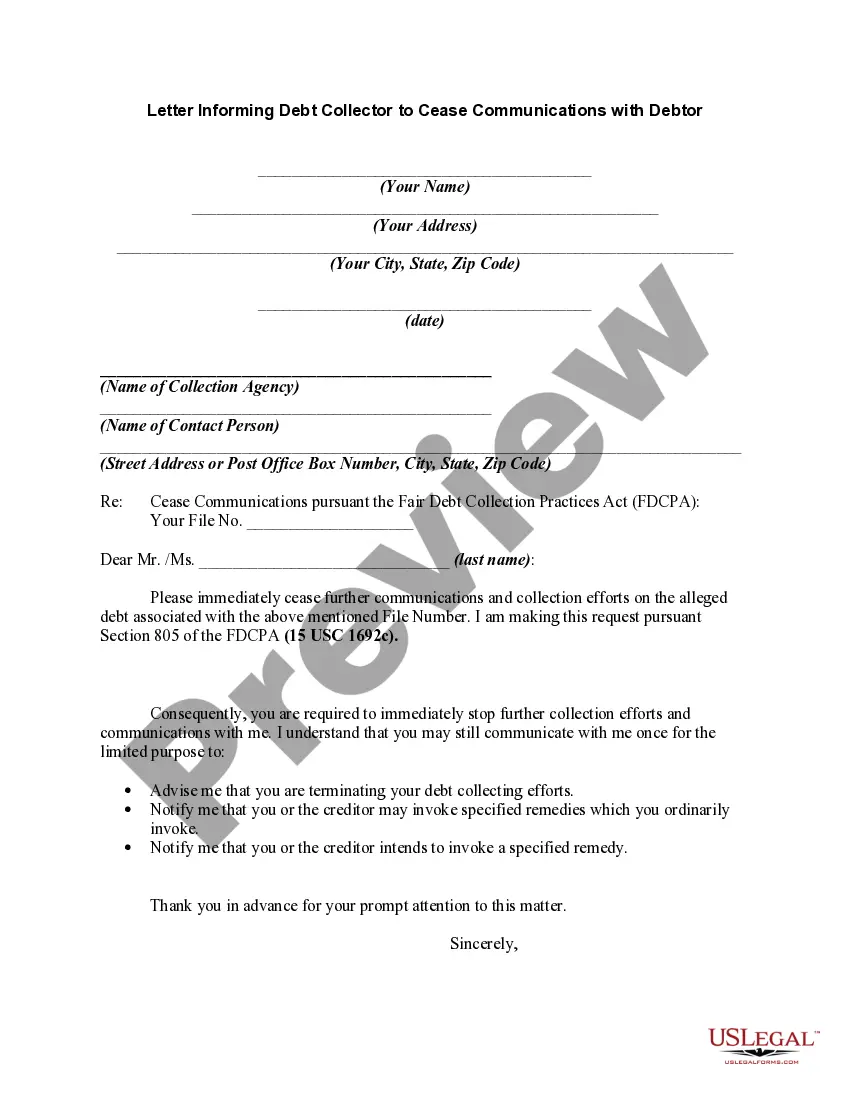
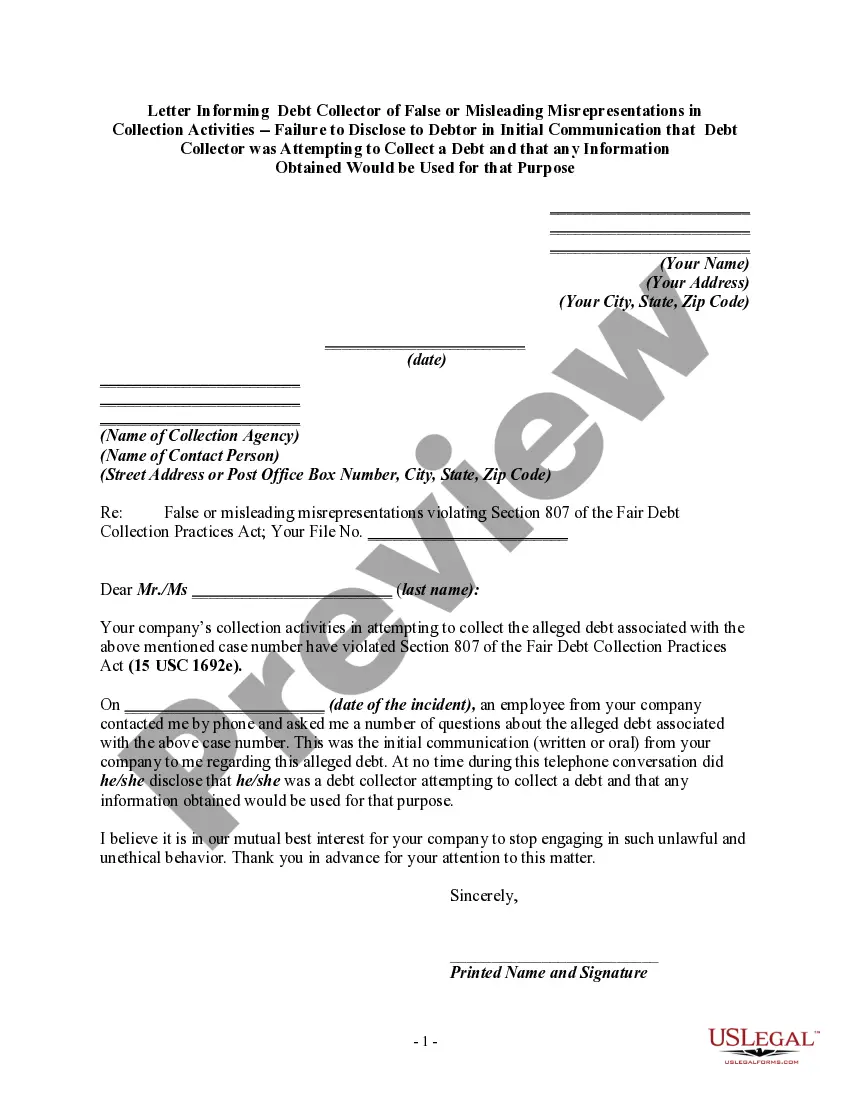
This form is a Letter Informing Debt Collector to Cease Communications with Debtor, which is used by consumers to formally notify debt collectors that they refuse to pay an alleged debt. Upon receiving this written notice, the debt collector is required by the Fair Debt Collection Practices Act (FDCPA) to stop all communication with the consumer, except for a few specific circumstances. This form helps protect consumers from unwanted harassment and ensures their rights are respected in the debt collection process.
Key parts of this document
- Your name and address for identification.
- Date of the letter to establish a timeline.
- Name and address of the debt collection agency.
- Statement of refusal to pay the alleged debt.
- Notification of the requirement for the collector to cease communications.
- Signature and printed name to authenticate the letter.
Situations where this form applies
This form is appropriate to use when you have received communication from a debt collector regarding an alleged debt that you believe is invalid or that you simply refuse to pay. It is a formal way to assert your rights under the FDCPA and request that the collector stop contacting you for collection purposes.
Who needs this form
- Consumers who are being contacted by debt collectors.
- Individuals who believe they are being pursued for a debt they do not owe.
- Those who wish to cease further communications regarding an alleged debt.
Instructions for completing this form
- Fill in your name and address at the top of the letter.
- Add the date you are sending the letter.
- Include the name and address of the collection agency you are addressing.
- Clearly state your refusal to pay the alleged debt.
- Sign the letter and print your name beneath your signature.
Notarization requirements for this form
Notarization is not commonly needed for this form. However, certain documents or local rules may make it necessary. Our notarization service, powered by Notarize, allows you to finalize it securely online anytime, day or night.
Get your form ready online
Our built-in tools help you complete, sign, share, and store your documents in one place.
Make edits, fill in missing information, and update formatting in US Legal Forms—just like you would in MS Word.
Download a copy, print it, send it by email, or mail it via USPS—whatever works best for your next step.
Sign and collect signatures with our SignNow integration. Send to multiple recipients, set reminders, and more. Go Premium to unlock E-Sign.
If this form requires notarization, complete it online through a secure video call—no need to meet a notary in person or wait for an appointment.
We protect your documents and personal data by following strict security and privacy standards.

Make edits, fill in missing information, and update formatting in US Legal Forms—just like you would in MS Word.

Download a copy, print it, send it by email, or mail it via USPS—whatever works best for your next step.

Sign and collect signatures with our SignNow integration. Send to multiple recipients, set reminders, and more. Go Premium to unlock E-Sign.

If this form requires notarization, complete it online through a secure video call—no need to meet a notary in person or wait for an appointment.

We protect your documents and personal data by following strict security and privacy standards.
Typical mistakes to avoid
- Failing to provide accurate contact information.
- Not including the date of the letter.
- Using vague language instead of clearly stating your refusal to pay.
- Neglecting to sign the letter, which can render it ineffective.
Benefits of completing this form online
- Immediate access to a legally drafted template by licensed attorneys.
- Convenience of completing the form from your home.
- Editability to customize the letter to your specific situation.
- Security and reliability of the document for legal purposes.
Looking for another form?




Form popularity
FAQ
Yes. The federal Fair Debt Collection Practices Act specifically gives you the right to sue a debt collector for harassment. If a debt collector is found to have engaged in harassing behavior, you are entitled to up to $1,000 in damages, along with court costs and attorney fees.
Cease and desist letters increase your chances of being sued The reaction is quite simple: when you send a cease and desist letter to a collection agency, collection attorney, or to your original creditor, you leave them only one way to effectively collect from you: filing a lawsuit.
Put the date at the top of the page. State your name and address. State the name of the collection agency and its address. State your account number. Open with Dear insert name of debt collector:
The Fair Debt Collection Practices Act (FDCPA) says debt collectors can't harass, oppress, or abuse you or anyone else they contact. Some examples of harassment are: Repetitious phone calls that are intended to annoy, abuse, or harass you or any person answering the phone.
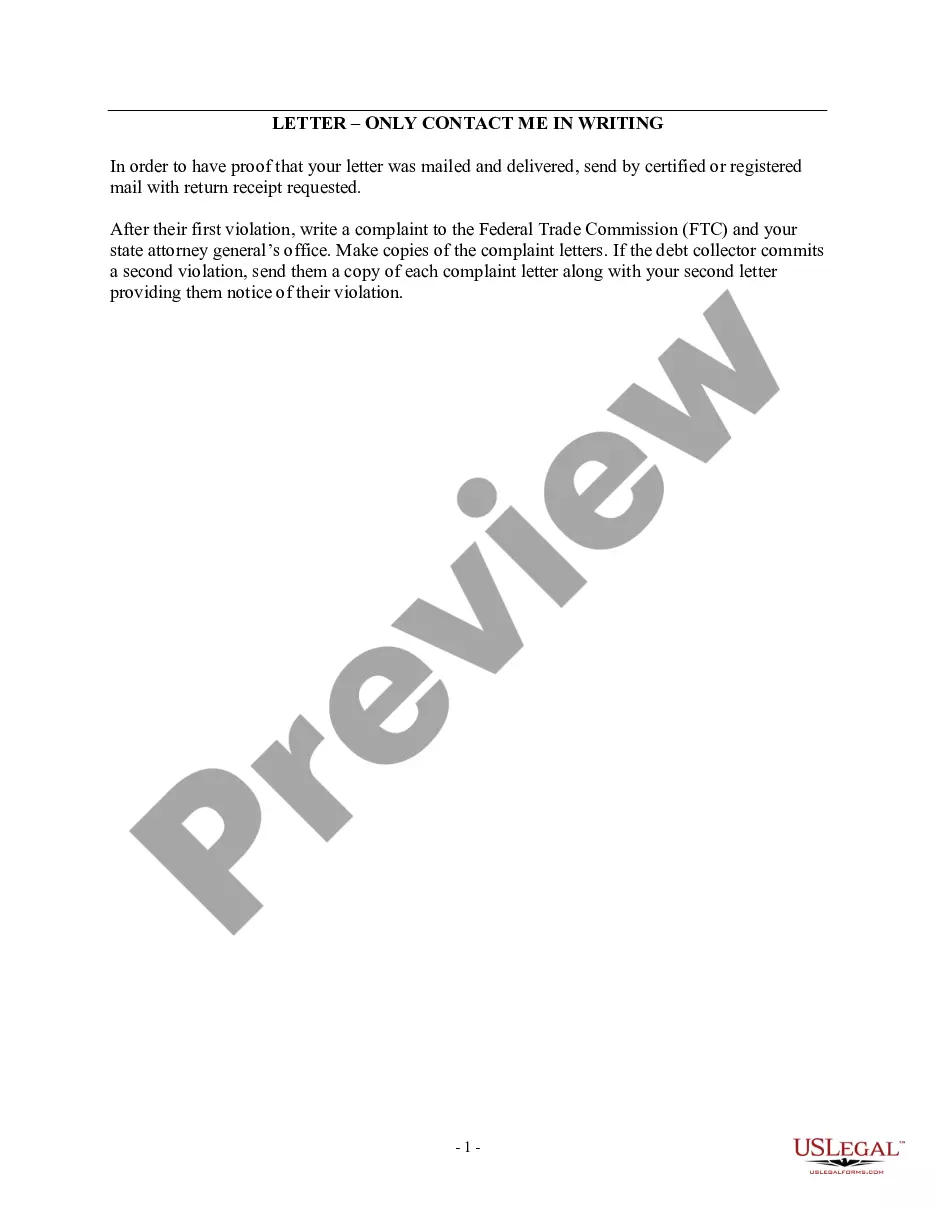
Write a Letter Requesting To Cease Communications. The first thing to do is to write the debt collector a letter telling them to stop calling you. Document All Contact and Harassment. File a Complaint With the FTC.
Debt Collectors Can't Call You Repeatedly to Harass You This means that while the FDCPA doesn't place a specific limit on the number of calls debt collectors can make, it prohibits them from calling you multiple times just to harass you. (15 U.S. Code § 1692d).
Of course, if the debt is invalid or does not apply to you, you have every right to stop the debt collection letters coming to your home. You can do this by writing to the collector and telling him/her that the debt they are trying to pursue is not owed by you.
How Long Can a Debt Collector Pursue an Old Debt? Each state has a law referred to as a statute of limitations that spells out the time period during which a creditor or collector may sue borrowers to collect debts. In most states, they run between four and six years after the last payment was made on the debt.
In the letter, reference the date of the initial contact and the method, for example, "a phone call received from your agency on April 25, 2019." You also need to provide a statement that you're requesting validation of the debt. Do not admit to owing the debt or make any reference to payment.