Agreement to Train and Race Thoroughbred Racehorses
Overview of this form
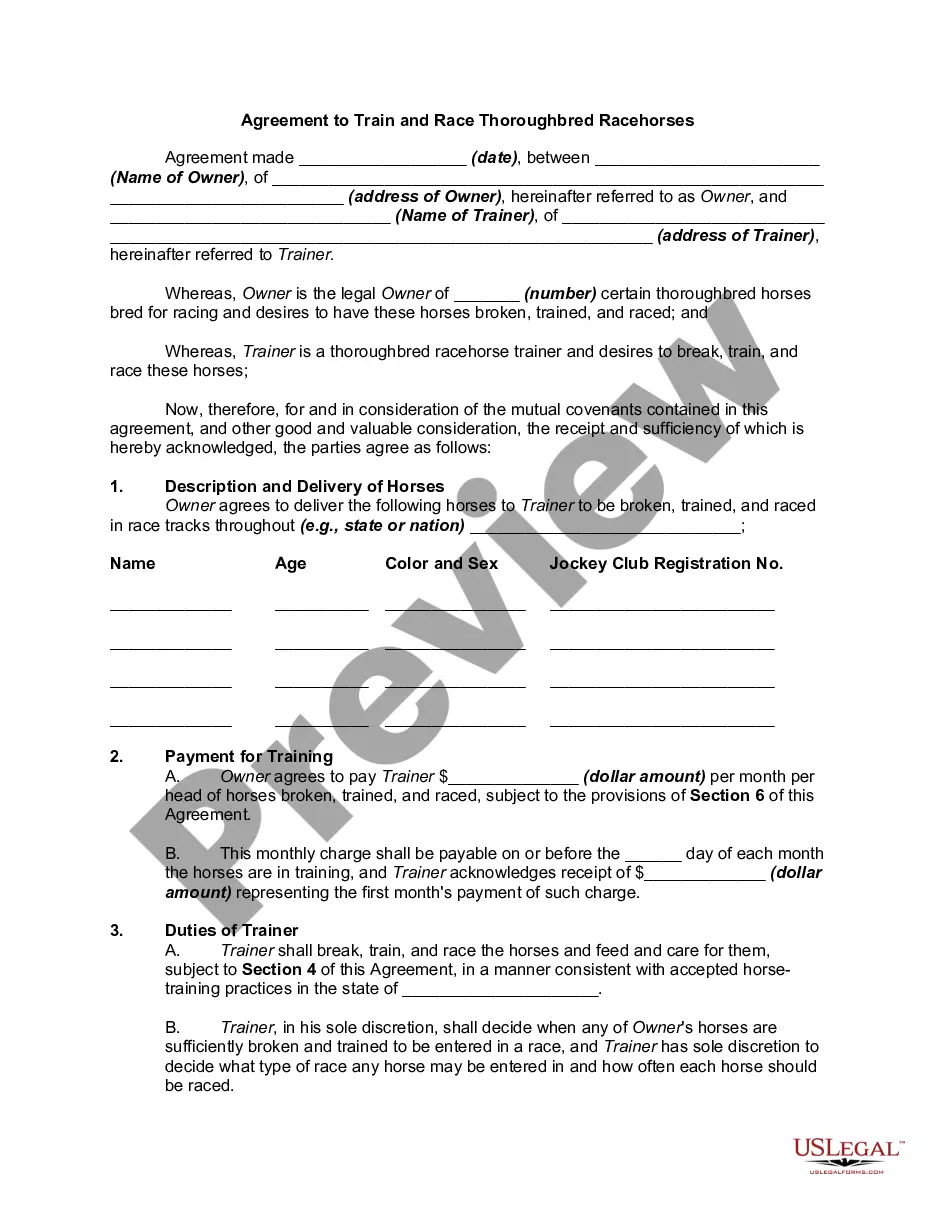
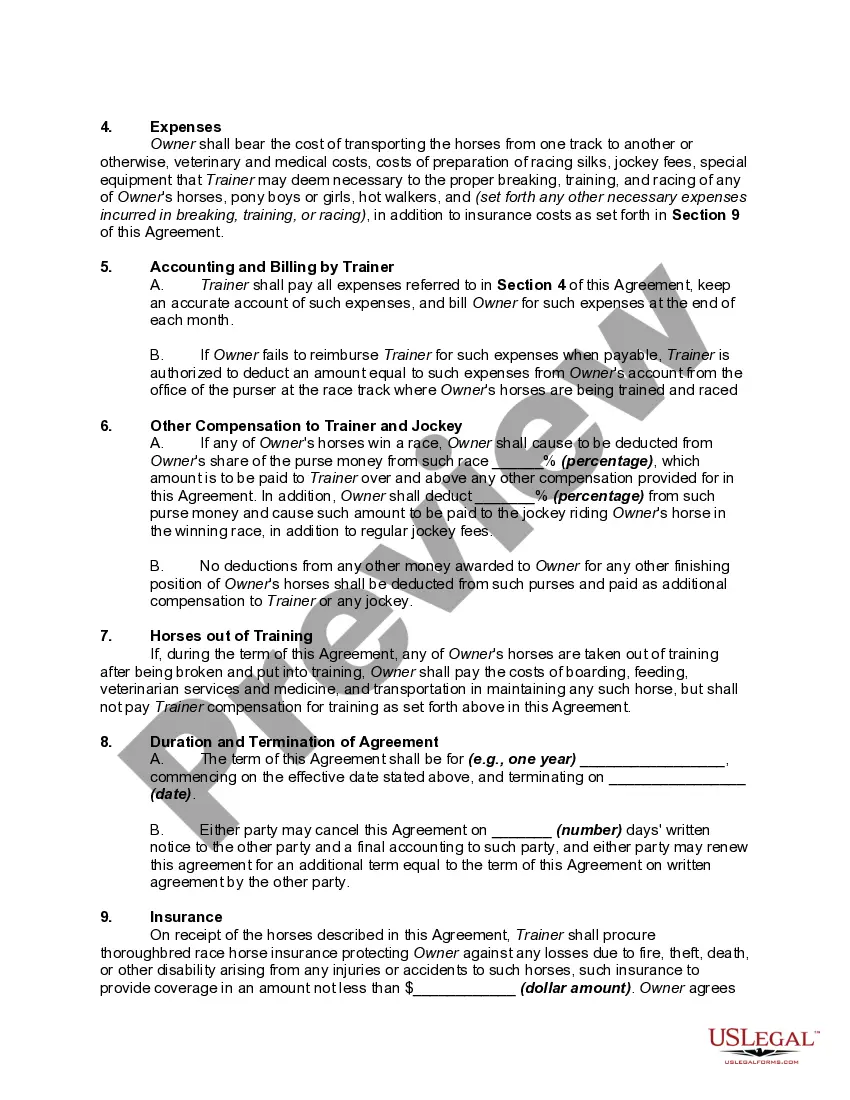
The Agreement to Train and Race Thoroughbred Racehorses is a legal document between a horse owner and a trainer. It outlines the responsibilities of both parties regarding the training and racing of thoroughbred horses. Unlike other agreements, this form is specifically tailored for the racing industry, detailing payment terms, care obligations, and compensation structures for the trainer and jockeys.
Key parts of this document
- Date of the agreement and identification of the owner and trainer
- Description of the horses to be trained, including age and registration details
- Payment schedule for training services
- Trainer's responsibilities regarding the care and racing of horses
- Compensation clauses related to race winnings
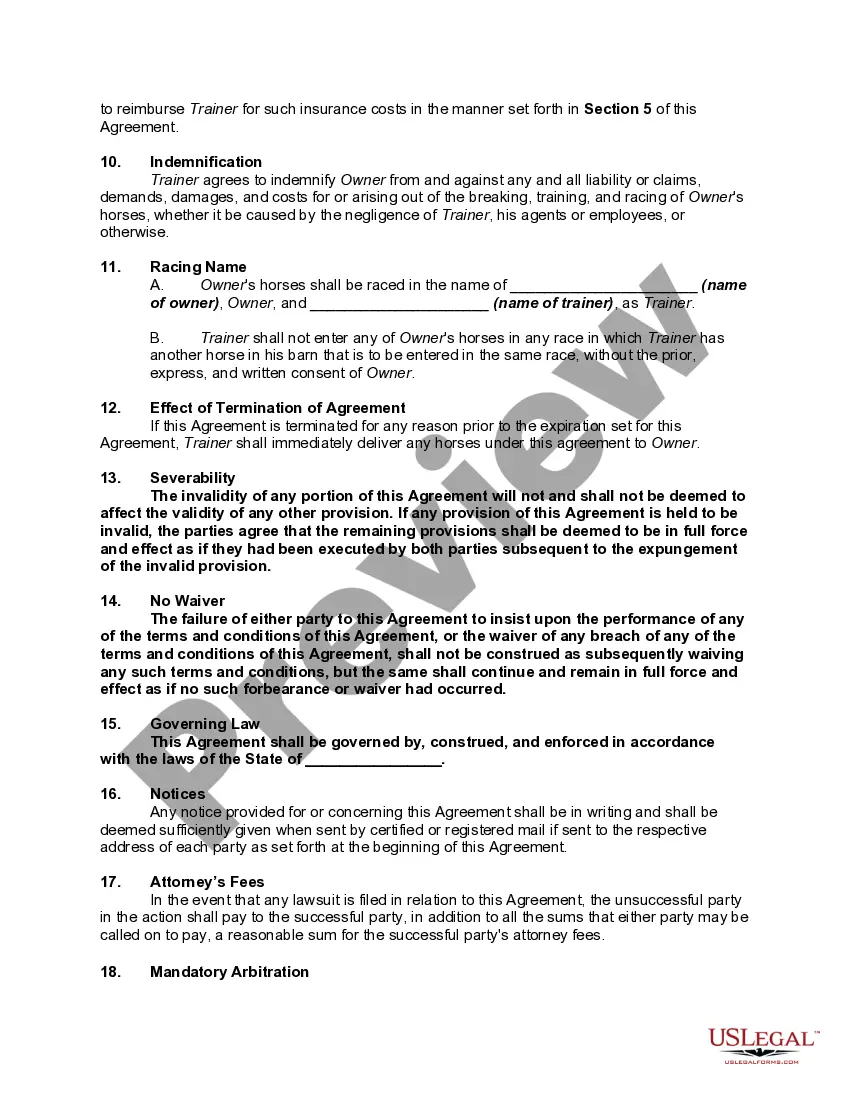
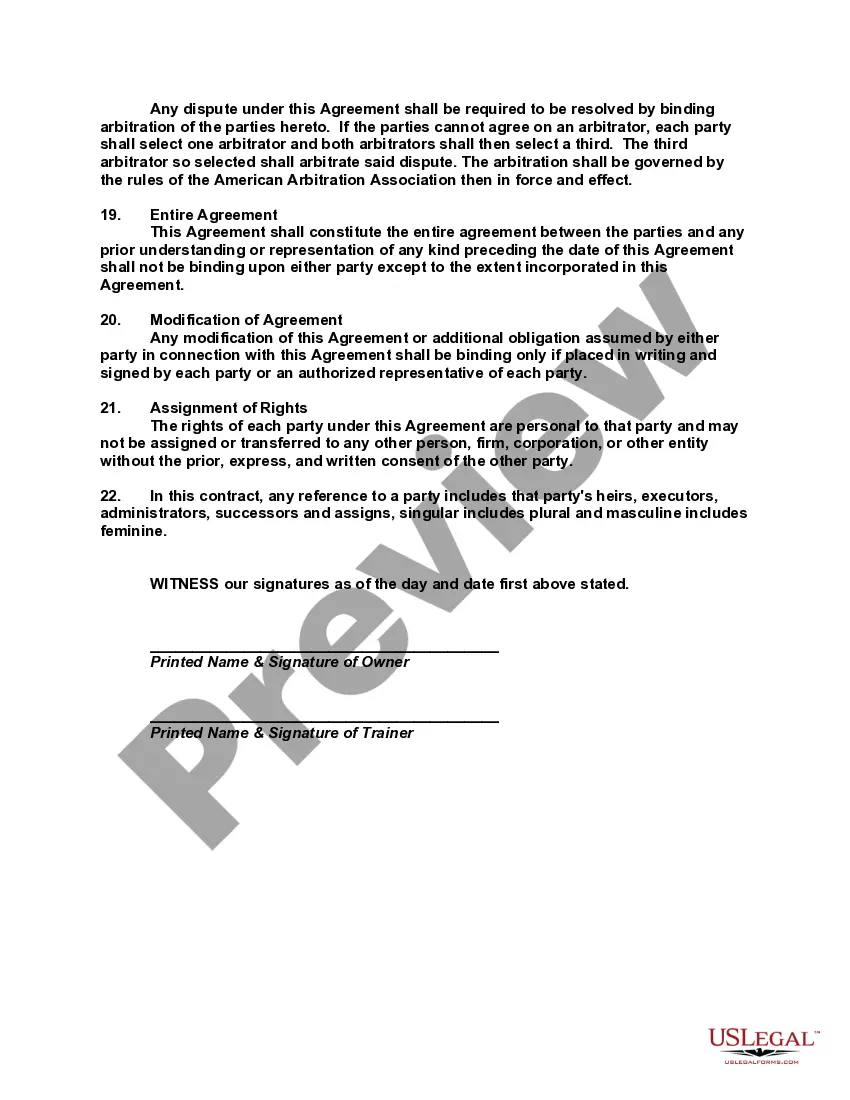
- Termination terms and conditions
- Insurance requirements and indemnification clauses
When to use this form
This agreement should be used when an individual or business entity owns thoroughbred racehorses and wishes to engage a trainer for breaking, training, and racing these horses. It formalizes the relationship, protections, and expectations for both the owner and the trainer in a legal context.
Intended users of this form
- Horse owners seeking professional training services for their thoroughbred racehorses
- Trainers who require a formal agreement with horse owners before commencing training
- Individuals or organizations involved in the thoroughbred racing industry
Completing this form step by step
- Identify and enter the date of the agreement.
- Provide the names and addresses of both the horse owner and trainer.
- List the thoroughbred horses being entrusted to the trainer, including details such as age and registration number.
- Specify the monthly payment amount for training services.
- Include terms regarding expenses related to veterinary services and transportation.
- Sign and date the agreement to make it legally binding.
Does this document require notarization?
This form does not typically require notarization to be legally valid. However, some jurisdictions or document types may still require it. US Legal Forms provides secure online notarization powered by Notarize, available 24/7 for added convenience.
Get your form ready online
Our built-in tools help you complete, sign, share, and store your documents in one place.
Make edits, fill in missing information, and update formatting in US Legal Forms—just like you would in MS Word.
Download a copy, print it, send it by email, or mail it via USPS—whatever works best for your next step.
Sign and collect signatures with our SignNow integration. Send to multiple recipients, set reminders, and more. Go Premium to unlock E-Sign.
If this form requires notarization, complete it online through a secure video call—no need to meet a notary in person or wait for an appointment.
We protect your documents and personal data by following strict security and privacy standards.

Make edits, fill in missing information, and update formatting in US Legal Forms—just like you would in MS Word.

Download a copy, print it, send it by email, or mail it via USPS—whatever works best for your next step.

Sign and collect signatures with our SignNow integration. Send to multiple recipients, set reminders, and more. Go Premium to unlock E-Sign.

If this form requires notarization, complete it online through a secure video call—no need to meet a notary in person or wait for an appointment.

We protect your documents and personal data by following strict security and privacy standards.
Common mistakes to avoid
- Failing to clearly identify all horses being trained.
- Not specifying the payment terms and due dates accurately.
- Overlooking the inclusion of necessary insurance clauses.
- Neglecting to include termination terms and conditions.
Why complete this form online
- Convenient access to a professionally drafted form.
- Editable fields allow customization to suit specific needs.
- Quick download ensures you can start the training process immediately.
- Legal reliability, as the form is created by licensed attorneys.
Key takeaways
- The agreement addresses essential terms between horse owners and trainers.
- Clarity on payment structures and responsibilities helps protect both parties.
- Consult local laws for specific compliance regulations related to horse racing.
Looking for another form?



Form popularity
FAQ
Every racehorse active in the sport has a dedicated trainer who is responsible for making sure it is race-ready and fit to compete at the highest level. Owners often ask particular trainers to take on this mantle, although trainers can and often do own and train their own horses.
After the race, while the horses might not grasp the excitement of winning the Triple Crown or even just the Derby and Preakness, they do know that people around them are excited or sad said Nadeau.That's the thing about horses they do read people's body's language.
By the way, horses can still run twice in a day in point-to-points, provided they get the permission of the stewards.By the way, horses can still run twice in a day in point-to-points, provided they get the permission of the stewards. It usually only happens when someone unseats or falls early in a race, or tnp.
Track rules require a minimum amount of days a horse must have off between races. In most states, it is six days rest before the horse is eligible to run again.
When our horses are placed back into work it normally takes ten weeks of training before they are ready to start trialling. Most horses will have two trials before racing thus an elapsed time from leaving stud to appearing on race day will be around 10-12 weeks.
There are rules about how many times a jockey can whip a horse. Currently, the maximum is seven times in a Flat race and eight times in a Jump race. (The rules had been made tougher in 2011 but, following a rebellion by jockeys, the industry softened its approach.)
Thoroughbreds are likely to breeze (run near or at race speed) once a week and complete one- or two-mile gallops about four days a week, whereas Quarter Horses don't necessarily gallop every day.
Track rules require a minimum amount of days a horse must have off between races. In most states, it is six days rest before the horse is eligible to run again.
They'll start by walking in and out of the gates, build up to standing for periods of time in the space, both by themselves and beside other horses, and finally learn to exit the stall at a run. Lead changes, working and gate training are just three aspects in training a racehorse, but they are all essential.